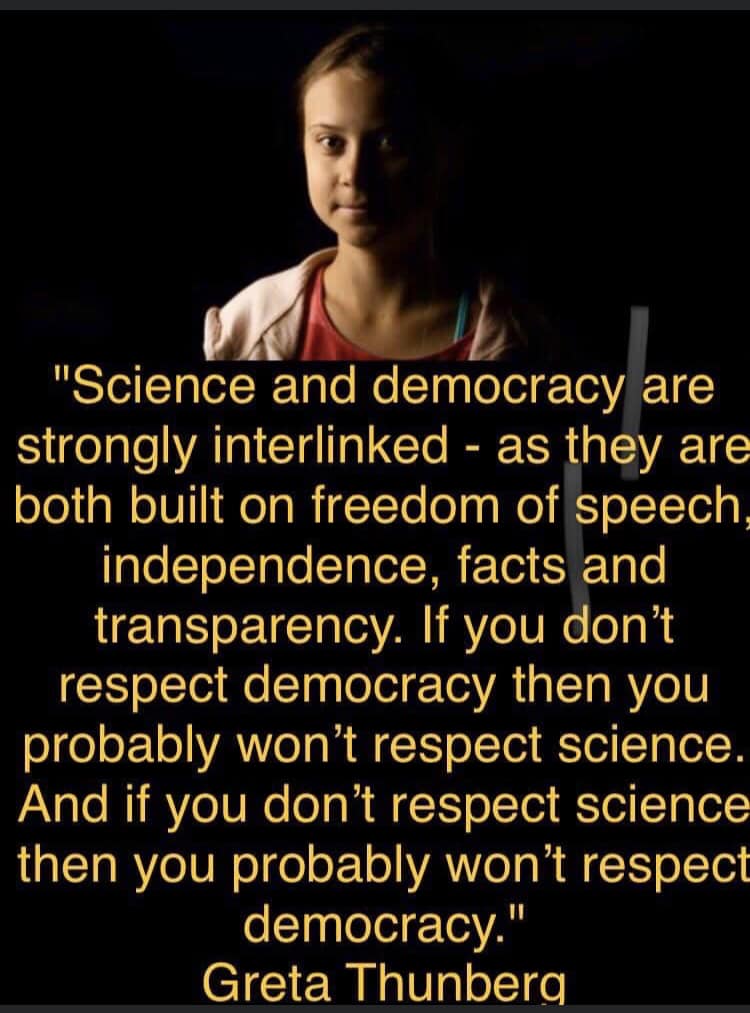
“Yes, we do need hope…But the one thing we need more than hope is action. Once we start to act, hope is everywhere. So instead of looking for hope, look for action. Then, and only then, hope will come.” – Climate Activist Greta Thunberg at her 2018 TED Talk
This is the toughest blog for me to write. In fact, I devoted the last year to writing about my life story and blogging for years before that. I knew it was vital for me to write this blog, but I dreaded writing it. For the past 23 years, I have felt that environmentalists, climate advocates, progressives and Democratic leaning voters were not smart about electing Presidential, state level, and local candidates who would protect our environment, planet, and our democracy.
This is a very painful blog to write, but I feel like I must share but to share my story. Hopefully, someone can learn from my disappointment and letdown I felt from environmental and climate Democratic voters who allowed awful candidates for President and other elected offices win.
Part 4: Healing from grief and Taking Climate Action in Oregon and Missouri 2009-2016
Finding Healing from Grief on Hawaii’s Big Island in October and early November 2008
In late May of 2008, I returned to work at Crater Lake National Park for the summer. Soon after I arrived in the park, I mentioned to my superiors that I wanted to give a ranger program about climate change. My Crater Lake supervisor, Eric Anderson, and the lead interpretive ranger, David Grimes, supported and encouraged my idea. I just did not feel like I knew enough or was brave enough to do such a program. It would take me three more years before I felt courageous and had enough knowledge to give my climate change evening program at Crater Lake.
During summer of 2008, I focused on my ranger programs, including adding a sunset guided ranger hike up Watchman’s Peak. I was still in a fog and feeling raw from losing my mentor Steve Robinson the previous October. In autumn 2008, Eric Anderson persuaded me to give ranger programs to the school groups visiting Crater Lake during the Fall Classroom at Crater Lake program. The school groups ranged from 5th grade to high school.
I quickly discovered giving ranger talks to school groups was not my thing. The students were frequently rambunctious since they were outside of their school for the day. I could relate because I was a boisterous brat when I was a kid, especially on school field trips. Many of the teachers were either overly demanding or aloof. At the same time, I saw fantastic teachers in action the way they successfully guided their students. I marveled at the great teachers and I doubted I had the adept skills to manage a classroom like them. The adult chaperones were often annoying. I would ask the students a question and the adults would jump in to answer.
Crater Lake is so beautiful, and we had a lot of gorgeous weather that fall. However, I could not wait for my commitment for Classroom at Crater Lake to be over. I still grieved over the loss of my friend and mentor Steve Robinson. I needed to go somewhere to do some healing. Fortunately, my friends John and Jeanette Broward invited me to come visit them on the Big Island of Hawaii. They were close friends of Steve and could relate the emptiness I felt at that time.
I visited the Big Island of Hawaii for 8 days around the end of October and the beginning of November 2008. During the trip, Jeanette told me that Native Hawaiians believed that each of the islands has a theme. They thought the theme of the Big Island was a place of healing. The Big Island had tranquil Pacific Ocean beaches, imposing volcanic mountains that destroyed yet created more land, and towering waterfalls on the Hilo side. If one was open to it, the Big Island was a place that can provide renewal for one’s heart, mind and soul.
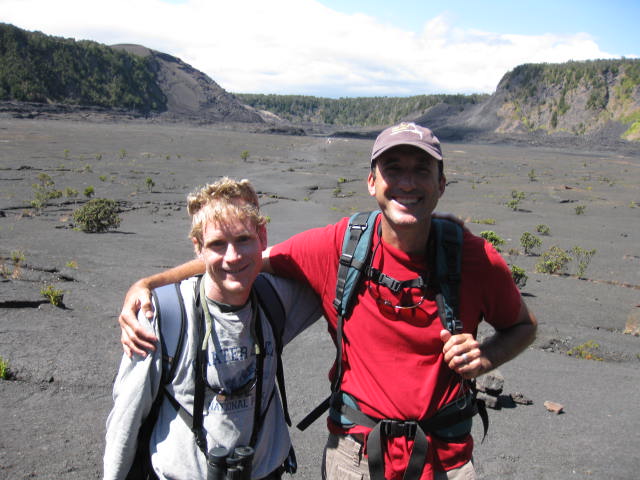
That warmed my heart to hear that. John and Jeanette lived in Volcano, which is right next to Hawaii Volcanoes National Park. John was a law enforcement ranger at the national park. On his day off, John took me hiking inside the national park for the day. During our hike, he told me that he had a recent dream where he had a conversation with Steve. In the dream, Steve was smiling and laughing. He told John that he was happy and doing great.
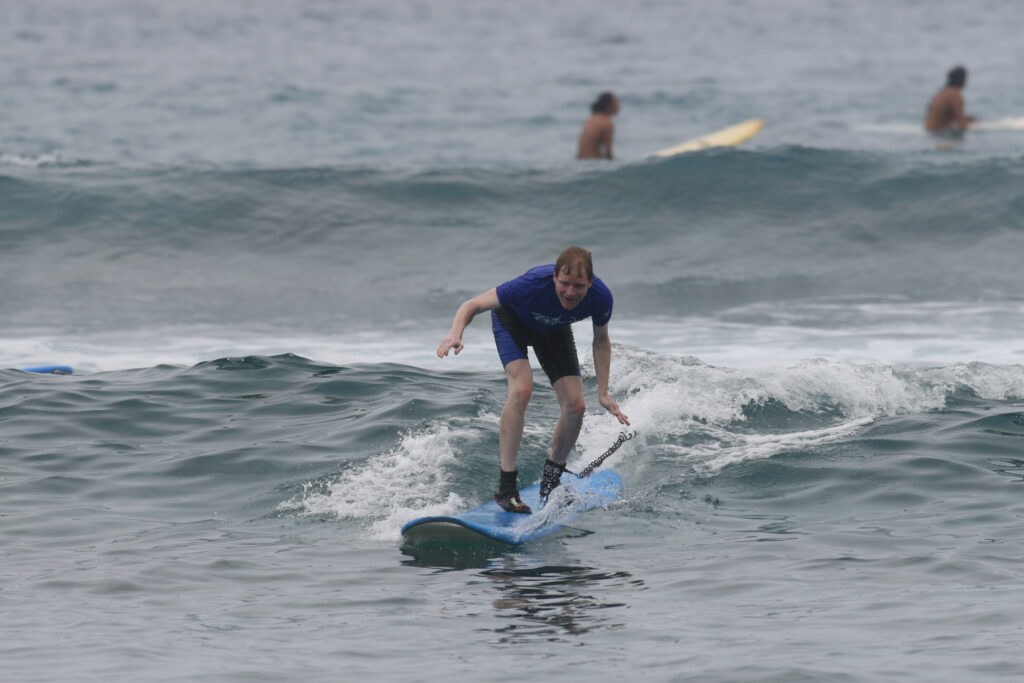
I really made the most of this trip. John and Jeanette took me to go snorkeling at a coral reef not far from their house. I tried parasailing and surfing near Kailua-Kona. I was terrible at surfing. It felt like a huge life victory when I was able to successfully stand up one time on the surfboard and ride a small wave. I visited all the national park sites on the island that were sacred heritage sites for the Native Hawaiians.
Brian Ettling surfing on the Big Island of Hawaii near Kona on October 28, 2008.
John and Jeanette arranged for me to go birdwatching with Jay Robinson, one of the top birding experts working at Hawaii Volcanoes National Park. He showed me endemic native colorful Hawaiian bird species such as the ‘I‘iwi, ‘Apapene, ‘Amakihi, ‘Oma’o, ‘Elepaio, Nēnē (Hawaiian goose), and other birds.
In my own exploring, I drove to the southernmost point of the Big Island, South Point Park. This is the southernmost point of the U.S. It’s one of the windiest places in the U.S. Thus, it was great to go there feel the winds, the big jagged cliffs overlooking the ocean and see the multiple wind turbines providing a portion of the electricity to the island.
I journeyed to the far northern part of the Big Island to see the Pololū Valley Lookout. I hiked down the tall sloping ridge to the beach and nearly had the whole area to myself as I walked. I made the most of this vacation and exploration around the Big Island. In my state of traveling bliss and soaking up the healing spirit of the Big Island, my friend John asked me a question that reminded me that I had a role to play as a responsible citizen.
When I hiked with John at Hawaii Volcanoes National Park, he inquired, “Did you vote by mail in the upcoming Presidential election?”
With the loss of Steve and my bitterness I still felt over the outcomes of the 2000 and 2004 elections, I admitted to John that I had not voted. John was flabbergasted and was disappointed with me that I had not voted. There was a lot of excitement across the U.S. that Barack Obama could win and become America’s first Black President. I shared with John that after what I experienced in the previous Presidential elections, I just could not get my hopes up. I was rooting for Barack Obama. I liked his message of ‘Hope and Change.’ I just felt hopeless at that point.
Brian Ettling (with bad hat hair that day) and his friend John Broward hiking at Hawaii Volcanoes National Park on October 30, 2008.
The Big Island provided the healing and renewal I needed. John’s question tugged at me that I needed to return my involvement in politics to take care of our natural environment and planet.
My long seasonal job at Crater Lake in 2009 with lots of traveling in between
For that winter of 2008-09, I returned to my hometown of St. Louis, Missouri to visit my parents, sisters, and their families. I got a seasonal job working at REI in mid November helping customers in the store shopping for holiday gifts and outdoor items for winter vacations. Sadly, the Great Recession dominated the economy in January 2009. The seasonal employees that were hired for the Christmas shopping season, such as me, were the first employees laid off.
I needed another job. The Spring Classroom at Crater Lake started in mid-March, and they needed rangers to guide the school programs. The manager of the Classroom at Crater Lake Program, Linda Hilligoss, was happy to have me return to Classroom at Crater Lake.
During the drive from St. Louis, MO to Crater Lake National Park in Oregon, I visited friends. I stayed with my college friend Brent Isaacs and his parents in Tulsa, Oklahoma. I met with Tess, a former Crater Lake boat captain, in Phoenix, Arizona. I then drove west I-10 and camped for a couple of nights in Joshua Tree National Park, California. It was a fun park to hike and explore. The Joshua trees were shorter and more stubby looking desert palm trees, not much taller than me. They still had a charming and majestic quality that was fun to take photos of them.
I then spent several nights visiting my friend Cherie Barth at Sequoia National Park. I knew Cherie from when we both worked in Flamingo in Everglades National Park years ago. It was magical to spend a couple of days hiking among the huge sequoia trees with their bright orange bark and their massive girth that seemed to extend to the heavens.
I arrived at Crater Lake on March 20th. I had a great spring working at Classroom at Crater Lake. I enjoyed leading the snowshoe hikes for the school groups. The snowshoe hikes were much more fun than the fall programs. I told the adult chaperones that if they jumped in to answer the students’ questions that they would be pelted with snowballs from the students. A couple of times when the adults jumped in to answer, the students grabbed their snowballs. They were getting ready to cock their arms to just pummel the adult with the snowballs. I then stepped in to save the adult’s life and they got the point to be quiet to let the kids answer the questions.
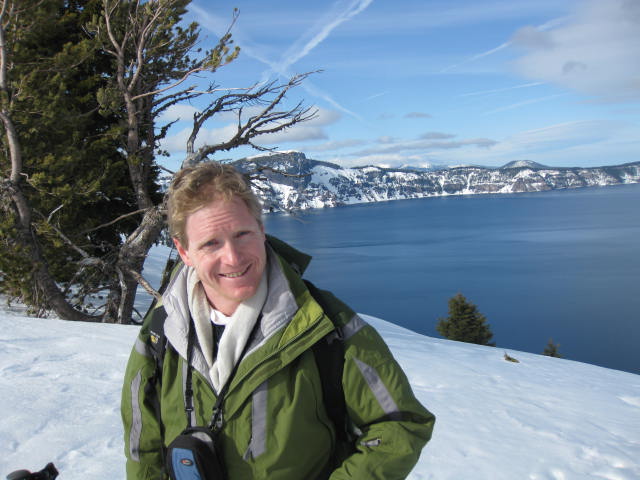
Brian Ettling at Crater Lake National Park on March 27, 2009
During the snowshoe hikes, I found a big snowy hill for the students to slide down. I always went first to show the students how to slide down the snow. Several occasions, the teachers and adults could not help themselves and slid down the snow. At the end the of program, I would line up the students at the top of a tall snowy embankment. I took off my snowshoes and was about 20 yards away from them. I stood on the paved road at Rim Village and dared them to hit me with a snowball. It was a fabulous workout to dodge the snowballs. The students were hilarious trying to hit me. One time a kid yelled at me, “Today is your funeral, mister!”
Because I planned to work a long season at Crater Lake from mid-March to the end of September, Crater Lake National Park had to lay me off for two weeks at the last week of May and the first week of June. This prevented the park from exceeding the number of hours and weeks I could work as a seasonal employee for the federal government during a fiscal year. For this two-week vacation, I decided to visit the national parks in Washington State.
For those two weeks, I camped and visited Olympic, North Cascades, and Mt. Rainier National Parks. I basically had sunny and warm weather the whole time. It was perfect weather for sightseeing, photography, hiking, and admiring the natural beauty of those places. Plus, on the drive up to Washington State, I stayed with my friends Gary and Melissa Martin and their daughter Shelby in Salem, Oregon. We visited Silver Falls State Park, which is less than an hour drive east of Salem. We spent the day hiking on the Trail of the Ten Falls. This is a loop trail over 7 miles long, with four water falls one can hike behind. The waterfalls are stunning, ranging from 27 to 178 feet. This was a state park that was so beautiful that it should be a national park.
In the second week of June, I returned to Crater Lake National Park to give my ranger programs for the summer. During that summer, I became lifelong friends with fellow seasonal park rangers Graham Hetland and Aubrey Shaw. They lived permanently in Ashland, Oregon where they attended Southern Oregon University. Graham’s mother lived in Ashland. They needed someone to housesit for his mom, Barbara, for the winter. Barbara planned to go on a cross country road trip in a RV. Thus, they wanted someone to watch her home and her friendly cat, Poppy. I planned to return to St. Louis, but they persuaded me to housesit for their mom.
Grabbing “Climate Change Comedian” Title while living in Ashland, Oregon in the fall 2009
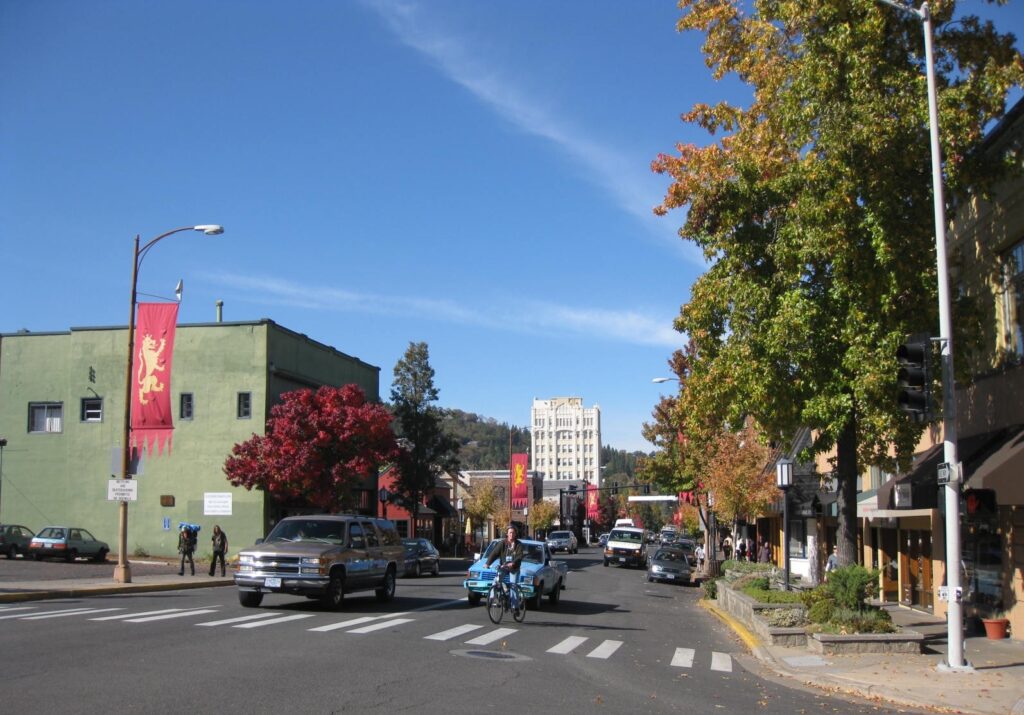
I moved from Crater Lake to Ashland, Oregon in October 2009. Ashland is a beautiful small city in southern Oregon nestled right against the Siskiyou Mountains. The leaves turned brilliant autumn colors while I was there. The weather had ideal Indian summer days while slowly getting cooler as the calendar immersed into fall. It was fun to walk around Ashland for exercise and take pictures of Ashland experiencing autumn. At the same time, I found myself restless. I wanted to pursue my climate change calling, but not knowing what to do about it.
Photo of Ashland, Oregon taken by Brian Ettling on October 22, 2009.
I decided to go to Southern Oregon University (SOU) and meet with Dr. Greg Jones, an SOU professor and climatologist. He specializes in the study of climate structure and suitability for viticulture. Specifically, he studies how climate variability and climate change influence grapevine growth, wine production, and quality. At that time, I was interested in attending grad school to learn more about climate change. I was eager to see if he had any advice for me. Even more, I was curious to see if maybe I could get my master’s degree studying under him at SOU.
My meeting with Dr. Jones did not go well. I shared my background of seeing climate change in the Everglades, plus watching the documentary about Al Gore, An Inconvenient Truth. He immediately let me know that he did not like Al Gore. He did not think Gore was a good spokesperson to explain to the public about climate change. That did not sit well with me because it was Al Gore and his advocacy that brought me to meet with him in his office. I left this awkward meeting I not knowing what my next step would be to pursue my climate change vision.
A few days later, I visited my friend Naomi Eklund who lived in Ashland for advice. She pressed me on what exactly did I want to do with my life. She kept pushing me harder. Finally, I snapped, “Fine! If I could do anything, I would like to be ‘The Climate Change Comedian!”
Naomi was a tough audience, but she nearly fell out of her fell out of her chair laughing. She responded: ‘That’s perfect! I want you to go home and grab that website domain name now, www.climatechangecomedian.com.’
I went home and did that. Barbara soon sent news that she did not like RVing across country. She decided to return to her home where I was housesitting in Ashland in mid November. When she moved back home, it felt awkward living in her house. Around Thanksgiving, Barbara announced that she did not want to share her home with me. My parents just moved into a new home in St. Louis. They wanted me to return home to spend the winter with them.
On December 10, 2009, I left Ashland, Oregon for a cross country drive back to St. Louis, Missouri. Like my previous road trips that year, I made the most of this trip. I visited a friend in downtown San Francisco and explored the city for a day. I then stopped by the beach in Monterey, California. Next I achieved a life goal seeing the picturesque Bixby Creek Bridge, just a few miles south of Monterey. Driving down the coast on Hwy 101, I spent the night in San Simeon, CA. The next day I achieved another dream to see Hearst Castle. From there, I drove across California to visit a friend in Death Valley National Park. From Death Valley, I traveled to Las Vegas to spend the night and walk around the city for the evening.
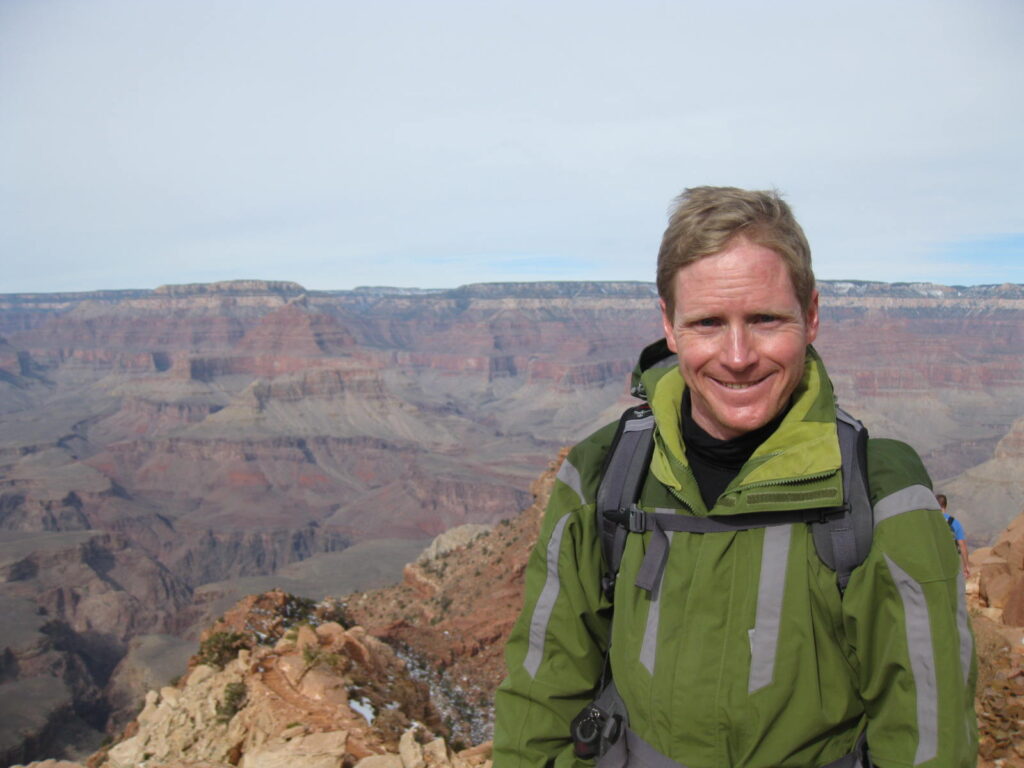
My next stop on this cross country trip was to visit my friends Steve and Melissa in Flagstaff, Arizona. Steve worked as a back country law enforcement ranger at Grand Canyon National Park. While chatting with Steve during a hike of a box canyon just south of Sedona, he asked me if I would be interested in hiking to the bottom of the Grand Canyon during this trip. I am always up for an adventure, so I said, “Yes!” The next thing I know, we were at the store buying groceries for this hike and Steve lent me his backpack and other gear. I hiked from Canyon Village on the south rim to the bottom of the Grand Canyon on December 20th. Steve arranged for me to spend that night at the Phantom Ranch Ranger Station at the bottom of the Grand Canyon.
Brian Ettling at Grand Canyon National Park. Photo taken on December 20, 2009.
I hiked back up from bottom of the Grand Canyon on December 21st. On December 22nd, I started the long drive to St. Louis. I faced winter weather snowing conditions driving up I-44 in Missouri on the afternoon of Christmas Eve. However, I arrived at my parents’ new house in St. Louis that evening to celebrate Christmas with my family just in time. After I settled into their home for the winter, I had to figure my next step with this “Climate Change Comedian” title.
During that winter in St. Louis, Naomi advised me to fully develop my website and create my own climate change PowerPoint that I would use for my presentations. Early in 2010, I developed my first climate change PowerPoint, “Let’s Have Fun Getting Serious about Climate Change.” I showed that PowerPoint to friends and family in the St. Louis. A family friend helped me launch my climatechangecomedian.com website that is still active to this day.
Finding my groove as a climate change speaker
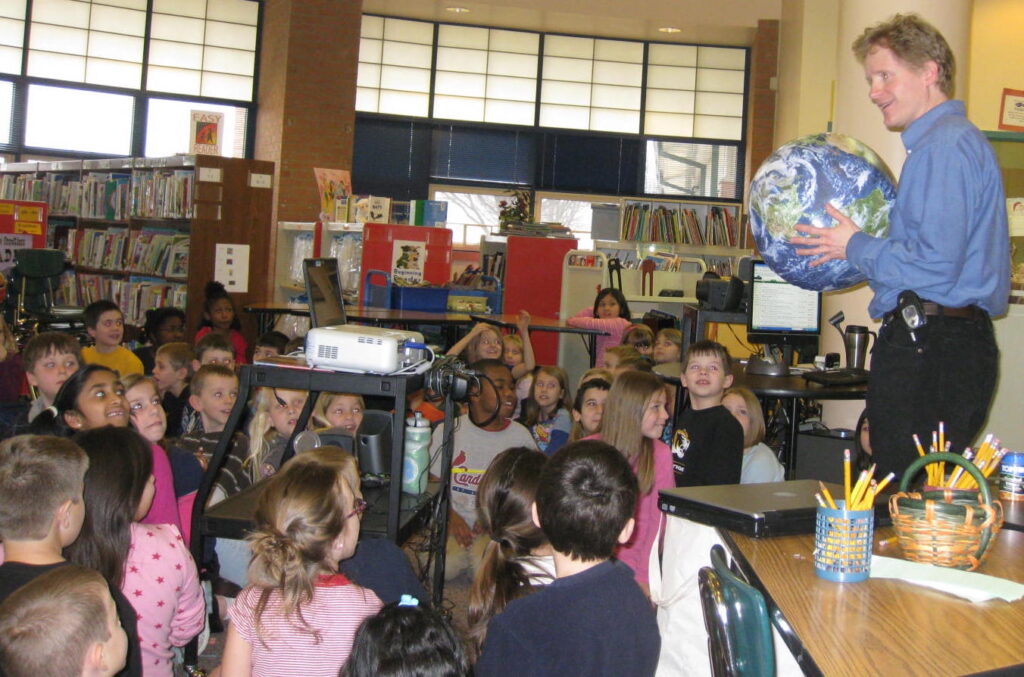
During the early months of 2010, my sisters in St. Louis wanted me to speak at my nieces’ and nephews’ schools. My younger sister first booked me to speak at my nephew Sam’s second grade class in St. Charles, Missouri on February 5, 2010. This was my first presentation outside of working as a ranger in the national parks.
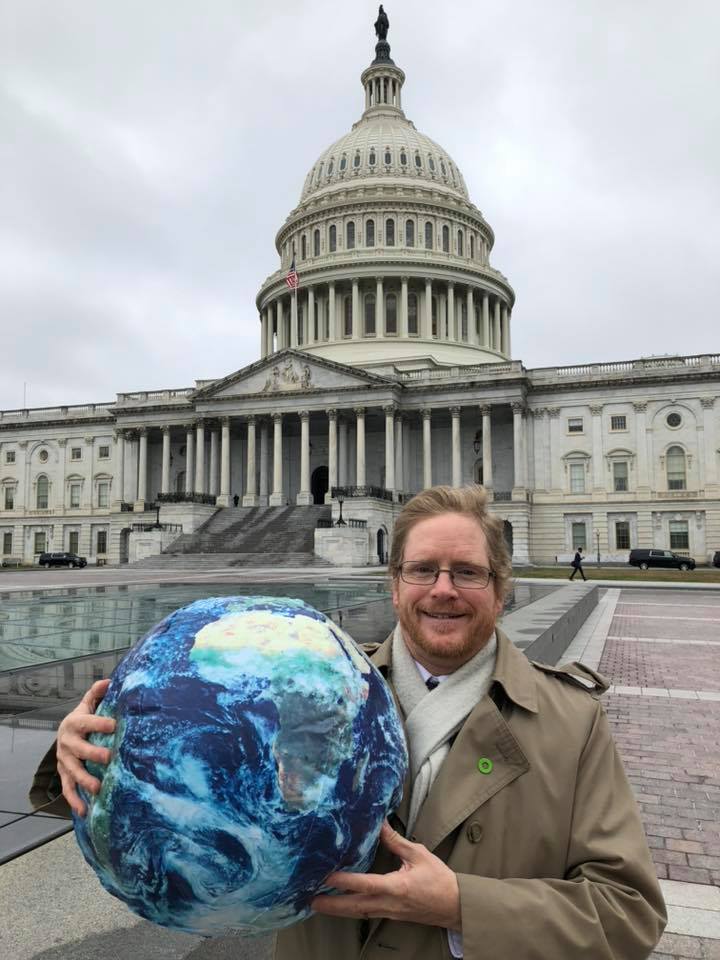
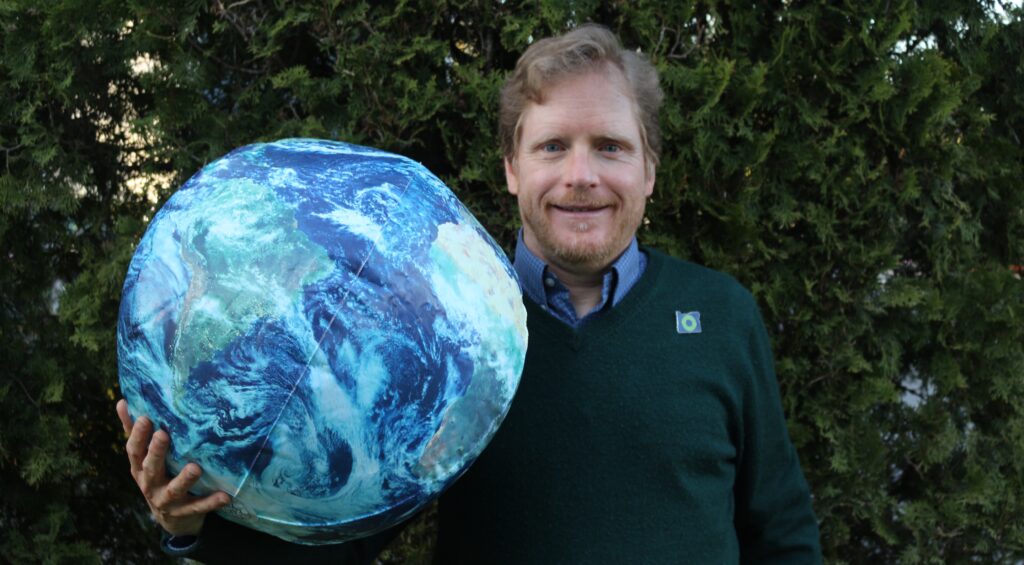
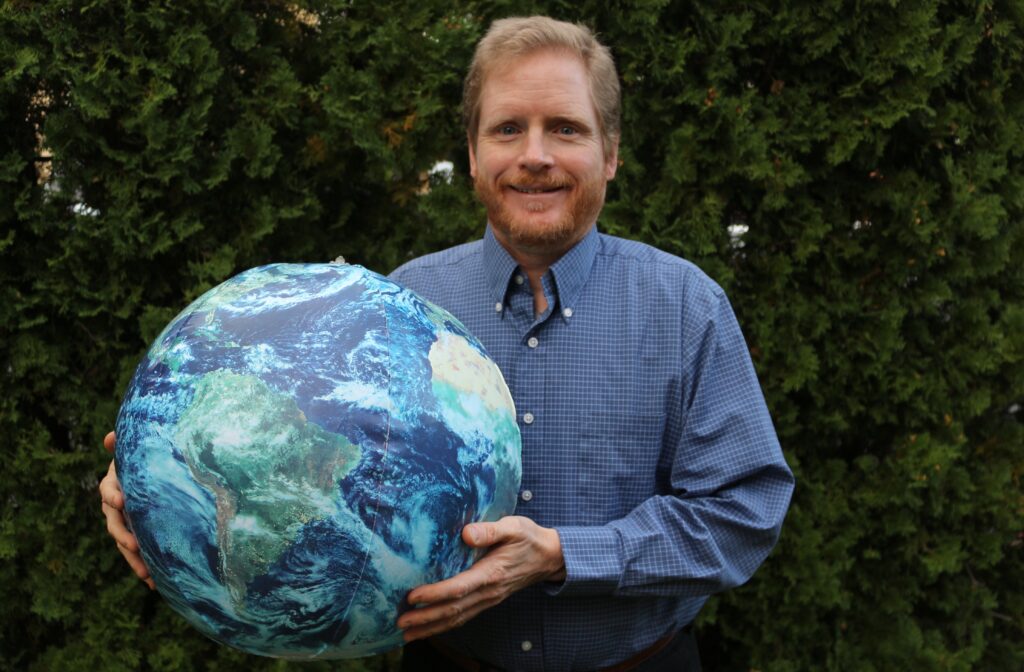
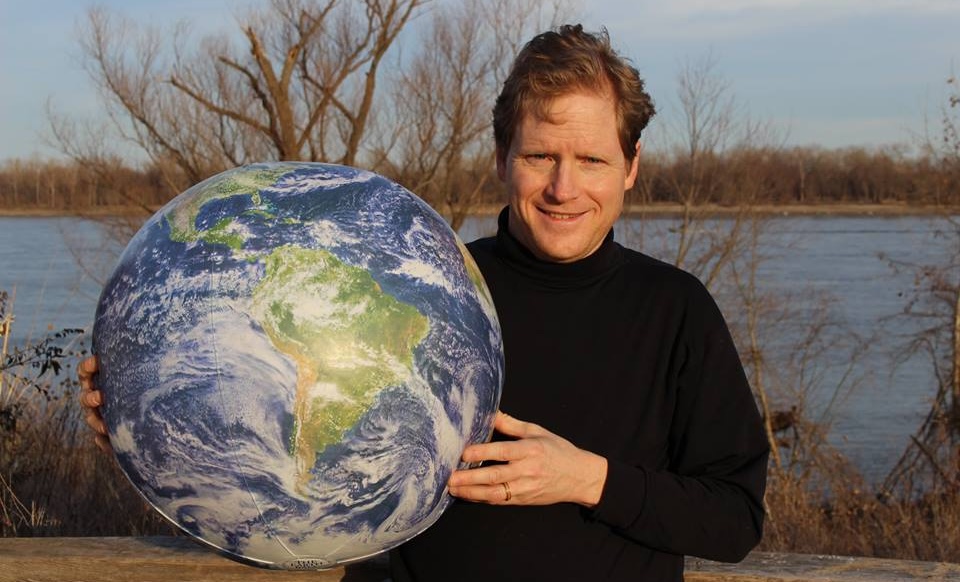
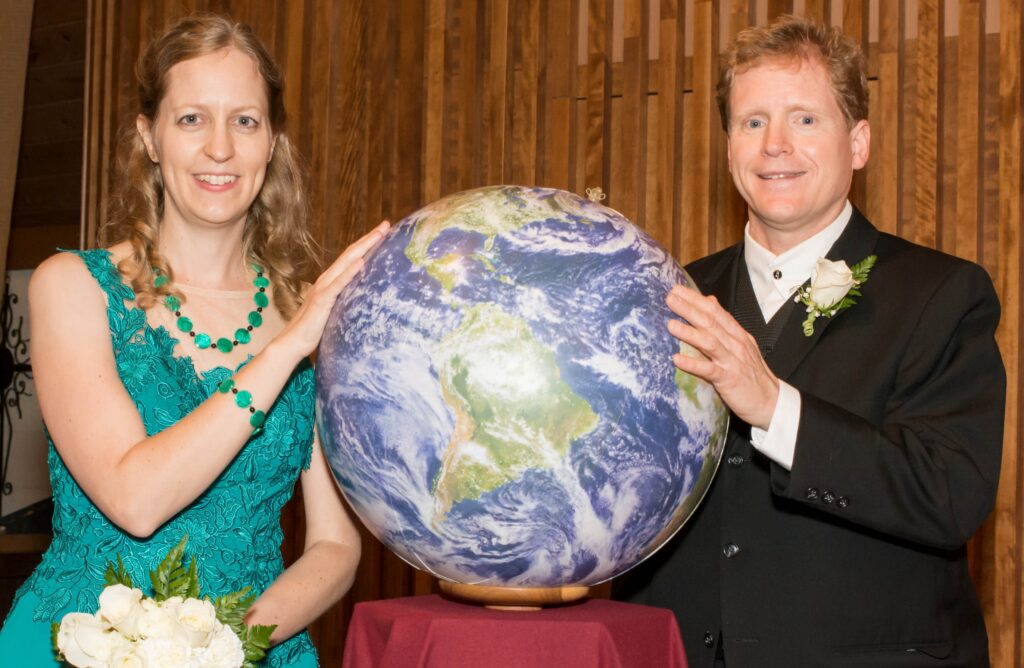
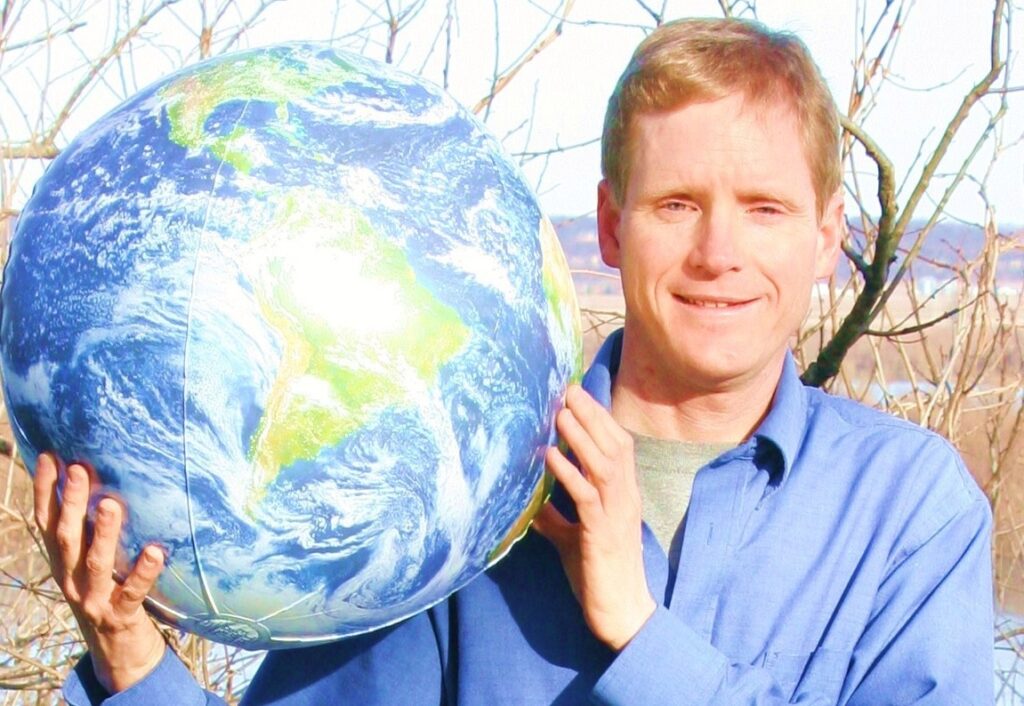
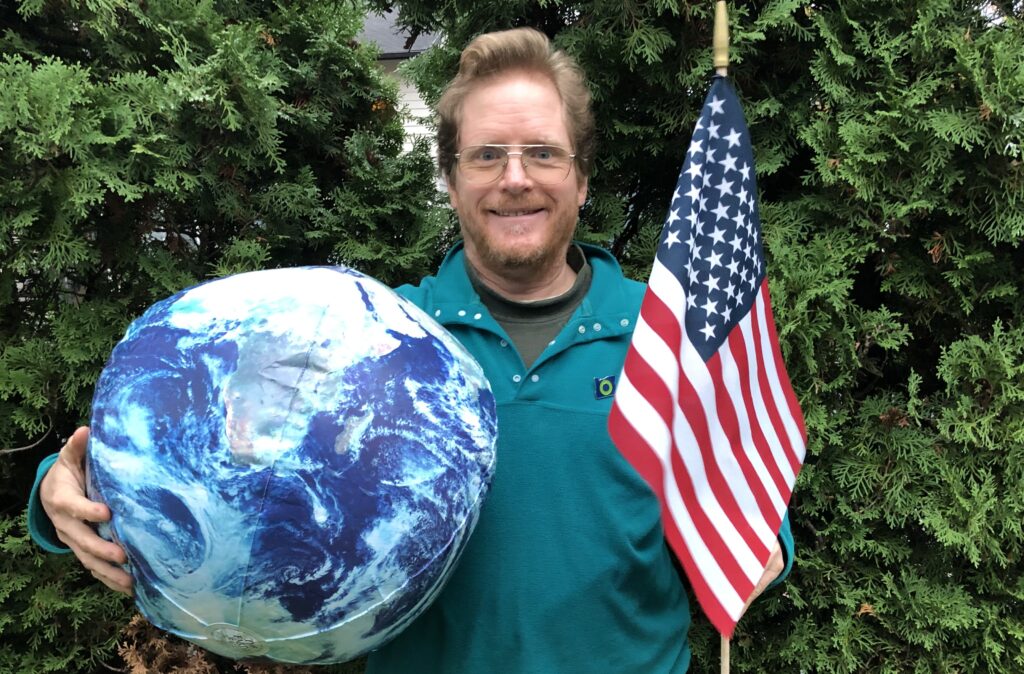
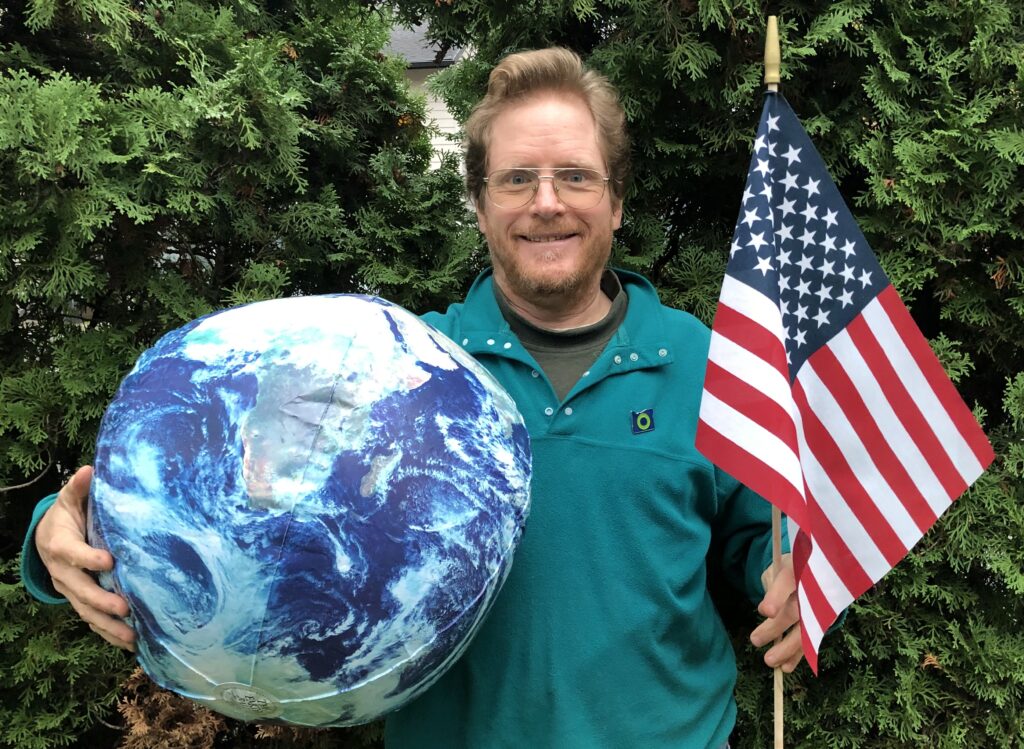
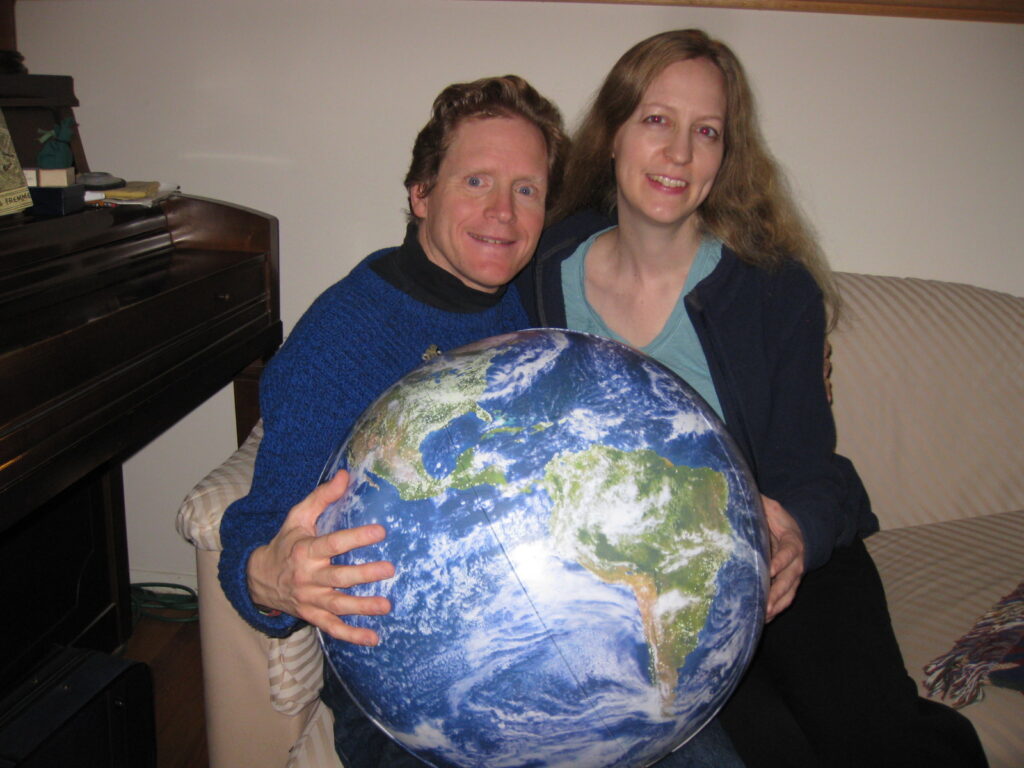
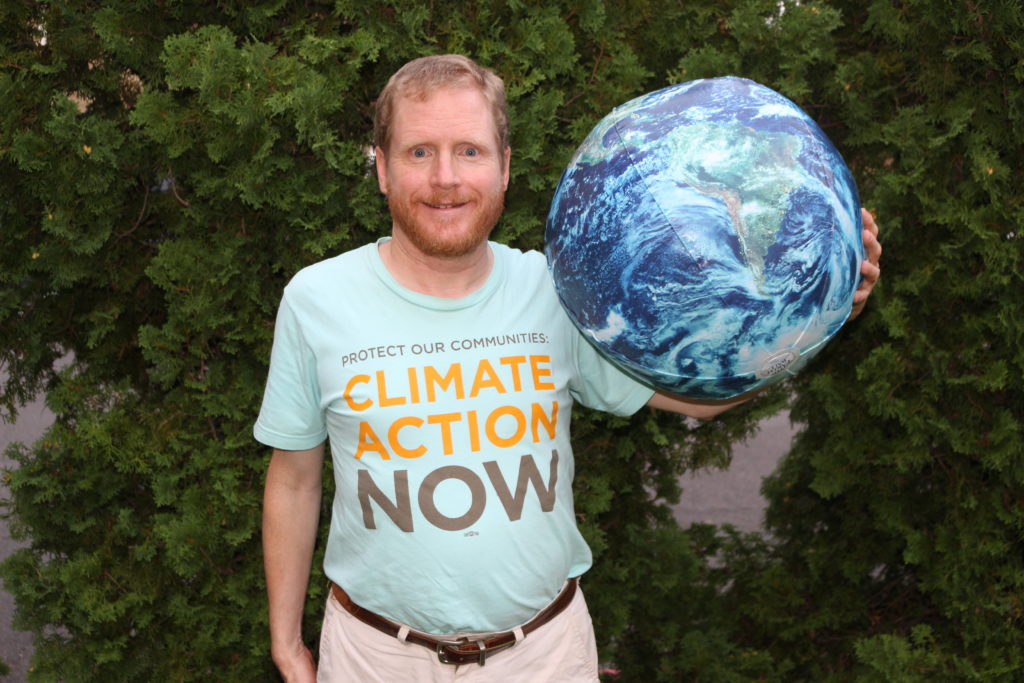
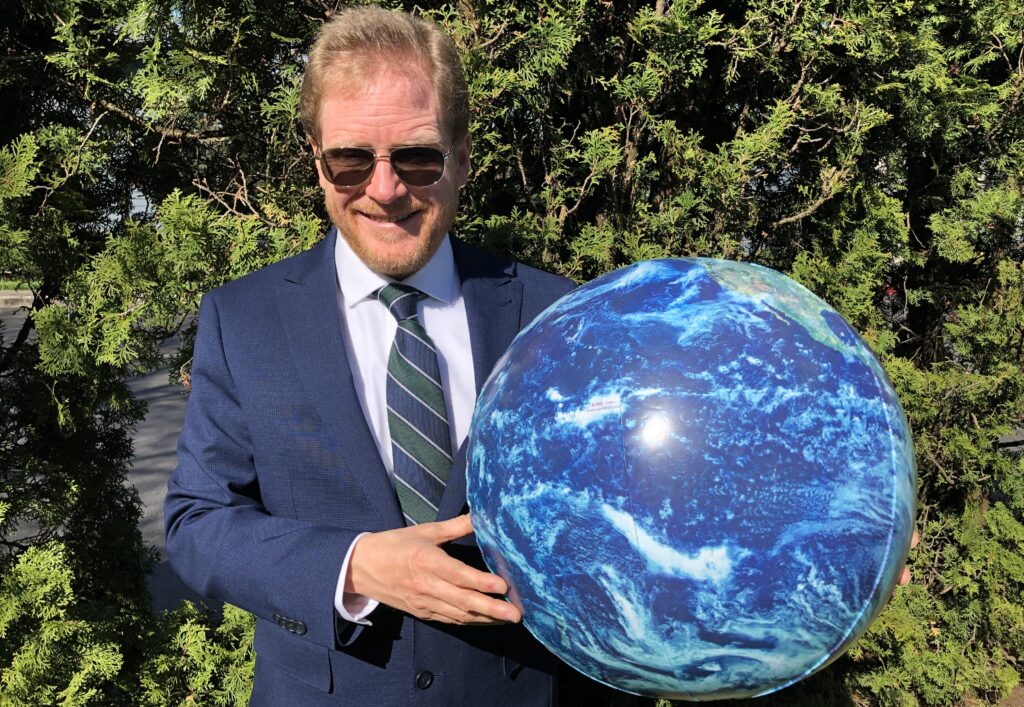
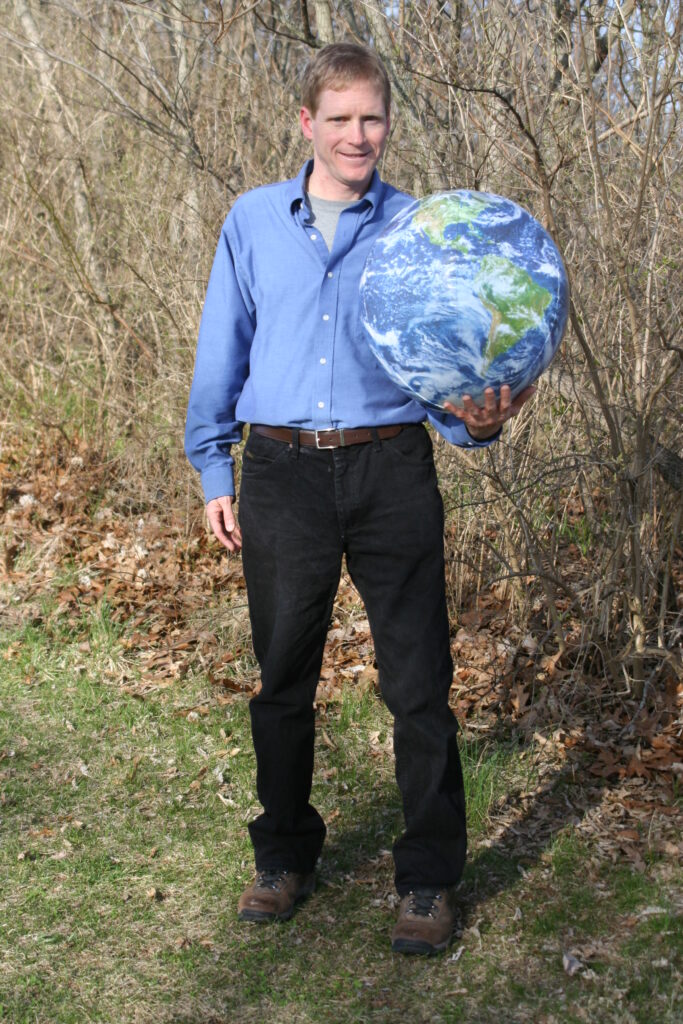
For this presentation, I brought my inflatable Earth Ball, which is my symbol for caring and appreciating our planet. I used an Earth Ball for years in my Everglades and Crater Lake ranger talks. The symbol of me holding an Earth Ball is the image I use for my website and all the social media platforms I use (Facebook, Twitter, and LinkedIn). The young students liked seeing the inflatable Earth during my talk.
Brian Ettling (far right) speaking to a second grade class at a grade school in St. Charles, Missouri on February 5, 2010.
Exactly one month later, March 5, 2010, I spoke at oldest niece and goddaughter Rachel’s seventh grade class in St. Louis. This talk was a breakthrough for me because this was the first time that I spoke about climate change in a public talk. I showed the average annual snowpack had gone down over the last several decades at Crater Lake. I defined global warming as humans trapping more carbon dioxide and greenhouse gases in our atmosphere. As a result, the average temperature of the planet has increased since the Industrial Revolution started in 1880.
I then talked about how climate change could cause problems with less snowpack, greater heat waves, and sea level rise. I then urged them to reduce the threat of climate change by recycling, unplugging voltage vampire appliances in their homes, and turning down the heat by putting on a sweater or snuggle blanket. Hopefully, this message on climate change somehow planted a seed in the minds with these students. I will always be grateful that my older sister, my oldest niece, her classmates, and her school gave me this opportunity to talk about climate change for the first time in a public talk.
At Crater Lake National Park that summer, I gave my climate change PowerPoint informally to some of my ranger friends one evening and I shared it with a few other ranger friends. During my cross-country drive from Crater Lake National Park, Oregon to St. Louis, Missouri in November 2010, I showed this PowerPoint twice. I shared it to some ranger friends in Page, Arizona and to my college friend Brent in Oklahoma City, Oklahoma. These friends gave me some helpful tips and feedback to improve my talk.
In 2011, things started happening for me as a climate change advocate. After I returned to St. Louis for the winter of 2010-11, I wanted to improve my skills as a public speaker and climate change communicator. I joined a local Toastmasters group, South County Toastmasters, in January 2011. Over the next five years, I gave 20 climate change speeches to this local Toastmasters Club. My fellow Toastmasters voted for me as “The Best Speaker” for 8 of these speeches.
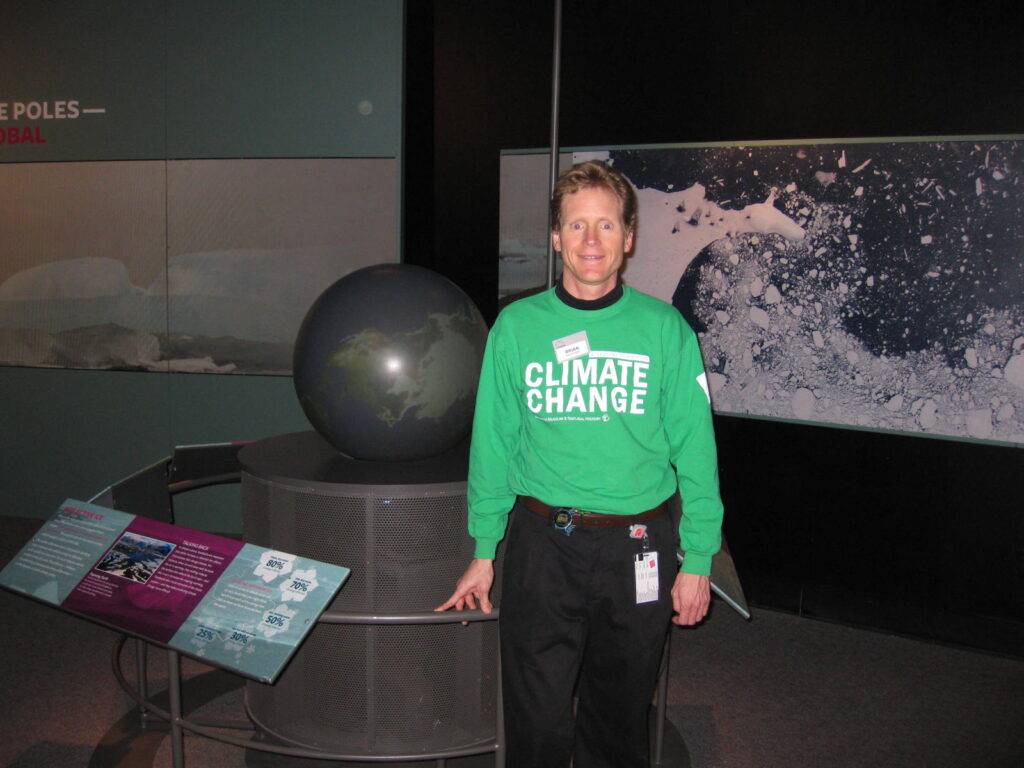
In March 2011, I had the fortuitous luck to be offered a job to work at the St. Louis Science Center’s temporary Climate Change exhibit. This was one of the few climate change museum exhibits in the United States at that time. While working there, I met St. Louis businessman Larry Lazar. We decided to co-found the St. Louis Climate Reality Meet Up in December 2011 (now known as Climate Meetup-St. Louis).
This Meet Up group is where I met Tanya Couture. She attended our events beginning in January 2012. We started dating in February 2013. We got married on November 1, 2015. As I joke in my climate talks, ‘Join the climate movement, you might meet the person of your dreams!’
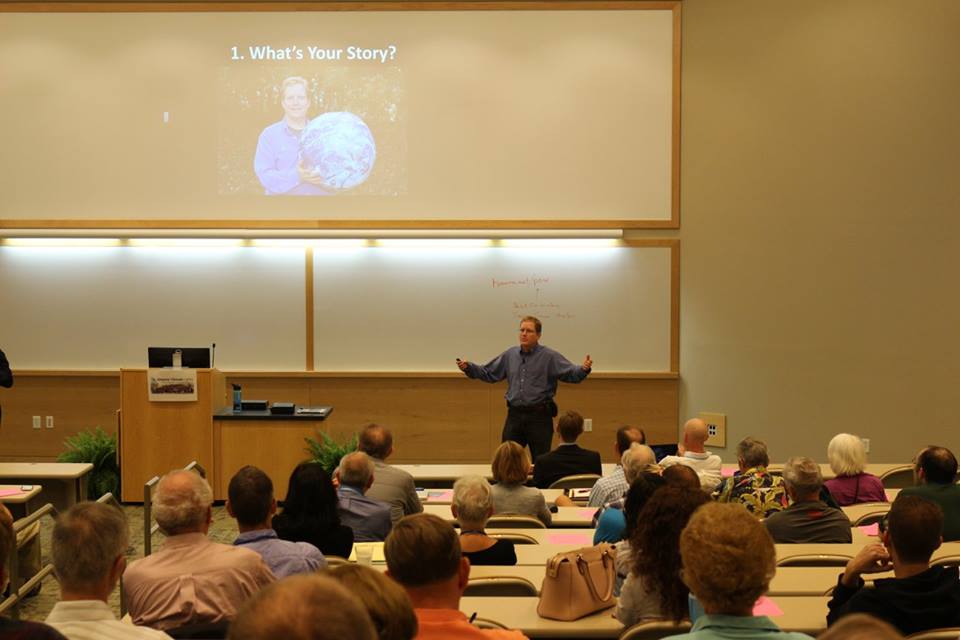
In August 2011, I gave my first climate change ranger evening program at Crater Lake National Park, called The Good, The Bad, and The Ugly. I performed this ranger talk at Crater Lake for the next five summers, up until 2017. Over the past 13 years, I ended up giving over 200 climate change talks in 12 U.S. states, Washington D.C, and Ottawa, Canada.
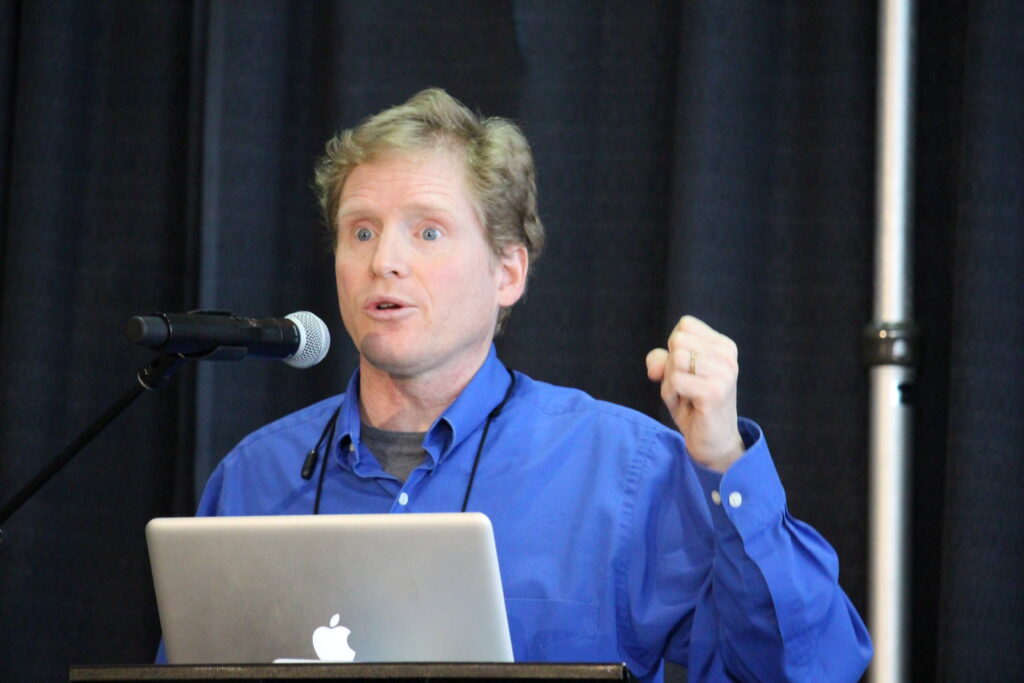
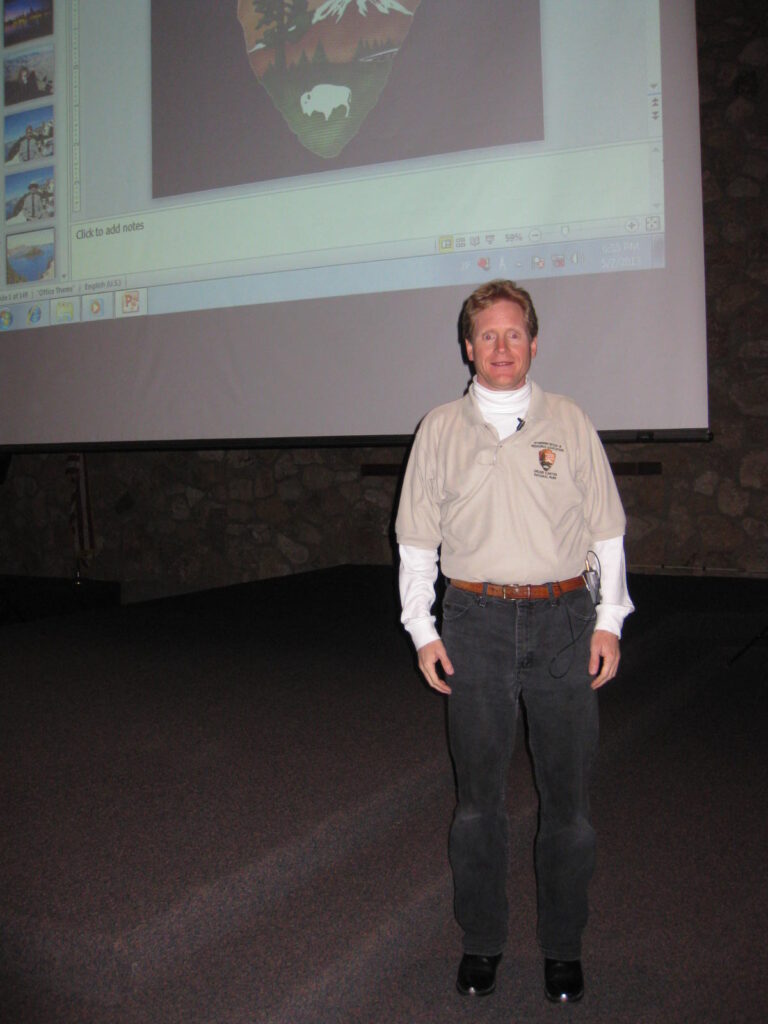
One of those speeches was at the Shrine of the Ages Auditorium at Grand Canyon National Park to an audience of over 200 park visitors and park staff in May 2013. Due to my ranger connections of working in the national parks for 25 years, my friend Pete invited me to give this talk.
Brian Ettling getting ready to speak at the Shrine of the Ages Auditorium at Grand Canyon Village on May 7, 2013.
Finding success and fulfillment as a climate change organizer
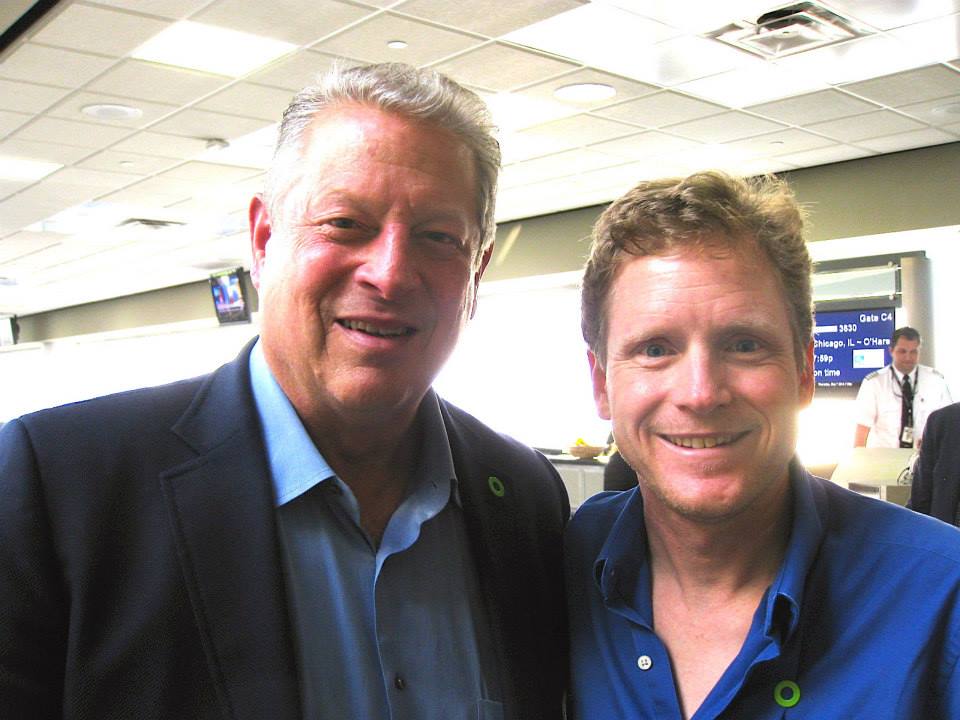
Besides speaking and hiking to the bottom of the Grand Canyon, I had many other adventures and exciting moments as a climate change organizer. In 2012, I attended a Climate Reality Project Training led by former Vice President Al Gore to become a Climate Reality Leader. I loved attending that training and was honored to be a mentor for 8 addition trainings to guide others become effective Climate Reality leaders. At the May 2015 Cedar Rapids Training in front of the group of my fellow mentors, I personally asked Al Gore how to best respond to his critics.
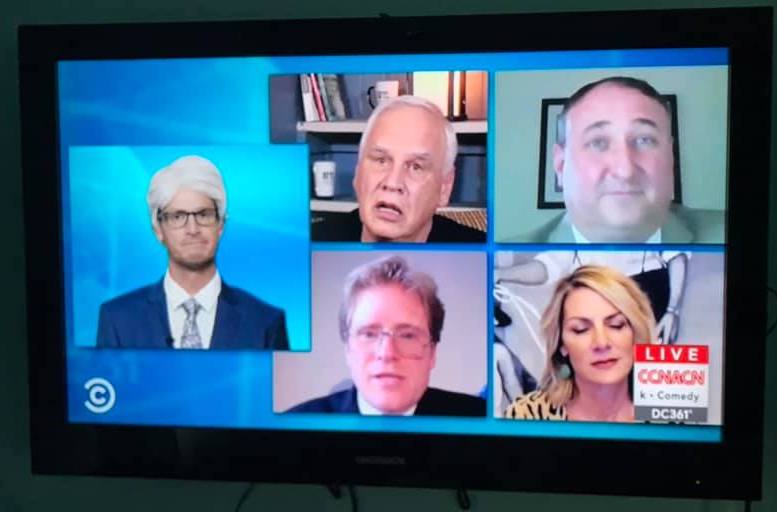
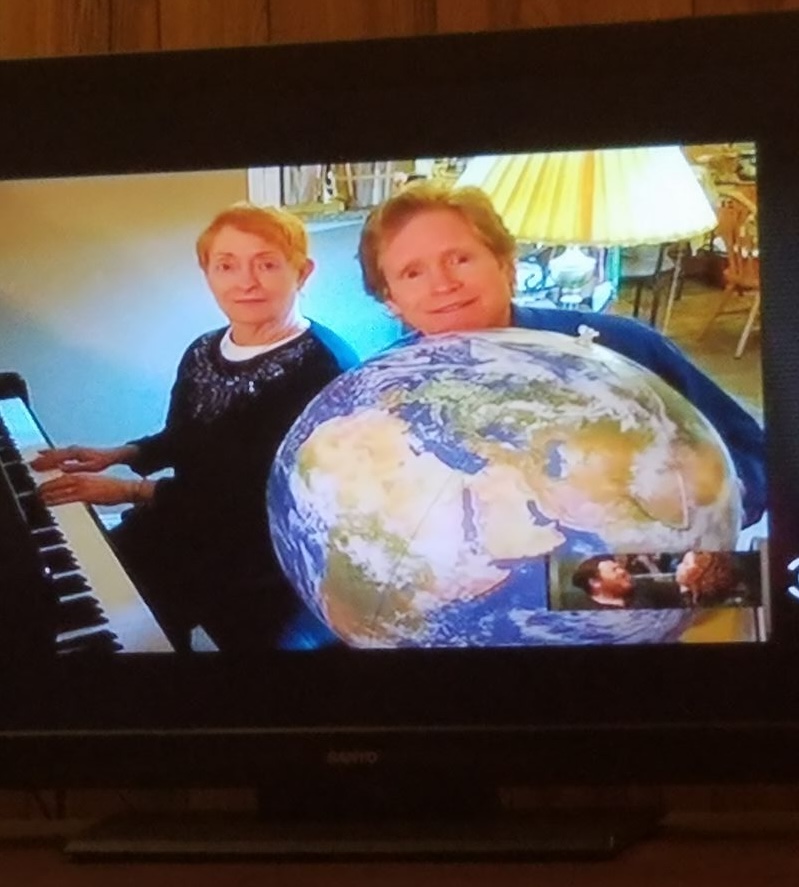
After I became The Climate Change Comedian, I created some YouTube videos with my wife Tanya, my mom Fran Ettling and my dad LeRoy Ettling. Comedy Central’s Tosh.o noticed these videos. This TV show flew my mom and I to Los Angeles in April 2016 to appear on their episode airing on August 2, 2016. I never dreamed that when I gave myself that title that it would be on a TV show seen by millions of people. My 2016 guest appearance met the satisfaction of Tosh.o because they invited me back for a second time for their November 10, 2020 episode.
In April 2012, Carol Braford, the St. Louis Chapter Leader for Citizens’ Climate Lobby (CCL) recruited me to volunteer for CCL. I immediately became deeply committed to CCL. While working as a park ranger at Crater Lake National Park during the summer of 2012, I reached out to various climate and environmental advocates in the Ashland, Oregon area. As a result of these interactions, I co-founded the Southern Oregon CCL chapter in 2013 that still regularly meets in Ashland. In 2013, CCL inspired me to write 10 published editorial opinions, two in the St. Louis Post-Dispatch and eight in newspapers throughout Oregon.
CCL inspired me to attend 8 of their Washington D.C. conferences from 2015-19 to lobby Congressional offices on Capitol Hill. I loved attending lobby meetings with fellow CCL volunteers to urge Congressional offices to support federal climate legislation. As a climate change organizer, public speaker, and writer, it felt like 2011 to 2019 were very productive years for me. My lowest point though was the Presidential election of 2016. It was an extremely painful time for me. I felt like I was reliving the election of 2000 all over again.
Brian Ettling working as a park ranger at Crater Lake National Park during the summer of 2007.
“When any great moral challenge is ultimately resolved into a binary choice between what is right and what is wrong, the outcome is foreordained because of who we are as human beings.” – Former Vice President Al Gore From his 2017 book An Inconvenient Sequel: Truth to Power.
This is the toughest blog for me to write. In fact, I have devoted the last year to blogging and writing about my life story and blogging for years before that. This was the blog I knew it was vital for me to write, but I dreaded writing this blog. For the past 23 years, I have not felt that environmentalists, climate advocates, progressives and Democratic leaning voters were smart about electing Presidential, state level, and local candidates who would protect our environment, planet, and our democracy.
This is going to be a very painful blog to write, but I feel like I have no choice to share but to share my story. Hopefully, someone can learn from my disappointment and letdown I felt from environmental and climate Democratic voters who allowed awful candidates for President and other elected offices win.
For Part 3, this post is about my life in 2007. I was not focused on politics or Presidential elections. Instead, I achieved the peak life experience of skydiving twice and enjoyed my park ranger interpretation job at Crater Lake while I lost a close friend from that same year.
Part 3: Loss of a friend, Leaving the Everglades, and finding my passion for climate action
My peak experience of skydiving and enjoying a new summer ranger job at Crater Lake
In the summer of 2006, I transferred an entrance station ranger to an interpretative ranger at Crater Lake National Park. After many years of working other jobs there, I felt triumphant leading a lodge talk about the park founder William Gladstone Steel, giving a geology talk, and narrating the boat tours. In late August, I debuted a junior ranger program and an evening campfire program when other rangers left for the season to return to their teaching jobs.
I really stretched my boundaries in 2007 by going tandem skydiving twice. The first time I did it was in the south Florida in April 2007, at a small airport near Everglades National Park. This was a life goal that I have been itching to do for a few years. The Everglades is extremely flat with no hills or mountains. This would be my opportunity to finally get a bird’s eye view of south Florida.
My friend and fellow Everglades ranger, Jackie Dostourian, joined me for moral support that day. She decided that day that she was not going to skydive, and I was fine with that. I was determined to do it. It was great having her at the facility as I was very nervous before this experience, and she immediately saw me after I completed my jump.
This would be a tandem skydive, attached to a professional who does this for a living. After I paid the hefty fee, the other customers and I watched a 20-minute video to prepare for our tandem sky dive. The narrator on the video explained how he designed the tandem skydiving equipment for maximum safety. Oddly, he had a very long hair and beard. His piercing eyes spoke right into the camera and right into you. He was wearing a suit and tie. His hair and beard were so long that they covered up his shirt and suit collars, as well as his tie knot.
The narrator looked like a cult leader, not a businessman selling people on skydiving. I was very nervous to complete this life goal. My mind was committed, but my body thought it was a terrible idea to want to jump out of a perfectly good airplane. Thus, I was scared this narrator was going to say towards the end of this video, ‘And if you find that you enjoyed your skydive, I hope you will join us to live in our community forever.’
My body was waiting for a message like this on this video so we could go screaming out of there. After watching the video with the others committing themselves to skydiving that day, I met the person I would be attached to for this tandem skydive. He was a friendly guy in a profession where everyone needs to be super chill to relax nervous folks like me. Yet, he was confident and very detail oriented to help relax and calm down nervous folks like me.
For me, getting ready to go skydiving felt the same feeling as going to the dentist. My mind was totally set to do this, but my body wanted no part of it!
Brian Ettling tandem skydiving near Eugene, Oregon in August, 2007.
The weather was a typical Florida partly cloudy day. There were enough clouds rolling in that the professional skydivers had to wait until the last minute to decide if it was safe to jump out of the plane. They made this decision after the plane took off and we were 10,000 feet above the ground. The person making the decision was the lead skydiver, who was attached to me. The door was open on the side of the plane to make the decision. Each time he leaned of the plane to make the final call, I was leaning out of the plane with him. It was freaky looking out 10,000 feet below me with nothing between me and the ground. It’s not natural to be looking down on clouds thousands of feet below me. This was one scariest parts was when he leaned over the side several times to make his final call.
To the joy of my mind and the horror of my body, he determined it was safe for all of us to jump out of the airplane. Before we knew it, I was outside of a perfectly good airplane falling 110 miles per hour. It sounded so damn loud, like driving your car at 110 mph with the windows down. The Everglades looked huge and flat from high up in the sky, not much different than the ground. We just needed to aim for the landing zone, which was right next to Everglades National Park. I did not want to end up in the Everglades with all the alligators, venomous snakes, etc.
The experience was over in just a few minutes. I was thrilled that I accomplished it. It was great that Jackie was there to greet me when it was over to share this experience with her. I called up my parents and sisters that evening to let them know I skydived that day. None of them seemed impressed. My dad remarked, “Don’t ever do that again!”
I always had a rebellious streak in me. After my dad said that, I was determined to do it again. I decided to do it again in Oregon when I returned to work at Crater Lake for the summer. I found co-workers at Crater Lake who were interested in joining me. We made our reservation to skydive in early August.
For this second time, I wanted to skydive to see the mountains of Oregon from 10,000 feet. This time, I decided to pay extra to have a video made of this skydive and pictures taken to remember this experience. Later on, I uploaded the video to YouTube.
In 2007, along with the skydiving experience, I had a terrific summer as an interpretative ranger at Crater Lake. I worked hard the previous summer to create all my ranger programs. Thus, I could enjoy my free time more in early July knowing that my ranger talks were ready from the previous summer. I just had to review my notes for all these programs. I felt like I improved each time I gave these ranger programs. It was a fabulous summer, but then tragedy struck.
The tragedy of losing my Everglades and Crater Lake mentor, Steve Robinson
In August 2007, we received news that fellow Crater Lake ranger Steve Robinson had pancreatic cancer. It was stage 4 and incurable. I knew Steve since I attended his ranger evening program in Flamingo in Everglades National Park in February 1993. When I returned to Crater Lake National Park for the summer, he narrated the boat tour I traveled on as a passenger in July 1993. I discovered that Steve and his wife Amelia Bruno were seasonal park rangers like me that spent their winters in Flamingo and their summers at Crater Lake.
In the years that followed, I stuck up a friendship with Steve and Amelia. He became a mentor to me how to be a good ranger, human being, and a man. When I worked in Flamingo and Crater Lake, I came to Steve and Amelia’s house to spend hours with Steve to learn his wisdom.
Everglades and Crater Lake National Park Ranger Steve Robinson (1950-2007)
I learned a lot from Steve trying to absorb his wisdom. At that time, I wrote down inspiration quotes from to pin on my bedroom bulletin board. Steve was an optimist who would respond to cynicism, “Just because it has not happened yet does not mean it can never happen.”
Steve was a fourth generation Floridian who had a deep love for the Everglades and natural world. For 25 years, he worked as a seasonal park ranger in Everglades National Park. Steve had the good fortunate to meet the ‘Mother of the Everglades’ Marjory Stoneman Douglas one time when he worked as a ranger. He happened to see her at one of the scenic overlooks in the park and struck up a brief conversation with her when they were both admiring a scenery. Steve loved to quote Marjory and share her stories.
Steve had the gift of connecting with park visitors and people caught up in momentary short term, knee jerk, superficial thinking. One time, Steve told me, “My goal in life is to remove the rocks that other people’s paths.”
One of the pearls of wisdom that Steve gave to me was, “Every single person makes the world every single day.”
Steve and I saw eye to eye that the best way to protect our environment and planet is by speaking out every day. Even more, it was vital to vote in elections for Democratic candidates such as Al Gore who made those issues a top priority. Steve, his wife Amelia, and I were big fans of Al Gore. We watched the election results together and we all had a difficult time processing what happened in Florida.
In August 2007, I assumed I had years to absorb Steve’s knowledge. It shocked me when I learned he had stage 4 pancreatic cancer, one of the deadliest and aggressive forms of cancer. I visited Steve often in the hospital as his health deteriorated. During my hospital visits, he was too weak and on too many medications to talk. Sadly, Steve passed away on October 1, 2007.
Cover photo from the audio CD of Steve playing music. This CD was put together as a tribute after Steve passed away in October 2007. Watch this YouTube video that is a Life Celebration of Steve Robinson.
I was in a daze for a year after Steve’s death. His mortality made me re-exam my own life.
Steve’s quick passing at the age of 57 years old showed me that tomorrow and a long life is not guaranteed. Steve made the most of his life as a park ranger, musician, husband, father, friend to many, someone who loved all people, and a mentor to me. He loved life and lived everyday like it was a gift to be alive. After Steve’s death, I felt lost no longer having my mentor around. I needed to do something different with my life to overcome the loss and to make the most of my life. I wanted somehow to be beneficial to the world as Steve was when he was alive.
Transitioning away from spending my winters in Everglades National Park 2007-08
In early September, around the same time that my mentor Steve was tragically losing his battle to pancreatic cancer, I received an email from my Everglades City District Supervisor Sue Reece. She told me that she would be happy for me to return to Everglades City for the winter. However, she had an opening for a winter seasonal ranger in the Shark Valley area in Everglades National Park. She thought I could be a good fit to work there. The Supervisor Ranger at Shark Valley at that time, Maria Thomson told Sue,
‘I want a good seasonal interpretative ranger to work at Shark Valley this winter. Someone who cares about the Everglades and can relay that to visitors. Someone like Brian Ettling.’
With Steve’s prospects of recovering from pancreatic cancer looking dim in September 2007, I needed some good news. It was heartwarming to hear that I was needed in Shark Valley. Therefore, I decided to work at that location in Everglades National Park for the winter. I would be narrating the tram tours, giving a short ranger talk, leading bicycle tours, and possibly providing a guided bird walk. This looked like a good opportunity to try a new location in the Everglades. Maria hoped I would work there. I had an opportunity to make a difference there.
When I arrived in Shark Valley in November 2007, it did not feel like a good fit for me. I had a housemate with a very surly personality. I missed my friends in Everglades City and other parts of the park. I felt like I was living in the middle of nowhere off Hwy 41, the Tamaimi Trail. The park housing was just a few miles west of Shark Valley, but it felt very isolating there. I could not sleep at night, and I fell into a very bad depression. I wanted to leave the Everglades, but I did not know where I wanted to go.
In my sleeplessness, depression, and restlessness, I found my life’s purpose. I wanted to carry forth my mentor Steve’s message of protecting our Earth and environment since he could no longer share that vision with others.
I recalled 1998 when I started giving ranger talks in Everglades National Park. Visitors then asked me about this global warming thing. Visitors hate when park rangers tell you, “I don’t know.” Visitors expect park rangers to know everything. Don’t you?
Soon afterwards, I rushed to the nearest Miami bookstore and to the park library to read all I the scientific books I could find on climate change.
The information I learned really scared me, specifically sea level rise along our mangrove coastline in Everglades National Park. Sea level rose 8 inches in the 20th century, four times more than it had risen in previous centuries for the past three thousand years. Because of climate change, sea level is now expected to rise at least three feet in Everglades National Park by the end of the 21st century. The sea would swallow up most of the park and nearby Miami since the highest point of the park road is three feet above sea level.
A photo by Brian Ettling of the wild Flamingos in Everglades National Park. Photo taken in 1999
It shocked me that crocodiles, alligators, and Flamingos I enjoyed seeing in the Everglades could all lose this ideal coastal habitat because of sea level rinse enhanced by climate change.
By the winter of 2007-08, I read several books on climate change. Al Gore’s film, An Inconvenient Truthand his companion book, as well as the HBO documentary Too Hot Not to Handle, dominated my thoughts. I knew I needed to do something on climate change, but I did not know what. I was very clear though that I would not find the answer by continuing to work winters in the Everglades. It was time for me to move on with my life. By the winter of 2007-08, I was burned out of the south Florida climate, the very flat terrain, and the long cross-country drive to spend the winter in the Everglades. Even worse, as a single man, it seemed like I would not find a wife there.
I said goodbye to the Everglades at the end of April 2008. I decided I would spend my winters in my hometown of St. Louis Missouri to organize for climate action. I had no idea how I was going to do that, but I was excited I found my life’s purpose.
Photo of Brian Ettling taken in St. Louis, MO on March 23, 2010.
End of Part 3 of For Climate Action, let’s protect our democracy
“We have everything we need to begin solving the climate crisis – save, perhaps political will. But in America, political will is a renewable resource.”
– Former U.S. Vice President Al Gore from his 2006 book, An Inconvenient Truth
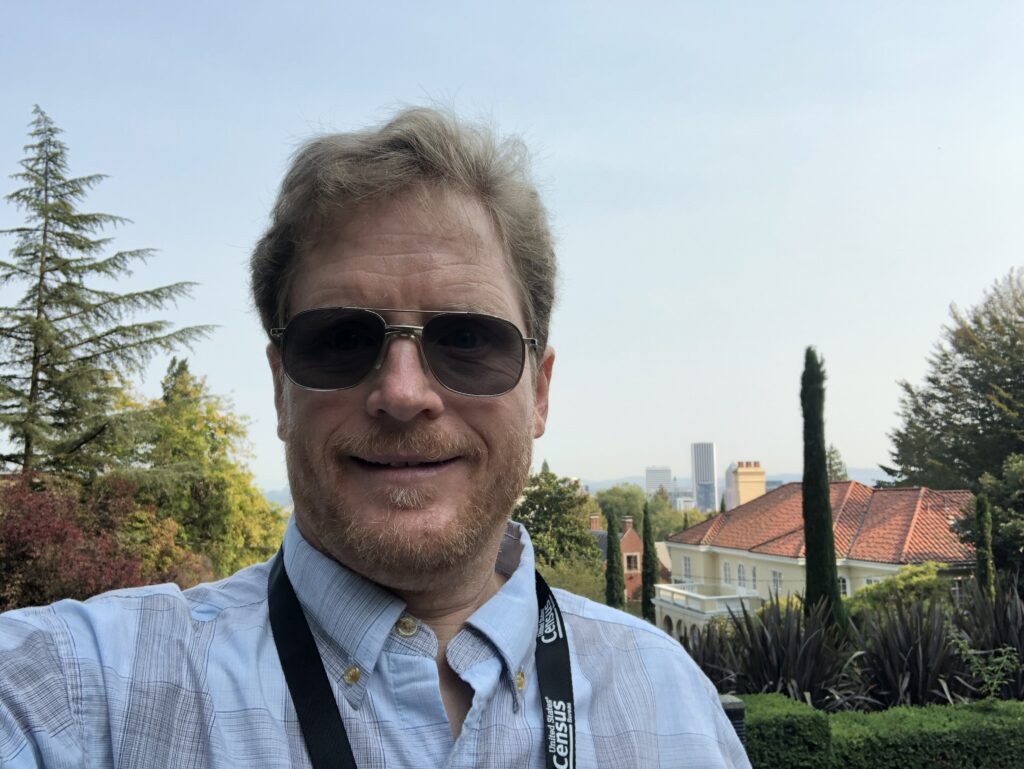
Photo of Brian Ettling taken on November 15, 2023.
This is the toughest blog for me to write. In fact, I have devoted the last year to blogging and writing about my life story and blogging for years before that. This was the blog I knew it was vital for me to write, but I dreaded writing this blog. For the past 23 years, I have not felt that environmentalists, climate advocates, progressives and Democratic leaning voters were smart about electing Presidential, state level, and local candidates who would protect our environment, planet, and our democracy.
This was a very painful blog to write, but I felt like I have no choice to share but to share my story. In the process of writing this blog, I discovered that I wrote so many pages that I am breaking this into an 8-part blog story. Hopefully, someone can learn from my disappointment and letdown I felt from environmental and climate Democratic voters who allowed awful candidates for President and other elected offices win.
Part 2: My disgust with President George W. Bush and my thrill with the return of Al Gore
My disillusion with politics after George W. Bush became President over Al Gore in 2001
I know that in the year 2000 no one could foresee what Al Gore would end up doing after the election, as President or as a private citizen. At the same time, we all saw how the George W. Bush Presidency was a total disaster. During his Presidential campaign, he supported putting mandatory limits on carbon-dioxide emissions. Then he flip-flopped soon after he became President. On March 13, 2001, Bush announced he would not regulate carbon dioxide, stated he did not believe in the science of global warming, and affirmed his opposition to the Kyoto protocol, the only international procedure attempting to reduce the threat of global warming.
The climate disinformation efforts by the Bush Administration became a central tenant of the Bush era – and perhaps causing the most long-term damage. Even more, they went out of their way to censor, doctor, and suppress government scientific reports on climate change that hamstrung government action and misled the public. The list is long how the George W. Bush Administration set back climate policy.
Just as outrageous to me was the case that the Bush Administration seemed asleep at the wheel when the 9-11 terrorist attacks happened. A month before the attack, Bush received an intelligence briefing paper called paper titled: “Bin Laden Determined to Strike in U.S.”
For years afterward, I felt guilty after every time I put gas in my car wondering if my money went to Saudi Arabia and then to finance terrorism there. There were zero attempts by the Bush Administration to try to switch the U.S. to clean energy to deprive oil money flowing to Middle East, which funds terrorism.
Knowing all that I have read about Al Gore and even meeting him, I have a hard time believing that Gore would have responded as awful as George W. Bush did to 9-11. Even more, George W. Bush and Bush administration ignored clear warnings that led to the 2008 housing crash and resulting Great Recession.
As I mentioned in the first post of this blog series, I grew up as a fiscal conservative Republican. George W. Bush was a total failure with exploding annual federal deficits and increasing the federal debt by 57%.
Bush inherited a federal budget that had surpluses for three straight fiscal years (after running deficits for nearly 30 years in a row) and was on course for a surplus in fiscal year 2001. In fact, according the Center on Budget and Policies, “both President Bush’s Office of Management and Budget and the Congressional Budget Office (CBO) projected that if the policies in place when President Bush took office remained unchanged, the budget would generate surpluses that would total $5.6 trillion over the next ten years — more than enough to pay off the entire outstanding federal debt held by the public.”
So why did large federal deficits and huge increases in the federal debt occur under President George W. Bush?
“The biggest factors were very large tax cuts and increases in security-related programs (primarily for two wars that were not paid for). The tax cuts and security spending increases cost nearly $3.4 trillion over those eight years and accounted for more than four-fifths of the fiscal deterioration that policy changes caused during that period.”
Oh, in case we forgot, Al Gore received over a half million more votes nationwide for President than George W. Bush, which should have made him the winner of the 2000 Presidential election. Instead, because of Florida tipping the Electoral College for Bush, he got to pick two Supreme Court Justices, John Roberts and Samuel Alito. Along with Donald Trump’s three Conservative Supreme Court picks, this current Supreme Court now tilts far right. As a result, in recent years, they overturned legalized abortion, favored loosening gun protection laws, allows for discrimination against LGBTQ+ individuals, etc.
I sure wish that the 2000 election Nader voters gave that more thought instead of hiding behind excuses that ‘Gore ran a weak campaign’ or getting easily duped when Nader referred to George W. Bush and Al Gore as “Tweedledum and Tweedledee.”
Not voting and squandering votes on 3rd party candidates in the 2000 election does have consequences that reverberate to this day. This still hurts for me to talk about 23 years later. The 2000 election deeply crushed my spirit.
With my job narrating the boat tours at Flamingo, I found some of the passengers from other states to be downright cruel. Some of them mocked me, ‘Can’t your state vote correctly.’ Or, I heard juvenile jokes about hanging chads. I responded that the same thing could have had in their state if their election results had been extremely close. Even more, it bothered me that we should be counting ballots to make sure that every ballot counts when we have extremely close elections. However, these visitors did not really care about this point I tried to make to them.
Even more, George W. Bush and his campaign were not interested at all in voter recounts to accurately determine who won Florida and the 2000 Presidential election. According to a 2023 CNN article,
“Amid ballot recounts in various challenged counties, the Florida secretary of state certified a 537-vote margin on November 26 for Bush, from 6 million votes cast. Bush strove to stop the recounts as Gore continued to challenge the state’s tallies.”
George W. Bush and his supporters wanted to win at all costs. For the sake of American democracy, they were not interested in holding off declaring victory until there was a completion of recounts to get a more accurate picture of who really won the election. I thought this started a dangerous precedent for American politics to try to win at all costs that Donald Trump and his supporters tried to do in the 2020 election.
After the election of 2000, I lost a lot of faith in the U.S politics, the American people, and American democracy. With thousands of Floridian environmentalists voting for Ralph Nader, the snarky comments I heard from Everglades visitors about the chaos counting the votes in Florida, and how Americans felt indifferent that a man who won the popular vote nationwide, plus possibility that Gore might have won the votes in Florida, left me feeling disgusted with the U.S. I felt very little sense of patriotism after that election.
I spent every day on the boat tours talking about ecology and trying to plant seeds in visitors minds to commit themselves to save the Everglades and our planet. The Florida Nader voters left me feeling less motivated to do this. There were probably many others who felt disheartened like me. Was that really the intention of those Florida Nader voters? Did they really think through the long-term implications of their actions?
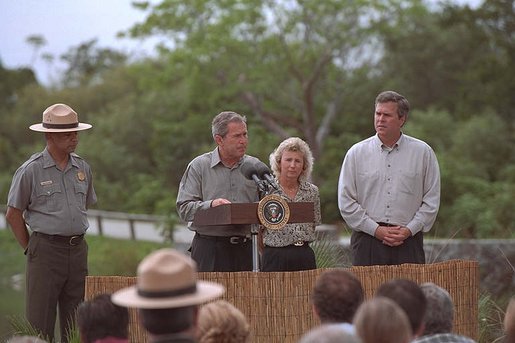
President George W. Bush came to Everglades National Park on June 4, 2001. The National Park Service asked me for help to volunteer for this event. I initially said yes. I loved working in the Everglades, and this was a big deal to have the President come to the Everglades. However, the more I thought about it, the more I could not participate. I did not believe Bush won the 2000 election fair and square. I believe he tried to stop the recounts to determine who really won. I did not consider him to be an honorable and trustworthy man. I still don’t to this day. Thus, I choose to protest with a good friend and fellow park employees with many others at a designated free speech area at the park entrance.
Focusing on my seasonal park ranger jobs and my disappointment with the 2004 election
A year later, I gave up my year-round naturalist guide job in the Everglades where I had full time benefits. I needed a break from trying to inspire visitors to save the Everglades during my boat tour narrations. In addition, in 2001 and early 2002, I volunteered giving ranger talks at the Royal Palm Visitor Center and the Flamingo Visitor Center on the water ecology of the Everglades. Like my boat tour narrations, I hoped to educate and influence them to protect the Everglades, our natural world, and our planet.
In May 2002, I drove away from Flamingo and Everglades National Park unsure if I would return. My friend Amelia Bruno hired me to return to my old summer job entrance station ranger job at Crater Lake National Park. I planned to enjoy the summer there and do lots of hiking. I was unsure what I would do next. It turned out that I was not finished with the Everglades.
In 2002, I had a wonderful summer at Crater Lake. It was a superb summer for me to return because the park was celebrating its centennial. Congress passed a bill establishing the national park and President Theodore Roosevelt signed it into law on May 22, 1902. It was great to make new friends working in the park since I was gone for four years. It was a joy to rediscover all the trails in the park that I enjoyed hiking.
The stressful part was I did not have plans for the winter of 2002-03. I applied to work for the National Park Service in the Everglades that winter at the Flamingo Campground Kiosk, but I did not hear back from the park. I ended up going back to St. Louis to stay with my parents.
I returned to the entrance station ranger job for the summer of 2003. In June, I had a new housemate at Crater Lake, David Grimes. He worked seasonally in other national parks such as Congaree Swamp in South Carolina and Zion in Utah. We became friends. We both applied to work as seasonal interpretation rangers in Everglades National Park for the winter 2003-04.
In late November, I received a phone call from Candice Tinkler, the District Supervisor Ranger at the Everglades City Visitor Center. Someone she hired for the winter declined to work there. She needed to hire a new ranger fast. She saw my name on the list of eligible candidates. Grimes highly recommended me, so she called to offer me an interpretative ranger position for the winter. She needed me to come down fast, within a week if possible. I started throwing my ranger uniforms and other belongs in the car to drive from St. Louis to Everglades City, Florida. I left shortly after Thanksgiving and arrived during the first week in December 2003.
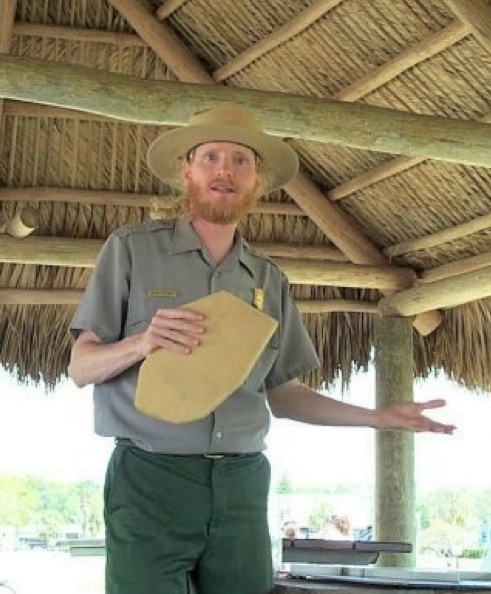
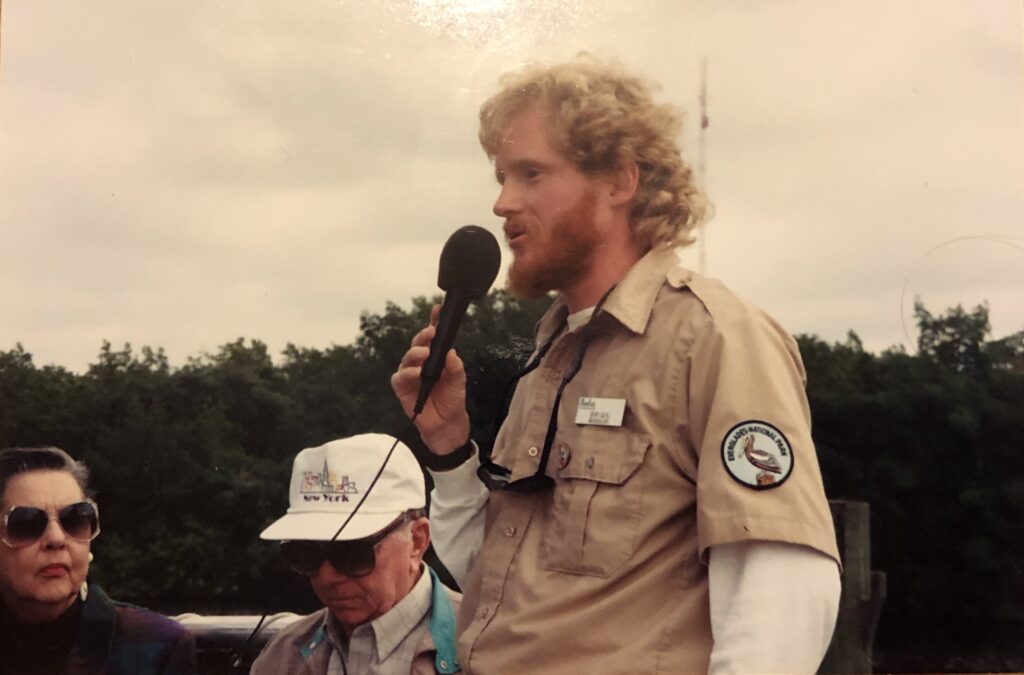
This was my first National Park Service interpretative ranger job. After my four years as a naturalist guide in Flamingo, this new ranger position was an ideal fit for me. I enjoyed narrating the boat tours in Everglades City, leading the canoe trips, and giving ranger talks on the water drainage issues and the Everglades Restoration plan. I liked spending the winter in Everglades City and I ended up spending three more winters there from 2004 to 2007.
Brian Ettling giving a ranger talk in Everglades City in the spring of 2004.
In subsequent winters working in Everglades City, I expanded to do additional ranger programs, such as guided bike tours and an evening program on the birds of the Everglades. I enjoyed my year-round work of summers working as an entrance station ranger at Crater Lake and the winters working as an interpretive ranger in Everglades City.
With Al Gore’s 2000 campaign where he was extremely close to winning the Presidency, I eagerly wondered in 2001 and 2002 if he would run for President. If he ran for President again, I would be tempted to give up my ranger jobs to volunteer or to even see if I could somehow work on his campaign. Leading up to his decision for 2004, I still thought Al Gore was the best potential Presidential candidate for the environment. I really wanted him to run again.
On December 15, 2002, I received the crushing news that Al Gore decided he would not run for President in 2004. Furthermore, he disclosed that he did not expect ever to run for president. I felt deflated by that news. I was in St. Louis living with my parents. I had to go for a very long neighborhood walk to try to process the news and attempt to somehow lift my spirits. I still considered him to be the leading voice in the U.S. for protecting the environment and reducing the threat of global warming. I hoped he would continue to use his voice and platform to make a difference and to influence citizens like me.
As the 2004 Presidential campaign heated up, I was happy that Al Gore endorsed Howard Dean for President. Like Gore, I was impressed with Dean’s ability to appeal to the nation’s “grassroots” elements and his fundraising. After his poor finishes in the New Hampshire primary and the Iowa Caucus, I lost interest in Howard Dean. After John Kerry became the Democratic nominee for President, I supported him for President hoping he could defeat George W. Bush.
On Wednesday, November 4, 2004, I heard on the radio that George W. Bush had officially won the election. I was inside my car, and I could not stop crying. I thought it was a fluke of the electoral college that Bush won the first time in 2000. It shocked me that a majority Americans re-elected him in 2004. With that election, it did not seem like Americans cared about the environment or any long-term damage humans were causing the planet. The election left me feeling numb and so disappointed with the U.S. The election of 2000 still felt like a recent open wound that crushed my spirit further when I heard the outcome of the 2004 election.
I needed some good news that Americans really cared about the environment and the health of our planet. During that time, I focused on my summer ranger entrance station job at Crater Lake and my winter interpretative ranger job in Everglades City.
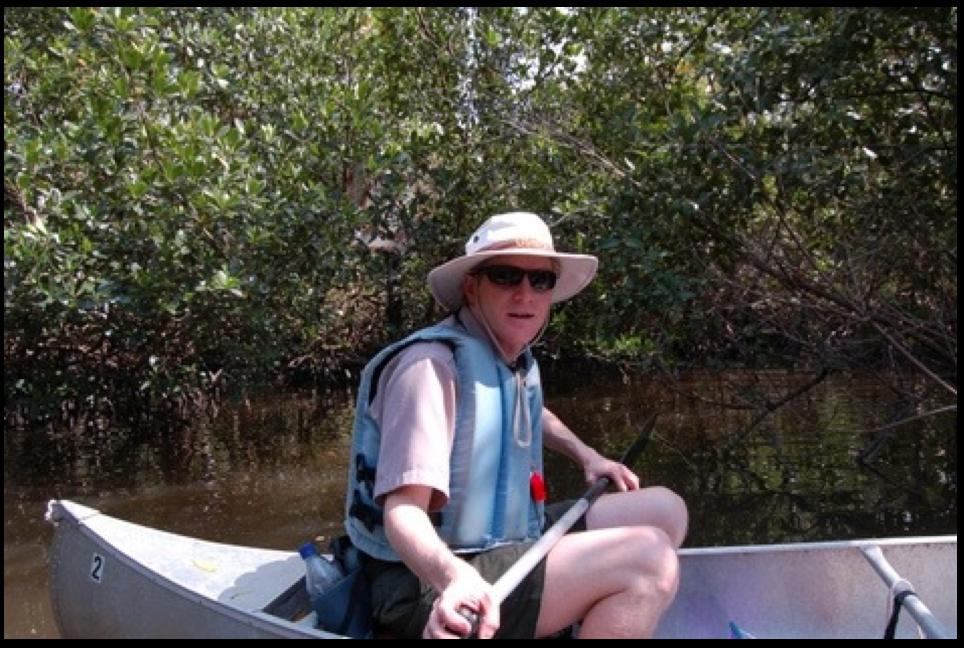
Brian Ettling leading a ranger led canoe trip in Everglades National Park around 2006.
My excitement seeing Al Gore back in the public spotlight promoting climate action
In May 2006, I saw that maybe America was getting a tad bit more serious about the environment and climate change. I had wrapped up my winter season in Everglades City. I embarked on a cross country drive to my summer job at Crater Lake. Along the way, I decided to visit friends in North Carolina. My friend Dana Ostfeld was getting ready to graduate from Duke University with a master’s degree in environmental management. My friend Sheryl Shultz lived that time not far away in Chapel Hill, North Carolina. I had a good visit with these friends. I then went to see the Biltmore Estate in Asheville, NC. I got a motel room to spend the night not far from Asheville. The next day, I had plans to visit and hike in Great Smoky Mountains National Park.
When I turned on the TV for a few minutes that morning to start my day, a documentary on HBO grabbed my attention. It was called Too Hot Not to Handle. The film had video interview clips with climate scientists throughout the program. The message of this documentary was that “Global Warming is the most urgent threat facing humanity today.” I found the film to be mesmerizing. It laid out a stark warning from scientists the threat of climate change and what they think we need to do to solve it. Soon afterwards, I bought my own DVD copy of it online from the HBO store to watch multiple times.
On a random news stand while I traveled across country, I noticed the May 2006 edition Wired magazine with Al Gore on the cover staring right at me. The headline of the magazine news proclaimed, “CLIMATE CRISIS: The Pro-growth, Pro-tech Fight to stop Global Warming.” In the lower right corner of the magazine had a sub-headline, “AL GORE and the Rise of the Neo-Greens.”
“Al Gore is traveling the globe, delivering a slide show that, by his own estimate, he’s given more than a thousand times over the years. His one-man campaign is chronicled in a new documentary, An Inconvenient Truth, which made Gore the unlikely darling of the Sundance Film Festival earlier year and will be released on May 26th by Paramount Classics. He has also written a forthcoming companion volume of the same name, his first book on the subject since the 1992 campaign tome Earth in the Balance: Ecology and the Human Spirit.”
This was suddenly my “must see” movie and book to read for the summer. When I returned to Crater Lake in June 2006, I watched the internet periodically to see when the film would be shown at a theatre in southern Oregon. Finally, An Inconvenient Truth had a showing at a movie theater in Ashland, Oregon in July 2006. I saw the documentary with my girlfriend at the time, Marie Malo. We were speechless afterwards how fantastic the film was. Al Gore was very compelling to watch and even displayed a great sense of humor as the film showed him giving his climate change presentation. The film was sobering about the serious danger of climate change.
As we watched the credits, our hearts were further touched by the Melissa Etheridge theme song. “I Need to Wake Up.”
Like many others who saw An Inconvenient Truth, I wanted to do something, but I was not sure what to do. I did not know of any individuals or organizations working on climate change at that time. The film did give great advice as the credits rolled, such as “Vote for leaders who pledge to solve this crisis. Write to Congress. If they don’t listen, run for Congress.” To further reinforce what I saw and learned in the documentary, I purchased the companion book. Laurie David, the Executive Producer of the HBO documentary Too Hot Not to Handle, was a producer of this film.
When the film came out on DVD that winter, I bought it as soon as it was available. At that time, I was working my winter seasonal ranger job in Everglades City. I never shop at Wal Mart. I despised their business practices how they displaced so many small independent businesses. However, I had so much fun that day walking into Wal Mart to buy this film. I wanted to vote with my dollars that this was a good product that they for sale that day.
An Inconvenient Truth turned out to be a profitable movie for Hollywood. It costs about $1 million to make and made over $50 million during its showing in movie theaters worldwide. That was an unheard of a box office success at that time for a documentary. It turned out that this film was one of the “must see” films for the summer of 2006, not just for me. Years later, I had friends tell me that they got involved in the climate movement after seeing An Inconvenient Truth. In fact, Marshall Saunders, founder of Citizens’ Climate Lobby (CCL) – one of the first climate groups I joined back in 2012 and became a volunteer, was motivated to start CCL after seeing the film and attending one of Al Gore’s Climate Reality Trainings in 2007.
I was elated over the buzz An Inconvenient Truth created in 2006 and 2007. On January 25, 2007, the film was nominated for an Academy Award for Best Documentary (Feature). On Sunday, February 25, 2007, the Everglades City rangers had an Oscar watch TV party. I was ecstatic when An Inconvenient Truthwon the Oscar for Best Documentary feature. Al Gore came on the stage with the Director Davis Guggenheim and producers Lawrence Bender and Laurie David to accept the award. Guggenheim even allowed time for Al Gore to give a short speech,
“My fellow Americans, people all over the world, we need to solve the climate crisis. It’s not a political issue, it’s a moral issue. We have everything we need to get started with the possible exception of the will to act. That’s a renewable resource. Let’s renew it.”
Later at that same Academy Award ceremony, rock musician Melissa Etheridge won the Oscar for Best Original Song for “I need to Wake Up.” Just like Gore, it was great to see her urge the audience of top Hollywood celebrities and a global TV audience of over a billion people to take climate action. She said,
“I have to thank Al Gore for inspiring us, inspiring me, showing that caring about the earth is not Democratic or Republican, it is not red or blue, we are all green.”
The accolades continued later that year when the 2007 Nobel Peace Prize was awarded to the United Nations Intergovernmental Panel on Climate Change (IPCC) and Al Gore. Their motivation to give the Prize to the IPCC and Al Gore was due to “their efforts to build up and disseminate greater knowledge about man-made climate change, and to lay the foundations for the measures that are needed to counteract such change.”
“According to the Nobel Committee, Gore is probably the single individual who has done most to rouse the public and the governments that action had to be taken to meet the climate challenge. ‘He is,’ in the words of the Committee, ‘the great communicator’.”
With an Oscar winning documentary feature about climate change, An Inconvenient Truth, plus a Nobel Peace Prize. I was happy for him and how he was elevating the issue. At the same time, it was bittersweet because he because he should have elected President in 2000.
At the same time Al Gore made a comeback from his devastating 2000 Presidential loss with the Nobel Peace Prize and an Oscar winning documentary about him in 2007, I experienced a bad depression and my own heart-breaking loss.
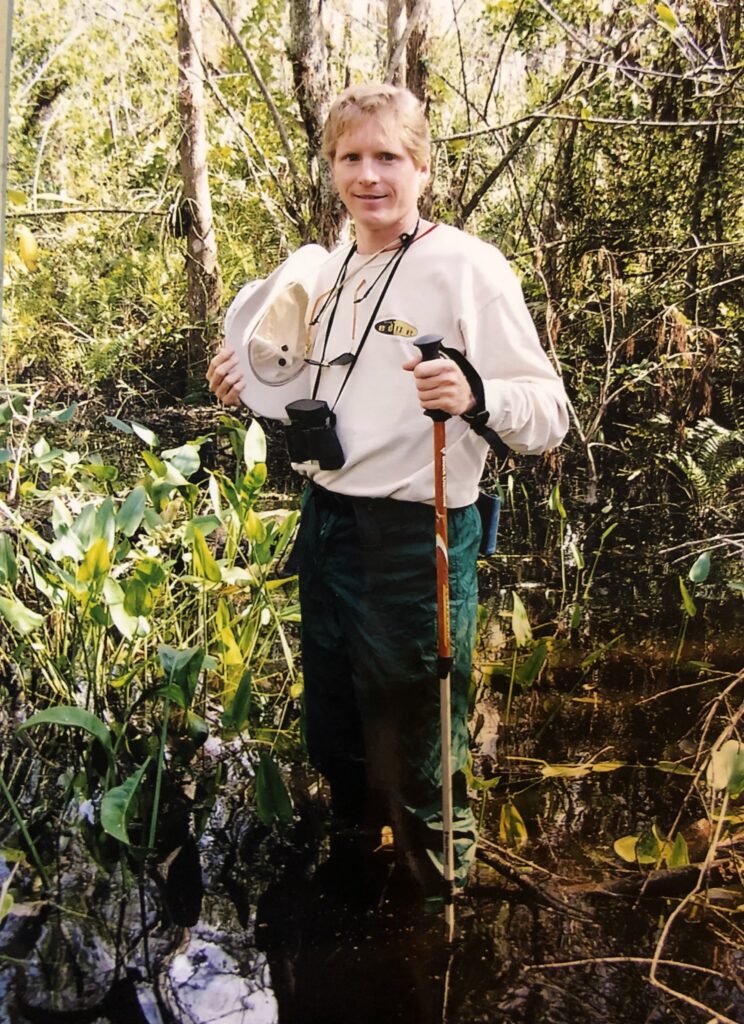
Brian Ettling in Everglades National Park in December 2006.
End of Part 2 of For Climate Action, let’s protect our democracy
Photo of Brian Ettling taken on November 15, 2023.
‘In order to fix the climate crisis, we need to fix the democracy crisis.’ – Former Vice President Al Gore
This is the toughest blog for me to write. In fact, I have devoted the last year to blogging and writing about my life story and blogging for years before that. This was the blog I knew it was vital for me to write, but I dreaded writing this blog. For the past 23 years, I have not felt that environmentalists, climate advocates, progressives and Democratic leaning voters were smart about electing Presidential, state level, and local candidates who would protect our environment, planet, and our democracy.
This is a very painful blog to write, but I feel like I have no choice to share but to share my story. In the process of writing this blog, I discovered that I wrote so many pages that I am breaking this into an 8-part blog story. Hopefully, someone can learn from my disappointment and letdown I felt from environmental and climate Democratic voters who allowed awful candidates for President and other elected offices win.
Part 1: My 1980s childhood in Missouri to witnessing 2000 Presidential Election in Florida
Growing up in Missouri with the American Dream in the 1970s and 1980s
I grew up in Oakville, Missouri, a suburb in the south part of the St. Louis metropolitan area. My childhood and teen years where in the 1970s into the 1980s. I am old enough to remember the Iranian hostage crisis of 1979-1981, when inflation and stagflation was high, and the malaise of the late 1970s. I was a kid in the late 70s and 1980 just happy to ride my bike, play with my Star Wars toys, and enjoy touch football with neighborhood friends. Yet, I remember my parents and other adults feeling somber with the inflation, hostage crisis, the 1980 boycott of the summer Olympics, and the direction of the country.
I was a 12-year-old kid fascinated with the nightly news anchored by Walter Cronkite and the humorous monologues of the Johnny Carson commenting on the times. At the time, it seemed like a positive shift in the country when Ronald Reagan became President. He projected confidence with his sunny disposition and a conservative simplistic governing philosophy that I could understand at that age, ‘government bad, private sector good.’ Reagan was President from when I was in 6th grade until I started college in 1988. Growing up on Reagan, he seemed someone like a grandpa figure for me that felt like he was good for America at that time.
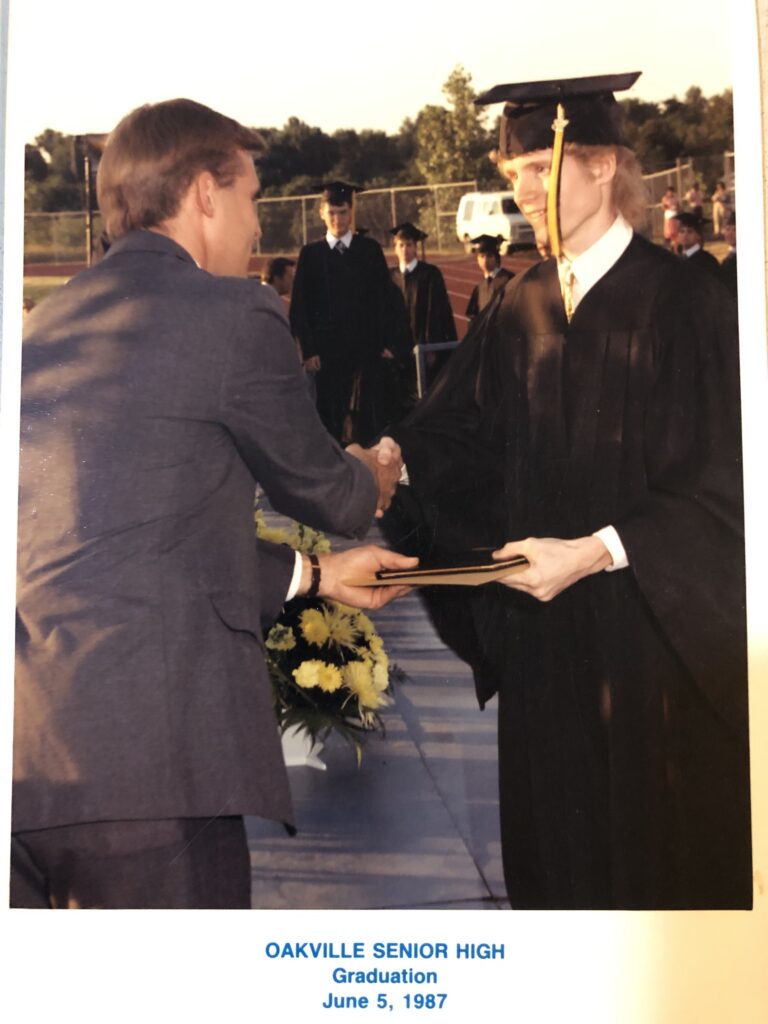
This was the 1980s when capitalism, money, and wealth were overly idealized in the U.S. The popular TV shows in America and our home at that time was Dallas, Dynasty, and Lifestyles of the Rich and Famous. I graduated from high school in 1987. I had no idea what to do with my life, so I took a gap year to travel a bit in the U.S. and work at the neighborhood gas station.
Brian Ettling graduating from Oakville High School, just south of St. Louis, Missouri
During that time, I was enthralled with the move Wall Street and Donald Trump’s book The Art of the Deal. Like Trump, I wanted to be a success in business and be rich. As I became 20 years old, America seemed like the perfect democracy. It was ‘the land of opportunity’ if one just worked hard enough in business and the free enterprise system.
To pursue that dream, I decided I would major in Business Administration when I started my freshman year at William Jewell College in Liberty, Missouri, which is just outside of Kansas City. I enjoyed my business classes. However, I could see that I was too much of a free spirit to spend my entire work career in an office cubicle and trapped inside an office building. I wanted to be outside or at least working close to the great outdoors. While I attended college, a recruiter for A Christian Ministries in the National Parks (ACMNP) convinced me to work a summer job in the national parks. They would find a concession job for me in the parks if I agreed to help lead interdenominational Christian church services on Sundays. At that time, I was very religious, so that seemed like a good deal for me.
Leaving Missouri to work summers at Crater Lake National Park, Oregon
I graduated from William Jewell College on May 17, 1992. That evening, I stepped on board an Amtrak train on a three-day train ride to take me from Kansas City to Los Angeles. I then changed trains in Los Angeles to take the very scenic Coast Starlight train from LA to Klamath Falls, Oregon. The train ride was phenomenal to see the Pacific Ocean beaches in Santa Barbara, watch the train weave into the Mediterranean interior climate of San Luis Obispo and then head up towards the Bay Area. We arrived at the Oakland Train station late at night to see the city lights of the East Bay, the sparkling twinkling lights of San Francisco, and the lights of the majestic bridges that span across the wide bay.
I woke up the next morning with the train veering around the massive snowcapped Mt. Shasta. Growing up in the low elevation of the Midwest, I had always dreamed of living close to mountains with snow on top. As the train wheels squealed going around the huge mountain. I felt like I had arrived in my new home. Mt. Shasta was a very welcoming sight for my blurry eyes that did not get much sleep sitting in the train coach seat that night.
A Crater Lake gift store park employee named Kevin picked me up at the Klamath Falls, Oregon train station. As we drove over an hour to get to Crater Lake National Park, I was so anxious to see it that I kept asking Kevin soon after the drive started, ‘Will we see the lake after we go over this next ridge?’ He assured me that we would see it on this drive. I just had to be patient. To make small talk, I asked Kevin about the dumb questions that visitors ask the employees. He said that he had heard that visitors sometimes asked park employees, ‘What time of year do the deer turn into elk?’
I laughed and responded, ‘Ha! That’s funny! How could they ask such a thing?’ Internally, I was thinking: ‘I don’t know a thing about deer or elk or really anything else about the park. I am going to have to learn quickly!’
When I saw Crater Lake for the first time on May 20, 1992, it changed my life. The scenery did not disappoint. Crater Lake was one of the most spectacular sights I saw in my life. The lake was 6 miles across at its widest point with this deep cobalt blue color. The rim mountains that surrounded it were decorated with snow, looking like an amazing cake decoration with the white icing on top. The pine trees where so tall, unlike the much smaller deciduous or leaf producing trees in my home state of Missouri. It was so quiet standing on the rim admiring the lake, except for the very light whistle of the wind and an occasional airplane flying overhead.
Seeing Crater Lake for the first time reminded me of a quote I later read from the founder of Crater Lake National Park, William Gladstone Steel. He saw it for the first time on August 15, 1885. One year afterwards, he wrote:
“Crater Lake is one of the grandest points of interest on earth. Here all the ingenuity of nature seems to have been exerted to the fullest capacity, to build one grand, awe-inspiring temple, within which to live and from which to gaze up on the surrounding world and say: ‘Here would I dwell and live forever. Here would I make my home from choice; the universe is my kingdom, and this is my throne.’”
I loved my summers at Crater Lake. I spent the summers of 1992-94 working in the Crater Lake gift store. Because this was a seasonal job, I had to find a different place to work in the winter.
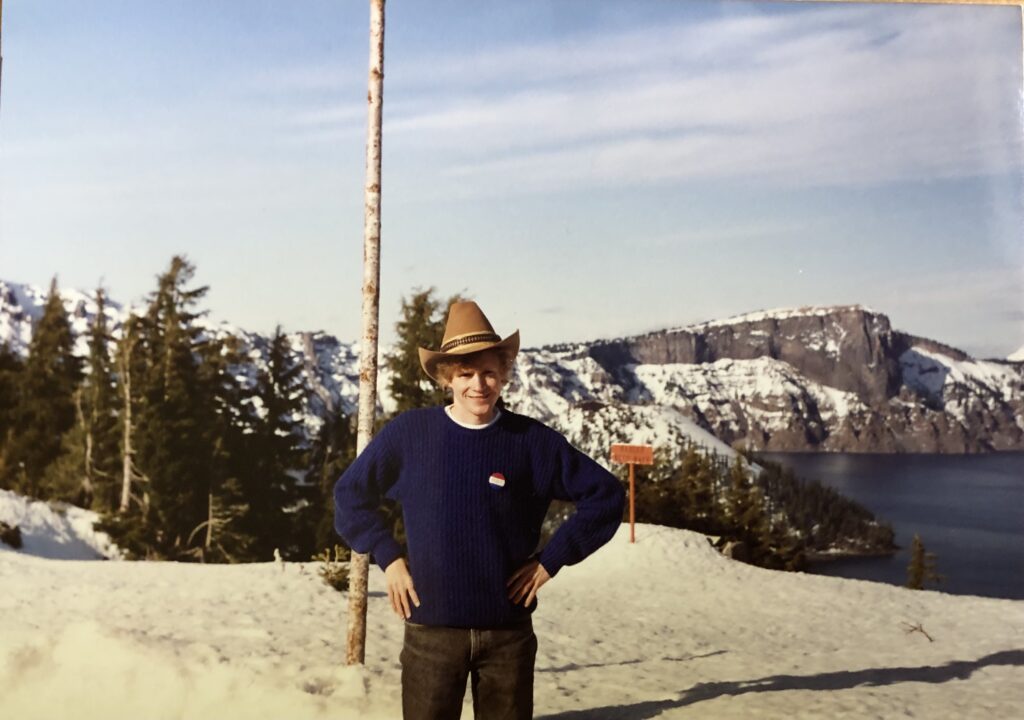
Brian Ettling at Crater Lake National Park. Photo taken on November 3, 1992.
Spending my winters working in Everglades National Park, Florida
I had to find another seasonal job for the winter in those months to mark time before returning to Crater Lake for the summer. Fortunately, the peak season for Everglades National Park visitation in Florida was from late November to early April. I arrived at the Flamingo Outpost in Everglades National Park in December 1992. My first job was working in housekeeping. I then transferred to a Front Desk job at the Flamingo Lodge.
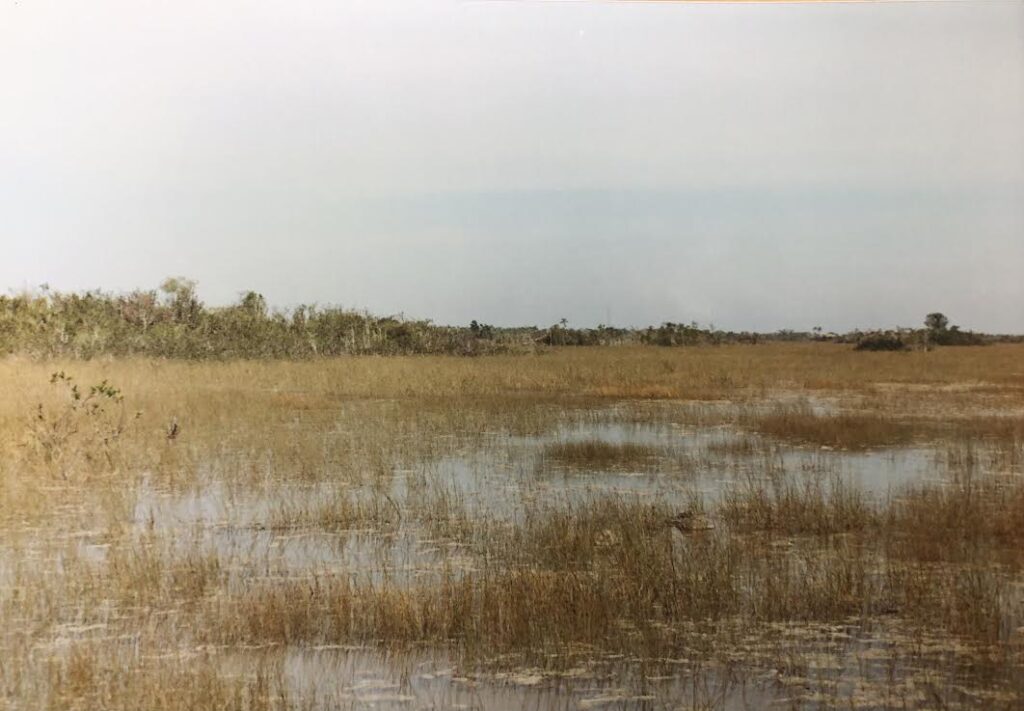
Unlike Crater Lake, I was disappointed with my first views of the Everglades. The sawgrass prairie, which made up much of the park, looked as flat as the eye could see. It looked like a Midwest farm field, not at all like the iconic western national parks with towering mountains. The only high features in the Everglades were the lofty clouds that I had to imagine they were as high and dominating as the Rocky Mountains, Cascades or Sierra Nevada Mountain ranges.
My seasonal housing unit looked out into the subtropical Florida Bay, which made up the lower third of Everglades National Park. Numerous mangrove islands dotted the shallow Florida Bay. In the western part of the bay, the water blended into the Gulf of Mexico. As a child growing up in the landlocked St. Louis, Missouri, I dreamed of living close to the ocean to see that horizon line where the ocean met the sky with no land to interfere. Flamingo was probably the cheapest place in Florida to live next to the ocean, even if Florida Bay was considered an estuary, a place where inland freshwater met and mixed with seawater from the ocean.
It felt very tranquil to live by so much water. Surrounding our housing area and Flamingo were subtropical mangrove trees living in the shallow waters and coconut palms stood by the higher solid grounds of the buildings. The Everglades had a fascinating variety of wildlife with alligators, crocodiles, dolphins, manatees, deer, raccoons, and a wide variety of colorful wading birds. November to April is the dry season in the Everglades where it rains occasionally and is most sunny most of the time. The high temperature from December to April is in the upper 70s to lower 80s. South Florida is a fun place to comfortably wear shorts in the depths of winter.
To mark time until I could return to Crater Lake, I made the best out of working winters in the Everglades. I relished exploring all around the park and seeing the unique wildlife I saw, such as alligators, crocodiles, dolphins, manatees, and the wide variety of birds. The canoeing in the Everglades was a fabulous experience. My high point was the overnight canoe trip with friends to Alligator Creek and Florida Bay in February 1993.
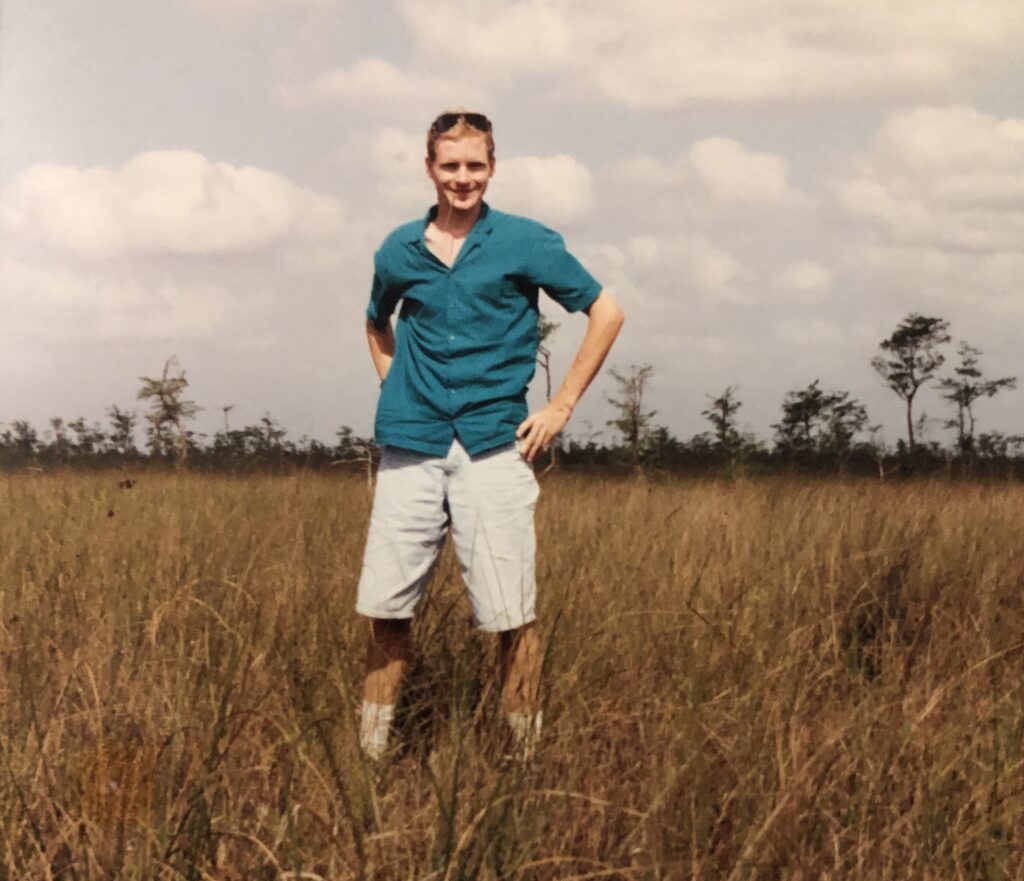
Brian Ettling in Everglades National Park, Florida. Photo taken in mid April 1993.
Reading books t deepen my connection with the national parks and the environment
In my first year of working in the national parks, I yearned to read everything about them. I bought picture books and guidebooks on the national parks, hoping to see them all someday. I wanted to learn the history of our national parks, so I purchased at the Crater Lake gift store, Regreening The National Parks. This was a 1992 book by Michael Frome, a conservationist writer and Professor of Environmental Journalism at the Huxley College of Environmental Studies at Western Washington University. In this book, Frome critiqued the over commercialization of the national parks and offers advice on the policies needed to truly protect them.
While working at the front desk of the Flamingo Lodge in Everglades National Park in January 1998, I had a chance encounter with Michael Frome. I recognized his name while checking him into the hotel. I complimented him on his book, and he appreciated my kind words. When he checked out the next day, he generously signed my copy of his book.
Besides Frome’s book, I read Dr. Tony Campolo’s 1992 book, How to Rescue the Earth Without Saving Nature: A Christian’s Call to Save Creation. At that time, I was a devout Christian with leading ACMNP Sunday church services at the campground amphitheaters at Crater Lake and Everglades National Parks. I felt a calling to save the environment, the national parks, and our planet in a way that honored God. I knew Dr. Campolo as a fantastic public speaker. He spoke twice to William Jewell College when I was a student. He was known as a progressive evangelical Christian theologian. He was a professor of sociology at Eastern College in Pennsylvania.
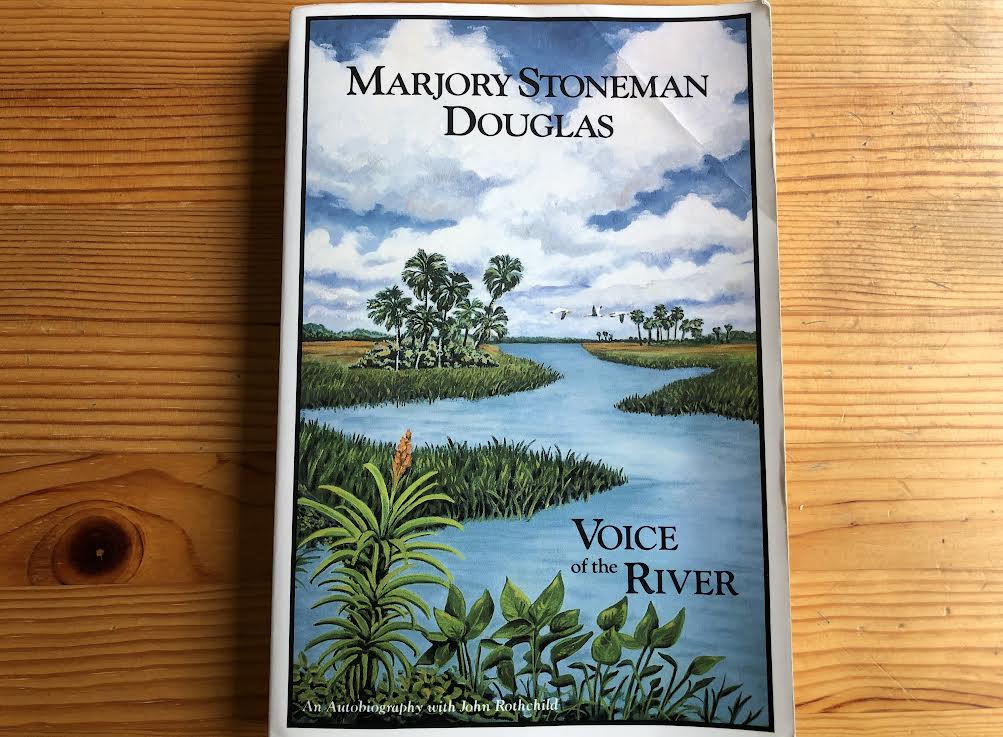
During my first winter in the Everglades, I figured one of the best ways to learn about it was to read the 1987 book Voice of the River by Marjory Stoneman Douglas, the mother of Everglades National Park. She ended up having a big impact on my life when I became a naturalist guide in Flamingo in 1998 and an environmental advocate for the Everglades. Unlike Dr. Tony Campolo, Marjory Stoneman Douglas was not religious at all. She did not seem to have much use for it. She ended her book with a quote that had a huge reverberation within me. She wrote,
“I believe that life should be lived so vividly and so intensely that thoughts of another life, or a longer life, are not necessary.”
Marjory was a huge voice speaking out for the protection of the Everglades and the natural environment. She lived as an outspoken advocate for the Everglades until she died in 1998 at the age of 108 years old. Even though she was an atheist, I thought at that time, ‘If there is a heaven and Marjory is not there, no one deserves to be there.’
I think Tony Campolo would have agreed with me on that point. Both Marjory and Tony loved people and getting to the truth of the matter. I think if they had ever met, they would have really liked each other.
Brian Ettling’s copy of Voice of the River by Marjory Stoneman Douglas. He purchased this book in the Everglades in 1993.
In early 1993, another book that had a massive influence on me was the 1992 book Earth in the Balance by Al Gore. He wrote the book while he as a U.S. Senator from the state of Tennessee. The book came to my attention when he ran for Vice President in 1992 as Bill Clinton’s Presidential campaign running mate. The book examined the threat to our planet’s environment from global warming, pollution, and deforestation. I thought that the book was very compelling, well researched, and very insightful how humans were threatening life on our planet and ourselves.
To back up, in November 1992, I supported Ross Perot for President. My thinking was then the federal deficit and debt had greatly increased under President George H.W. Bush. I considered myself to be a fiscal conservative then and I did not find Bush to be an effective leader. At the same time, I was intrigued for years by Al Gore with his strong stands to protect the environment. My older sister shared with me afterwards her favorite moment of the Vice-Presidential Debate between Vice President Dan Quayle, Admiral James Stockdale and Al Gore on October 13, 1992. Forty two minutes into the debate, Dan Quayle attacked Al Gore for supposed statements made in the book. After Quayle finished attacking Al Gore, he responded, ‘Dan, I appreciate that you read my book.’
My older sister said she laughed when she saw that on TV and she noticed laughter from some members in the audience at the debate. Thus, I was curious to Gore’s book. I found it to be a very helpful reference for the global environmental problems happening at that time. I remember thinking, ‘Thank God that Al Gore is our Vice President. After reading his book I became a big admirer of Al Gore. I still considered myself to be a Republican at that time. By 1996, I voted for Bill Clinton to be re-elected as President primarily because Al Gore was his Vice President. To me, Gore seemed to be by far the strongest environmental champion in politics. I eagerly looked forward to supporting and voting for him for President in 2000.
Becoming a Crater Lake park ranger and a naturalist guide in Everglades National Park
I left the Everglades in the middle of April 1993 to return to work at the Crater Lake National Park Gift Store for the summer. I briefly worked at Furnace Creek in Death Valley during the spring of 1994 before working again at the Crater Lake gift store for the summer. The General Manager of the Crater Lake concessionaire talked me into working the night auditor position at the rehabilitated Crater Lake Lodge during the grand re-opening summer of 1995. I quickly discovered that working graveyard shifts was not my cup of tea. I was sleeping during the daytime beauty of Crater Lake.
In 1996, the National Park Service (NPS) hired me to be an Entrance Station ranger at Crater Lake. I wore the ranger uniform with pride as I welcomed visitors to Crater Lake and charged them the $5 entrance fee. I was working in a tiny entrance station booth, which was more like a box. The park entrance road was surrounded by the tall skinny lodgepole pine trees. Except for the stream of vehicle traffic in the summer, it felt like I was working in the woods.
For the summer of 1997, it was soul satisfying to return to this Crater Lake entrance station ranger job. That summer NPS changed the job title to Visitor Use Assistant. I did not care what they called me. I was delighted to spend my summers at Crater Lake. Yet, I found myself drawn to spend my winters working in Everglades National Park.
I skipped two winters, 1993-94 and 1994-95, to spend time with family in St. Louis. I returned to Flamingo in the 1995-96 winter to work as a night auditor at the lodge front desk. I thought I would use my Business Administration college degree to do this accounting job to balance the lodge’s daily receipts. Like my 1995 summer at Crater Lake, I was a glutton for punishment working this overnight job. It was stressful to complete all the office work in time. The computers were finicky and glitchy with no one around to assist if I ran into technical issues. The sleep schedule was brutal and hard on my dating relationship at that time. I vowed to never do that job again.
I skipped working in the Everglades in 1996 to 1997 to visit family in St. Louis. It was good to be home that winter because to be at the hospital hours after my oldest niece and goddaughter, Rachel was born. When I returned to Everglades National Park in November 1997, I worked front desk at the Flamingo Lodge. In early January 1998, a naturalist guide position opened to narrate the boat tours in Flamingo. I applied for the position and started in late January 1998.
Brian Ettling narrating a boat tour in Everglades National Park. Photo taken around 1998-2002.
My admiration for Marjory Stoneman Douglas while working as a naturalist guide
It was great to talk about how and why the Everglades became a national park in 1947. Unlike western national parks which were protected for their dramatic scenery, the Everglades National Park was the first national park in the world protected for its biodiversity. Florida conservationists wanted it protected because of its wide diversity of plants and animals.
I greatly admired “The mother of the Everglades” Marjory Stoneman Douglas who fought many years to protect the Everglades. She wrote the most renowned 1947 book, The Everglades: River of Grass. She opened the book by writing,
“There are no other Everglades in the world. They are, they have always been, one of the unique regions of the earth, remote, never wholly known…The miracle of the light pours over the green and brown expanse of saw grass and of water, shining and slow-moving below, the grass and water that is the meaning and the central fact of the Everglades of Florida. It is a river of grass.”
I shared that quote and others from Marjory Stoneman Douglas during my boat tour narrations. Sadly, She passed away in May 1998 at the age of 108 years old. This happened just months after I became an Everglades naturalist guide. It felt like her torch moved on to me and others in my generation to cherish and protect the Everglades. When possible, I made sure park visitors knew about her during my interactions.
Most of all, this job gave me a great opportunity to talk about the importance of saving the Everglades, our precious environment, and our planet from the harm caused by humans. In most of my programs, I talked about how the Everglades was one of the most threatened national parks in the United States due to over development and over drainage. In December 2000, Congress passed and President Bill Clinton signed a multi-billion-dollar plan to try to save the Everglades.
I ended most of these narrations with a famous quote incorrectly attributed to Marjory Stoneman Douglas to this day. In fact, a lesser-known Everglades activist named Joe Podgor gave Marjory the iconic quote: “The Everglades is Test. — If We Pass, We May Get to Keep the Planet.”
Photo by Brian Ettling of the Everglades “River of Grass” taken in 1993.
Becoming active environmentalist whiling working in Everglades National Park
During my time off from work, I attended monthly meetings of the Miami Chapter of the Sierra Club and the Tropical Audubon Society, located in Miami. After I became a Flamingo naturalist guide in 1998, I read all the articles I could find about what was happening in the Everglades.
I soon discovered that developers, the City of Miami, and even the state of Florida wanted to turn the former Homestead Air Force Base into a commercial airport to deliver products from Latin America, Europe and around the U.S. to the south Florida area. The Hurricane Andrew destroyed Homestead Air Force Base in 1992, leaving a large hole in the local Homestead and south Miami economy.
The outgoing George H.W. Bush Administration, incoming Bill Clinton Administration, and the U.S. Defense Department did not think it was vital to rebuild the Homestead Air Force Base for American security or military training. Instead, local Miami business leaders and many local, state, and federal officials supported building a commercial airport where the Homestead Air Force Base was located. They believed a new commercial airport would grow the economy and provide jobs for Homestead and the surrounding south Miami area.
The problem was that this airport would be located just a few miles between Everglades and Biscayne National Parks. The Everglades was already one of the most threatened national parks in the U.S, if not the world. This was due to over drainage, pollution from Miami, introduction of exotic plants and animals, etc. The last thing that Everglades National Park and Biscayne National Park needed was a constant sound and emissions pollution from jet airplanes constantly flying overhead with up to 600 flights a day. I was not a scientist, just a naturalist guide who loved the Everglades. The idea of constant low flying jets over the Everglades and Biscayne National Parks sounded like a terrible idea to me.
In 1999 and 2000, I attended public hearings and meetings about the proposed Homestead Jetport plans. The meetings became very contentious with yelling on both sides. Local environmentalists strongly opposed the jetport. However, business leaders, local businesses, and members of the minority communities who wanted the jobs pushed hard for this airport.
I will never forget one public meeting where arguments broke out. One individual even said, ‘This airport would be under construction right now except for you rich people on Key Biscayne that don’t want it.’
I remember a gasp from the audience that hung in the air after that very blunt statement. A friend and I turned to each other thinking, ‘This airport will eventually lose. Don’t ever piss off rich people. They have lawyers and they know exactly how fight the system for their advantage.’
A final decision to approve the construction for the jetport resided in a federal environmental review by the Clinton Administration. This environmental review final statement would have definite winners and losers. The quandary that this decision was bumping up against the 2000 Presidential election and the end of the Clinton Administration on January 20, 2001. One group of Florida voters would be very happy, and the other side would be very angry with the final decision of the environmental review. In the fall 2000, it seemed very likely that the Presidential race could result in Florida determining the outcome for the Electoral College.
My heartbreak seeing up close Al Gore lose the 2000 Presidential election in Florida
For Democratic Presidential candidate Al Gore and Republican candidate George W. Bush, both of them needed those votes to possibly win Florida and then win the White House. Some south Florida voters wondered, ‘Why won’t Al Gore, ‘Mr. Tree Hugger, pro-environment, anti-global warming candidate’ stop or at least come out publicly to oppose the Homestead airport?’
Great question! The problem for Al Gore was that Miami-Dade County Mayor Alex Penelas, a key Gore ally in Florida, was a strong supporter of the airport.
Sadly, the Homestead airport ended up costing Al Gore the 2000 Presidential election.
To this day, this is an open wound for me that never healed. In 2000, Florida environmentalists were upset with Al Gore for not publicly making statements against the Homestead airport. From my perspective, he was staying silent until the environmental assessment was complete, so it did not appear he was interfering in the process. Even more, it looked like the Clinton Administration was slow walking the environmental decision until after the election so they would not upset the Gore supporters who strongly advocated for the proposed commercial airport.
On January 16, 2001, four days before the Clinton Administration left office, the Air Force rejected the airport plan as “inappropriate.” By then, the election was over, and Al Gore lost.
In the fall of 2000, I pleaded to no avail with environmentalists in south Florida who were upset with Al Gore to not vote for Green Party candidate Ralph Nader. In late October, Nader flew to south Florida and publicly spoke out against the Homestead Airport, criticizing Gore in the process. This was music to the ears of many environmental activists trying to stop the airport.
For the November 3, 2000 Presidential election, Ralph Nader ended up 96,000 votes in Florida. Al Gore lost the state to George W. Bush by 537 votes. In his 2002 book Crashing the Party, Ralph Nader admits on page 276 that the Homestead Airport issue was a ‘”another ‘what-if’ that might have brought Gore the state of Florida and the White House.”
In his June 23, 2002 article, Washington Post writer Michael Grunwald quoted Nathaniel Reed, a prominent South Florida conservationist who served in the Nixon administration, who said the airport issue cost Gore “conservatively, at least 10,000 votes.”
To this day, I still feel raw that the strongest candidate on the environment at that time was abandoned by many Florida environmental voters. Al Gore was the man who wrote the landmark book Earth in the Balance that impacted me to be become an environmental activist. He was a strong advocate for protecting the Everglades. If one read between the lines, you could see that Al Gore was not favor of a Homestead commercial airport.
Al Gore was a visionary for climate action who would be featured in the 2006 documentary An Inconvenient Truth. That film won the Academy Award for the best documentary at the 2007 Oscars ceremony. This is the same man who would go on to co-win the Nobel Peace Prize, along with the United Nations Intergovernmental Panel on Climate Change, for his climate advocacy. It’s the same person who would take his proceeds from An Inconvenient Truth to create the Climate Reality Project. That organization led by Al Gore would train thousands of volunteers to become effective climate advocates, including me.
From 2012 to 2019, I attended eight Climate Reality Trainings, seven as a mentor to guide new Climate Reality Leaders. Al Gore led all those trainings, giving up to a 3-hour slide show explaining the problem and solutions to the climate crisis. Plus, he led many of the panel discussions during these trainings. Even more, I met and chatted with him during the 2015 Climate Reality Training in Cedar Rapids, Iowa. At each training, I marveled how much he knew about climate change and his passion to make a difference on that issue. These trainings were bittersweet for me to see him in person. Yet, I was angry because he should have elected President in 2000.
Al Gore and Brian Ettling at the Climate Reality Training in Cedar Rapids, Iowa on May 7, 2015.
End of Part I of For Climate Action, let’s protect our democracy
In part 2, of this blog series, I will cover my experience living in the years 2001 to 2007 with my disgust with President George W. Bush and my thrill with the return of Al Gore. Stay tuned!
Tanya Couture and Brian Ettling on their wedding day on November 1, 2015.
“Very few people on earth ever get to say: ‘I am doing, right now, the most important thing I could possibly be doing.’ If you’ll join this fight, that’s what you’ll get to say.” – Environmental author and activist Bill McKibbenspeaking about the climate movement.
How would you like have fun getting involved in the climate movement? Heck, you might even meet the person of your dreams. That’s what happened to me!
Since 2008, my life’s mission is to take action to reduce the threat of climate change. From 1992 to 2017, I was a seasonal park ranger in the national parks. I worked in my summers at Crater Lake National Park, Oregon and winters working in Everglades National Park, Florida.
In 1998, I started giving ranger talks in Everglades National Park. Visitors then asked me about this global warming thing. Visitors hate when park rangers tell you, “I don’t know.” Visitors expect park rangers to know everything. Don’t you?
Soon afterwards, I rushed to the nearest Miami bookstore and to the park library to read all I the scientific books I could find on climate change.
The information I learned really scared me, specifically sea level rise along our mangrove coastline in Everglades National Park. Sea level rose 8 inches in the 20th century, four times more than it had risen in previous centuries for the past three thousand years. Because of climate change, sea level is now expected to rise at least three feet in Everglades National Park by the end of the 21st century. The sea would swallow up most of the park and nearby Miami since the highest point of the park road less than three feet above sea level.
It shocked me that crocodiles, alligators, and Flamingos I enjoyed seeing in the Everglades could lose this ideal coastal habitat because of sea level rinse enhanced by climate change.
I became so worried about climate change that I quit my winter job in Everglades National Park in 2008. I decided to move back to my hometown of St. Louis, Missouri. I had no idea what I was going to do there. However, I knew I had to speak out, write and organize locally to inspire others to take action to reduce the threat of climate change.
Brian Ettling at the Climate Change Exhibit at the St. Louis Science Center on March 25, 2011.
It took me several years to try to figure out what to do. In March 2011, I got a short-term job at the St. Louis Science Center at their temporary climate change exhibit. At that job, I met local businessman Larry Lazar, who was also very worried about climate change. We would regularly meet for coffee early in the mornings to brainstorm. In November 2011, we co-founded the St. Louis Climate Reality Meet Up (now called Climate Meetup-St. Louis) group to discuss, learn, and take climate action.
At one of the Climate Reality-St. Louis Meet Ups in early 2012, a beautiful slender woman with long blonde hair sat at the bar drinking a birch beer. As one of the founders of the group, I walked up and introduced myself. She was shy and quiet However, she seemed interested to meet me since I was one of the leaders of the group. Her name was Tanya and I asked her how she liked her birch beer soda. She let me try some of her drink. I invited her to a planning meeting for our Meet Up group and she came.
Tanya and I struck up a friendship. I asked her to meet me for coffee to hear one of my climate change talks and she said yes. Thus, we met for coffee at a Starbucks in December 2012 and again in February 2013. I practiced climate change talks for her both times. During the second meeting, I asked her if she would be interested in having dinner and seeing a movie. We ended up eating at a fun local Indian restaurant and seeing the Jennifer Lawrence and Bradly Cooper movie, Silver Linings Playbook.
Right away, there was a wonderful chemistry between us. We started dating in March 2013. She kept coming to my climate change talks around St. Louis. In April 2013, I took the train to see her Little Rock, Arkansas when she performed with the Little Rock Sympathy. One week later, Tanya played the violin for my parents’ 50th Anniversary Party.
Tanya Couture and Brian Ettling in Little Rock, Arkansas on April 14, 2013.
Tanya invited me to her parents’ house for dinner in April 2013 so they could meet me. Around that time, I dropped 7 Mentos into 2-liter bottles of diet Coke to make 25-foot fountains to demonstrate how volcanic eruptions work when I was a guest speaker for St. Louis area schools. Tanya has a quirky sense of humor like me. She thought I should bring the Mentos and Coke to demonstrate to her parents in their backyard after dinner. Her parents, Nancy and Rex Couture, didn’t say much about that demonstration in their backyard. They seemed to enjoy it and they liked meeting me.
That summer, Tanya came to visit me at my summer ranger job at Crater Lake National Park. She saw me narrate a trolley tour around Crater Lake. We then went to see Redwoods National Park in northern California. We stayed at a beautiful beachside motel just south of Crescent City just yards from the ocean. It was fun to hike along the beach and along the big trees. She thought it was hilarious how I craned my neck up to look at the Redwoods and remark, “Big Trees!” She then mimicked what I said. When I asked her if we could take a selfie with my digital camera, she had never heard that term. Afterwards, she kept going, “Selfie!” to because the sound of that word sounded so silly.
Through Tanya, I was invited to speak at a climate change event when I returned to St. Louis for the winter that October. In December 2013, her good friend Connie who manages a library in north St. Louis asked me to give a climate change talk at her library. January 2014, Tanya and I started filming goofy videos for YouTube where we promoted ourselves as the “Climate Change Comedian and the Violinist!”
By the summer of 2014, we had so much fun being around each other that each of us was starting to think about marriage. Tanya got a job at the visitor center at Crater Lake for the summers of 2014 and 2015 so we could be together. We had fun driving from Crater Lake to St. Louis in October 2014, briefly stopping for a day to visit Yellowstone National Park. I proposed to her on Christmas Eve, 2014 at Castlewood State Park, located west of St. Louis. My proposal was on one knee at a bench high on a bluff overlooking the Meramec River and a vast Missouri forest.
Throughout 2015, we had so much fun planning our November 1st wedding with Tanya’s mother, Nancy. Tanya and Nancy laughed and approved all my goofy ideas for the wedding. My inflatable Earth Ball that I use for all my climate change talks played a dominant role in the wedding. The minister for our ceremony, Darla Goodrich, talked about our love for the earth and protecting creation from climate change during her homily. Tanya chose to wear a beautiful green dress. The front of our wedding bulletin had an image of the earth.
The day of our wedding was a sunny warm autumn day. We could not have asked for better weather to take our wedding photos outside. Tanya’s mother, Nancy, is originally from Denmark. Nine of her family members flew from Denmark for this wedding. We must have had around 100 people attend our wedding and reception. Nancy gave a fabulous toast at our reception. She welcomed me into the family and stated she admired my climate advocacy.
My best man was Larry Lazar, who I had co-founded the Climate Reality-St. Louis Meetup. Without Larry asking me to co-create this Meet Up, I am not sure if I would have met Tanya. Thus, all the credit goes to him. Larry gave a wonderful toast how Tanya and I met and about all my climate change efforts. During the toast, he invited the reception guests to come to our next meet-up, a screening of the Merchants of Doubt documentary, on Sunday, November 14, 2015.
Surprisingly, two people from the reception came to this event two weeks later. Larry joked during his toast, and I concurred, that people should come because maybe they too might meet the person of their dreams, like Tanya and I did.
Tanya Couture and Brian Ettling in front of the Centre Block Parliament Building in Ottawa, Canada on November 27, 2016.
Tanya has been so supportive of all my climate change organizing, public speaking and lobbying over the years. She flew with my mom and I in April 2016 to Los Angeles when the Comedy Central TV show Tosh.o taped an episode with host Daniel Tosh interviewing me. I appeared as “The Climate Change Comedian” and my mom played the comedic role as the overbearing mom. In November 2016, Tanya joined me for a short trip to Ottawa, Canada, when I spoke at the Citizens Climate Lobby Canada Conference. Tanya and I then attended separate lobby meetings with members of the Canadian Parliament to lobby them for climate action.
In October 2018, Tanya joined me for a speaking tour across Missouri. During this trip, I gave climate change talks at my alma mater William Jewell College, the University of Missouri in Columbia MO, St. Louis University, St. Louis Community College, and Oakville High School, where I graduated in 1987. Over the years, I have given over 200 climate change talks in over 12 U.S. states. I could not have done all my climate actions without her.
She is my best friend. We have fun hiking together and just hanging out. Today is our 8th wedding anniversary and we are still very happily married.
In all my climate change talks, I share the story how Tanya and I met. I then say, “If you join the climate movement, you might meet the person of your dreams!”
The audience members always laugh. Some of the older men jokingly respond, “Sign me up!”
So, what are you waiting for? It’s time for you to join the climate movement. You might meet the person of your dreams!
Brian Ettling and Tanya Couture. One month after they were engaged on January 26, 2015.
Brian Ettling giving oral testimony to the Oregon Senate Environmental & Natural Resources Committee on February 6, 2020
“Speak the truth even if your voice shakes.” – Maggie Kuhn, American activist and founder of the Gray Panthers movement.
On June 1, 2023, I had the opportunity to speak truth to power. I first heard that expression “Speak truth to power” from former Vice President Al Gore from the 2017 documentary about him An Inconvenient Sequel: Truth to Power and his 2017 companion book by the same title.
According to dictionary.com, “The specific phrase speak truth to power is credited to Bayard Rustin in 1942. Rustin was a Black Quaker and a leader in the Civil Rights Movement, advocating nonviolent methods in his fight for social justice. In a letter written that year, Rustin stated that ‘the primary social function of a religious society is to “speak the truth to power.” The truth is that war is wrong.’”
As a climate change organizer since 2010, I found that expression, “speak truth to power,” to be very empowering when Al Gore spoke it in 2017. After I was aware of the phrase, I wanted to find opportunities to “speak truth to power” about the climate crisis and urge elected officials to enact policy solutions to reduce the threat.
On May 31, 2023, Ethan Krow called and texted me. He is the Senior Campaign Strategist at Stuart Collective, a Portland Oregon communications organization that organizes for progressive causes and candidates. Ethan asked me to come to the Oregon Capitol on Wednesday, June 1st at 5 pm to attend a legislative hearing.
Just an hour before Ethan contacted me, Oregon Senate Republican Leader, Senator Tim Knopp, issued a press release. It announced, “The first Joint Committee on Oversight and Accountability will be held on Thursday, June 1st at 5:00 PM in H-174. Members of the Oregon Legislature and members of the public are invited to bring their experiences and observations related to state government and where it requires greater oversight.”
This was a strange public statement. Julia Shumway, Deputy Editor of the Oregon Capitol Chronicle and a media reporter at the Oregon Capitol, tweeted an image of the press release. She commented on Twitter, “As (Oregon Republican Senators’) walkout enters its fifth week, they are holding an unofficial committee hearing about government oversight tomorrow.”
Ethan alerted me that Oregon Republican Senators scheduled to hold an unofficial “sham” hearing with no Democratic legislators planning to attend. As of May 31st, Oregon Senate Republicans had “walked out” the Senate floor for five weeks, the longest legislative walkout in Oregon history. The Oregon Constitution has a quorum rule that 2/3rds of the members of each legislative chamber, the House and Senate, must be present on the floor to vote and pass legislation. The Republican Senators walked out to prevent Senate votes on bills to address abortion access, gun control, and gender affirming care.
Even though they refused to set foot on the Senate Floor to vote on legislation, Republican Senators still joined the Democratic Senators in committee meetings to hold public hearings and work on legislation. Oddly, GOP Senators and their Republican House colleagues created this unofficial Joint Committee on Oversight and Accountability for greater scrutiny of state government without input or an agreement with the Democratic legislators. Thus, no Oregon Democratic Senators or Representatives joined this committee.
With only one-party present, this committee meeting looked to be more of a media spectacle than a committee working on serious legislative business. There was a possibility the committee would invite the public to come forward give comments. Thus, Ethan wanted to pack the room with progressive leaning advocates like me to call out and embarrass the GOP Senators for attending this committee meeting while they refused to end their Senate floor walkout.
In my phone call and text with Ethan, I told him that I could attend. However, I don’t like to drive to Salem. My wife, Tanya, and I share a car. Tanya uses our car daily to commute to work. Even more, I don’t like the heavy traffic on I-5 from Portland to Salem which can make the hour drive much longer. I don’t like the wear and tear on my car to drive to Salem, plus there are parking fees to park by the Capitol Building. Even more, as a climate advocate, I don’t like to burn my own fossil fuels using my car to travel to Salem. Therefore, I made it clear to Ethan that I would be happy to go to Salem the next day if I could find someone to carpool with to the Capitol.
Brian Ettling at the Oregon state Capitol on June 1, 2023.
Ethan agreed he would help find a ride for me to Salem. I asked around some of my climate friends. I discovered that Rich Peppers, who I know from the Metro Climate Action Team, planned to go to Salem to attend this committee meeting. Rich offered me a ride in his electric car, a Chevy Bolt. Thus, I was all set to go to Salem for the committee meeting the next day.
Rich and I arrived inside the Oregon Capitol Building around 4:30 pm. Ethan and other paid organizers directed us to the Committee room inside the Capitol where the meeting scheduled to start at 5 pm. Ethan was uncertain if there would be public testimony. However, if there was, he encouraged us to testify to strongly urge the Republican Senators to end the walkout.
When we arrived in the committee room, we saw around 20 people seated. They all looked like Oregon Democratic allies. We were surprised that we saw no Republican supporters. We figured that some would show up, but they never did. It was shocking and amusing that the Republican legislators and their staff were disorganized by not inviting their supporters.
The Republican legislators walked into the committee room and sat in their chairs behind the dais. They called the meeting into session. Each committee member gave an opening statement for why this committee is necessary for more government accountability and oversight. They stated that they hoped their Democratic colleagues would eventually join this committee.
After they finished with all their opening statements, which took 24 minutes, they announced they would open the meeting for public comments. They made it clear that this committee was about promoting a better and more efficient state government. They intended to expose corruption and unethical actions by state government officials and agencies. They wanted to hear from the public at this meeting, especially any potential whistleblowers, to let them know where the state government was falling short on the job.
Rep. Vikki Breese-Iverson, Reagan Knopp – Chief of Staff to Senate Republican Leader Tim Knopp, and Senator Dick Anderson at the Oregon Legislative meeting of the Joint Committee on Oversight and Accountability at the Oregon Capitol on June 1, 2023.
Yes, all of us seated in the gallery were ready to let them know exactly where we were completely unsatisfied with state government: The Republican Senate walkout. One by one, citizens walked up to the microphone to introduce themselves. Each person expressed in their own words how unhappy we were the GOP Senate walkout. We insisted they end the walkout immediately and start voting on bills.
Julia Shumway from the Oregon Capitol Chronicle was in the room. She posted live tweets with frequent updates about the meeting, including a summary of what each speaker said.
I was the fifth speaker. This was my opportunity to “speak truth to power.” It was my chance to let these Republican Senators I was furious with their walkout. I insisted that they end it immediately to vote on vital bills, including legislation waiting votes for climate action.
This was an unofficial committee with no nonpartisan legislative staff. Instead, Senator Knopp’s and Rep. Breese-Iverson’s aides filled in as staff. Oddly, they did not post agendas or stream video on the official legislative website known as OLIS (Oregon Legislative Information System). However, the Oregon Senate GOP Twitter page posted a video recording of the meeting.
The video camera pointed at the legislators for the entire committee meeting. Thus, you cannot see me or the other individuals who gave oral testimony. However, you can hear us clearly on the video. From that video, I created a video of my oral testimony, that I uploaded to YouTube. Below the YouTube link, I typed out a transcript of my oral testimony for you to read.
My June 1st oral testimony to Oregon Joint Committee on Oversight and Accountability
“My name is Brian Ettling. Members of the committee, thank you so much for this opportunity to be here today. I live in outer northeast Portland.
For 25 years, I was a seasonal park ranger at Crater Lake National Park. Hopefully, everyone has been there. One of the most beautiful places in the world. It is such a gem in Oregon. I know with my job that I had to show up for work every day, and I had to do all the duties with my job. I could not choose which programs I could, or I did not want to do. I had to do all the programs assigned to me by my boss.
That’s the same thing for all of you, all the Republican Senators. Show up on the floor. Do your job! You don’t have to vote for the bills. Do your job!
When I was working at Crater Lake, I saw climate change. Climate change is happening here in Oregon. I saw our snowpack going down in the 25 years that I was working there. I saw the fire season getting worse and worse. We need to pass bills for protecting our forests. We need to address issues such as homelessness and affordable housing.
This will only happen if YOU show up on the floor and vote. Please don’t waste this legislative session just to have a tantrum here. Do your job! Be adults in the room. Put on your big boy pants.
That is why so many of us are here today because we are tired of the games that you are playing. Thank you so much for this opportunity.”
The aftermath of my testimony to this Oregon Legislative Committee
Eleven Oregonians gave testimony demanding the GOP Senators end their walkout to return to the Oregon Senate floor immediately to vote on bills. That was the only message from the public. After everyone testified, Republican Senator Tim Knopp gave a statement that the reason for their walk out was that the Democratic Senators were treating them unfairly with an “unlawful, uncompromising, unconstitutional agenda.”
The audience did not buy Senator Knopp’s message. As the GOP legislators stood up to leave the committee room, the crowd clapped and chanted “QUORUM!” I will never forget how the Republican legislators left the room with their shoulders hunched and looking downcast. This committee meeting did not go anything like they planned. The looks on their faces showed it was a publicity disaster. The media accounts that evening and the next day indicated it was.
Some of the members of the public in attendance at the Oregon Legislative meeting of the Joint Committee on Oversight and Accountability at the Oregon Capitol on June 1, 2023.
That evening, local CBS Portland TV station KOIN 6, reported on the committee meeting and quoted me for the story. KOIN 6 noted, “None during public testimony spoke in support of the walkout. As the committee meeting wrapped, there was no direct response to the public testimony pleas.” They showed video footage of us chanting “quorum” as the GOP legislators left the committee room.
On June 2nd, Julia Shumway wrote a story for the Oregon Capitol Chronicle about the committee meeting. This article quoted me and others who gave testimony. Julia reported in the article that “11 Oregonians – most from the area around the Capitol, but some who had driven in from as far as Tillamook County – calling on Republican senators to return.”
This article was picked up by newspapers across Oregon. It was a publicity fiasco for the Republicans. The next day, I received texts and emails from friends who work at the Capitol as legislative aides and lobbyists thanking me for my oral testimony.
A friend working for the Democratic Senate President texted me, “Your testimony looked so cathartic! Thank you for putting words to all our feelings. Your KOIN interview was great too! They ran with it.”
Meredith Connolly, Director of Climate Solutions, an Oregon climate advocacy group that lobbies the legislators emailed me, “Deep appreciation for you, Brian. Thanks for all you do, speaking no nonsense truth to these irresponsible ‘leaders’ still in power.”
She added, “I hope your message sinks in too. I think it is reflective of the majority of Oregonians.”
My legislators, Senator Kayse Jama and Representative Andrea Valderrama, complimented me on my testimony when they saw me at public events that summer. At an August 29th town hall, Rep. Valderrama told the audience that she was proud I was one of her constituents when she saw me on TV. She happened to see the KOIN 6 News story about the committee meeting. Her 8-year-old daughter was curious about the story and wanted to meet me at the town hall.
Screenshot of Brian Ettling seen on the 11 pm local Portland TV news KOIN 6 on June 1, 2023.
The Republican legislators ended the walkout two weeks later on June 15th. The Democrats watered down their bills on abortion rights, gender affirming care, and gun safety to entice them to return to the Oregon Senate floor. The full Oregon Senate barely had enough time to pass pass hundreds of bills before the legislative session came to its constitutional end on June 29th.
On Saturday, June 28th, it was a relief for me that major climate priority bills for the 2023 passed the Senate before the session ended the next day. On April 8th, I testified to the Joint Ways and Means Committee to support the Natural Climate Solutions Bill. It allows financial incentives for voluntarily managing Oregon’s farms, forests, ranches, and natural lands for carbon sequestration. In addition, I urged them to support the four Building Resilience Bills.
The Building Resilience bills align energy efficiency programs and building codes with state climate goals for rapid deployment of heat pumps, weatherization, and building retrofits for Oregonians. Even more, these bills will improve energy efficiency of existing large commercial buildings and state government buildings, including schools.
On that Saturday afternoon, I watched the Oregon Senate floor session live as those climate bills passed with a few hours to spare before the session ended. I was nervous to see if those bills would squeak through with all the other hundreds of bills that the Oregon Senate needed to pass on the final days of the session. I was very relieved and happy when those bills passed. Whew! I texted the Oregon Senators that I know personally to thank them for their support.
Brian Ettling with his Oregon Senator Kayse Jama. Photo taken on July 31, 2022.
Final Thoughts: pay attention to your state legislature and SPEAK TRUTH TO POWER
The best advice I received as a climate organizer was from my fellow Climate Reality Leader and Citizens’ Climate Lobby friend, Greg Hamra. He once said: ‘Do you know who your member of Congress is? Wait! Better yet: Do they know who you are?’
I extended Greg’s advice getting to know state legislators and local elected officials. I show up at many local events and chat with them, so they know who I am as a climate organizer. I hope I leave an impression to make passing and enacting climate action a high priority for them as elected officials. To be effective at climate organizing or any kind of organizing, one must know who are the key elected officials that can pass significant climate policy.
For members of Congress to know who you are, they want to see that you are reaching out in coalition to other climate or environmental groups. Even more, the members of Congress listen to key stake holders of the community, such as local elected officials when deciding on policy positions. For five years now, I have contacted my Oregon representatives and senators and other Oregon legislators to urge them to pass strong climate legislation. Even more, I organized two large events, one in September 2019 and the other in January 2020 to urge Oregon legislators to pass a statewide cap and invest bill to address climate change.
In 2019 and 2020, cap and invest bills in the Oregon legislature fell short of passage. Not because of lack of Democratic votes. There were enough Democratic votes to pass these bills. These bills failed because of Republican legislative walkouts denying the 2/3rds chamber floor quorum to pass these bills. As with many climate advocates in Oregon, I felt devastated when Republican legislators used that trick to stop these bills.
An Oregon media source, KGW 8 News, noted 10 legislative walkouts in the Oregon Legislature since 1971, over a period of 52 years. However, 7 of those 10 walkouts happened since 2019. A four-year time frame! At a town hall lead by Oregon Senator Michael Dembrow that I attended earlier this year, he shared a quote from a legislator commenting about a walkout that happened decades ago, ‘If they become accepted, they will be expected.’
Photo by Brian Ettling of the Oregon Senate from June 20, 2019. 10 Republican Senators walked off the floor that day to prevent passage of the climate cap and invest bill, known as the Clean Energy Jobs Bill, or HB 2020.
Sadly, the walkouts have become accepted by Oregon Republican Senators and expected by many of their constituents. In 2021, the Republican Senators decided not to walk out over a gun control bill. As a result, the conservative constituents of Senate Minority Leader Fred Girod and Senator Lynn Findley unsuccessfully tried to organize to file recall petition against them after they didn’t walk out to prevent a vote on a Democrat-sponsored gun control bill. Thus, Oregon Republican Senators face intense heat from their constituents to walk out to prevent passage of Democratic Senate bills on gun control, raising taxes to fund schools, abortion, gender affirming care, and prominent legislation to address climate change.
Many Americans don’t realize the power their state legislators have in shaping nationwide policies. In 1932, U.S. Supreme Court Justice Louis Brandeis referred to state governments as ‘laboratories of democracy’ that can “try novel social and economic experiments without risk to the rest of the country.’
In the past century, state legislatures led efforts, such as for workers’ rights in Wisconsin, Louisiana creating a precursor to President Franklin Roosevelt’s New Deal programs, Mitt Romney’s efforts to healthcare as governor of Massachusetts served as a template for President Obama’s Affordable Care Act, and multiple states pushed in the legalization of gay marriage. Unfortunately, David Pepper, a political activist, former elected official, adjunct professor, and the Chairman of the Ohio Democratic Party between 2015 and 2021, warned in his 2021 book that conservative leaning states have become Laboratories of Autocracy.
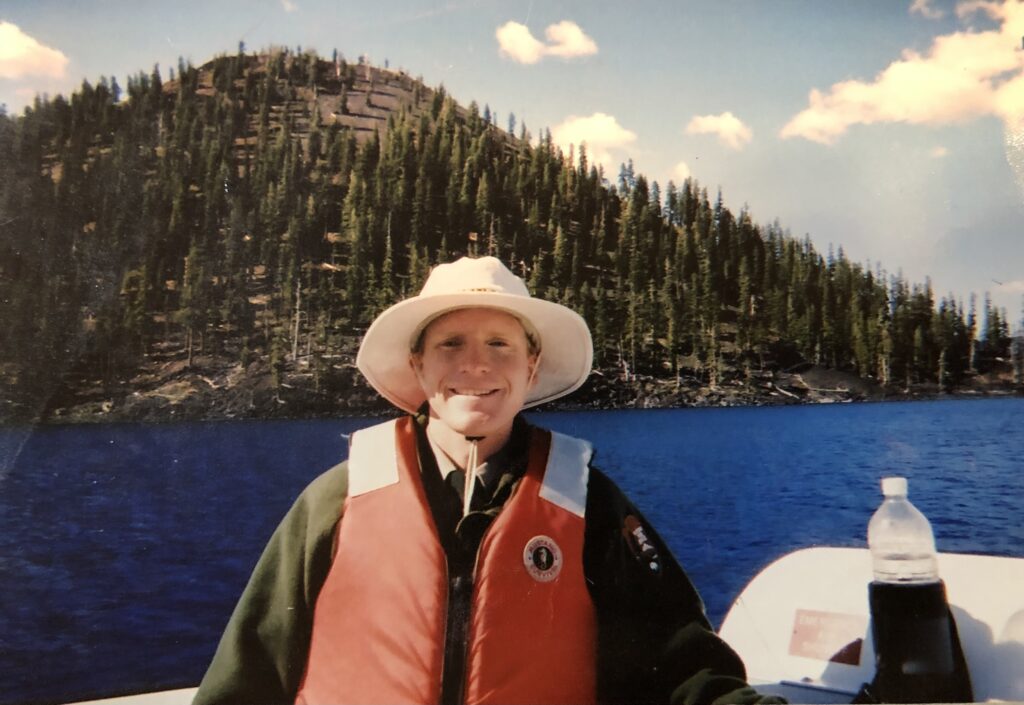
In recent years, states with Republican dominated legislatures have passed laws to reverse workers’ protections, ban abortions, loosen gun control laws, suppress voter turnout, and allow for heavily gerrymandered districts to keep themselves in power against the will of the voters.
Why is this happening? According to David Pepper, “Too few people, including those in politics, understand the immense power–the potential for both good and ill–in our nation’s statehouses.” He went on to say, “If the average voter doesn’t know or care what state reps do and can do, but insiders and interests know exactly what they do and can do, that’s dangerous. And a huge vulnerability to the common good.” (his emphasis)
David Pepper then explains the overlooked importance of state legislatures. They distribute federal funding to local communities and citizens. Local governments must operate within the defined powers given to the by the state legislatures. State legislatures write the laws the defines the parameters and duties as well as the laws that must be followed by statewide office holders, such as the Governor, Attorney General, Secretary of State, State Treasurer, etc. They hold the power over how federal, state, and even local elections are administered in the state. They draw Congressional and legislative districts after the U.S. Census is held every 10 years. Oh, and they set the state budget, among their other powers.
The people who are elected as your state legislators matter. Even more, the party that controls your state legislative chambers matter. It is important to know if they are passing effective bills for climate action. If your legislators are, thank them. If they are not, call their offices, email them, write a letter, or attend their town halls to urge them to support strong climate legislation. If they refuse or ignore you, support their opponent in the next election. If they don’t have an opponent, run for office. It is jaw dropping how many state legislative races and even local election races go uncontested with just one candidate running.
When your legislators hold public hearings on good or bad legislation that impacts the environment and the climate, show up to give public testimony. I have given oral testimony to legislative committees numerous times. I enjoyed testifying to look legislators to tell my story why they should support or reject a specific bill. It is a very empowering experience.
Even more, your legislators might hold bogus hearings on oversight and accountability. While they hold that hearing, they could be refusing to perform their required job duties such as showing up on the chamber floor to vote on vital legislation. If they do that, like what recently happened in Oregon, make sure you show up and SPEAK TRUTH TO POWER!
Brian Ettling with his Earth Ball in Portland, Oregon. Photo taken August 22, 2018.
Brian Ettling standing on the summit of the Watchman Peak when he worked as a seasonal park ranger at Crater Lake National Park on September 10, 2013.
“A man or woman could hardly ask for a better way to make a living than as a seasonal ranger for the National Park Service.” – American environmentalist author Edward Abbey from his 1973 book Cactus Country
From 1996 to 2017, I proudly worked as a seasonal park ranger in the national parks. When I write about my life, I mostly simplify to say that I worked as a park ranger at Crater Lake National Park, Oregon and Everglades National Park, Florida from 1992 to 2017.
Upon graduating from William Jewell College with a Business Administration degree in 1992, I knew that I did not want to office cubical or for a large corporation in my work career. The idea of making money just to make money just never appealed to me. My desire was to get the most out of life, see as much of the world as I could, while living in beautiful and scenic locations.
My first seasonal summer jobs working at Crater Lake National Park, Oregon 1992-2005
I arrived at Crater Lake National Park on May 20, 1992, to work in the Rim Village gift store for the summer. With the deep cobalt blue color of the lake and the glistening snowcapped mountains surrounding it, I felt like I found my new home. I enjoyed hiking up the mountain peak trails to get a bird’s eye view of the area and the satisfaction of the exercise it took to reach the mountain summits. I loved how quiet the park was during the day, except for an occasional airplane flying overhead. You could hear the wind whispering through the trees. The sunsets over the lower western Cascade Mountains on a clear night were not to be missed. The sky over Crater Lake were so dark on a moonless night that I had never seen the Milky way as clear or so many stars in the sky.
I loved my summers at Crater Lake. I spent the summers of 1992-94 working in the Crater Lake gift store. The General Manager of the Crater Lake concessionaire talked me into working the night auditor position at the rehabilitated Crater Lake Lodge during the grand re-opening summer of 1995. I quickly discovered that working graveyard shifts was not my cup of tea. I was sleeping during the daytime beauty of Crater Lake.
In 1996, the National Park Service (NPS) hired me to be an Entrance Station ranger at Crater Lake. I wore the ranger uniform with pride as I welcomed visitors to Crater Lake and charged them the $5 entrance fee. I was working in a tiny entrance station booth, which was more like a box. The park entrance road was surrounded by the tall skinny lodgepole pine trees. Except for the stream of vehicle traffic in the summer, it felt like I was working in the woods.
For the summer of 1997, it was soul satisfying to return to this Crater Lake entrance station ranger job. That summer NPS changed the job title to Visitor Use Assistant. I did not care what they called me. I was delighted to spend my summers at Crater Lake. I typically worked at Crater Lake from early May into sometime in October. I skipped the summers of 1998-2001 to work year-round as a natural guide in the Everglades. I returned to work summers at the Crater Lake entrance stations from 2002 to 2005.
Brian Ettling at Crater Lake National Park. Photo taken on November 3, 1992.
My first seasonal winter jobs working in Everglades National Park, Florida 1992-1995
The weak point of the Crater Lake jobs was that they were only temporary summer jobs. Thus, I had to find another seasonal job for the winter in those months to mark time before returning to Crater Lake for the summer. Fortunately, the peak season for Everglades National Park visitation in Florida was from late November to early April. I arrived at the Flamingo Outpost in Everglades National Park in December 1992. My first job was working in housekeeping. I then transferred to a Front Desk job at the Flamingo Lodge.
Unlike Crater Lake, I was disappointed with my first views of the Everglades. The sawgrass prairie, which made up much of the park, looked as flat as the eye could see. It looked like a Midwest farm field, not at all like the iconic western national parks with towering mountains. The only high features in the Everglades were the lofty clouds that I had to imagine they were as high and dominating as the Rocky Mountains, Cascades or Sierra Nevada Mountain ranges.
My seasonal housing unit looked out into the subtropical Florida Bay, which made up the lower third of Everglades National Park. Numerous mangrove islands dotted the shallow Florida Bay. In the western part of the bay, the water blended into the Gulf of Mexico. As a child growing up in the landlocked St. Louis, Missouri, I dreamed of living close to the ocean to see that horizon line where the ocean met the sky with no land to interfere. Flamingo was probably the cheapest place in Florida to live next to the ocean, even if Florida Bay was considered an estuary, a place where inland freshwater met and mixed with seawater from the ocean.
It felt very tranquil to live by so much water. Surrounding our housing area and Flamingo were subtropical mangrove trees living in the shallow waters and coconut palms stood by the higher solid grounds of the buildings. The Everglades had a fascinating variety of wildlife with alligators, crocodiles, dolphins, manatees, deer, raccoons, and a wide variety of colorful wading birds. November to April is the dry season in the Everglades where it rains occasionally and is most sunny most of the time. The high temperature from December to April is in the upper 70s to lower 80s. South Florida is a fun place to comfortably wear shorts in the depths of winter.
To mark time until I could return to Crater Lake, I made the best out of working winters in the Everglades. I skipped two winters in 1993-94 and 1994-95 to spend time with family in St. Louis. I returned to Flamingo in the winter of 1995-96 to work as a night auditor at the lodge front desk. I thought I would use my Business Administration college degree to do this accounting job to balance the daily receipts at the lodge. Like my 1995 summer at Crater Lake, I was a glutton for punishment working this overnight job. It was stressful to complete all the office work in time. The computers were finicky and glitchy with no one around to assist if I ran into technical issues. It was a brutal sleep schedule and hard on my dating relationship at that time. I vowed to never do that job again.
Brian Ettling in Everglades National Park, Florida. Photo taken in mid April 1993.
Working as an Everglades naturalist boat tour guide 1998-2002
I skipped working in the Everglades in 1996 to 1997 to visit family in St. Louis. It was good to be home that winter because to be at the hospital hours after my oldest niece and goddaughter, Rachel was born. When I returned to Everglades National Park in November 1997, I worked front desk at the Flamingo Lodge. In early January 1998, a naturalist guide position opened to narrate the boat tours in Flamingo. I applied for the position and started in late January 1998.
In the summers of 1992-1994 at Crater Lake, I volunteered to lead church services at the campground amphitheater on Sunday mornings for A Christian Ministries in the National Parks (ACMNP). I grew up as a church going Christian, plus I was influenced by my maternal grandfather, Arthur Johnson Sr, who was a charismatic Baptist Minister. Since I was a child, I enjoyed giving speeches at school. ACMNP recruited me while I was in college to volunteer for them leading church services in a national park and they would find a job for me. They found my first gift store job at Crater Lake in the summer of 1992 and my housekeeping job working in Flamingo in the winter of 1992. Thus, I was an ACMNP volunteer in Everglades National Park during the winter of 1992-93.
I liked the opportunity to do public speaking leading the church services. It was extra responsiblies while working full time in the national parks. The good news was that it was typically a new group of visitors attending each weekend. I could recycle my sermons and not necessarily come up with a new talk every weekend. As I worked in the national parks, I knew that I eventually wanted to become an interpretive park ranger. They lead the public ranger talks, guided hikes, guided canoe trips, narrating boat tours, presenting evening campfire programs, etc. They looked like they had the most fun of any job working in the national parks. Flamingo had the tradition of the ACMNP volunteer leading the sunrise Christmas and Easter boat trip each year.
Everglades did not have an ACMNP volunteer to lead the Christmas morning sunrise tour in December 1997. I volunteered to lead the service. The service went exceptionally well. We had over 40 people on board the boat that held over 97 people. It was an astonishing sunrise over Florida Bay. I spoke briefly on the meaning of Christmas before we experienced a captivating sunrise. Leading that service helped me land the concession naturalist job. The lead naturalist, Rob Parenti, was on board that board that morning as the first mate to assist the boat captain. He saw me in action. Rob noticed I was very comfortable with public speaking. He joked after I got the Flamingo boat tour naturalist guide job that he knew I would be a good fit because he could tell that “I liked to talk a lot.”
This naturalist boat tour guide job was my first time talking full time for a living. I loved that job at the time. I narrated two different boat tours, one into the more open waters of Florida Bay and the other boat tour up the Buttonwood Canal into the backcountry waters of the Everglades. I pointed out alligators, crocodiles, manatees, dolphins, and various wading birds to the boat passengers. It was fun to learn about the history of the Everglades, the Native Americans, and the outlaws that settled in the Everglades.
It was great to talk about how and why the Everglades became a national park in 1947. Unlike western national parks which were protected for their dramatic scenery, the Everglades National Park was the first national park in the world protected for its biodiversity. Florida conservationists wanted it protected because of its wide diversity of plants and animals.
“There are no other Everglades in the world. They are, they have always been, one of the unique regions of the earth, remote, never wholly known…The miracle of the light pours over the green and brown expanse of saw grass and of water, shining and slow-moving below, the grass and water that is the meaning and the central fact of the Everglades of Florida. It is a river of grass.”
I shared that quote and others from Marjory Stoneman Douglas during my boat tour narrations. She lived to 108 years old. She passed away in May 1998, just months after I became an Everglades naturalist guide. It felt like her torch moved on to me and others in my generation to cherish and protect the Everglades. When possible, I made sure park visitors knew about her during my interactions.
Most of all, this job gave me a great opportunity to talk about the importance of saving the Everglades, our precious environment, and our planet from the harm caused by humans. In most of my programs, I talked about how the Everglades was one of the most threatened national parks in the United States due to over development and over drainage. In December 2000, Congress passed and President Bill Clinton signed a multi-billion-dollar plan to try to save the Everglades.
I ended most of these narrations with a famous quote incorrectly attributed to Marjory Stoneman Douglas to this day. In fact, a lesser-known Everglades activist named Joe Podgor gave Marjory the iconic quote: “The Everglades is Test. — If We Pass, We May Get To Keep The Planet.”
Brian Ettling narrating a boat tour in Everglades National Park. Photo taken around 1998-2002.
At that time, I felt like I was doing what I could to save the planet by narrating those boat tours. I hoped I planted some seeds to inspire some individuals, especially younger individuals on these boat tours, to become environmentalists.
Working as an Everglades City winter seasonal interpretation ranger 2003-2007
By the spring of 2002, I was burned out narrating the Flamingo boat tours. I was tired of fighting with boat captains. I had enough their giant egos who were not interested in providing quality customer service and working as a team with me to provide a lifetime experience with the passengers. I detested the 10-hour days in the winter leading up to 4 two-hour tours. It was too much talking for me and started to strain my vocal cords. I became so concerned that I went to see a doctor about that. I had lost faith in the Flamingo management that did not care for my well being and low pay with the long hours and impacts on my health.
On top of all that, I missed Crater Lake National Park and the western part of the United States. I was tired how flat south Florida was. I wanted to see hills and snowcapped mountains again. Fortunately, my friend Amelia Bruno, who oversaw the Entrance Station fee program at Crater Lake, offered me my old seasonal job back of working at the entrance station. Just a few months before, I bought my first car a green (my favorite color) 2002 manual transmission Honda Civic, which I still own to this day. I wanted to go for a long cross drive in my new car.
I never worked at Flamingo again. I had a wonderful summer at Crater Lake. It was a superb summer for me to return because the park was celebrating its centennial. Congress passed a bill establishing the national park and President Theodore Roosevelt signed it into law on May 22, 1902. It was great to make new friends working in the park since I was gone for four years. It was a joy to rediscover all the trails in the park that I enjoyed hiking.
The stressful part was I did not know what I was going to do for the winter of 2002-03. I ended up going back to St. Louis to stay with my parents. I returned to the entrance station ranger job the next summer. In the summer of 2003, I had a new housemate at Crater Lake, David Grimes. He had worked seasonally in other national parks such as Congaree Swamp in South Carolina and Zion National Park. We struck up a friendship. We both applied to work as seasonal interpretation rangers in Everglades National Park that winter.
As summer turned to fall, Grimes (as he likes his friends to call him) accepted a winter seasonal position in the Everglades City district in Everglades National Park. Unfortunately, I received no word for a winter position in the Everglades. I decided to return to St. Louis for the winter, not sure what I planned to do after I returned there.
In late November, I received a phone call from Candice Tinkler, the District Supervisor Ranger at the Everglades City Visitor Center. Someone she hired for the winter declined to work there. She needed to hire a new ranger fast. She saw my name on a list of eligible candidates. Grimes highly recommended me, so she called to offer me an interpretative ranger position for the winter. She needed me to come down fast, within a week if possible. I started throwing my ranger uniforms and other belongs in the car to drive from St. Louis to Everglades City, Florida. I left shortly after Thanksgiving and arrived during the first week in December.
Brian Ettling leading a ranger led canoe trip in Everglades National Park around 2006.
This was my first National Park Service interpretative ranger job. After my four years as a naturalist guide in Flamingo, this new ranger position was a ideal fit for me. I enjoyed narrating the boat tours in Everglades City, narrating the canoe trips, and giving ranger talks on the water drainage issues and the Everglades Restoration plan. I liked spending the winter in Everglades City and I ended up spending three more winters there from 2004 to 2007.
In subsequent winters working in Everglades City, I expanded to do additional ranger programs, such as guided bike tours and an evening program on the birds of the Everglades. At that time, I knew nothing about PowerPoint. Candace Tinkler left Everglades City in 2005 to work in Redwoods National Park. The new District Supervisor, Sue Reese, quickly taught me how to put together a PowerPoint presentation. I became quickly hooked on PowerPoint to create presentations. I am still enamored with PowerPoint to this day, as well as Mac Keynote since 2013, to create over 100 climate change talks since 2010.
Sue gave me an opportunity to be creative to make a temporary display in the visitor center honoring Marjory Stoneman Douglas with pictures, quotes, and brief information about her. She allowed me to create a wooden box with a mirror on the inside. The visitor center had a small display about the ecological damage and restoration plans for the Everglades. The wooden box hung by those displays. On the outside of the box, I printed out a sign, “Look inside at the person most responsible to save the Everglades.”
When the visitor opened the box, they would see a reflection of themselves. The other rangers and park visitors got a good laugh out of my display. I doubt that box with that message is still there today. However, I loved the message I conveyed that each of us is responsible for saving the Everglades, the environment, and the planet. No excuses.
Brian Ettling giving a ranger talk in Everglades City in the spring of 2004.
My first seasons as an Interpretative Ranger at Crater Lake National Park 2006-07
I delighted as a winter seasonal interpretative ranger in Everglades City from 2003 to 2007. During those winters, I became eager to become a summer interpretative ranger at Crater Lake National Park. I applied to be a summer interpretative ranger at Crater Lake in 2005. However, Martha Hess, the Interpretative Supervisor Ranger at Crater Lake, decided that I was better suited to stay as an Entrance Station Ranger. I felt dismayed when she shared that with me. However, I was not discouraged. I applied the next winter and Martha called me in May 2006 offer me a summer season interpretative ranger position at Crater Lake. I dreamed for several years hoping to get this position. I felt ecstatic when she extended the job offer to me.
Like my previous winters working interpretation in Everglades National Park, I was overjoyed working as an interpretative ranger at Crater Lake National Park in the summers of 2006 and 2007. After many years of working other jobs at Crater Lake, I felt triumphant leading a lodge talk about the park founder William Gladstone Steel, giving a geology talk, and narrating the boat tours that summer. In late August, I had to debut a junior ranger program and an evening campfire program when other rangers left for the season to return to their teaching jobs.
I loved using PowerPoint, but I found it stressful to pull together an evening program while working full time without much office time to craft it. I pulled a couple of all-nighters without much sleep, and I presented a new evening on the birds of Crater Lake at the campground amphitheater in late August 2006. It was a huge relieve to have this ranger program completed. Most Crater Lake rangers are required to debut their evening program in their second season at Crater Lake. However, Crater Lake was short of rangers to give evening programs in August 2006. Thus, I was required to present an evening campfire program my first summer.
I received good audience responses from my Birds of Crater Lake evening program. It soon became my favorite ranger talk. I loved making the campfire and interacting with the large audience of visitors before, during and after my evening ranger program. When I returned to Crater Lake for 2007, I was eager to give this talk. After I had created this program, I was thankful Grimes pushed me hard to debut it in 2006. Otherwise, like most Crater Lake interpretive rangers, I would have spent the winter worried about constructing this program.
Ranger Brian Ettling giving his evening campground program at the Mazama Campground Amphitheater at Crater Lake National Park on July 8, 2015.
The lead interpretative ranger, David Grimes, was impressed with my Lodge talk I put together about the founder of Crater Lake National Park, William Gladstone Steel. He thought we should videotape my talk. We would then submit the video to the NPS Interpretative Office as Harper’s Ferry to see if they would certify this program. We filmed my talk in August 2006. I waited that winter to see if the NPS Office certified this talk.
When I returned to Crater Lake in June 2007, I received the good news announced during seasonal training that they certified my talk. Twelve years later, I uploaded this video to YouTube so you can see this talk. Learning about William Gladstone Steel when I assembled this talk had a big influence on my life. I wrote about him earlier this year, The historical person who inspired me to be a Climate Lobbyist.
In 2007, I had a terrific summer as an interpretative ranger at Crater Lake. I worked hard the previous summer to create all my ranger programs. Thus, I could enjoy my free time more in early July knowing that my ranger talks were ready from the previous summer. I just had to review my notes for all these programs. I felt like I improved each time I gave these ranger programs. It was a terrific summer, but then tragedy struck.
The tragedy of losing my Everglades and Crater Lake mentor, Steve Robinson
In August 2007, we received news that fellow Crater Lake ranger Steve Robinson had pancreatic cancer. It was stage 4 and incurable. I knew Steve since I attended his ranger evening program in Flamingo in Everglades National Park in February 1993. When I returned to Crater Lake National Park for the summer, he narrated the boat tour I traveled on as a passenger in July 1993. I discovered that Steve and his wife Amelia Bruno were seasonal park rangers like me that spent their winters in Flamingo and their summers at Crater Lake.
In the years that followed, I stuck up a friendship with Steve and Amelia. He became a mentor to me how to be a good ranger, human being, and a man. When I worked in Flamingo and Crater Lake, I came to Steve and Amelia’s house to spend hours with Steve to learn his wisdom.
I learned a lot from Steve trying to absorb his wisdom. At that time, I wrote down inspiration quotes from to pin on my bedroom bulletin board. Steve was an optimist who would respond to cynicism, “Just because it has not happened yet does not mean it can never happen.”
Steve was a fourth generation Floridian who had a deep love for the Everglades and natural world. For 25 years, he worked as a seasonal park ranger in Everglades National Park. Steve had the good fortunate to meet the ‘Mother of the Everglades’ Marjory Stoneman Douglas one time when he worked as a ranger. He happened to see her at one of the scenic overlooks in the park and struck up a brief conversation with her when they were both admiring a scenery. Steve loved to quote Marjory and share her stories.
Steve had the gift of connecting with park visitors and people caught up in momentary short term, knee jerk, superficial thinking. One time, Steve told me, “My goal in life is to remove the rocks that other people’s paths.”
Everglades and Crater Lake National Park Ranger Steve Robinson (1950-2007)
Steve had great stories to try to shift other people’s perspective. At the start of my March 8, 2012 blog and March 2012 Toastmasters speech, I shared this story about Steve. In his spare time as a seasonal ranger in the Everglades, Steve would drive up to a scenic overlook in the park known as Pa-hay-okee. He loved to sit there and look over the beautiful scene of a saw grass prairie stretching out to the horizon as far as the eye could see. One occasion, when he was there for a time, a park visitor drove his car up to the nearby parking lot. The visitor grabbed his camera from the car and quickly ran to the overlook. When he got there, the visitor felt disappointed in the lack of action and the flatness of the plain saw grass vista. He mumbled, “Nothing.”
Steve smiled at him. He looked at the sawgrass prairie, stretched out his arms, and proclaimed “Everything.”
The last several summers that Steve worked at Crater Lake National Park, he worked at the Watchman Peak Fire Lookout. He would scan for wildfires. In addition, he relished the opportunities to engage with park visitors who hiked the trail, which was less than a mile long with over an elevation gain of 420 feet. The view at the summit provided one of the best panoramic views of Crater Lake and the surrounding area. Visitors often were flabbergasted on the summit, unsure of what to say with this 360 bird’s eye of view of the area. One visitor commented to Steve, “Looks like I reached the end.”
Steve was amused by the statement. He responded, “No, you reached the beginning.”
Steve and I laughed at this story because I could totally relate. As a park ranger and avid hiker, I observed that visitors often did not know what to do when they reached a mountain summit. Some look disappointed or restless because they hoped for something more. Others would quickly enjoy the view, but then they hurry down eager to get to their next destination or point of interest at Crater Lake. They use a mountain summit to like a mental check list of something that they conquered and then they wanted to move onto their next goal.
Steve and I both looked at a mountain summit as a place for deep reflection. A place to truly enjoy the view. It’s a spot to truly ponder life and our place in the world. A location to bring a lunch, meditate, read a book, and observe the world. With patience, one might see a bird soaring or other wildlife. It’s a great place to people watch or even start up a conversation with a stranger, as Steve liked to do there. Steve and I both thought of a mountain summit as the beginning, not an end. It’s a place for renewal and to reflect upon our lives.
One of the pearls of wisdom that Steve gave to me was, “Every single person makes the world every single day.”
A mountain summit can be an ideal spot to contemplate that.
View at dusk from the summit of Watchman’s Peak at Crater Lake National Park on August 19, 2013. Photo by Brian Ettling
In August 2007, I assumed I had years to absorb Steve’s knowledge. It shocked me when I learned he had stage 4 pancreatic cancer, one of the deadliest and aggressive forms of cancer. I visited Steve often in the hospital as his health deteriorated. During my hospital visits, he was too weak and on too many medications to talk. Sadly, Steve passed away on October 1, 2007.
I was in a daze for a year after Steve’s death. His mortality made me re-exam my own life. Steve’s quick passing at the age of 57 years old showed me that tomorrow and a long life is not guaranteed. Steve truly made the most of his life as a park ranger, musician, husband, father, friend to many, someone who loved all people, and a mentor to me. He loved life and lived everyday like it was a gift to be alive. After Steve’s death, I felt lost no longer having my mentor around. I needed to do something different with my life to overcome the loss, make the most of my life. I wanted somehow be beneficial to the world as Steve was when he was alive.
Transitioning away from spending my winters in Everglades National Park 2007-08
In early September, around the same time that my mentor Steve was tragically losing his battle to pancreatic cancer, I received an email from my Everglades City District Supervisor Sue Reece. She told me that she would be happy for me to return to Everglades City for the winter. However, she had an opening for a winter seasonal ranger in the Shark Valley area in Everglades National Park. She thought I could be a good fit to work there. The Supervisor Ranger at Shark Valley at that time, Maria Thomson told Sue, ‘I want a good seasonal interpretative ranger to work at Shark Valley this winter. Someone who cares about the Everglades and can relay that to visitors. Someone like Brian Ettling.’
With Steve’s prospects of recovering from pancreatic cancer looking dim in September 2007, I needed some good news. It was heartwarming to hear that I was needed in Shark Valley. Therefore, I decided to work at that location in Everglades National Park for the winter. I would be narrating the tram tours, giving a short ranger talk, leading bicycle tours, and possibly providing a guided bird walk. This looked like a good opportunity to try a new location in the Everglades. Maria hoped I would work there. I had an opportunity to make a difference there.
When I arrived in Shark Valley in November 2007, it did not feel like a good fit for me. I had a housemate with a very surly personality. I missed my friends in Everglades City and other parts of the park. I felt like I was living in the middle of nowhere off of Hwy 41, the Tamaimi Trail. The park housing was just a few miles west of Shark Valley, but it felt very isolating there. I could not sleep at night, and I fell into a very bad depression. I wanted to leave the Everglades, but I did not know where I wanted to go.
In my sleeplessness, depression, and restlessness, I found my life’s purpose. I wanted to carry forth my mentor Steve’s message of protecting our Earth and environment since he could no longer share that vision with others.
I recalled 1998 when I started giving ranger talks in Everglades National Park. Visitors then asked me about this global warming thing. Visitors hate when park rangers tell you, “I don’t know.” Visitors expect park rangers to know everything. Don’t you?
Soon afterwards, I rushed to the nearest Miami bookstore and to the park library to read all I the scientific books I could find on climate change.
The information I learned really scared me, specifically sea level rise along our mangrove coastline in Everglades National Park. Sea level rose 8 inches in the 20th century, four times more than it had risen in previous centuries for the past three thousand years. Because of climate change, sea level is now expected to rise at least three feet in Everglades National Park by the end of the 21st century. The sea would swallow up most of the park and nearby Miami since the highest point of the park road is three feet above sea level.
It shocked me that crocodiles, alligators, and Flamingos I enjoyed seeing in the Everglades could all lose this ideal coastal habitat because of sea level rinse enhanced by climate change.
A photo by Brian Ettling of the wild Flamingos in Everglades National Park. Photo taken in 1999
By the winter of 2007-08, I had read a number of books on climate change. I saw the documentary film about Al Gore, An Inconvenient Truth, and read the companion book in 2006. I knew I needed to do something on climate change, but I did not know what. I was very clear though that I was not going to find the answer by continuing to work winters in the Everglades. It was time for me to move on with my life. In the winter of 2007-08, I was burned out of the south Florida climate, flatness, and the long cross country drive to spend the winter in the Everglades. Even worse, as a single man, it seemed like I was not going to find a wife there.
I said goodbye to the Everglades at the end of April 2008. I decided I would spend my winters in my hometown of St. Louis Missouri to organize for climate action. I had no idea how I was going to do that, but I was excited I found my life’s purpose.
Creating a Guided Ranger Hike in Summer of 2008 using my wisdom and Steve Robinson’s
In late May of 2008, I returned to work at Crater Lake National Park for the summer. Soon after I arrived in the park, I mentioned to my superiors that I wanted to give a ranger program about climate change. My Crater Lake supervisor, Eric Anderson, and the lead interpretive ranger, David Grimes, supported and encouraged my idea. I just did not feel like I knew enough or was brave enough to do such a program. It would take me three more years before I felt courageous and had enough knowledge to give my climate change evening program at Crater Lake.
For the summer of 2008, David Grimes announced in early June that we had a large enough staff for the first time in years to lead ranger guided hikes up the Watchman Peak. Standing barely over 8,000 feet tall, the Watchman Peak is located on the western side of the Crater Lake rim. It receives the deepest snow accumulation in the park with snow drifts up to 50 feet thick. In some years, the West Rim Drive does open for the season until late June. This is due to the time it takes for the road snow removal crew to plow the tremendous amount of snow on the West Rim Drive, especially around the Watchman Peak.
After West Rim Drive opens sometime in June, it takes another month for the snow to melt back for the trail to the Watchman Peak summit to open. Thus, the ranger guided hikes would not start until the end of July. The summer of 2008 would be my first opportunity to lead a ranger guided Watchman Peak hike. I had several months to prepare. Ranger David Grimes allowed me to shadow one of his first hikes for the season at the end of July. I would then have about a week to prepare for my own Watchman Hike in early August 2008.
Park visitors on the summit of Watchman Peak. Photo taken by Brian Ettling on August 2, 2017.
After I saw Ranger Grimes’ hike, I had ideas how I would create my own guided ranger hike up the Watchman’s Peak. I wanted to give the visitors on my hike a “mountain top experience” using the wisdom I had accumulated as a person, a park ranger, and the advice I received from my mentor Steve Robinson. When visitors went on guided hikes, I used to ask them as a park ranger, ‘Why are you going on this ranger hike?’
Visitors often replied, ‘Because I want to learn something. I don’t feel like I know anything about this national park or trail. I feel like the ranger can share something that I did not know.’
Thus, I determined to construct my hike around the visitor longing to learn something insightful from the ranger. I thought I would even give them something to take home with them for their next hike when I was not with them.
I decided to give each person attending my hike a pocket-sized card to take home with them called “Ranger Brian’s Wisdom.” I would present it to them at the conclusion of my hike. It would be at my last narrated stop, which was a short distance before the Watchman summit and the fire lookout. A tip that you quickly learn as a national park ranger or naturalist guide: don’t talk during a sunset or sunrise. The audience will be absorbed in the moment taking pictures and watching the sun move on the horizon line. They won’t hear a word that you are saying.
I timed my talk so that I would give my gift 10 minutes before the sunset. If I tried to give my conclusion and my pocket-sized card less than 10 minutes from the sunset, the park visitors on my hike would skip my final stop to go to the fire lookout to watch the sunset.
At the introduction of my guided hike, I told my audience that the trail is always open. They are more than welcome to walk past me to hike to the summit. I don’t want to hold them back if they are anxious to see the view from the fire lookout and worried that they might miss the sunset. I assured them that I will be watching the time closely so that we will be at the summit in plenty of time to see the sunset. However, I warned them that if they blew past me to get to the summit, they would not receive my free gift right below the fire lookout.
Like kids waiting for gifts on Christmas morning, the visitors were anxious to know what gift I would have for them. They would even ask me during the introduction: “What’s the gift?”
I would coyly answer: “You will have to stay with me to find out.”
Giving out these pocket-sized gifts became very rewarding for me. I used these cards in May 2011 a Toastmasters speech I gave when I was a member of South County Toastmasters. This speech was a success with this Toastmasters group. I joined this club in February 2011. It was my third speech to the club. The members voted for me as “Best Speaker” for the first time in the three speeches I gave to the group. A fellow Toastmaster filmed most of this speech which I uploaded to YouTube five years ago.
Image of Brian Ettling’s pocket sized card that he gave to visitors as a gift at the conclusion of his ranger guided sunset hike on Watchman Peak 2008-2017.
The Significance of the words of “Ranger Brian’s Wisdom”
Steve Robinson passed away just one year previously on October 1, 2007. I started giving my Watchman sunset ranger guided hike in mid-August 2008. It was less than a year since I lost my mentor and friend. He was very much on my mind as I wrote out these words.
I remember Steve remarking, “For Every Question, There Is Not Necessarily an Answer. Yield to the Mysteries of Nature.”
As a park ranger, visitors wanted me to have answers to all their questions. Sometimes there were no answers to some of their questions. The visitors would occasionally give me a frustrated look if I could not answer a question about Crater Lake, the Everglades, the wildlife, the age of specific tree, etc. I never wanted to lie or mislead visitors when I did not know the answer. In fact, there is beauty in the unknown. One can find joy in researching and finding a scientific answer to question. Or better yet, conducting research to answer a scientific question that has not been answered yet.
As far as my second three lines, “Take Time to Enjoy the View and Smell the Roses. Find your Own Sacred Place.”
That might have been a synergy of thought between Steve Robinson and me. I was frequently dumbfounded as a park ranger seeing how rushed people were on a vacation to visit Crater Lake and the Everglades. I often wondered, ‘Are they really enjoying themselves?’
Even more, it astonished me how park visitors would tell me they were on a mission to see all the national parks. To those visitors, I would sometimes respond, ‘Don’t miss the good stuff in between the national parks.’ Or ‘After you see all the national parks, what are you going to do?’
I loved working and living as a summer seasonal park ranger at Crater Lake for 25 years and a winter seasonal ranger in Everglades National Park for 16 years. In between seasons, I cherished visiting Yellowstone, Yosemite, Grand Canyon, Arches, Sequoia, Mt. Rainier, North Cascades, Olympic, Death Valley, and other national parks multiple times. I never had the mindset of ‘one and done’ with visiting a national park. I wanted to see the parks that I visited again and again.
Steve and I had many conversations about visitors who seemed to have mental checklists to visit as many national parks as possible and the sights within a national park once. With “Ranger Brian’s Wisdom,” I wanted to slip in a message to “Find your own sacred place.” Even more, it’s good to visit your happy place multiple times.
This was one of Steve Robinson’s favorite observations: “If Nature is Your Hobby, You Will Never Be Bored. You Can Never Step in the Same Stream Twice.”
If one hung around Steve long enough, he would share this deeply held belief he had. He then would give stories of wildlife, weather patterns, and situations he encountered in nature. He was a master storyteller of his interactions in the outdoors.
When given a chance, Steve loved to preach this thought when he had an audience: “There Are Things We Love, Things We Hate, And Things to Which We are Indifferent. However, In Nature, Everything Matters.”
When park visitors and friends would chat with Steve, they would assert that they hated snakes, mosquitoes, insects, wildfires, cold weather, etc. Steve would then get a twinkle in his eye and a charming smile behind his long beard. He would then find a way to politely counter that we might not like those parts of nature. It’s not necessarily his favorite things in the outdoors. However, Steve would point out that the things that we don’t like in nature that are not cute, fuzzy, adorable, and majestic are still a vital part of nature.
This was Steve’s quote, “Every Single Person Makes the World Every Single Day.”
It was an inspiring statement that had a deep impact on me when it heard Steve say it. I matter. You matter. Everyone matters. Every action we take every single day makes a difference in the world. That goodness I received from Steve’s gem of wisdom stays with me to this day..
Finally, I originated the line, “Think Globally, Act Daily.”
Decades ago, I saw that bumper sticker on cars “Think Globally, Act Locally.” My reaction was, ‘That’s nice, but some days I don’t want to act locally. However, I can act daily for the environment, our planet, and for our local neighborhood.’
Brian Ettling at Crater Lake National Park. May 2016.
I loved creating Ranger Brian’s Wisdom. I must have given way several hundred of these cards over the years. I laminated them so they would last longer. I always trimmed off the sharp edges with scissors at the Crater Lake interpretative work room, so visitors would not get paper cuts from handling these cards. Hopefully, these cards have planted some seeds to influence people to care for our parks, the environment, and our planet.
Videotaping my ranger guided Watchman Peak sunset hike
The visitors and David Grimes responded positively to my ranger guided Watchman Peak sunset hike. Grimes scheduled another seasonal ranger, Terra Kemper, to video this hike in September 2008. Like what occurred with my lodge talk in 2006, we submitted the video to the NPS Interpretative Office as Harper’s Ferry to see if they would certify this program.
When I returned to Crater Lake in June 2009, I received the good news announced during seasonal training that the NPS did certify my talk. Nine years later, I uploaded this video to YouTube so you can watch this talk.
I initially inserted the YouTube written transcript into this blog of my ranger guided Watchman Peak sunset hike, but it doubled the length of this blog. Thus, I decided against it. Hopefully, you will take the time to see the video or read the transcript on YouTube.
Final Thoughts
American author and environmentalist John Muir wrote, “In every walk with Nature one receives far more than he seeks.”
My favorite memories as a child were exploring the woods by my parents’ house and hiking in nature by myself during family camping trips. I intuitively lived by the John Muir quote about the fulfillment I received from spending time in nature without an awareness of John Muir or this quote. I did not know about John Muir until I started working in the national parks.
In fact, you can sum up my life in this nutshell: I loved spending time in nature as a child. My first job out of college was working in the national parks so I could be close to nature. As I spent time in the national parks, I wanted to be a park ranger so I could educate others about the national parks and our natural world. As a national park ranger, visitors expected me to be knowledgeable about climate change. As I became informed about climate change, I decided to transition from a park ranger to a climate change organizer. As climate change organizer, I am now deeply concerned about the state of American democracy.
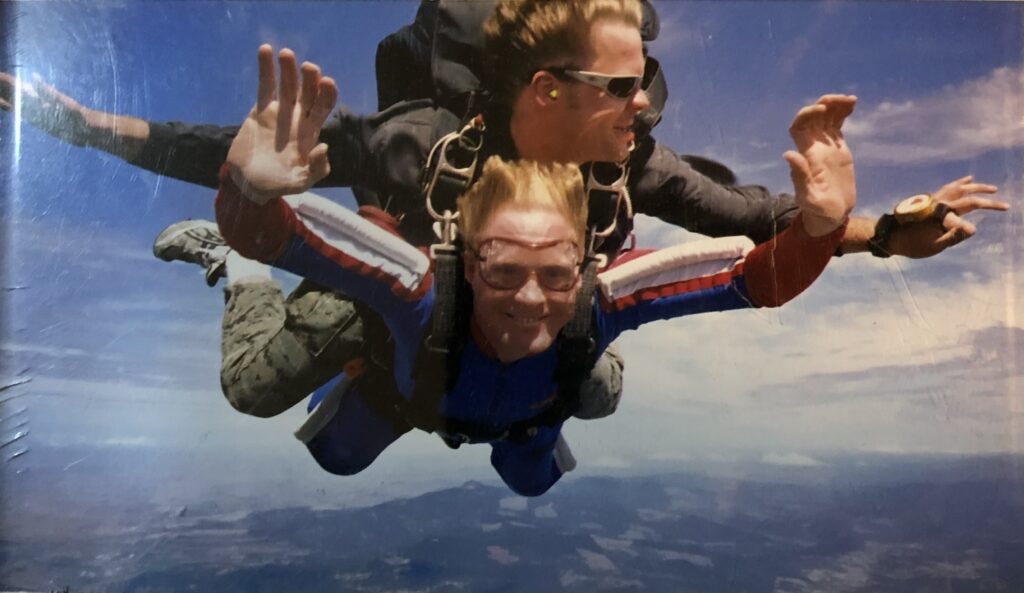
As I wrote this blog, I stumbled across another John Muir quote, “Between every two pine trees there is a door leading to a new way of life.”
That’s what happened to me. I had no idea when I took a seasonal gift store clerk job at Crater Lake National Park in 1992 how much it would change my life. When I hiked between the pine trees there, it completely led to a new way of life for me. I hope that others that visit and work in national parks experience a life transformation.
Even more, I had a mentor seasonal Ranger Steve Robinson who looked like a cross between John Muir and Dr. Suess’ The Lorax who was willing to guide me. He showed me how to be a better man, park ranger and ultimately a climate advocate. He taught and showed me that all my actions and interactions with others matter. As Steve liked to say,
“Every single person makes the world every single day.”
Cover photo from the audio CD of Steve playing music. This CD was put together as a tribute after Steve passed away in October 2007. Watch this YouTube video that is a Life Celebration of Steve Robinson.
I am deeply proud of my 25 years as a seasonal park ranger at Crater Lake and Everglades National Parks. Every day was a blessing to work there. On my worst days living in the national parks, I dealt with situations such as feeling lonely, depressed, heartbroken after a relationship breakup, a bad encounters with park visitors, a demanding supervisor unhappy with my work performance, a difficult co-worker making an unhealthy work environment, and upper park or concession management creating toxic politics on the job. With all that, I might get very little sleep that night or subsequent nights. However, all I had to do was to walk outside. The serenity of the national parks renewed me with its peaceful energy embracing me and whispering, “You are going to be ok.”
It’s that energy of the natural world rejuvenating me as a park ranger that inspired me to become a climate change organizer to protect our planet.
Working in the national parks, over 97% of the visitors I met were good people who were happy to be there. They loved their families and partners deeply. They wanted to show their families, children, loved ones, and good friends some of the most beautiful scenic locations on the planet. They cared profoundly about nature, the environment, the outdoors, the national parks, and our world. It was park visitors who insisted I learn and care about climate change. For years, I was scared to talk about climate change, fearing I would receive arguments from park visitors. When I started giving climate change talks at Crater Lake in 2011, it was park visitors who were very supportive, enthusiastic, and encouraging me to keep speaking out on that topic.
John Muir noted, “Thousands of tired, nerve-shaken, over-civilized people are beginning to find out that going to the mountains is going home; that wildness is a necessity; and that mountain parks and reservations are useful not only as fountains of timber and irrigating rivers, but as fountains of life.”
Last month, on a weekend in September 2023, my wife, her parents, 8 of her Danish relatives, my in-law’s best friends, and I (14 of us total) visited Glacier National Park. It was one of the most magnificent places I saw in my life. I stopped working at Crater Lake National Park in 2017, six years ago. Yet, I felt like I was home when I went to Glacier. I could immediately relate to the John Muir quote that “going to the mountains is going home.”
Sadly, Glacier National Park had little visible signs of glaciers from areas that we traveled by car, boat, and foot. Like my experience working in the Everglades and Crater Lake, Glacier sent a very loud message to ‘Please take action to reduce the climate change threat.’
I understood this clear and loud message. I ensured others got the message with my two previous blogs about seeing climate change at Glacier National Park calls for climate action. Visiting national parks for a day or working in them for 25 years should change us as individuals.
Edward Abbey penned so splendidly, “A man or woman could hardly ask for a better way to make a living than as a seasonal ranger for the National Park Service.”
It truly was a gift to work and live in the national parks for 25 years as a ranger. I hope my experience and wisdom I gained from that experience can benefit others, such as you.
Brian Ettling standing on the summit of the Watchman Peak when he worked as a seasonal park ranger at Crater Lake National Park on September 10, 2013.
P.S. Should I have given more credit to Steve Robinson in “Ranger Brian’s Wisdom?
As I write this blog in October 2023, I am wrestling with the realization that half of the thoughts on my pocket sized card for “Ranger Brian’s Wisdom” came from Steve Robinson. My original thought was to call it, “Advice from a Ranger.” This title would have been more broad to allow for that the advice was a combination of Steve Robinson’s and mine. I used that title, “Advice from a Ranger” for my first couple of guided hikes on Watchman Peak in 2008.
I showed my “Advice From A Ranger” card to Steve’s widow, Amelia Bruno. She was touched I had written this to honor Steve as well as my own advice for park visitors. She immediately posted it on the bulletin board at her Crater Lake Fee Program Manager Office.
At that time, I was influenced by Ilan Shamir‘s Your True Nature collection that was sold at the Crater Lake Visitor Center gift stores and elsewhere. Ilan’s company is now called Advice for Life by Your True Nature. Ian’s story is that he was a former marketing businessman with 7UP and free-spirit backpacker. One day in 1999, Ilan walked by a tree in his Colorado neighborhood that he frequently noticed. This time he stopped at the tree and asked for advice. Ilan heard the tree say to him: “Stand tall and proud…Be content with your natural beauty… Go out on a limb!”
Ilan turned the tree’s wisdom into a poem, “Advice from a Tree,” He then included it in his book Poet Tree: The Wilderness I Am. In 2000, Ilan started the Your True Nature Company with the “Advice From a Tree” poster. Then came a bookmark, minibook, and postcard giving the tree’s advice. Then inspiration hit him to share the advice of the river, mountain, garden, and hummingbird. He went on to pen the advice of the bear, moose, owl, horse, dog, butterfly, etc. Ilan and his company now offers more than 50 different advice by animals, plants and natural places.
I shared my “Advice from a Ranger” card with Vickie Grieve, Executive Director at Crater Lake Natural History Association, which runs the Crater Lake Visitor Center gift store. Vickie was thrilled that Ilan’s “Advice from a Tree” and the other Your True Nature Advice items sold in the Visitor Center inspired me to write “Advice from a Ranger.” Vickie knew Ilan personally and she gave me his email address.
I emailed Ilan in early 2009 and I did hear back from him on March 9th. He wrote:
“Brian, Thanks so much for the Advice from a Ranger poem. I will show it around here in the office and be back in touch soon. Ilan”
The next day, I responded:
“Ilan, Thanks for the nice e-mail. I am always hoping that when I do a ranger program that I am making a difference and people might remember it months later. I enjoyed composing the Adviced from a Ranger. Half of it was inspired and is attributed to my mentor, Steve Robinson. He was a naturalist ranger at Crater Lake and Everglades National Park for over 25 years. Unfortunately, he passed away from cancer less than a year and a half ago. He used to love to share his thoughts and observations with me. The other half is just thoughts and observations from my time of being a ranger.”
Ilan replied: “Thanks Brian… for sharing about the creation of Advice from a Ranger. What are your thoughts on how you would like to see it used?”
I wrote: “As far as my thoughts for advice for a ranger. I am open to any suggestions you might have. I thought about selling them alongside your Advice poems. I would only want my poem to compliment, not compete against your poems. Your advice poem series certainly inspired me to create my Advice from a ranger. I had never heard of them until I saw Vickie Grieve selling them in the Crater Lake bookstores. Vickie seemed interested in selling my advice poem in the bookstore too when I first showed it to her last fall. However, we both wanted to seek out your input before we proceeded.
I thought selling them as bookmarks, postcards, and possibly even notecards. I have never sold anything artistic before for retail. Thus, I would like your advice. I would be more than willing to split and profits and revenue with you. I am willing to shorten or edit the contents, if you felt that was needed. I am very flexible. I am visioning a green backdrop with mountains and a river, maybe even an arrowhead, similar to the NPS logo. I thought it would be fun to have a drawing of a ranger. Again, I will be curious to your thoughts and ideas too.
Again, I do not want to compete again your advice series. I think they are so beautiful and inspiring. Furthermore, they inspired me when I had to create the content for my ranger sunset hike at Crater Lake. The visitors attending my program have really seemed to enjoy receiving them too. If I could make my Advice from a Ranger Poem marketable and sell them, but in a way that honors your product too, that is my goal.”
Unfortunately, I soon received a cease and desist letter from Ilan’s attorney that I could no longer use the title, “Advice from a Ranger.” I felt crushed. The email was very cold and unfriendly. I went from hoping to partner with Ilan on this project to losing respect for him. Vickie Grieve and Amelia Bruno both advised me to change my card to a different title. Thus, we agreed upon “Ranger Brian’s Wisdom.”
Since half of the thoughts on the card were Steve Robinson’s, I now wonder if I should have called it, “Ranger Brian and Steve’s Wisdom.” However, that seems to be a long title. For Steve Robinson’s quotes on my pocket sized card, I now wonder if I should have directly cited him. However, at that time, Amelia was fine with me calling it, “Ranger Brian’s Wisdom” and how I displayed the information on the card. Thus, I kept the title and content simple to this day. If you watch my Watchman Peak Hike YouTube video where I discussed “Ranger Brian’s Wisdom,” you will notice I talk a lot about Steve Robinson.
With a new title, Vickie seemed interested in selling “Ranger Brian’s Wisdom,” at the Visitor Center Gift Stores. She advised me to create quality artwork with it so she could present it to the Crater Lake Natural History Association Board of Directors. Two years later, I asked fellow Crater Lake interpretative park ranger Ross Wood Studlar, who is a cartoonist and illustration artist, to create artwork for my “Ranger Brian’s Wisdom.” Ross created a lovely color drawing.
In 2011, I presented Ross’ color artwork and my text to Vickie to present to the Board of Directors. Sadly, they voted to decline to sell the product that Ross and I created. Their decision stung, but I quickly forgot about it as I became devoted in 2011 to follow my passion as a climate change advocate.
Josephine Lake in the foreground. The white snow in the background high up on Mount Grinnell is the Grinnell Glacier. Photo by Brian Ettling on September 10, 2023. Photo by Brian Ettling.
“Are there really glaciers in Glacier National Park?”
My co-worker Jennifer asked this question during a lunch break while we worked at the gift store at Crater Lake National Park, Oregon in July 1992. This was my first summer working at Crater Lake. The scenery was magnificent with the cobalt blue lake with the snow-capped mountains surrounding it.
The employees, including me, loved working, and living at this marvelous national park. It was a fun park to hike and explore. During our breaks, we chatted about our hikes we completed at Crater Lake. Working at Crater Lake for the summer sparked an interest in us to swap information about other national parks.
When Jennifer asked that question during one of our national park discussions, we busted out laughing. We thought, ‘Of course there’s glaciers in Glacier National Park!’
Jennifer prided herself on being ditzy and knowing as little as she could. She skirted through life on her bubbly personality and her cute attractive looks. She honestly did not know if Glacier National Park had glaciers. She knew by asking this question it would provoke a strong reaction by the deep thinkers and the worldly park enthusiasts in the break room.
I knew nothing about Glacier National Park since it was probably close to 1,000 miles away in Montana. I assumed that it had glaciers by the name of the park. A co-worker who knew much more about Glacier than me sighed and informed Jennifer that Glacier did have Glaciers.
Jennifer’s question sparked an interest me to learn more about the glaciers at Glacier National Park. However, her question faded in my mind as I continued to work seasonally at Crater Lake during the summers for 25 years. Sadly, I worked long enough at Crater Lake to see climate change firsthand. With my own eyes, I could see the annual average snowpack diminishing and the summer wildfire season becoming smokier and more intense. I became so worried about climate change that I started giving my evening campfire ranger program in 2011 on the impacts of climate change on Crater Lake National Park.
At the beginning of this ranger talk, I talked about how climate change impacted other national parks such as Everglades in Florida, Kenai Fjords in Alaska, Joshua Tree in California and Glacier National Park in Montana. While researching this program, I learned climate change is erasing the glaciers at Glacier National Park. During this ranger talk, I showed images of the Shepard Glacier in Glacier. I had a park photo of what that glacier looked like in 1913, compared another photo from 2005. On top of that, I stated to the audience that the “National Park Service and NASA scientists believe the park’s glaciers could no longer exist in 25 years.”
Comparison photos of Shepard Glacier from 1913 to 2005 from Glacier National Park. This screenshot from a slide image from Brian Ettling’s climate change evening program at Crater Lake National Park he gave from 2011-2017.
Over the past 30 years, I visited nearly all of America’s most scenic national parks, such as Yellowstone, Yosemite, Grand Canyon, Mt. Rainier, Olympic, Sequoia, Death Valley and others. However, Glacier alluded me because it was just too far out of the way on my cross-country trips in northwestern Montana to visit. I was just not sure if I was ever going to reach it.
This year, my wife’s parents, planned a big family trip to Glacier National Park in September. My in-laws wanted Tanya and I to join them this 10-day trip. Fourteen of us total met in Seattle on September 5th and traveled to Glacier National Park on September 9th and 10th and then returning to Seattle on September 15th.
We were crammed in three large vehicles. It took us several days to drive from Seattle across eastern Washington, northern Idaho and into Montana to reach Glacier National Park.
When we reached Glacier, we had our jaws open with the beauty of the Going-to-the-Sun Road, the road that cuts through Glacier National Park. Nothing prepared us for the magnificent scenery as we climbed in elevation towards Logan Pass of the jagged mountains and deep forested valleys at Glacier.
We had a picnic lunch at the Wild Goose parking and picnic area. Most of our group, including Tanya and me, hiked 2.4 miles one way to St. Mary Falls. We walked the trail along St. Mary Lake with the towering rocky peaks of Glacier National Park dominating on either side of us.
As we hiked, something seemed odd. I noticed it the next day when we were at another area of the park, Many Glacier. None of the mountain peaks had any snow or glaciers on them. It felt eerie. Yes, all these mountains probably get a good snowpack for the winter that melts by mid to late summer. From my 25 years working at Crater Lake and visiting other national parks, I understood seasonal winter snowpack is gone by late summer. At the same time, this was Glacier National Park. Shouldn’t there have been some sign of a glacier somewhere?
A sign on the Going-to-the-Sun Road near the high point of the road point to Jackson Glacier at a distant mountain, but I found it hard to see. As I spent more time in the park, it felt like we were at an excellent party where the host disappeared long ago. The party was fantastic. I would go to this party again. However, it seemed like it was nearly impossible to get a glimpse of the guest of honor.
The next day, I asked a park employee, Captain Nicole, who drove and narrated the boat tour at Many Glacier, “Are there any glaciers are left in Glacier National Park?”
She responded there are currently 25 glaciers in the park. The glaciers are predicted to disappear by 2030, if not earlier. Nicole defined a glacier as a mass of ice so big that it flows under its own weight and has a size about 25 acres. She then commented that around 1850, an estimated 150 glaciers existed within the present boundaries of the park.
Even though I knew for over a dozen years that the glaciers were disappearing in glacier national Park, it was still sad for me to hear this from a Glacier Park employee. I shared with Nicole my analogy that my visit to Glacier felt like we were at an excellent party where the host disappeared long ago. She had no pushback or objections to my observation.
Because of my concerns seeing climate change in the national parks, I stopped working as a seasonal park ranger in 2017. I organized for climate action in Portland, Oregon since then. Barely seeing any glaciers in Glacier National Park in September has inspired me to double my efforts to organize for climate action.
If I ran into Jennifer today, she still might ask: “Are there really glaciers in Glacier National Park?”
My answer would be “Yes! However, they are nearly gone due to climate change. The good news is that can we reduce our pollution that causes climate change. If we switch to 100% clean energy by 2050, we can save our civilization. We can then ensure that we will not then disappear like the glaciers that are nearly gone in Glacier National Park.”
Brian Ettling at St. Mary Lake from Sun Point in Glacier National Park on September 9, 2023.
For over 30 years, I had a life goal to visit Glacier National Park in Montana. As a child growing up in St. Louis, Missouri, I dreamed of living somewhere far from my hometown. I considered the local scenery with the rolling Ozark Mountains and the wide dominating Mississippi River to be lovely, but also bland. I wanted to live close to dramatic high snowcapped mountains.
Fortunately, after I graduated from William Jewell College in Kansas City, Missouri in May 1992, I took a summer job working at Crater Lake National Park, Oregon. This was my dream came true to live at a high elevation of over 7,100 feet surrounded by majestic mountains topped with glistening snow. It was a magnificent national park to work, hike, explore, and live in for the summer. Working at Crater Lake during the summers from 1992 to 2017, I craved to see other American national parks with spectacular scenery.
When I worked at the Crater Lake National Park gift store from 1992-1994, I would thumb through their picture books of other national parks longing to see those places someday.
Crater Lake was only a summer job. Thus, I worked during the winters in Everglades National Park from 1992 to 2008. During the months of May and October, I traveled across the United States from Oregon to Florida to reach my seasonal jobs in these parks. These cross-country journeys allowed me to see so many iconic national parks multiple times.
One of the best perks as a park ranger was meeting friends who worked and lived in other national parks. It allowed me to stay with friends in their ranger houses for multiple days while I explored these parks. This saved me a lot of money. Even more, it allowed me to reconnect with friends who knew these places well and could easily recommend the best highlights in these parks. I stayed with friends in national parks such as Yellowstone, Yosemite, Grand Canyon, Redwoods, Canyonlands, Death Valley, Capitol Reef, and Sequoia.
One national park alluded me on my cross-country road trips, Glacier National Park in Montana.
Glacier was always too far off my routes to reach it. Even more, the Going-to-the Sun Road that cuts through Glacier National Park was open for the year from mid June to early October. This road had a similar season for when it was open to vehicles as the Rim Road at Crater Lake National Park. Crater Lake’s Rim Road is typically open for vehicles from late June to sometime in October. Therefore, it would be too risky for me to take a very long drive for me in early May or mid-October up to northern Montana to try to see Glacier, only to be turned around with the Going-to-the-Sun Road closed for the season.
I never gave up on my dream to see Glacier National Park. I just never found a way to logistically make it happen as a seasonal park ranger.
Brian Ettling’s first summer at Crater Lake National Park. Photo taken on November 3, 1992
Climate Change made me curious to see Glacier National Park
In 1998, I started giving ranger talks in Everglades National Park. Visitors then asked me about this global warming thing. Visitors hate when park rangers tell you, “I don’t know.” Visitors expect park rangers to know everything. Don’t you?
Soon afterwards, I rushed to the nearest Miami bookstore and to the park library to read all I the scientific books I could find on climate change.
The information I learned really scared me, specifically sea level rise along our mangrove coastline in Everglades National Park. Sea level rose 8 inches in the 20th century, four times more than it had risen in previous centuries for the past three thousand years. Because of climate change, sea level is now expected to rise at least three feet in Everglades National Park by the end of the 21st century. The sea would swallow up most of the park and nearby Miami since the highest point of the park road is three feet above sea level.
It shocked me that crocodiles, alligators, and Flamingos I enjoyed seeing in the Everglades could all lose this ideal coastal habitat because of sea level rinse enhanced by climate change.
I was so worried about climate change that I quit my winter job in the Everglades in 2008. I started spending my winters in my hometown of St. Louis Missouri to organize for climate action. Up until 2017, I still worked my summer job Crater Lake. I loved the incredible scenery there and wearing the ranger uniform with pride while engaging with park visitors.
In in the spring of 2008, I first mentioned to my superiors at Crater Lake that I wanted to give a ranger program about climate change. My Crater Lake supervisor, Eric Anderson, and the lead interpretive ranger, David Grimes, supported and encouraged my idea. I just did not feel like I knew enough or was brave enough to do such a program. Finally, in 2011, I felt I was ready. David helped me with the information and images about climate change that he had wrote about for years in the park newspaper. I used the PowerPoint graphs and information I received from the park scientists that they had shared with the ranger staff during seasonal training.
After months I of putting it together in my spare time, I debuted my climate change evening program at campground amphitheater on August 3, 2011.
My evening program title was The Good, The Bad, and the Ugly. I stole the title from the old Clint Eastwood 1966 spaghetti western film. With the subject of climate change, I talked about how the lake surface temperature has gone up in recent years due to climate change. However, the lake’s overall condition is “good.” Rising air temperatures from climate change have been “bad” for pikas, a mammal closely related to rabbits living at Crater Lake and in the western mountains. Finally, the “ugly” mountain pine beetles are destroying white bark pine trees at Crater Lake and other trees in the west. Historically, very cold winters kept those insects in check. However, rising temperatures from climate change allows more of them to survive the winter.
I blogged about my Crater Lake climate change evening program elsewhere. David Grimes videotaped the program on September 22, 2012, so I could upload it to YouTube. It’s not easy to travel to Crater Lake. Furthermore, I stopped working at Crater Lake in 2017. It is great to have this program on YouTube so that you can watch it.
Basically, from my 25 years working at Crater Lake National Park, I saw climate change firsthand. With my own eyes, I observed the annual average snowpack diminishing and the summer wildfire season becoming smokier and more intense.
At the beginning of my Crater Lake climate change evening program, I mentioned other national parks experiencing climate change. I gave the examples from Kenai Fjords National Park, with the loss of the Bear Glacier 1909 to 2005, Pederson Glacier 1909 to 2005, and the Northwestern Glacier from 1940 to 2005. I had contrasting photos of the glaciers receding starting from 1909 or 1940 (in the case of the Northwestern Glacier) and 2005. The Northwestern Glacier was especially troubling for me since both of my parents were born in 1940. It was stunning to see the disappearance of the Northwestern Glacier in 65 years.
At the other extreme, I shared that scientists are concerned we could lose all the Joshua Trees in Joshua Tree National Park over the next 50 years due to rising temperatures from climate change. I then talked how climate change would lead to sea level rise in the Everglades.
Among these national park examples, I showed the Shepard Glacier in Glacier National Park, Montana. I had a park photo of what that glacier looked like in 1913, compared another photo from around 2010. On top of that, I stated to the audience that the “National Park Service and NASA scientists believe the park’s glaciers could no longer exist in 25 years.”
In addition, I heard statistics from fellow park rangers and from the NPS that the glaciers in Glacier National Park might be totally gone by 2020.
Thus, from hearing this alarming news about the glaciers disappearing in Glacier National Park, I wanted to see this national park before the glaciers were totally gone.
I stopped working in the national parks after the summer of 2017 so I could organize full time for climate action. My wife and I moved to Portland, Oregon in February 2017. Glacier was too far of a drive from Portland. Before the pandemic, I was too busy with my climate organizing to travel to Glacier. During the 2020-21 COVID pandemic, it did not seem safe to travel to places like Glacier. In recent years, I was uncertain how I would ever see Glacier National Park.
Slide image from Brian Ettling’s climate change evening program at Crater Lake National Park he gave from 2011-2017.
A possible family road trip presents to see Glacier National Park
As I wrote previously, I met my wife Tanya after local businessman Larry Lazar and I co-founded the St. Louis Climate Reality Meet-Up group (now called Climate Meetup-St. Louis) in November 2011. I recall Tanya attending one of our first meetings in January 2012. I asked her out for coffee in February 2013. My pickup line was, “Maybe we could meet for coffee sometime and I could practice my climate change talk with you.”
The line worked! We started dating soon afterwards. As I joke in all my climate change talks: “If you join the climate movement, you might meet the person of your dreams.”
The audience always laughs and an older person in the audience typically responds with humor: “Sign me up!”
Tanya invited me to her parents’ house for dinner in April 2013 so they could meet me. Around that time, I dropped 7 Mentos into 2-liter bottles of diet Coke to make 25-foot fountains to demonstrate how volcanic eruptions work when I was a guest speaker for St. Louis area schools. Tanya has a quirky sense of humor like me. She thought I should bring the Mentos and Coke to demonstrate to her parents in their backyard after dinner. Her parents, Nancy and Rex Couture, didn’t say much. They seemed to enjoy the demonstration and they liked meeting me.
Tanya’s parents have always been very supportive of my climate organizing. They attended a climate presentation I gave that December at a county library in north St. Louis County. They came to see a couple of my Toastmasters speeches on climate change when I was an active member of South County Toastmasters. Even more, my mother-in-law, Nancy Couture, gave a heartwarming toast at our wedding reception on November 1, 2015. In the speech, she said,
“We admire you, Brian and welcome you in our family. The passion that drives you is admirable. You (are) working hard at making people understand the seriousness of climate change and we thank you for this.”
Nancy Couture, Brian Ettling, Tanya Couture, and Rex Couture at Brian and Tanya’s wedding on November 1, 2015.
Tanya’s parents, Tanya, and I have always enjoyed our trips together. They typically come visit us for several days every August. We then take day trips to go hiking in nearby areas. Tanya and I visit St. Louis once or twice a year to see them and my parents. Nancy and Rex drive us to great day hikes in Missouri and nearby in Illinois. Nancy is originally from Denmark. All her siblings and cousins still live there. Tanya and I travel to Denmark every other year to see her relatives. We arrange to be there when her parents travel there to attend family events together. While we are there, we like to do some hiking and exploring local sites together.
In August 2022, the four of us enjoyed traveling on a road trip from Portland OR to the Olympic Peninsula in Washington state to see Olympic National Park. We had ideal warm clear summer weather to see the highlights of this splendid national park, such as the Hoh Rain Forest, the ocean beach at La Push, Cresent Lake, Marymere Falls, and a panoramic view of the Olympic Mountains at Hurricane Ridge. The last couple nights on this trip, we stayed with Nancy’s cousin Peter and his spouse Karen, in Sequim, WA. At Peter and Karen’s home, we ate outstanding sea food they caught nearby in Sequim Bay.
In addition, the four of us, plus one of Nancy’s older sister, Sonja and her spouse Erik, plus Nancy’s cousin Nils and his spouse Hanna, 8 people total, traveled to Yosemite National Park, California in May 2018. We had a terrific time hiking on the Mist Trail to see Nevada and Vernal Falls, driving to see Glacier Point, and a short walk to see the base of Yosemite Falls up close.
Nancy’s siblings and their spouses are getting up in years. Before the pandemic, it was a loose tradition that Nancy, Rex and Tanya visited Denmark every other year. In the year in between, Nancy’s siblings, their spouses, and some cousins came to the U.S. to explore areas, such as Missouri and Arkansas, the Pacific Northwest, Washington D.C. and Philadelphia.
During our June 2022 trip to Denmark, Nancy asked her siblings if they would be open to traveling in the U.S. in 2023. She thought that they would probably not be interested. Surprisingly, they expressed an interest to see America again. They reached a quick consensus to do a big family road trip to see Glacier National Park in 2023. Tanya enjoyed these big family trips. Thus, it looked like this would be my big opportunity to finally see Glacier National Park.
Nancy Couture, Rex Couture, Tanya Couture, and Brian Ettling at Trout Lake, Washington to get views of Mt. Adams on July 28, 2018.
Traveling from Seattle, WA to Glacier National Park, MT in September 2023
Tanya’s parents, Nancy and Rex Couture, made all the arrangements for this 10-day trip. Their plan was to meet in Seattle, WA and travel to Glacier National Park, MT from September 5th to September 15th. She called me to help her book one of the hotel reservations, such there was a limit of how many rooms at one hotel could be booked under one name. In addition, she asked me contact Glacier National Park to see if I could book one of the days for their vehicle reservation system. Like her, I did not have success booking a vehicle reservation for one of the days. I knew nothing about Glacier National Park, so I left all the planning for the trip up to them.
On September 5th, Tanya and I took the Amtrak Cascades train to the Seattle area to meet up with the group. It was a pleasant 3-hour train ride. We got off the train at the Tukwila train station, not far from SeaTac International Airport. Tanya and I figured that getting off at Tukwila would put us closer to SeaTac than the downtown train station. All of the participants on this trip were flying into SeaTac and picking up their rental cars around that area.
Tanya and I stepped off the train at the Tukwila station at 11:30 am. When we arrived, we saw no restrooms, no Amtrak staff, or other services as we waited for several hours for one of Nancy’s cousins to pick us up by car. This commuter parking lot and station, also used by the local Seattle Sound Transit light rail, was a mile walk to the nearest gas station to use the bathroom. Tanya and I ate our lunch in the shade on the commuter lot benches and read our books. I periodically ran up to the train platform to see the freight and passenger trains roll past the station.
Finally, Nancy’s cousin, Jørgen and his wife Marianne picked us up after 3 pm. The plan was to retrieve Tanya and me after 1 pm, but it took a lot longer at the rental place to obtain their car. We then met up with all 14 people at the scenic Snoqualmie Falls, located about 45 minutes east of Tukwila and SeaTac Airport. Tanya and I saw Snoqualmie Falls on June 30, 2018. However, it rained hard that summer day, making it awkward to stay warm and dry while trying to enjoy the waterfall. After eating an early dinner at the Snoqualmie Lodge, the 14 of us went by our three vehicles to drive an hour and a half east to spend the night in Ellensburg, WA.
Snoqualmie Falls, Washington on September 5, 2023. Photo by Brian Ettling
From that point forward, three vehicles (a large minivan, a Chevy Tahoe SUV, and a jeep) transported 14 of us towards Glacier National Park over the next three days. We stopped many times over the next three days for sightseeing. Our first stop was Ginkgo Petrified Forest State Park for a view of the Columbia River and Native American petroglyphs. These petrographs are some of the best examples of petroglyphic art in Central Washington. They were removed from their original site, below which is now covered by the Wanapum Reservoir.
From there, we drove along Lenore Lake and Banks Lake on Hwy 17. We stopped at the Dry Falls overlook for a picnic lunch. After lunch, we headed up to Grand Coulee Dam to take a guided tour of the reservoir. The dam is one of the largest concrete structures in the world and the largest hydro-electric producer in the United States. We spent the night in nearby Grand Coulee, watching a laser light show projected on the dam that evening.
The next morning, we watched a 45-minute film at the Grand Coulee Dam Visitor about the construction of the dam. Tanya and I felt a bit restless that we wanted to move on to see other sites along the route to Glacier National Park. I worked at Crater Lake National Park as a seasonal ranger for 25 years. Crater Lake’s Park film only takes 17 minutes to explain the Mazama volcano, the climatic eruption, and the collapse of volcano that created Crater Lake. Tanya and I thought, ‘Why would it take 45 minutes to explain the construction of a dam?’
Others in our party wanted to see the film. Tanya and I were stuck at the visitor center since we did not drive our own vehicle. Thus, we watched the film. The film surprised us that it was good. It showed a different time when the U.S. built huge civil projects to improve the way of life for business, farmers, and provide electricity for citizens. It sparked good conversations in the vehicles afterwards why doesn’t the U.S. build massive projects like that anymore.
From Grand Coulee, we drove to take a short hike at Hawk Creek Falls State Park and had a picnic lunch on a tranquil spot near Fort Spokane along the Spokane River. That evening we made it to Bonner’s Ferry, Idaho, way up north in the Idaho panhandle. Bonner’s Ferry is less than 30 miles from the Canadian border. I was excited because the next day we were scheduled to travel to Glacier National Park, Montana. Since working at Crater Lake National Park in 1992, I wanted to see Glacier for over 31 years. We were now only about 180 miles or a 4-hour drive away from Lake McDonald Lodge in Glacier National Park. My in-law’s itinerary had us eating dinner there the next day. My dream to see Glacier was coming true the next day. Or so I thought…
Grand Coulee Dam, Washington on September 6, 2023. Photo by Brian Ettling
My disappointment of not making it to Glacier National Park on Friday, September 8th.
We woke up on Friday morning to have a continental breakfast in the lobby of the hotel. The food available was some toast, cereal, and some fruit. It was minimal for a breakfast, but I was fine with it. I was eager to see Glacier and whatever sights we would see along the way.
Basically, everyone in our group was ready to leave the motel in Bonners Ferry around 9 am. The first item on the agenda was the Boundary County Historical Society Museum in downtown Bonners Ferry. However, the museum did not open until 10 am. Therefore, we had time to kill.
The owner at the hotel at Bonners Ferry recommended that we visit the Kootenai National Wildlife Refuge, located near the city center, while we waited for the museum to open. We went to the Wildlife Refuge took some pictures of the Kootenai River as it meandered and made a sharp curve by the boat dock. We saw a Bald Eagle in a close by in a tree next to the road. However, we saw no other animals as we drove the loop road through the refuge. One member of our party was accidentally left behind at the boat dock as we made the loop drive through the refuge. He was fuming as we returned to pick him up. It was a bit chaotic and not much to see at this refuge. It served the purpose to kill time, but that was all.
In my mind I thought: Can’t we just drive towards Glacier? Why all these distracting side trips?
The Boundary County Historical Society Museum in downtown Bonners Ferry was mildly interesting when we walked inside at 10 am. I enjoyed chatting with the official volunteer greeter of the museum. His name was Howard. He was a lifelong resident of Bonners Ferry in his late 70s or early 80s. Howard sat in a chair and recounted Bonners Ferry stories for anyone who was interested. I was anxious to see Glacier, but the others seemed content walking around the crowded contents of the museum. I made the best of it by having an engaging conversation with Howard and I liked hearing his lifelong account of living in Bonners Ferry. At the same time, I was eager to see Montana and Glacier National Park, the goal of this trip.
It was around noon that we left Bonners Ferry. We did not cross the Montana boundary until around 12:30 pm. At 1 pm, we stopped at the Kootenai Falls Park right along Hwy 2, which was 22 miles east of the Idaho border. We had a picnic lunch there. Afterwards, our more agile group members hiked over a mile to the Kootenai waterfalls and then another mile along the Kootenai River to the “swinging bridge” that spanned the river. The main falls dropped over 30 feet with a series of loud roaring rapids around it that looked too dangerous to kayak or try on river rafting. The river, the falls, and swinging bridge was nestled against a steep ridge of a mountain covered in pine trees that felt like we officially arrived in western Montana. It got me more excited for what we might see that day in Glacier National Park.
Kootenai Falls, Montana in northwestern Montana on September 7, 2023. Photo by Brian Ettling
After the able-bodied hikers in our group, such as Tanya and I, returned to the parking lot, the Danish relatives gathered at a picnic table having a coffee break and eating ice cream. I was not interested in food or any drinks since we ate lunch less than two hours ago, but I was hungry to see Glacier National Park. We left the Kootenai Falls Park sometime after 3 pm.
We had a two-and-a-half-hour drive to Columbia Falls, Montana to the house we rented for the next three nights. We arrived after 5:30 pm. The original plan was to unload our luggage and then drive to Lake McDonald Lodge inside Glacier National Park for dinner.
We arrived in Columbia Falls to a bright blue sky with no clouds or haze. The weather was in the lower 70s. It was the perfect weather to visit a national park on a late afternoon. The sun was lower in the sky which would make for perfect photos. The park boundary was only about 19 miles away, about a 30-minute drive. It was so close I could almost taste it. I was pumped full of energy to see Glacier National Park. I was within minutes of reaching a life goal.
Then I received the bad news. Almost everyone in our party were tired and did not want to go to the park. My wife Tanya was interested, as well as my father-in-law Rex, but that was it. Everyone else felt worn out from being a car passenger or driving that day. I was livid. I wanted to scream at someone, but I knew it would not do any good.
Instead, I immediately went for a long walk to “cool my jets” and with all the adrenaline I felt in the moment. We stayed at a large house at the back end of the Meadow Lake Resort. I decided to take a long way around the resort area. I regretted I did not drive my own car on the trip to take off at that moment to explore the park on my own with possibly my wife Tanya and my father-in-law Rex. I visited many national parks on my own, so I felt trapped on this trip. I was at the mercy of the group with the coffee breaks, side excursions, slower members taking longer to get ready, and long conversations about how to meet at the next rendezvous point.
Yes, we would travel to Glacier National Park the next day. However, we would never have that chance again to visit Lake McDonald and have dinner at the scenic lodge that Friday afternoon when the weather was perfect. The park enticed me to visit, but I had no means to get there.
My wife texted me that they were walking to the Meadow Lake Bar and Grille for dinner, which happened to be a few minutes away from the spot I just walked past. I turned around to walk to the Bar and Grille. I waited for my wife and the rest of the group to arrive.
The long walk did help exhale those feelings of anger, disappointment, and hurt. By the time Tanya and others met me at the restaurant, I put on a happy face and resigned myself to the situation. I would see Glacier National Park, but it would not happen until the next day.
West Entrance sign to Glacier National Park. Sign is located about 20 miles or a 24 minute drive from the house we stayed in Columbia Falls, Montana. Photo by Brian Ettling on September 9, 2023.
Finally seeing Glacier National Park for the first time on Saturday, September 9th
The day finally arrived for our group and me to see Glacier National Park. To my ongoing ire, we got off to a slow start that morning. We bought gas, which always took time to figure out the gas pumps at each location. We then ran into a long line of vehicles proceeding to the entrance station. Fortunately, the traffic moved somewhat quickly through the park entrance. It was a relief that it moved much faster than when Tanya and I visited Mt. Rainier National Park in July.
Minutes after we entered the west entrance of Glacier National Park, we stopped at the Apgar Visitor Center. I was on a sole mission to get a tri-fold park map. I asked inside the visitor center store, but they directed me to a box outside that had maps. The box was empty. I then wanted to ask a ranger, but there was a long line to ask the ranger questions. Three different rangers were behind outdoor desks to answer visitor questions. However, the visitors were very longwinded asking the rangers to plan their trips and to go over the junior ranger badges with the kids. Our group was leaving the visitor center to head back to our vehicles. I gave up my place in line to catch up with them. Thus, I could not get a map. My day was not off to a good start.
On the bright side, we had fabulous weather that day, as we did throughout our trip. The weather was sunny and partly cloudy. It felt like a perfect day to go hiking and explore a national park. There was a hint of an autumn breeze in the air to prevent the day from feeling too hot.
A long stretch of the Going-to-the-Sun Road by Lake McDonald for several miles was stripped of pavement and in the process of getting repaved. We were lucky no road crew worked on this Saturday morning to delay traffic and impede our time to travel through the park.
All of us in our group had our jaws open with the beauty of the Going-to-the-Sun Road. I worked 25 years at Crater Lake National Park, traveled to Yosemite several times, driven through Yellowstone more than once, drove along the south rim road at the Grand Canyon, etc. Nothing prepared me for the magnificent landscape as we climbed in elevation towards Logan Pass. The jagged mountains and deep forested valleys of Glacier National Park were mesmerizing.
We had a picnic lunch at the Wild Goose picnic area. Tanya and I, and the more physically able in our group, hiked 2.4 miles one way to St. Mary Falls. We walked on the trail along St. Mary Lake with the towering rocky peaks of Glacier National Park dominating all around us.
As we hiked that day, something seemed odd. I noticed the same thing the next day when we were at another area of the park, Many Glacier. None of the mountain peaks had any snow or glaciers on them. It felt eerie. Yes, all these mountains probably get a good snowpack for the winter that melts by mid to late summer. From my 25 years working at Crater Lake National Park and visiting other national parks, I understood seasonal winter snowpack is gone by late summer. At the same time, this was Glacier National Park. Shouldn’t there have been some sight of a glacier somewhere?
A sign on the Going-to-the-Sun Road near the high point of the road points to Jackson Glacier on a distant mountain, but I found it hard to see. As I spent more time in the park, it felt like we were at an excellent party where the host disappeared long ago. The party was fantastic. I would go to this party again. However, it seemed like it was nearly impossible to get a glimpse of the guest of honor.
We had one more day to visit Glacier National Park on Sunday, September 10th. I was determined to ask a park ranger or a park employee to find out what’s happening with the glaciers.
The Garden Wall by Logan Pass on the Going-to-the-Sun Road in Glacier National Park on September 9, 2023. Photo by Brian Ettling
Visiting Many Glacier area in Glacier National Park on Sunday, September 10th
I must give Tanya’s parents, Nancy and Rex Couture, full credit for planning an excellent itinerary for every day of our trip from Seattle, Washington to Glacier National Park, Montana, and back September 5-15. Sometimes we did not make our marks for places to visit because arranging 14 people to travel together is like herding cats.
Sunday, September 10th was one of the best planned days of the trip. We left the house we where we stayed around 9 am. We arrived at the West Entrance Station for Glacier National Park around 9:30 am. This time, we were stopped for road construction around the Lake McDonald area. With winter coming soon to the mountains, I figured the road construction crew would be under pressed to complete their road re-pavement work soon. The good news was that it was only about a 5-to-10-minute wait.
It was an ideal beautiful day to visit Glacier with just a few clouds and a bright blue sky. The plan was to drive across the park on the Going-to-the-Sun Road and then travel to the northeast area of the park to known as Many Glacier. From Many Glacier, we would have a picnic lunch, travel on two different boats, and then allow folks in our group the option to do some hiking.
On the way to Many Glacier, we stopped at the Lunch Creek pullout on the Going-to-the-Sun Road. This pullout is just past Logan Pass, the highest point on the road and the spot where the Continental Divide crosses the road. The view of the mountains, the cascading creek, and the pine trees was magnificent at Lunch Creek.
My father-in-law, Rex Couture, wanted to look for a specific rock there, called stromatolites. These rocks are the fossilized remains of algae dating back a billion and a half years ago. At that time, Glacier National Park looked more like the modern-day Bahamas, with clear waters holding some of the most primitive life forms on earth—cyanobacteria (blue-green algae)—which these rocks preserve in great abundance. Rex could not locate those rocks, but it did not matter. It was very sublime to taken in the scenery at Lunch Creek before we had to drive further.
From there, we drove to Many Glacier without stopping. Correction: we stopped once so I could take a picture of the Glacier National Park entrance sign at the east entrance on the Going-to-the-Sun Road. When we arrived at Many Glacier, the panoramic view blew us away with the pointy jagged peaks and an emerald dark green reflective lake in front of the mountains. In the foreground was the Many Glacier Hotel. The Great Northern Railway built this hotel in 1914-15 as a Swiss-style lodge. The Many Glacier area is known as the “Switzerland of North America.′′ I have never been to Switzerland to compare it to Many Glacier. However, I could have spent hours staring at the scenery there from the back porch of the Many Glacier Hotel.
The view from the back porch of the Many Glacier Hotel of the Swiftcurrent Lake and the nearby mountains in Glacier National Park on September 10, 2023. Photo by Brian Ettling.
The Boat Tours to see Grinnell Lake in Glacier National Park
My in-laws, Nancy and Rex Couture, arranged for all 14 of us to take a boat tour that departed from behind the Many Glacier Lodge on Swiftcurrent Lake. A month before the trip, Nancy emailed the itinerary to all the trip participants. Her description for Sunday, September 10th:
“We have a boat tour scheduled for 2 pm. This is a guided tour. We need to plan on being at Many Glacier 1 hour prior to tour. We will sail one lake then traverse up a relatively steep hill to the next lake. The incline is described as a 5 story climb. Should this be too much for some, the boat will return to Many Glacier and hikes can be taken there.”
For 20 years of working in the national parks, I narrated boats in the Everglades and Crater Lake National Parks. It felt weird for me to take a boat tour in a national park without narrating the tour. The boat was different than any of the tours I led in the Everglades or Crater Lake. It had an enclosed wooden top and glass windows. Tanya and I sat in the very back away from the others in our group. I wanted the flexibility in the back to take more photos and a chance to be away from the others to enjoy each other’s company during the tour.
Sadly, sitting in the back of the boat, we were right next to the noise of the gruff humming engines. This made it hard to hear the tour. This was my pet peeve giving boat tours in national parks. Why don’t they design the boats to be quieter so visitors can hear the tour narrations?
The boat captain narrated the tour. I never piloted a boat at Crater Lake, with the rare exception of one emergency at Crater Lake. The battery died on the boat and the engine would not start. However, we put the passengers in PFDs to be safe, we got towed back to the dock on the National Park Service research boat. The boat captain secured and monitored the boat lines tied to the research while I boat steered the boat while it was getting towed.
That always seemed like too much mental work for me to be operating a boat while giving a tour narration. Our boat captain was Nicole. I was pleased with the narration that I could pick out over the loud boat engines. Like it or not, some visitors want park employees to have some humor in their tour narrations. Other visitors just want the facts without any corny jokes. With that said, I thought that Nicole nailed the one joke I could hear over the boat engines.
She talked about the Many Glacier Hotel how mountain goats occasionally and accidentally cause damage to the hotel roof during the winter. To monitor the lodge during the winter, she said there was one individual on site all winter. She then dryly remarked, “You might have seen a documentary about this on Neflix. It’s called The Shining.”
I laughed as well as several of the boat passengers. I thought she nailed that joke.
We then reached the other end of Swiftcurrent Lake. Three of the oldest members of our party stayed on board the boat to return to Many Glacier Hotel. They sat in the Hotel’s Great Hall to have cocktails and read while they waited for the rest of us to complete our hikes and return.
The other 11 members of our group walked up the hill, which seemed more like a two- or three-story building to take the other boat tour on Lake Josephine. The boat then let us off on the far side of Lake Josephine for an optional hike 3.5 mile hike to see the Grinnell Glacier up close, a 1.1 mile hike to see Grinnell Lake, or ride the boats back to Many Glacier Hotel. Captain Nicole announced she would lead a guided walk to Grinnell Lake.
Tanya and I decided to hike on our own to Grinnell Lake. The late afternoon sun angling to the west made it hard for us to see the Grinnell Glacier high up on Grinnell Peak as we looked towards the west. I could barely make it out with the dark shadows that the wide shoulders of the mountain refusing to let us get a good look that time of day. From what I could see, it looked like the glacier was hanging on by its fingernails, doomed to disappear soon.
Tanya and I enjoyed the hike out to Grinnell Lake. It was nearly a flat trail through the woods as it headed towards the lake. The lake had a mint green hue from the glacial silt in the water. It was captivating color that I had not seen in a lake before, even glacial lakes that I might have encountered previously. Tanya and I enjoyed taking lots of photos and appreciating the view of the lake with the silhouette of the towering Mount Grinnell directly behind the lake.
Grinnell Lake in Glacier National Park on September 10, 2023. Photo by Brian Ettling.
Talking to Captain Nicole about the glaciers receding in Glacier National Park
On return hike, we ran into Captain Nicole. She finished her guided walk to Grinnell Lake and spent this time casually chatting with visitors. We talked for close to 15 minutes. As we got off the second boat at Lake Josephine, I asked her a quick question about the glaciers and mentioned that I used to be a national park ranger. She was curious to hear about my story.
I told her that I worked 25 years at Crater Lake and the Everglades as a seasonal interpretive park ranger giving public talks, such as boat tours. I shared how I discovered climate change over 20 years ago working the in Everglades. Even more, I saw the diminishing annual snowpack and a more intense wildfire season working 25 years at Crater Lake National Park. Seeing climate change in the national parks caused me to spend my winters organizing for climate action in my hometown of St. Louis. This was how I met my wife, Tanya, who was standing next to me.
I then elaborated that I started giving evening ranger campfire programs about climate change at Crater Lake over 12 years ago. I began that program by talking about how climate change impacted other national parks, such as Glacier. I gave the example of the Shepard Glacier in this park. In that presentation PowerPoint, I showed a park photo of what that glacier looked like in 1913, compared another photo from around 2005. I relayed my understanding from over 10 years ago that all the glaciers in Glacier National Park might be gone by 2020.
I asked Captain Nicole if she heard that same fact. She affirmed that she had. Nicole said that she was originally from Minnesota and she is 25 years old. She first visited Glacier National Park when she was 9 years old, which would be around 2009. She remembers hearing that fact then and she recalls seeing a difference in the glaciers in the park from 14 years ago until now.
Nicole stated she is very worried about climate change. She likes to share information about climate change at Glacier National Park during her boat tour narrations. However, she struggles internally how much knowledge to share since with park visitors since they are on vacation. She is uncertain the amount of climate change facts to give visitors if they would be truly open to listening to the information.
Josephine Lake in the foreground. The white snow in the background high up on Mount Grinnell is the Grinnell Glacier. Photo by Brian Ettling on September 10, 2023. Photo by Brian Ettling.
I had that same dilemma when I wanted to talk about climate change in the national parks over 12 years ago. Some audiences were very receptive, other audiences just wanted to be entertained since they were just on vacation. I then asked her the key question: how many glaciers are left in Glacier National Park?
She responded the park currently has 25 glaciers. She defined a glacier as a mass of ice so big that it flows under its own weight and has a size about 25 acres. She then noted that around 1850, an estimated 150 glaciers existed within the present boundaries of the park.
Even though I knew for over a dozen years that the glaciers were disappearing in Glacier National Park, it was still sobering and sad for me to hear this from a Glacier Park employee. I shared with Nicole my analogy that my visit to Glacier felt like we were at an excellent party where the host disappeared long ago. She had no pushback or objections to my observation.
Nicole announced on the boat tour that it was her final tour of the season. I wished her success in whatever she did next. Nicole informed Tanya and me that she did not know what she was doing for the winter. I understood that feeling 100%. Many seasons when I left my summer job at Crater Lake National Park, I did not know what I was doing for the winter.
Nicole told us that she had an excellent summer. She loved working there, even more than the previous summers. The snow from wildfires was not bad, except for the beginning of June with the Canadian wildfire smoke than impacted much of the eastern U.S. Nicole liked her roommates, but she could almost hear them recite each other’s boat narrations in their sleep. She hoped to return to Glacier next year.
I gave Nicole my business card just in case she wanted to learn more about my climate change comedy. I felt old chatting with her since I was around her age when I started working at Crater Lake in 1992. I turned 24 years old that July. Many of my co-workers at the Crater Lake gift store in 1992 were around my age if not a year or two younger. I am now old enough to be Nicole’s dad and old enough to be a parent of the new generation now working in the national parks.
My conversation with Nicole felt like the future is in good hands, especially with the next generation of park employees. She loved Glacier, enjoyed interacting with the park visitors, cared to share accurate information about the park, and was deeply concerned about climate change. I apologized for taking up to 15 minutes of her time. However, she indicated that I was not interfering with her work, and she liked her conversation with Tanya and me.
Swiftcurrent Lake with a tour boat approaching Many Glacier Hotel on September 10, 2023. Photo by Brian Ettling
Leaving Glacier National Park to see Mt. Shuksan at North Cascades National Park
We hiked all the way back from Grinnell Lake to Many Glacier Hotel. It was a 3.5-mile hike with not much elevation rise or fall. The hike skipped taking the boat tours back. The trails skirted along Lake Josephine and Swiftcurrent Lake. The scenery was astonishing as we stopped frequently to take pictures. Our goal was to pace our walk to return about the same time that Tanya’s parents and others in the group returned to the Many Glacier Hotel riding on the boats. We achieved success that we showed up the same time their boat arrived. Tanya and I were delighted with all the exercise we received that day hiking on the trails.
I felt a bit of sadness that our 10-day trip to Glacier National Park had reached its climax. We were now getting ready to leave the park for the two-hour drive to return to the house we rented Columbia Falls, Montana. The next day, Monday, September 11th, we dropped two members of our group at the Kalispell City Airport. We then had 12 people to travel the next couple of days to North Cascades National Park, Washington.
On Wednesday, September 13th, we reached the Mt. Baker Ski Area at 6 pm to see Mt. Shuksan. The low afternoon western sunset lit up the mountain brilliantly as we saw it. We spent the night at a large house in Glacier, Washington, about a 40-minute drive from the Mt. Baker Ski Area. We then returned to the Mt. Baker Ski Area the next day to drive to the of the road at Artist’s Point. From that location, we had fantastic views of Mt. Baker and Mt. Shuksan.
I had a poster of Mt. Shuksan on my wall in high school in St. Louis in the 1980s. I had no idea where that mountain on my poster was located. However, I vowed to see that mountain someday. When working in the national parks, I learned Mt. Shuksan is in North Cascades National Park. At the end of May 2009, I took advantage of a two-week vacation break from my Crater Lake job to go see Mt. Shuksan. With the spring snowpack and timeless glaciers clinging to the mountain, I thought it was the most beautiful site I saw in my life. I still think that to this day.
The Mt. Baker Ski Area with the view of Mt. Shuksan is my favorite spot on planet Earth. It is, as they saw these days, ‘My happy place.’ Ironically, the glaciers on Mt. Shuksan are very easy to spot, compared to the glaciers at Glacier National Park. It must be noted that Mt. Shuksan is roughly 50 miles from the ocean waters next to Bellingham, Washington. Mt. Shuksan is a lot closer to the Pacific Ocean than the mountains of Glacier National Park. Therefore, Shuskan gets a lot more snow and potential for glaciers than the mountains of Glacier National Park.
I shudder to think how Mt. Shuksan’s glaciers shrunk due to climate change. There’s documented evidence the snowpack and glaciers have receded on Mt. Baker in recent years.
Brian Ettling with Mt. Shuksan behind him at the Mt. Baker Ski on September 14, 2015.
Final Thoughts
I know from my own life of working at Crater Lake and Everglades National Parks that climate change is real, human caused, scientists agree, and is negatively impacting our national parks. Even more, I know from reading books and published articles from climate scientists and clean energy experts that we can limit the damage caused by climate change if we chose.
I had the good fortune in my life to work 25 years in the national parks, travel to many of the most iconic American national parks, marry Tanya who likes to hike in natural areas, and marry into a family that likes to visit national parks and scenic areas. Spending time in national parks and nature allowed me to become the climate advocate that I am today.
Because it is a remote and difficult location to travel, I am uncertain if I will see Glacier National Park again in my life. My conversation with Captain Nicole at Glacier National Park reminded me that I am getting older. I am now 55 years old and probably have more yesterdays than tomorrows. Thus, a future opportunity to go to Glacier might be unlikely. I wish Tanya and I lived closer to Glacier to enjoy it more frequently.
I do know for sure that my recent trip to Glacier National Park, my ample visits to see Mt. Shuksan at the Mt. Baker Ski Area, and working 25 years at Crater Lake and Everglades National Parks have inspired me to commit my life to take action for climate change.
From my time working in the national parks and hiking in the outdoors, I believe that we have an innate sense of needing nature and to connect with grand scenic beauty.
More than 100 years ago, American naturalist John Muir wrote in his book The Yosemite, “Everybody needs beauty as well as bread, places to play in and pray in, where nature may heal and give strength to body and soul alike.”
More recently, the late Harvard naturalist Dr. Edward O. Wilson coined the term Biophilia, which he described in his book by the same title, as “the urge to affiliate with other forms of life.” We hope when we spend time in nature to see a large mammal, colorful bird, fascinating reptile or incest, or a majestic forest of trees. Even if we don’t see any wild animals in the outdoors, we still have deep longings to connect to the natural world. Merriam-Webster’s Dictionary defines biophilia as “a desire or tendency to commune with nature.”
Most of us have an internal longing to spend time in nature, love it, protect it, and to find a way to reduce the harm caused by humans. Yes, I acknowledge that some people are solely interested in power, greed, corruption, domination, and pleasure. However, most of us do want to connect with nature. Many of us dream of traveling to remote and iconic places, where we can be in nature and learn about it. Some of us even crave that sense of renewal, peace, and healing from spending time in the outdoors.
Spending time in nature should challenge us to take better care of it. To love and appreciate the natural world should inspire you to want to protect and defend it from imminent threats such as climate change. One should leave nature with a sense of purpose to protect it. I don’t think one should leave nature as the same person who entered it. One should leave nature with a sense of elevated renewal. The gift of communing in the outdoors should inspire us take better care of ourselves, be more caring to others, and be better stewards or citizens of our planet.
This was why I stopped working as a national park ranger in 2017. I loved the national parks and nature. I felt most at home there. At the same time, I learned and saw first hand that nature and our national parks are suffering because of human caused climate change. That awareness called me to be a climate change advocate. My time working in the national parks changed me to become the person writing this today.
My recent visit to Glacier National Park reminded me that I have a lot more work to do in my climate advocacy. My own eyes saw lack of glaciers there. My conversation with Captain Nicole confirmed that the glaciers are disappearing. Recently I read on the Glacier National Park website that ‘the retreat of glaciers seen in recent decades can be increasingly attributed to human-caused climate change.’ With this new insight, Glacier National Park is now challenging me to be a better and more effective climate change organizer.
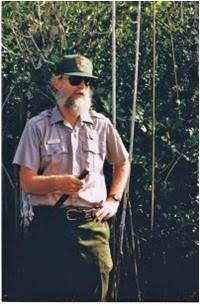
American writer and environmentalist Edward Abbey wrote in his 1977 book The Journey Home,
“The idea of wilderness needs no defense. It only needs more defenders.”
I went to Glacier eager to complete a life goal to see it, and spend quality time with my wife and her extended family. I left Glacier with a new determination to take climate action.
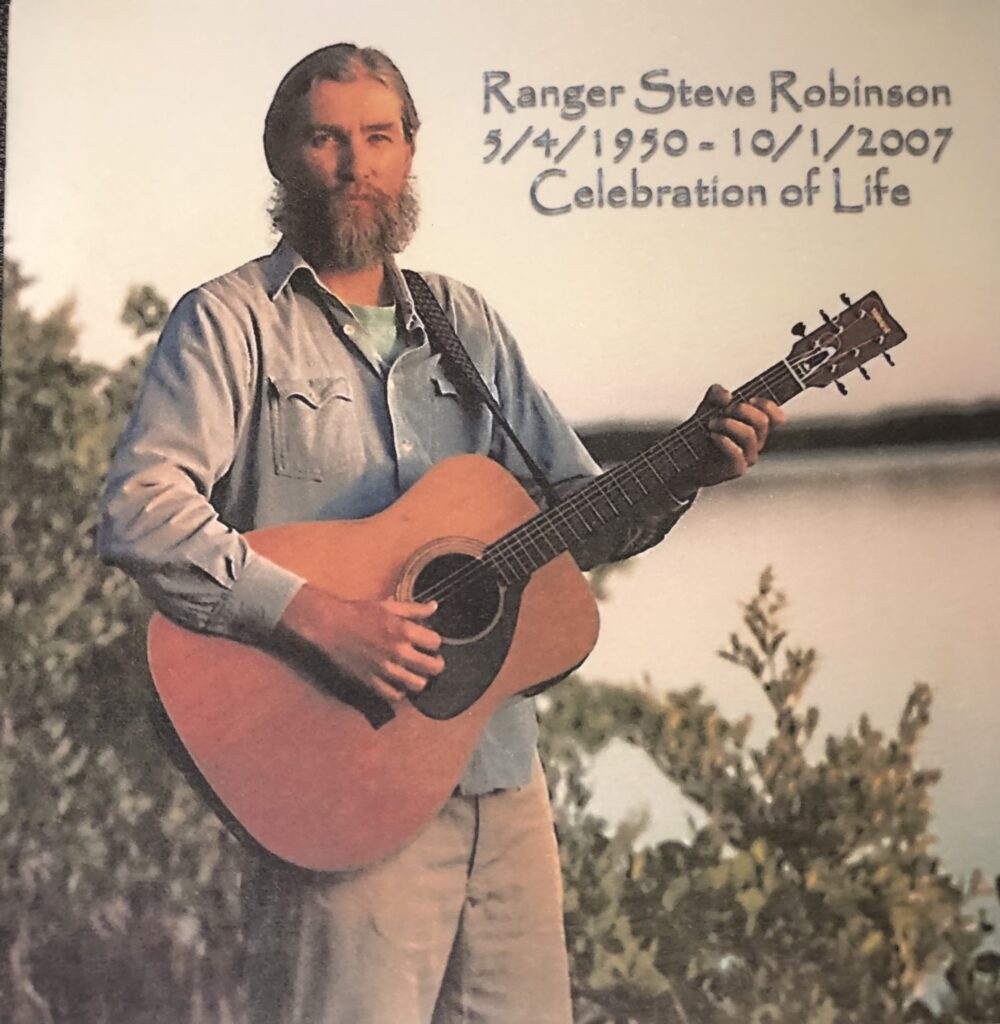
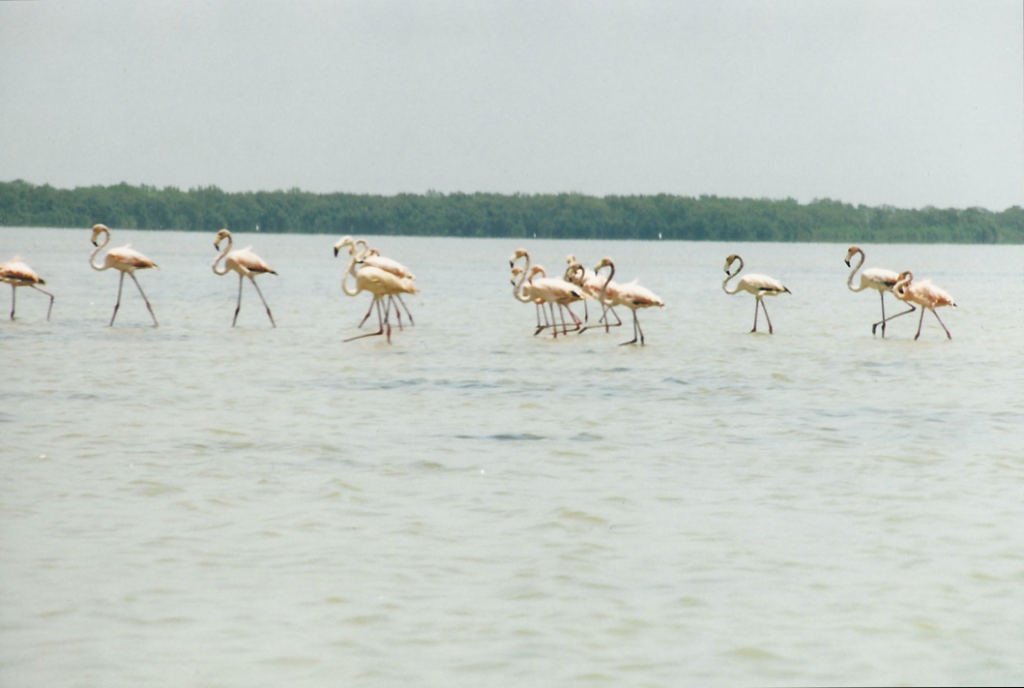
Thank you, Nancy and Rex Couture, for this fantastic opportunity to see Glacier National Park!
Brian Ettling and Tanya Couture at St. Mary Lake from Sun Point in Glacier National Park on September 9, 2023.
Brian Ettling standing in front of the Missouri state Capitol in Jefferson City on April 1, 2017.
‘Do not go where the path may lead. Go instead where there is no path and a leave trail.’
– attributed to the 1903 poem “Wind-Wafted Wild Flowers” by Muriel Strode
In 2016, I had a dream to travel around my home state of Missouri to give presentations for climate change. I was inspired by friends and volunteers with Citizens’ Climate Lobby (CCL) who conducted state speaking tours in the previous years.
In 2015, CCL friends such as Peter Bryn, Ricky Bradley, Larry Kremer, and Brett Cease completed the ‘Texas Energy Freedom Tour!’ This group held 71 events: 25 public presentations primarily to identify new CCL group leaders, and 46 meetings with various community leaders including Chambers of Commerce, county Farm Bureaus, mayors, newspapers, faith leaders, and Republican County Chairs. The goal was to promote climate action, recruit new volunteers for CCL, and create support for CCL’s policy solution of carbon fee and dividend.
The 2015 Texas Energy Freedom Tour inspired other U.S. CCL volunteers to organize state tours in 2016 such as in Georgia. Peter Bryn’s team followed up with the ‘2016 Southern Energy Freedom Tour.’ They drove 2,751 miles to visit 22 cities, giving 17 public presentations and 7 media interviews. They had 35 meetings with businesses, political leaders, NGOs and other groups. They hosted 4 CCL group start workshops and a CCL regional conference. Even more, they met with members of Congress 13 times, and generated 245 letters to U.S. representatives.
As a climate organizer, these state speaking tours looked like a fun adventure to make a difference for climate action. I wanted to do something similar in my home state of Missouri. In addition, I spent the summers working as a seasonal park ranger at Crater Lake National Park. Thus, Oregon intrigued me to undertake a climate change speaking tour.
My struggle to pitch a MO climate speaking tour at a CCL Midwest Regional Conference
As I wrote on a previous blog, I attended the CCL Midwest, officially known as the “Tornadoes Region,” conference on November 12 and 13, 2016. Donald Trump won the Presidential election on November 8th, just days before in that same week. Climate advocates were on edge trying to determine the actions we should take to counter the incoming Trump Administration. There was no doubt they would try everything possible to roll back any progress to address climate change during the Obama Administration. Personally, I wanted to up my game for climate action by pitching the idea of a CCL speaking tour across Missouri, just like CCL volunteers did in Texas in 2015 and 2016. I had no idea about the resistance I would receive.
During a brainstorming breakout session of Missouri CCL volunteers during the conference, we determined that the best way to get more people involved was to organize a state tour across Missouri. It would be composed of speaking events to expose the public to CCL and its preferred climate solution, carbon fee and dividend. A leader was needed to speak at these different cities. I volunteered myself since I had the time and passion to do it. At that time, I was a seasonal park ranger at Crater Lake National Park. It was in between seasons from my summer job, so I had the availability and enthusiasm to lead this tour. After I volunteered myself to lead this tour, I immediately got some pushback from the local Kansas City volunteers.
They were concerned about the finances needed to complete this tour. That part didn’t bother me. I figured the money would work itself out, one way or another. As we brainstormed, they wouldn’t let this issue go. It got more contentious. They kept hammering how I was going to pay for this tour. I was annoyed they weren’t supportive and trying to think outside the box how we were going to grow CCL to get more people involved. To get them from stop dwelling on this sticking point, I finally said: “I will do my own fund raising to make this tour happen.”
That seemed to silence the critics, at least I naively thought at the time. However, two weeks later, I received a phone call out of the blue from the Vice President of CCL, Madeleine Para, who attended the conference in Kansas City. Madeleine started off the conversation cordial asking me how I was doing. In that moment, I was very excited talking about an upcoming trip I was planning to Ottawa Canada. I was invited to be a guest speaker and lobby members of the Canadian parliament for a Citizens’ Climate Lobby Canada conference. She sounded rather cold and calculated when she said: “Well, I am going to have to burst your bubble.”
She went on to say: “I was just talking to the Executive Director, Mark Reynolds, and we agreed that you can’t do your own fund raising for a state tour. We feel like any fund raising that you would do would interfere with the organization’s fund raising. We can’t let you do that.”
It felt like I had been kicked in the stomach. I didn’t have the words to respond, so I hung up the phone. I did email her to apologize, but I felt deeply hurt. She did seem to understand that in a responding email and relaying a comment days later to a mutual friend. That was it though. There was no other action taken to reach out to me to try to heal the breach. Immediately after Madeleine’s call, I called a few CCL friends across the country, and they didn’t know what to say. They still advised me to do this tour if I wanted to do it.
Brian Ettling at Citizens Climate Lobby Conference in Washington D.C. on November 14, 2016.
During that phone call with Madeleine, I had no words to dig deeper into her reasoning. From my interactions with her, I felt an underlying jealousy. She didn’t seem to like my enthusiasm and energy to accomplish big things as a climate organizer. It felt like my plans to organize around Missouri were somehow a threat to her position. Therefore, she had to find a way to get the Executive Director on her side to stop my plans. Her phone call made no logical sense. If I had the words to say in that moment, I would have responded: ‘What was the point of that regional conference? I somehow had the impression it was to think outside our comfort zone to grow our organization to make a difference for climate action. I don’t see your logic how my own fund raising for a tour would compete with fund raising of the national organization.’
I saw for the first time that people involved in the climate movement don’t always have the best intentions to effectively act on climate. They don’t always want to help volunteers like me reach for their full potential to make a difference for climate action. Sadly, I discovered as a climate organizer that others’ politics, power, and jealousy can get in the way of my yearning to make difference. Unfortunately, it was a lesson that I would have to learn repeatedly.
Planning for the 2017 CCL Missouri speaking and lobbying tour
The good news is that I didn’t let Madeleine stop me. In the fall of 2016, the CCL regional coordinator for the Tornados, Carol Braford, invited me to be the CCL Missouri state co-coordinator. I would work closely with the other co-coordinator, George Laur, a retired engineer who lived in Jefferson City, Missouri. George and I met months earlier and we became friends. We looked forward to collaborate as CCL co-coordinators for Missouri. We had regular phone calls after the November 2016 CCL Tornados Regional Conference. George liked my idea of a CCL speaking tour across Missouri. He started making some inquiries about me giving climate change talks in Jefferson City, Kirksville in northeastern Missouri, and elsewhere.
In late January 2017, my wife Tanya had a job offer in Portland, Oregon. We decided we would move to Portland in the first week of February 2017. After our decision, I called climate friends in Missouri, such as George Laur, to inform them we were moving. Thus, I would not be organizing events in Missouri anymore. George was happy for Tanya and me, but he was sad because we enjoyed working with each other. George then said to me: ‘Looks like you will have to fly back to Missouri in March because I plan for you to speak in Jefferson City and Kirksville, MO.’
After Tanya and I moved to Oregon in February 2017, I realized it would be expensive to fly back to Missouri in March to give talks there. I love to travel, especially to give climate change talks. However, I was nervous to pay for this round-trip plane ticket. When I expressed this to George, He generously asked CCL volunteers in Jefferson City and Columbia Missouri to raise money to pay for my airline ticket. They easily raised the funds for my airplane fare. The generosity of George Laur and his CCL friends in central Missouri touched me. This motivated me to take this trip back home to Missouri to give quality climate change presentations. Even more, this gesture of kindness inspired me to see what other climate actions I could bundle into this trip.
Brian Ettling and George Laur at the CCL Conference in Washington D.C. on November 15, 2016.
In early March, I bought my airline tickets to fly from Portland, Oregon to St. Louis, Missouri on Monday, March 27th. I bought my return ticket from St. Louis to Portland on Monday, April 3rd. George planned for me to speak in Jefferson City on Wednesday, March 29th at 7 pm. In addition, George and the new CCL Missouri co-coordinator, Sharon Bagatell, booked me to speak at Truman State University in Kirksville, MO on Friday, March 31st at 7 pm.
Besides those two events, I hoped to bundle in more climate related events to make the most of this trip. For several years, CCL encouraged its volunteers to do spring in district lobby meetings with their local Congressional offices. In between the speaking engagements in Jefferson City and Kirksville, George arranged a meeting with staff of U.S. Senator Roy Blunt at his district office in Columbia, Missouri on Thursday, March 30th. This inspired me to reach out to the Congressional offices of U.S. Representative Ann Wagner to have a meeting with her staff on Tuesday morning, March 28th. St. Louis CCL volunteer David Henry scheduled a meeting with staff of U.S. Senator Claire McCaskill at her St. Louis district office on Tuesday afternoon, March 28th.
I was excited that while I was still in Oregon in mid-March, I coordinated a trip to Missouri to give two climate presentations and three lobby meetings. In addition, I would have a chance to visit family. I would stay with my in-laws while in St. Louis. On Monday evening, March 27th, I would have dinner with my in-laws and parents.
As I planned this trip in March while living in Portland, something serendipitous happened. On February 28, 2017, I got an e-mail from Ian Mason, a senior at Ladue High School, located in west St. Louis County. Today Ian Mason is a Weekend Anchor/Meteorologist in North Platte, Nebraska for NBC Channel 2 in Nebraska since April 2022. In that February 2017 email, Ian wrote:
“Dear Brian,
I’m not sure if you remember me or not, but I was a high school student and I attended your class on Climate Change at St. Louis Community College a couple years ago. I’m currently working with a student organization called Global Student Square and I’m doing a video on the Trump administrations Gag orders to scientists, specifically in the climatology field. I think I remember you saying that you were a Park Ranger at some point so I was interested in your point of view.
I would love to meet up at some point and talk if that is okay with you. Thank you so much!”
I responded to Ian that I would be lobbying Congressional Offices in St. Louis and giving climate change talks in Jefferson City and Kirksville in the last week of March. He was welcome to shadow me for any of these events. Ian was very enthusiastic about this. After I would fly into St. Louis on March 27th, I planned to have lobby preparation meetings with local CCL volunteers who would join me at a local Starbucks. I suggested to Ian that he could join our lobby prep meetings and even the lobby meetings. Ian jumped at the opportunities to attend our lobby prep meetings and attend one of the lobby meetings on March 28th.
Brian Ettling with Ian Mason. Photo taken in St. Louis, MO on March 27, 2017.
On top of all this planning, I booked an Amtrak train ticket from St. Louis to Jefferson City on Wednesday morning, March 29th. I would take the train to Jefferson City to rendezvous with George and his wife Kathy Laur before our event in Jefferson City on the evening of March 29th. I loved taking trains, as well as flying. Therefore, this was shaping up to be a great trip to Missouri to promote climate action and CCL.
First Day of the 2017 CCL MO Climate Speaking and Lobbying Tour, Monday, March 27th
Earlier that month, I booked an early morning direct flight from Portland, Oregon to St. Louis, Missouri to arrive early in the afternoon to attend my lobby prep meetings with local CCL volunteers. As I always do on Southwest Airlines, I try to board as early as I can to get a window seat. I love to grab a window seat to get a great view of the scenery as the plane flies. I can’t imagine flying without a window seat.
As I made a beeline for an available window seat towards the back of the plane, a pleasant 30 something couple sat in the seats next to me. At first, we did not make conversation because I focused on looking out the plane window. I was enjoying the silence before I would be talking a lot during this trip to CCL friends, Congressional staff, family, public presentations, etc. Not long into the flight, the man sitting next to me remarked: “I think that I know you.”
His name was Nicholas Bentley and he remembered we are Facebook friends. He attended a Climate Reality Training and admired my climate organizing. He was flying with his partner Kristen Lavelle, who took our photo. This was a great start to my trip. It was great to hear that he liked following on Facebook what I was doing to act on climate. Since this trip to Missouri was all about climate action, this started my trip on a good note.
I forgot why Nicholas and Kristen were flying to St. Louis. According to his Facebook page, Nicholas was a former New Media and Online Resources Officer at Greater Yellowstone Coalition and a former Organizer at Reclaim Democracy. When we chatted, he designed board games as a career. I always loved board games. Nicholas and Kristen live in Madison, Wisconsin. I hope our paths cross again at some point so we can play some board games.
Nicholas Bentley and Brian Ettling on a flight from Portland, OR to St. Louis, MO on March 27, 2017.
My in-laws, Rex and Nancy Couture happily picked me up at the airport and then dropped me off at Starbucks for my lobby prep meetings. It was great to see them. My lobby preparation meetings went well. I met at a local Starbucks with St. Louis area residents Sue Bell, Liz de Laperouse, Jim Rhodes, and Ian Mason. Congresswoman Ann Wagner is a conservative Republican and U.S. Senator Claire McCaskill is a moderate Democrat, so the planning for these meetings was very different. After we chatted about these meetings, I made time for Ian to see if he had any questions for me with his video project that focused on my climate organizing.
That evening, my in-laws Nancy and Rex Couture had a lovely dinner at their home for my parents and me. I wish that my wife Tanya could have been there. I enjoy traveling and visiting family with her. I did call her on Facetime so that she felt included.
Second Day of this 2017 CCL MO Climate Speaking & Lobbying Tour, Tuesday, March 28th
The meeting with Congresswoman Ann Wagner’s staff was at 9 pm. This district office was in Ballwin, Missouri, just a few miles from where my in-laws lived in west St. Louis County. My in-laws generously allowed me to use their 2002 Toyota Corolla during my St. Louis trip. Before this meeting, I had an 8:30 am meeting with Steve O’Rourke at a local Starbucks in Ballwin close to the district office. Steve was the only participate who was not able to meet with me the day before to prepare for this lobby meeting.
I first met with staff at Rep. Ann Wagner’s district office on February 14, 2014, as part of CCL’s spring in district Congressional lobby meetings. In the spring of 2013, I volunteered to be the volunteer CCL liaison for Rep. Ann Wagner. This role involved being the point of contact person between CCL and this Congressional office. According to the CCL Community website, “CCL liaisons build relationships with their assigned members of Congress and their staff through regular personal contact, scheduling lobby meetings, and other communications with that office.”
With my role as CCL liaison to Rep. Ann Wagner, this would be my fourth in-district meeting with staff. I also lobbied the Ballwin office in 2015 and 2016. I enjoyed meeting with her Ballwin district staff, as well as her Washington D.C. staff when I lobbied there for CCL in November 2015 and 2016. I consider myself to be a moderate to progressive leaning Democrat. Rep. Wagner, plus her staff are rock solid conservative Republicans. I enjoyed adhering to CCL’s Core Values that we lobby Congressional offices with “respect, appreciation, and gratitude.”
In addition, CCL coaches it’s volunteers to be great listeners during these lobby meeting. It has offered trainings on motivational interviewing to be a more engaged and effective listener. CCL emphasizes motivational interviewing to be a superb listener so that the Congressional staff feels heard. They encourage us to be more “interested than interesting.”
CCL insists its volunteers to start every Congressional lobby meeting with a sincere appreciation for action the member of Congress took to benefit constituents in the district or state. This can be hard if the person lobbying has an opposite political philosophy of the member of Congress or staff whom they are meeting. One might object to nearly everything that member does. However, if one looks at the member of Congress’ website or does a Google search, you can find something to applaud nearly all members of Congress. Maybe it’s their efforts to get funding for veterans, seniors, disaster relief, or a job creating policy for the district. I always sincerely thanked Rep. Wagner’s office for her efforts to stop sex trafficking, a high priority for her.
Brian Ettling, Jim Rhodes, Sue Bell, and Liz de Laperouse meeting at a coffeehouse in St. Louis on March 27, 2017. We had a prep meeting to prepare for our CCL Congressional Lobby meetings scheduled for the next day.
Congressional offices genuinely appreciates that we start the meeting applauding a specific action of the member of Congress. It helps them let down their guard that we are not there to protest, lecture, yell, and belittle them on areas where we strongly disagree. In fact, as CCL volunteers, we strive to find common ground with these offices. We don’t back down that we are there to promote climate action, specifically a carbon fee and dividend solution. At the same time, we aspire to carefully listen to find what is their objections and sticking points to supporting climate policies, especially carbon fee & dividend. When we find a sticking point or objection where we disagree, we strive not to counter with facts why we think they are wrong. Instead, we attempt use motivational interviewing to drill down further in their objections to find common ground. In those areas of disagreement, we seek to find areas where we can work together.
I followed CCL’s lobbying philosophy for years with meeting with Rep. Ann Wagner’s Baldwin and Washington D.C. staff and I found success with their methods for lobbying. Rep. Wagner’s staff liked meeting with me, and I developed a good rapport with them over the years. Unlike other environmental and climate groups, we don’t shame them for their climate and environmental positions. For instance, Wagner’s staff told me that they felt annoyed when the Sierra Club and other groups would drop off “Worst Polluter” awards or protest in front of their Ballwin Office. It did not shift their thinking on issues. CCL believes “there is a place for protest, but our approach is to build consensus, which we believe will bring enduring change.”
Having said that, my goal for this lobby meeting was to meet with the District Director, which is the highest position in this office. They generally pick up the member of Congress from the airport and are with them for in-town events. Yes, the member of Congress listens to the junior members of the district staff. However, the District Director generally has the ear of the member of Congress for what’s happening in the District and where that member of Congress should put their priorities. A good meeting with a District Director and developing a great relationship with them is very beneficial for trying to influence that member of Congress.
In early March, I learned Rep. Wagner’s District Director, Miriam Stonebraker, would join our lobby meeting. This felt like a breakthrough for me after years of lobbying her office. Since this was a meeting with senior staff, I wanted this meeting to be a success. Previous meetings, I brought in volunteers that were strong climate advocates and local CCL volunteers. The advantage of lobbying with CCL volunteers is that they generally understand the CCL mode of lobbying of appreciation, motivated interviewing, and looking for common ground. The disadvantage is that a conservative Republican member of Congress might dismiss these constituents as not their most loyal voters that they aim to serve their district in Congress. If one reads about Rep. Ann Wagner, you discover she is Catholic, a strong supporter of the U.S. military – her son Raymond is an Army Captain, and an avid supporter of small businesses in the St. Louis area.
Therefore, for this lobby meeting, I networked hard to try to find someone who served in the U.S. Armed Forces, a local businessperson – preferably someone who worked in the solar industry, and a devout Catholic. I failed with my contacts to find someone Catholic who could attend this meeting. Through my Sierra Club contacts, they recommended Sue Bell, who was a Missouri Sierra Club Intern and spent her career in the U.S. Army. Through other climate contacts, I found Steve O’Rourke, who was then VP Business Development with Microgrid Solar, which was rebranded as Pivot Energy in 2018.
The other person joining us was Liz de Laperouse. She was not a Catholic, veteran, and a solar businessperson. However, Liz had an impressive background as a champion of the environment in the St. Louis area. Liz was the Volunteer Chair at the Whitney R. Harris World Ecology Center. It is known locally as the Harris Center, which is a premier financial supporter of education and research ecology and biodiversity conservation at UMSL (University of Missouri St. Louis), the Missouri Botanical Garden, and Saint Louis Zoo. These are very respected institutions in the St. Louis area. With her work at the Harris Center, Liz was very well connected in the St. Louis.
Even more, I moved from St. Louis to Portland, Oregon one month earlier. Thus, I was no longer a constituent of Rep. Ann Wagner. It was time for me to pass the baton to constituent Liz de Laperouse so she could be the CCL Liaison to Rep. Wagner. From my interactions with Liz in 2017, I found her to be excellent to be my replacement. Having her in this lobby meeting would provide continuity for the positive relationship between CCL and Rep. Wagner’s office.
Sue Bell, Liz de Laperouse, Brian Ettling and Steve O’Rourke at a CCL lobby meeting at Congresswoman Ann Wagner’s office in Baldwin, MO on March 28, 2017.
I felt like I had my lobby dream team assembled. Before the meeting, I just wanted to make sure I had them on the same page as far as CCL’s lobbying methodology. Even more, my priority to make sure that they knew we were lobbying for “the long game.” We were not going to persuade Rep. Ann Wagner in a single lobby meeting with her staff to become a climate champion that supported CCL’s carbon fee and dividend. Rather, my goal was to build a positive rapport with her staff over years to help guide her to shift her position on climate change. I had a great meeting with Liz de Laperouse and Sue Bell the day before to emphasize my lobby plan. They were totally on board and enthusiastic for this meeting.
On the morning of March 28th, I had a positive meeting with Steve O’Rourke. We hit it off immediately. If I had continued living in St. Louis, I would have liked to have become good friends with him. I found him to be very energetic, a great storyteller, passionate about solar, and a fun person to be around. After my meetings with Sue, Liz, and Steve, I felt pumped up we were going to have a terrific lobby meeting.
I was very happy with everything that happened with this lobby meeting. Miriam gave us a full hour for this meeting. In Washington D.C lobby meetings, Congressional staff often only schedules lobby meetings for 15 minutes due to their busy schedules. If they have time or feel like your lobby meeting is important, they will schedule 30 minutes. It was very gracious of Miriam to schedule a full hour for us.
CCL insists that our lobby meetings are confidential to maintain our trust with Congressional staff and members of Congress. Thus, I will limit what share what happened in this lobby meeting regarding discussions about climate change, their positions on climate policies, and their candid assessments of what is happening with Congress.
However, I will share a couple of items that stood out from the lobby meeting.
First, towards the end of the meeting, District Director Miriam Stonebraker said something unexpected to me that I will never forget. She looked right at me and commented,
“By the way I am really impressed with (Citizens’ Climate Lobby’s) website, I went on there it is very clearly laid out. It is very easy to follow. It shows that you know how to get things down. You have clear goals, and you reach them. I am very impressed because lobbying is not easy. Is it Brian?”
The comment left me feeling speechless. Miriam strongly indicated during the meeting Rep. Wagner is NOT interested in supporting any climate action in Congress. Yet, it felt like Miriam admired my tenacity with climate lobbying and she was cheering me on.
After a moment of trying to process her admiration for my climate efforts, I smiled back and quickly responded, “‘No, lobbying is not easy, but is it so rewarding.”
It felt in that moment and afterwards that she understands how hard it is to lobby. It can be just down right totally frustrating at times. Miriam’s comment inspired me to write a blog two months later, “Climate Lobbying is very hard, but it is so rewarding.”
Brian Ettling dropping off a thank you card after lobbying Congresswoman Ann Wagner’s Ballwin MO District Office on March 23, 2016.
Second, during the introductions, Steve O’Rourke introduced himself as a businessman with Microgrid Solar. Miriam responded: ‘I bet things are not going well for solar these days.’
Steve quickly responded, ‘Actually things are going well these days.’ Steve then explained the good developments happening in St. Louis at that time. Miriam and the other Wagner staff person in this meeting listened intently on what Steve had to say.
As we were wrapping up the meeting, I asked Miriam directly, ‘Who in our district you like to hear more from when it comes to climate change and solutions like clean energy?’
Miriam pointed right at Steve O’Rourke. Miriam indicated she and Rep. Wagner want to hear more from businesspeople like Steve as they consider policies related to clean energy and climate change. That felt like a victory to me that I succeeded in getting Steve, a solar businessman, in this lobby meeting. Even more, it felt like a good roadmap how to approach for future lobby meetings with Rep. Wagner’s office.
To develop more rapport with Rep. Wagner’s staff, I brought in a large plate of my mother-in-law Nancy Couture’s delicious chocolate chip cookies. My in-laws are proud Democratic voters who don’t like Ann Wagner. It was very generous of Nancy to make these cookies. Nancy has always been very supportive of my climate organizing. When I presented the large plate of cookies, Miriam and the Wagner staff did not want to touch them with a 10-foot pole.
“Are these cookies store bought?” she asked with hesitation looking at the cookies. She was leery of anything perceived as a bribe or an unethical lobbying gift over $10.
“No!” I replied. “My mother-in-law made them for you! they are delicious.”
Finally, Miriam and other members of the staff decided they could bravely accept the cookies.
After the meeting was completed, I had a good debriefing with Liz, Sue and Steve outside and around the corner from Rep. Wagner’s office. I wanted to make sure our lobby team could talk frankly without Wagner’s office hearing us. Everyone was very happy how the meeting went, including the photos we got from the meeting. I then had everyone sign a thank you card to Miriam. After Sue, Liz, and Steve left. I dropped off the note inside Rep. Wagner’s office. The hilarious part was that the plate of mother-in-law chocolate chip cookies that Miriam and the staff were initially afraid to accept was nearly devoid of cookies. Apparently, they loved the cookies.
Later that same day, I joined David Henry, Jim Rhodes, Ian Mason and others for a great meeting with staff of U.S. Senator Claire McCaskill at her regional office in St. Louis. David Henry was the CCL liaison for U.S. Senator McCaskill. After I the work I put into the meeting with Rep. Ann Wagner’s staff, it was fun for me to be a general participant in this meeting. Unlike Rep. Ann Wagner, Senator Claire McCaskill is more firm on her position that climate change is real, human caused, and a priority for action.
At the same time, Senator McCaskill was a very moderate Senator who tried to take positions that she felt reflected her Missouri constituents. In past meetings with the Senator or her staff, she was reluctant to support CCL’s carbon fee and dividend. She was afraid it would increase costs on seniors with fixed incomes. I don’t remember much about this lobby meeting, except that it did go very smoothly. I remembered McCaskill’s staff asking about how a carbon fee and dividend would impact rural and primarily low-income school districts looking to transition their gasoline burning school buses to electric buses.
Ian Mason, Jim Rhodes, David Henry, Kurtus Hoffman Kahle, David Henry and Brian Ettling lobbying U.S. Senator Claire McCaskill’s St. Louis Office on March 28, 2017.
For me, one of the best parts of lobbying meetings are the questions that I cannot answer on the spot. I use those questions posed to me in the lobby meetings as homework to follow up with answers for the Congressional staff. In the days after this meeting, I emailed CCL staff to ask them how they would respond how a carbon fee and dividend would impact rural communities switching their gas burning school buses to electric buses.
After the lobby meeting, I met with Ian Mason for a short interview about the lobby meeting to provide any help he needed for his video project. I left this lobby meeting feeling tired and very happy from a productive day of lobbying for climate action in my home state of Missouri.
Third Day of the 2017 CCL MO Climate Speaking & Lobbying Tour, Wednesday, March 29th
The day started off well with a beautiful Amtrak train ride from the Kirkwood Train Station in west St. Louis County to Jefferson City, Missouri. It was a lovely overcast spring day in Missouri. My in-laws kindly dropped me off at the train station for this two-hour train travel. I tried to get some work done with my climate organizing using the internet on the train. At the same time, it was enjoyable to watch the scenery go by on the train.
The train went through Castlewood state Park along the Meramec River, where I proposed to Tanya on Christmas Eve over two years before. It was fun to spot Six Flags Amusement Park in Eureka, MO where we went as a family when I was a child. West of Eureka, there’s a tunnel that seems like it is a couple miles long going through the Ozark Mountains. The train emerges from the tunnel paralleling the Missouri River for the rest of the trip, stopping in the historic towns of Washington and Herman, Missouri before dropping me off in Jefferson City.
My friends George and Kathy Laur picked me up at the train station, located just a block from the majestic state capitol building in Jefferson City. We were happy to see each other. In my excitement, I commented: “the Missouri state Capitol sure is a beautiful building.”
George wryly replied: “Yes, beautiful building on the outside. Horrible things happen on the inside.”
Ironically, we noticed small Missouri utilities lobbyists were having a barbecue cookout for legislators at the front of the Capitol building to urge them to oppose any clean energy policies and allow them to continue burning dirty fossil fuels. Point was taken, George! For a healthy planet, it looked like horrible things were happening on the outside of the building that day.
George and Kathy took me to a nearby country diner for a delicious Missouri fried catfish lunch. Yummy! I loved Missouri catfish since I was a child. We then went to their splendid home on the other side of the Missouri River from Jefferson City. Their house sits high on a bluff with a glorious view of the state Capitol and the Missouri River. We spent the afternoon chatting in their comfortable home and working on last minute details for my climate talk that evening.
After dinner, we headed to the venue where I would present my climate talk. It was the auditorium at the Runge Conservation Nature Center just west of Jefferson City. We briefly walked through an impressive nature museum about Missouri on our way to the auditorium towards the back of the building. When we reached the auditorium around 6:30 pm, we made sure that my PowerPoint slides worked, my microphone functioned properly, the projector was properly showing my PowerPoint slides, and other logistics. Everything went fluently.
This auditorium seated well over 100 people. It looked very empty when we arrived. I always had that fear if anyone would show up. George assured me that we would get a big size crowd. He was not sure how many. However, it was well advertised by the River Bluffs Audubon Society, the Osage Group of the Missouri Sierra Club, the Jefferson City/Columbia Chapter of CCL, the Runge Conservation Nature Center, and in the Jefferson City News Tribune newspaper.
It turned out over 100 people did show up for this event. The auditorium looked almost full, yet not overly crowded. My presentation was called “Is Climate Change Affecting Our National Parks?” It was fun to tie in my background of growing up in Missouri and then working in the national parks. Then sharing how I saw climate change in Everglades and Crater Lake National Parks. That observation led me to organize on climate change solutions, such as CCL’s carbon fee and dividend (CF&D). This was an enthusiastic audience that laughed at my jokes.
At the end of my presentation, I asked the audience to fill out and sign CCL constituent comment forms. These forms had the signees urge their members of Congress to act on climate and asked the members of Congress to support climate solutions, such as CF&D. We would then make sure that their filled out copies would go to all three of their members of Congress, U.S. Senator Roy Blunt, U.S. Senator Claire McCaskill, Rep. Blaine Luetkemeyer or Rep. Vicky Hartzler. The good news was that 52 people wrote comment forms to their MO members of Congress asking climate action. Sadly, we ran out of forms or more people would have filled them out. It was a very empowering evening.
I was delighted Ian Mason and his mom, Gina Kratky, came to this talk. Gina drove Ian from St. Louis to Jefferson City to attend my presentation, which is around a two-hour drive one way. Even more, this was on a school night because Ian was a senior in high school at the time. Ian asked me before my event if he could video tape my presentation for his video project. I happily agreed that he could video my talk. He generously shared the video with me afterwards, which I uploaded to YouTube. I was pleased that Ian shot a good video to document this occasion.
After the event, Gina and Ian drove back to St. Louis so he could attend school the next morning and she could go to work. When George and Kathy drove me back from the Nature Center to their house, it rained hard that evening. Thank goodness we had a short drive of a few miles. When we returned to their house, George turned on the TV local news. It turned out the heavy rains caused some standing water on the roads and flash flooding. I thought about Gina and Ian. I emailed Ian to see if they made it back to St. Louis safely. He responded later that they did make it back to St. Louis. However, the heavy rains did really slow them down that they made it home much later than they would have liked, especially on a school and work night.
This was a great public speaking experience for me. Thanks to George and Kathy Laur, this a highlight among many of the over 200 climate change talks I have given over the years.
Fourth Day of the 2017 CCL MO Climate Speaking & Lobbying Tour, Thursday, March 30th
The next morning, I woke up to see the Jefferson City News Tribune had an article about my talk the previous evening, “Climate change threatens park, ranger says.” It gave a good synopsis of my presentation, especially my emphasis to the audience to contact our Missouri members of Congress, especially the Republicans, to urge them to prioritize climate action.
That talk must have made quite an impression. Besides their article, the News Tribune printed a cartoon from their conservative cartoonist Jim Dyke aimed at me. He had the wrong colors for the ranger uniform, and it did not look much like me. The statements in the cartoon looked like a real head scratcher that did not make any scientific sense. Having said that, I was flattered and honored to have inspired this political cartoon. The cartoonist tried to mock me. However, I thought the joke was on him since he seemed to have a lack of scientific understanding.
Political cartoon by Jim Dyke in the March 30, 2017 edition of the Jefferson City News Tribune. It was in response to a climate talk Brian Ettling gave in Jefferson City, MO on March 29, 2017.
George and I then drove from Jefferson City to Columbia, Missouri, which is about a 30-minute drive. We arrived in Columbia late in the morning to attend a meeting with staff of U.S. Senator Roy Blunt at his regional office in Columbia, MO. George arranged for this meeting with Senator Blunt’s staff. Local CCL volunteer Jack Meinzenbach joined us for this meeting. George was the CCL liaison to Senator Blunt. Because George had met with this office several times, he a good relationship with them. Unlike the lobby meeting I led with Rep. Ann Wagner’s staff on Tuesday, I don’t remember any details about this lobby meeting, except that it was pleasant.
After this lobby meeting, George and I then drove to Dancing Rabbit Ecovillage in Rutledge, Missouri. This was over a two-hour drive from Columbia, Missouri. It was located due north of Columbia, MO in northern Missouri. We were meeting up with Sharon Bagatell. She was the new CCL Missouri co-coordinator, replacing me when I moved to Oregon the previous month. Sharon lived at Dancing Rabbit. She scheduled the climate presentation for me to give at Truman State University in Kirksville, Missouri the next day.
Dancing Rabbit was a communal living sustainable community. As their website says, “We build our homes using alternative techniques such as straw bale and cob, powering them with renewable energy from the Sun and wind. Vehicles at DR are owned cooperatively and powered by electricity and biodiesel. Overall, we eat an ever-increasing amount of local, organic, and in-season foods including many home-grown vegetables.”
This community was different from anything I had experienced before in my life. Actually, I like the conveniences of modern living, so it was an adjustment spending time there. Sharon arranged for me to stay in one of the vacant houses where one of the village members was traveling off site during my visit. George spent the night in a nearby motel.
I met Sharon at the eco village café. We had dinner there that evening. Sharon was a kind, soft spoken person that you would want as a friend. After dinner, I needed a place with power and internet access to use my laptop. Sharon suggested I use their community center. I wanted look over my talk the next day for Truman State University, make edits to the PowerPoint, catch up on other emails relating to my climate organizing, and touch base with my wife Tanya. In addition, this community building had showers, and lighting in the bathroom to brush my teeth.
Dancing Rabbit had no streetlights, porch lights or any kind of lighting at night. The houses were haphazardly laid out with no street signs, addresses on the homes, etc. The houses were all loosely thrown together and constructed uniquely with scrap wood, straw bale, and cob. No two houses looked the same, yet they all looked like the same hippie abstract art in the dark. I stayed way too long at the community building working on emails, updating my PowerPoint, and connecting with Tanya. By the time I finished all my tasks, it was late in the evening.
A big challenge was feeling home my way in the dark. My headlamp in my backpack did not work and my flip phone (yes, I still used a flip phone in 2017) did not give off much light. I worked 25 years in the national parks, and this eco village was one of the dark places I had seen. That night was overcast with no moon, making it more like total darkness. I was sober. I had no alcohol that day. Yet, it felt like I was drunk going home stumbling into uneven ruts on the dirt road, obstacles on the side of the road and unsure what street I was walking.
I deeply missed Tanya and our well-lit apartment in Portland. As I walked backed and forth by the houses, I could not find the house I was suppose to be sleeping. In my frustration, I became angry. I wondered what I was doing there. I questioned if I was making any difference for climate action. I was uncertain why I was in that situation. Finally, with luck and perseverance, I found the house where my suitcase was located and where I would be sleeping.
Dancing Rabbit did not connect with me, except for making friends with Sharon. The truth was Sharon wanted to leave Dancing Rabbit. She recently lost her life partner there. She was still grieving with daily memories of her partner everywhere at Dancing Rabbit. She wanted to start a new life for herself far away from there. I felt like an outsider visiting an outsider there.
Sharon explained to me that most people living there thought they were doing their part for the planet by living a simple life, “off the grid,” in a more sustainable way. She had a hard time convincing her fellow community members on the importance of contacting their elected officials and lobbying for climate action. Their attitude was “I am already doing my part.”
I have always felt frustrated by climate advocates who solely took individual actions by going vegan, not flying, not owning a car, not having kids, putting solar panels on their homes, living off the grid, buying an electric car, etc. Yes, do those things. I applaud those doing that. They set a good example and they do make a difference. At the same time, it’s not enough. As climate scientist Dr. Michael Mann wrote in USA Today op-ed in June 2019, “You can’t save the climate by going vegan. Corporate polluters must be held accountable.”
As the protest signs at climate marches and protests say, ‘We needs systems change, not climate change.’
Image source: Eurodiaconia, Weekly editorial: “A planet in all our hands,” September 27, 2019. https://www.eurodiaconia.org/is/weekly-editorial-a-planet-in-all-our-hands/
In addition to doing those individual actions, we need climate advocates contacting their members of Congress, state legislators and local elected officials. I consistently had Congressional staff of Republican members of Congress tell me in lobby meetings that they don’t hear much from their constituents about climate change. Members of Congress need to hear regularly from more climate advocates to make climate change a top priority. Thus, just living sustainably in an eco village sounded to me like a stifling and ineffective way to address climate change.
Sharon’s perspective shaped my opinion about Dancing Rabbit that it felt cut off from the rest of the world. It was too isolated for me. Sadly, nor George or anyone else briefed me much on Dancing Rabbit before I went there to approach it with an open mind. I went to bed that night in the very dark guest house exhausted and eager to sleep. Yet, I was anxious to leave the next day to give my climate talk and to return to a modern world much more familiar to me.
Fifth Day of the 2017 CCL MO Climate Speaking & Lobbying Tour, Friday, March 31st
I set my alarm before I went to bed to meet Sharon for breakfast at her Dancing Rabbit residence. Waking up to the natural morning light felt like I had been camping the previous night. Yet, I woke up in this strange hippie like commune in Missouri. I had always thought of Missouri as a square Midwestern state. Yes, Missouri has its share of Ozark Hillbillies and low-income white rural residents struggling to make ends meet. However, I never thought of Missouri having hippies living in an eco-commune. This seemed more West Coast Oregon where I spent my summers than Missouri. Dancing Rabbit kind of seemed like an experiment gone wrong to try Burning Man, Woodstock, or the Oregon Country Fair in the conservative Show Me state.
Sharon had some tea and some nourishing food for me for breakfast. I heard wonderful things about her from George Laur and Carol Braford, the CCL Midwest Regional Coordinator. For months Carol indicated to me that she wanted to get Sharon more involved with CCL in a leadership position. Sharon shared with Carol that she wanted to be more active. However, she needed time to grieve while slowly committing to CCL or other interests.
Carol Bradford had great foresight for Sharon Bagatell’s potential. Sharon accepted Carol’s offer to step into my role as CCL co-coordinator for Missouri after I moved to Oregon in February, 2017. Sharon did a wonderful job of organizing my speaking event at Truman State in Kirksville that day, as well as other meetings she scheduled that day with the City’s mayor, business community, students on campus, and a reporter with the local newspaper. Sharon then became CCL’s current Youth Action Team Coordinator.
It was a great conversation with Sharon that morning. This was just my second conversation with her after having dinner with her the previous day. I found her to have a very kind heart, gentle spirit, a calming and centered presence, a great listener, fun sense of humor, and a big smile that she was not bashful to share. I asked her about her life at Dancing Rabbit and her loss. She opened to me how difficult it was to lose her partner.
Sharon had good memories living in Dancing Rabbit, but it was no longer a fit for her. She wanted to move to North Carolina to be with her family and work more with youth. We were not chatting in the public café in Dancing Rabbit like we were the previous day when many of the residents know her. Thus, it was great to have a more natural conversation with her.
We then gathered our belongings for the day. Around 8:45 am, Sharon drove us to Kirksville and Truman State University where we would spend the day. We met up with George Laur in the campus cafeteria to start planning our full day of meetings, capped off with my speaking event that evening. At 9 am, Sharon, George, and I met with the Mayor of Kirksville to see if Kirksville was taking action to address climate change. We then introduced him to CCL and the carbon fee and dividend policy. He was interested and polite with our climate organizing, but not very committal.
Brian Ettling, Sharon Bagatell, and George Laur at Truman State University in Kirksville, Missouri on March 31, 2017.
Around 10 am, the three of us met with one of the leading businessmen of Kirksville. Just like the 9 am meeting with the mayor, the meeting went smoothly. We were interested in his take on climate change, and he listened carefully about our involvement with CCL. Like the meeting with the mayor, the meeting was a good exchange of information. He was gracious but said he would have to think more about CCL and the carbon fee and dividend.
Around lunch time, Sharon scheduled me to meet with a group of 6 to 8 of science students interested in ecology and climate change. We met at the cafeteria during lunch. I quickly discovered they were interested in astronomy. I talked about the fabulous night sky I saw when working the summers at Crater Lake National Park as a park ranger. They were planning a spring break trip to a western national park to do their astronomy. The national parks are known for their “dark skies” generally away from city lights and air pollution to see the Milky Way and do more astronomy. They acknowledged that the night sky was good when you drive several miles away from Kirksville by the open fields. However, it gets better further out west from Missouri to see more stars and to see more stars clearer with their telescopes.
These Truman State students and I did not talk much about climate change, which was fine. I was interested in what they had to say about astronomy. They indicated that they might come to my talk that evening, but they were not sure. My talk was on a Friday evening. Some had plans with friends, some went home of the weekend, and some had a lot of homework to do complete. They were mildly interested. I mentioned I hoped to see them there, but I did not oversell the event.
During the day, Dr. Peter Goldman, a biology professor at Truman State University joined us periodically, in between his classes and teaching schedule. He did a fabulous job of creating publicity posters for my speaking event that was posted around the University and Kirksville. He sent me a PFD of the poster promoting the event with a mountain pine beetle at the top and a photo of a dead white bark tree at Crater Lake National Park at the bottom. It was so beautifully created that I was speechless when I first saw the 5.5 x 17-inch poster. That evening, I asked Peter for extra copies, and he generously obliged. I gave copies of the poster to my parents, in-laws and kept a few for myself. My parents and I both had these posters professionally framed and hung in our homes. My in-laws proudly displayed their poster on their refrigerator.
Poster that Dr. Peter Goldman created to promote Brian Ettling’s climate talk at Truman State University on March 31, 2017.
Early in the afternoon, Dr. Goldman arranged a meeting with George, Kathy and I with Truman State University’s economics professor and one of his peers from the science department. This was a good meeting as they absorbed the information we gave them about CCL and carbon fee and dividend. They assured us that they planned to attend my presentation that evening.
Later that afternoon, George, Sharon, and I went to the Kirksville Daily Express newspaper office to meet with newspaper reporter Jason Hunsicker to chat about my climate change talk that evening and our involvement with CCL. I remember we awkwardly all stood in the newspaper lobby with Jason while he asked us questions. Later, Jason took us to a newspaper office where a gathering had just ended to ask us a few remaining questions before we wrapped up our meeting. Sharon, George, and I then had dinner at a western looking café in town.
My presentation that evening went great. We had over 60 people in attendance, nearly filling up the classroom where I spoke. It felt like a more subdued audience than when I presented in Jefferson City two days before. I don’t remember who introduced me or the questions from the audience. With two big presentations, three lobby meetings, and a day filled with meetings with a mayor, business leader, students, professors, and a newspaper reporter, I was tired. Sharon, George, and I got a picture of the three of us before we said goodbye to Sharon. George and I then departed to return to Jefferson City. We left close to 10 pm and we returned to George’s home well after midnight. We felt exhausted from our schedule from the last few days.
A week after I returned to Portland on April 10th, Jason Hunsicker from the Kirksville Daily Express wrote an article profiling me included a lovely picture of me at Crater Lake. The newspaper had a scenic picture of Crater Lake on the front page with a small photo of Sharon Bagatell in the lower left side. The article printed in the newspaper was titled, “Citizens’ Climate Lobby tries to make a difference.” The article summarized my presentation at Truman State University in Kirksville on March 31st. The bad news is that there is no online link available. The good news is that Sharon Bagatell, mailed a hard copy of the newspaper to me.
Screenshots of a hard copy of the front page and page 2 of the April 10th Kirksville Daily Express with an article featuring Brian Ettling on page 2.
Final Days of the 2017 CCL MO Climate Speaking & Lobbying Tour, April 1st to April 3rd
In planning this trip, George stated that he would drive me back to St. Louis from Jefferson City on Saturday, April 1st. I was happy to take the train, but George insisted that he would drive me back to St. Louis. As we drove back from Kirksville to Jefferson City, George asked me if I could take the train back to St. Louis instead. I love traveling by train, so that was no problem for me. Fortunately, I was able to buy a ticket very late that night after we returned to his home.
Late Saturday morning, George drove me to the Jefferson City Amtrak Station. Before the train arrived, George took photos of me with my camera in front of the Missouri state Capitol Building to help document this trip. I enjoyed spending George and Katy over the last several days.
I arrived at the Kirkwood, MO train station in midafternoon. My parents picked me up. I spent Saturday evening with them and most of Sunday at their home in south St. Louis County. They dropped me off at my in-laws’ house in west St. Louis County late Sunday afternoon. My in-laws live closer to Lambert International Airport. They took me to the airport around noon on Monday so I could catch the 2 pm direct flight from St. Louis to Portland, OR. I missed my wife, so I could not wait to fly back to Portland to be with her. My flight was scheduled to land in Portland around 4 pm and she would then pick me up at the airport as she was getting off work.
Passengers crowded at the gate waiting to board this airplane. In fact, it was too crowded with waiting passengers. This flight was overbooked. The ticket agents announced they needed volunteers to get bumped from this flight to take other Southwest flights to Portland. I ignored the first couple of announcements because I was anxious to see my wife. However, each announcement they increased the number of free credits offered on future Southwest flights.
When they announced $525 credits on future Southwest flights for the next 12 months, I jumped at the offer. I did not have to go to work early the next morning, so it did not matter how late I arrived. The Southwest ticket agents booked me on a flight to Oakland, California.
It was a good flight from St. Louis to Oakland. As always, I grabbed the first available window seat and had a great view flying across the United States. In California, no clouds were below us as the plane flew right over Mono Lake, the Sierra Nevada Mountains, and Yosemite National Park. The mountains were glistening white with the robust snow pack they received that winter. I recognized Half Dome from the airpIane window and even took a picture of it. From visiting Yosemite numerous times, it was fun to spot this iconic feature during the flight.
Half Dome pictured in the middle of this photo taken by Brian Ettling as he flew over Yosemite National Park on a commercial flight from St. Louis, MO to Oakland, CA for April 3, 2017.
I then had a 6-hour layover, arriving in Portland at 11 pm that evening. I called Tanya in St. Louis earlier in the day to tell her about the change of plans. She found it to be humorous that I jumped at this deal. I figured we would be flying again soon, so these airline credits would come in handy. We were thrilled to see each other when she picked me up at the airport.
I used my free credits to fly to Washington D.C. in June to attend the CCL Conference and Lobby Day. Thus, I spent these airline credits for more climate organizing. Even more, George Laur pooled donations from the Jefferson City/Columbia CCL chapter and others to pay for my airfare to St. Louis for this tour. Thus, I was adept at this trip of turning free airline tickets into more free airline tickets for me. I felt like a shrewd businessman, but hopefully making a difference for the planet.
On April 17th, Ian Mason informed me that the Global Student Square published the article he wrote about me. For that article, Ian created a video report which he then uploaded to YouTube. I was honored to be the subject and to be interviewed by Ian for this project.
Final Thoughts
This tour happened because of George and Kathy Laur. George and Kathy were determined that I returned to Missouri after I moved to Oregon one month previously to speak in Jefferson City and Kirksville, Missouri. I will always be grateful to them for this fun trip back to Missouri.
In addition to George and Kathy Laur, this tour succeeded because of the Jefferson City/Columbia Chapter of Citizens Climate Lobby (CCL), River Bluffs Audubon Society, the Osage Group of the Missouri Sierra Club, Runge Conservation Nature Center, Sharon Bagatell, Dr. Peter Goldaman, Ian Mason, Gina Kratky, Sue Bell, Liz de Laperouse, Steve O’Rourke, David Henry, Jim Rhodes, Miriam Stonebraker and Congresswoman Ann Wagner’s staff, Jack Meinzenbach, Dancing Rabbit Ecovillage, cartoonist Jim Dyke of the Jefferson City News Tribune, my in-laws Nancy & Rex Couture, my parents Frances & LeRoy Ettling, and others I wish I could remember.
Thank goodness George Laur and I did not listen to Madeleine Para, Vice President of Citizens’ Climate Lobby, when she called to say, “You can’t do your own fund raising for a state tour.”
If you want to make a difference in the world on a serious threat like climate change, don’t listen to the naysayers, critics, and people in leadership positions like Madeleine who will try to hold you back. Act boldly! Find friends like I did like George Laur and the others I mentioned above who will support you. You can do it!
This March 2017 Missouri tour led to two other state climate change speaking tours. In October 2017, I traveled across Oregon for the CCL Oregon Stewardship Tour. In October 2018, my wife Tanya and I traveled across Missouri for another climate change speaking tour. I spoke at my alma mater William Jewell College, just outside of Kansas City, MO. I then spoke at Missouri University in Columbia, MO. Then Tanya and I traveled to St. Louis where I gave a talk at my alma mater Oakville High School, taught a climate change continuing adult education class at St. Louis Community College, and gave a presentation at St. Louis University.
I love to travel to give climate change talks. In my previous talk, I wrote how I gave over 200 climate change talks in 12 U.S. states, plus Washington D.C. and Ottawa, Canada over the past 13 years. I hope to give more climate change talks in the future in more locations.
Please consider inviting me to give a climate change talk to a group or school in your area.
Brian Ettling speaking at Runge Conservation Nature Center in Jefferson City, MO on March 29, 2017.