Monthly Archives: March 2026

For Climate Action, my oral testimony to legislative committees Part IV (2026)

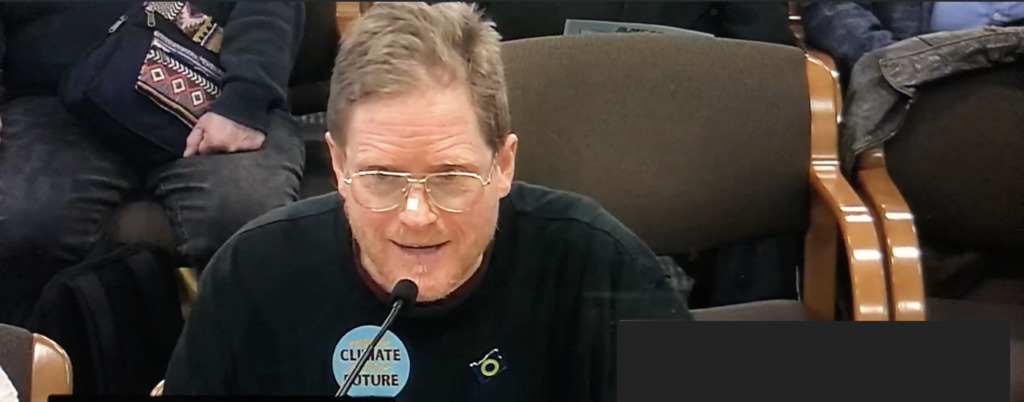
Brian Ettling giving oral testimony in favor of the Climate Resilience Superfund Bill at the hearing for the Oregon Senate Natural Resources and Wildfire Committee on February 5, 2026.

“Here comes the sun
Here comes the sun
And I say, ‘It’s all right’”
From The Beatles song “Here Comes the Sun,”
lyrics by George Harrison

This is my update to oral testimony I gave to the Oregon Legislature over the years. Here I document the two times I gave oral testimony to the OR Legislature during its 2026 short session.

This blog can be considered as a continuation of the 3 previous times I blogged about giving oral testimony to the Oregon Legislature: 

1. For Climate Action, my oral testimony to legislative committees Part III, focused on the 9 times I gave oral testimony in 2025. It was primarily giving testimony to various Oregon Legislative committees. I also included the oral testimony I gave to the Oregon Environmental Quality Commission on March 11, 2025.
 
2. For Climate Action, my oral testimony to legislative committees Part II” was about my oral testimonies to the Oregon Legislature from September 2023 to March 2024.

3. “For Climate Action, giving oral testimony to legislative committees,” detailed the times I gave oral testimony to the Oregon Legislature from 2019 to 2023. 

This blog focuses on the two bills in the Oregon Legislature for the 2026 short session where I gave oral testimony: The Balcony/Plug-In Solar Bill (House Bill or HB 4080) and the Make Polluter Pays/Climate Resilience Superfund Bill (Senate Bill or SB 1541).

Balcony/Plug-In Solar Testimony Story

In autumn 2025, I first hear about the concept of balcony solar, also known as plug-in solar. I heard Oregon legislator, Representative Sarah Finger McDonald from Corvallis, planned to introduce a balcony solar bill in the 2026 OR Legislative session. For the last 9 years in Portland OR, my wife Tanya and I have lived in an apartment. The chances were slim that the apartment complex where we live would ever install solar panels. Thus, I was immediately enthusiastic when I heard about this bill for apartment dwellers to be able to install solar panels on their balconies to create their own source of electricity to offset a portion of their electricity bill. 

As a climate organizer, I was an enthusiastic supporter of residential solar panels for years. In the spring of 2018, I worked for Tesla Energy selling solar panels to home owners at Home Depots in the east Portland area.
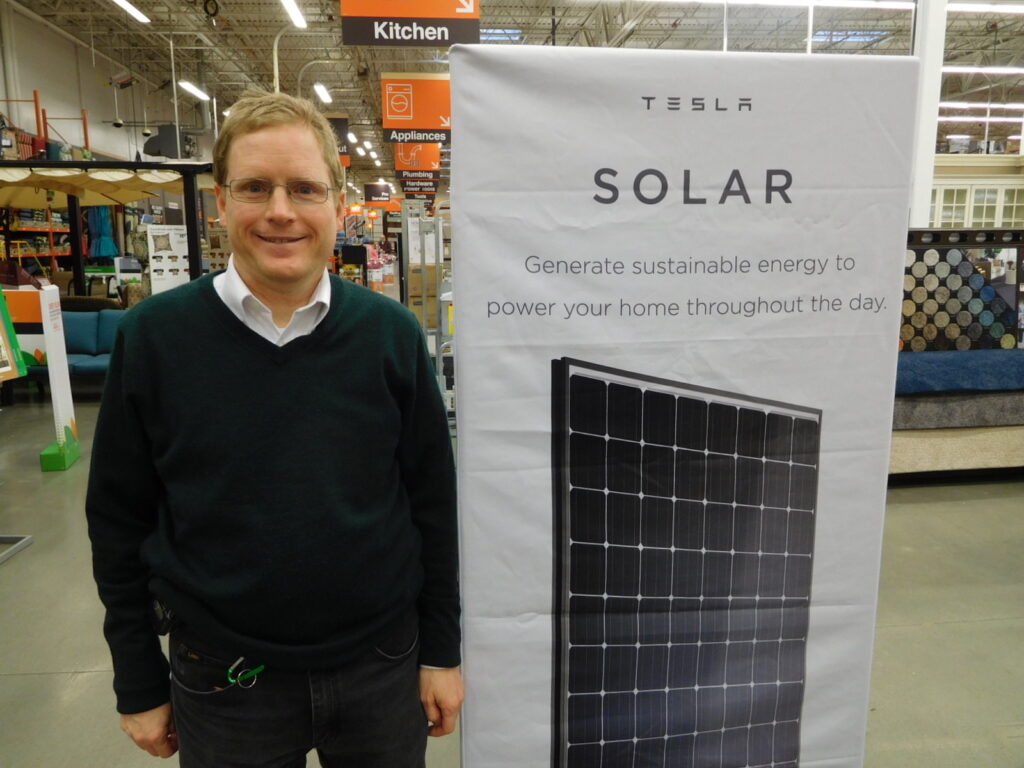
Brian Ettling working for Tesla Energy at a Home Depot in Portland OR on February 18, 2018

Balcony solar first became poplar in Germany. According to one source, “As of late June (2025), 1,009,390 balcony solar systems were registered with the German Federal Network Agency, including more than 220,000 added in the first half of 2025 alone. Given many haven’t been officially registered, Müller says that the real figure is likely to be two or three times higher.” 

Some estimates note as many as 4 million households in Germany have installed the systems, which people can order through Ikea

The demand for plug-in solar is growing in Germany with “A quarter of Germans want solar systems on their balcony or garden” in the findings of one survey

In December 2024, The Guardian reported, “Next in line after Germany in the solar stakes are Spain, Italy and Poland, while balcony power is gaining in popularity in France. Meanwhile, Belgium, which outlawed plug-in solar devices over fears of having unregistered systems feeding into the grid, will lift its ban.” 

In May 2025, Utah enacted the first law supporting plug-in solar, and now over 30 pieces of similar legislation were introduced around the U.S. The bad news is that Balcony Solar bills were delayed in Arizona, New Mexico, Washington and Wyoming. The good news is that Plug-Solar bills recently passed the Maine and Virginia Legislatures. They now sitting on the desk of state governors of those states waiting for those governors to sign those bills into law. 

The 2026 Oregon legislative session ran for 5 weeks from Monday, February 2nd to Friday, March 6th. The Oregon Constitution stipulates that “The Oregon State Legislature convenes annually in January at the State Capitol in Salem, but sessions may not exceed 160 days in odd-numbered years and 35 days in even-numbered years.” Since the even number years legislative sessions are compressed to 5 weeks, Oregon’s 90 lawmakers are allowed to introduce two bills apiece, and legislative committees can introduce three. This meant Rep. Finger McDonald would spend half of her personal political capital on this bill for the 2026 OR Legislative session. Therefore, it was vital that climate advocates, including me, showed strong support for this bill. 

On February 5th, a coalition of labor unions, Oregon Food Bank, Oregon Working Families Party, environmentalists, and teachers organized a Fight for Our Future Rally at Oregon State Capitol State Park. This rally was a loud message to OR Legislators that massive federal tax breaks for corporations and the ultra-wealthy threatened funding for Oregon schools, healthcare, and other critical community services. They called on lawmakers to step up and fight for Oregon families during the session by reigning in giveaways that only enrich the wealthy.

As a climate organizer, I volunteer with Oregon League of Conservation Voters (OLCV) and Mobilizing for Climate Action Together (MCAT). I like to attend OLCV and MCAT’s lobby days at the Oregon Capitol to urge legislators to support strong climate and environmental bills. OLCV urged its volunteers like me to attend this rally on February 5th. I told OLCV that I would be there. However, I needed to find a ride since Tanya and I share my 2002 Honda Civic. She needs that car for work, and I like to carpool to Salem to network with fellow climate organizers. Plus, I don’t like to drive, especially if I can save on gas and wear & tear on my car. Oh, I like to drive less so I am not polluting the air with more carbon emissions contributing to climate change. 

I found two friends from MCAT, Pat DeLaquil and Joseph (Joe) Stenger, who were carpooling to Salem on Thursday, February 5th. The catch was that they were leaving early that morning to give oral testimony for Rep. Finger McDonald’s Balcony Solar Bill (HB 4080). That bill was scheduled for a public hearing for the House Committee on Climate, Energy, and Environment at 8 am. That meant that we would have to meet at a TriMet park and ride lot at 6:30 am to beat the morning commute traffic from Portland to Salem to arrive in plenty of time for the hearing. 

When I learned that Pat and Joe planned to give oral testimony for the Balcony Solar Bill, I decided to sign up in advance on the Oregon Legislative Information System (OLIS) to give oral testimony. In my many years of preparing oral testimony to give to legislators in Salem, I knew they would be limiting the public comments to 2 minutes. The day before the hearing, I drafted my testimony, printed it out, and practiced it several times with a stopwatch on my Ipad to make sure I would be comfortably under 2 minutes. 

On Thursday, February 5th, I got up super early before 5 am take the bus and a MAX train to meet Pat and Joe at a southeast Portland Park and Ride lot at 6:30 pm. It typically takes around an hour to drive from Portland to Salem, depending upon traffic. The morning commute traffic was not bad to arrive in Salem around 7:40 am. That was plenty of time to try to find a place to park near the Capitol Building, pay for street parking, go through the security check point to enter the Capitol, and walk to the hearing room. The Committee meeting was held in a hearing room in the basement or now known as the “concourse” of the Capitol. 

Hearing rooms and a new restaurant in the brand new “concourse” were in use for the first time during January legislative meeting days. This portion of the capitol was closed for over three years for construction for a seismic retrofit to make the Capitol Building safer in the event of a severe Cascadia Zone earthquake. When I walked into the basement hearing room, it had a glowing ultra-modern look. I heard Oregon Senator Lew Frederick say later at his monthly town hall that the new concourse committee hearing rooms looked like “something out of Star Trek.” 
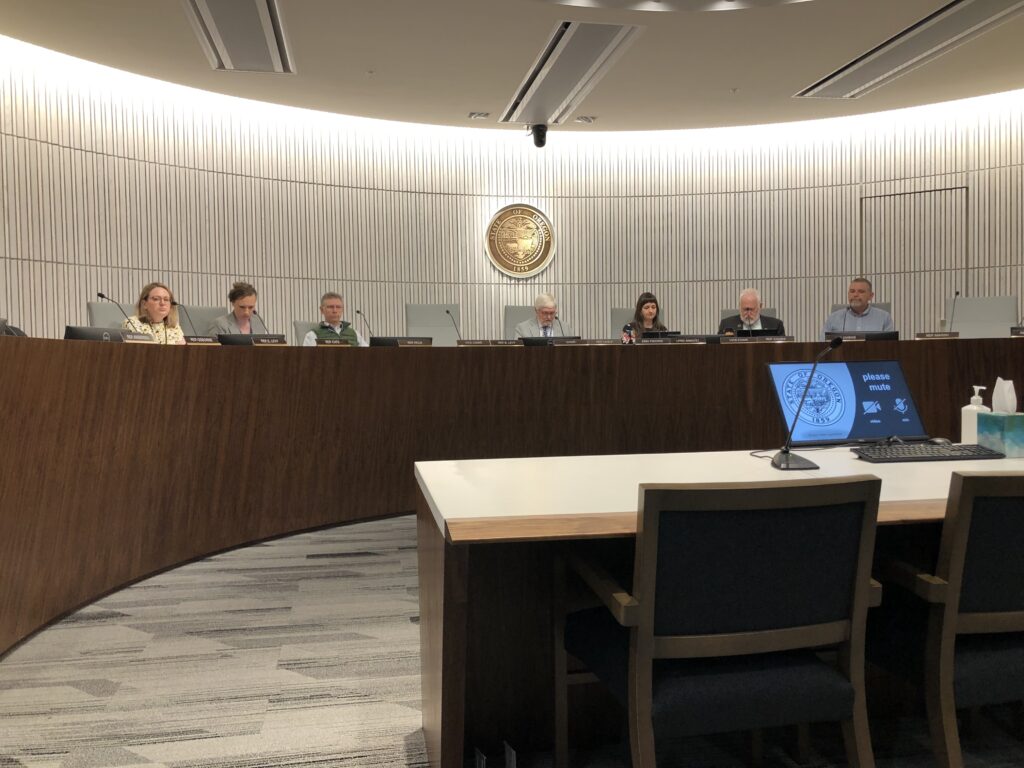
Image by Brian Ettling of one of the new hearing rooms in the concourse level of the Oregon State Capitol in Salem. Photo taken on February 5, 2026.

Pat, Joe, and I arrived at the Hearing Room just before 8 am. The gallery was full of people seated eager to give oral testimony for the Balcony Solar Bill. The committee hearings typically last around an hour and a half. The Committee Chair tries to keep a tight schedule so the legislators can leave the committee meetings at the end of the scheduled times to arrive in time for their next committee hearings or other scheduled meetings. The House Committee on Climate, Energy, and Environment had hearings on several other bills that morning. In addition, this committee meeting had work sessions where they voted on bill amendments and/or takes a final vote to pass the bill out of committee to the House Floor or send to a Joint Ways and Means Committee if it required state money or a “fiscal” in order for each legislative chamber to pass the bill. 

The Chair of the House Committee on Climate, Energy, and Environment was Rep. John Lively of Springfield, Oregon. Fortunately, the other bills in consideration for this meeting had only a few citizens signed up to give oral testimony in person or online. The work sessions for the other bills took only minutes to complete. Thus, Chair Lively was able to open the last 50 minutes of the meeting to the Balcony Solar Bill, (House Bill) HB 4080. For the next 25 minutes, the Chief Sponsors who sat on this Committee, Reps. Sarah Finger McDonald and Mark Gamba, gave oral testimony supporting the bill and answered questions from their committee colleagues. That left about 25 minutes for the public to provide oral testimony to the committee. 15 people, including me, signed up to give oral testimony. 

Chair Lively remarked that he was limiting testimony to 2 minutes to try to “accommodate the majority of people (who signed up to testify) to give them a chance to speak.” 

At this point, I was not sure if there was enough time remaining for me to give oral testimony to support this bill. Not everyone who signed up in person to testify, such as my friends, Pat DeLaquil and Joe Stenger, were able to testify. The good news was that with 9 minutes left in the committee meeting, Chair Lively called my name to give oral testimony to the committee to support HB 4080, the Balcony Solar Bill. 

My Balcony Solar (HB 4080) Oral Testimony for February 5, 2026 

Members of the Committee, my name is Brian Ettling. For the last 9 years, my wife and I live in outer northeast Portland in an apartment complex. 

For many years, I dreamed of living at a location where I could have solar panels on my roof generating some if not most of the electricity that we use. I like the apartment complex where I live. They are very quick at fixing maintenance issues in our apartment.  But, my apartment complex is owned by a large corporation that is not interested nor has any financial incentives to put solar panels on the roofs our apartment buildings. It’s sad because I have a perfectly exposed south facing roof that would be ideal installing solar panels. 

This is why I love balcony solar. It will help renters like me. If you fully support it and fight hard to pass it, you would be following the lead of the Utah Legislature that it passed unanimously in 2025 with very strong Republican and Democratic support. 

Plug-in solar opens solar to over 70% of us Oregonians who can’t benefit from rooftop solar today, such as renters and homeowners who can’t afford rooftop or have shady or unsuitable roofs. Even more, passing this bill would be a cushion against rising electric bills in Oregon. 

This bill could make solar more widely available, push down the costs, and make solar even more affordable for Oregon homeowners. 

If you support this bill and pass it, it will remind me of one of the happiest songs from my teenage years from way back in 1986, 40 years ago! The song was “The future’s so bright, I gotta wear shades.” 

Thank you for your time! 

The next day, I found the video recording of this legislative hearing on OLIS. I created my own video of my oral testimony from the OLIS video. I then uploaded my oral testimony for HB 4080 on YouTube for others to see. Here is the video: 

As I wrapped by my oral testimony quoting the Timbuk 3 song “The future’s so bright, I gotta wear shades,” I put on a pair a dark sunglass. As I hoped would happen, it received a big laugh from the legislators, the audience in the gallery, and basically everyone in the room. Republican Representative Bobbi Levy loudly chuckled and enthusiastically responded, “Great visual!” 

Only one other person had time to give oral testimony after me. His name was Karl Koening, President of the Oregon State Firefighters Council. He opposed the bill and legislators asked him questions about his opposition. The meeting adjourned after Karl spoke. Thus, I was lucky to speak to the committee to support this solar bill. 

Unfortunately, some Oregon electricians and fire marshals gave oral testimony and submitted written testimony against the Balcony Solar Bill. They primarily cited safety concerns of the balcony/plug-in solar panels potentially causing residential fires. Sadly, the testimony from the fire marshals and electricians led to Chair Lively killing the bill later in the session by not allowing it to come to the committee for a work session or final vote.  

It still felt rewarding for that chance to publicly advocate for solar power for renters like me. 

My Oral Testimony for the Make Polluters Pay or Climate Resilience Superfund Bill 

The same day I testified to support the Balcony solar Bill, I also gave oral testimony in support of the Make Polluters Pay or Climate Resilience Superfund Bill, SB 1541. This was a Senate Natural Resources and Wildfire Committee bill put forward by the Chair, Senator Jeff Golden.

This 2026 bill was similar to a Climate Resilience Superfund Bill that Senator Golden introduced in the 2025 Oregon Legislative session, SB 1187. That 2025 bill was referred to the Senate Committee on Energy and the Environment. At that time, the chair of the committee was Senator Janeen Sollman. She held a hearing this bill on April 7 and 9, 2025.

In writing this blog, I forgot I gave oral testimony for SB 1187 on April 7, 2025. Fortunately, I found the one minute video clip of my oral testimony I made that I posted on my social media on April 9, 2025. I created that video clip from OLIS video recording from the April 7th Senate Energy and Environment Committee hearing. While creating this blog, I posted it to YouTube. Here is the video:

Sadly, Senator Sollman did not schedule a work session for the bill, so the 2025 bill died in her committee. Senator Golden thought it was important to introduce the bill into the 2026 OR Legislative session. Even more, he made sure the bill was assigned to the Senate Natural Resources and Wildfire Committee. He was the Chair of that committee. Thus, he could schedule a public hearing and work session to guide it forward out of his committee. 

The Oregonian described SB 1541 as establishing “a climate disaster fund, allowing the state to recoup the costs of responding to wildfires, droughts and heat domes and help respond and prepare for extreme weather. The bill is named and modeled after the 1980s-era federal Superfund program that requires polluters to pay for cleaning up the nation’s most contaminated land.

The ‘Climate Superfund’ bill targets multi-national companies that produce and sell crude oil, natural gas and coal – such as Exxon or Chevron – based on their historical greenhouse gas emissions. Just 32 companies have been linked to over half of global fossil fuel and cement CO2 emissions in 2024, according to a database of historical production data from 178 of the world’s largest fossil fuel and cement producers.” 

The SB 1541 was modeled after the Climate Superfund Bills that already passed in states such as New York and Vermont, plus considered recently by other state legislatures. 

Nearly every Oregon climate and environmental group that I volunteered with or had partnered in the past made it their top priority for the Oregon Legislature to try to pass this bill for the Oregon 2026 Legislative session. These groups included OLCV, MCAT, Building Resilience Coalition, 350PDX, Third Act Oregon, Oregon Environmental Council, and others that made up the Make Polluters Pay Coalition. 

I attended the 350PDX Make Polluters Pay Action Night on January 22, 2026, to energize Oregon climate and environmental advocates to contact their legislators, sign up to give oral and written testimony supporting the bill to the Oregon Legislature, and attend the Make Polluters Pay Lobby Day in Salem on Monday, February 16th. Many of the environmental and climate groups from the Make Polluters Pay Coalition were in attendance that evening.  Third Act Oregon had their own Zoom Call to organize volunteers for Make Polluters Pay on January 28th. MCAT had their general meeting on January 22nd requesting their volunteers to contact legislators to support the Make Polluters Pay or Climate Resilience Superfund bill. 
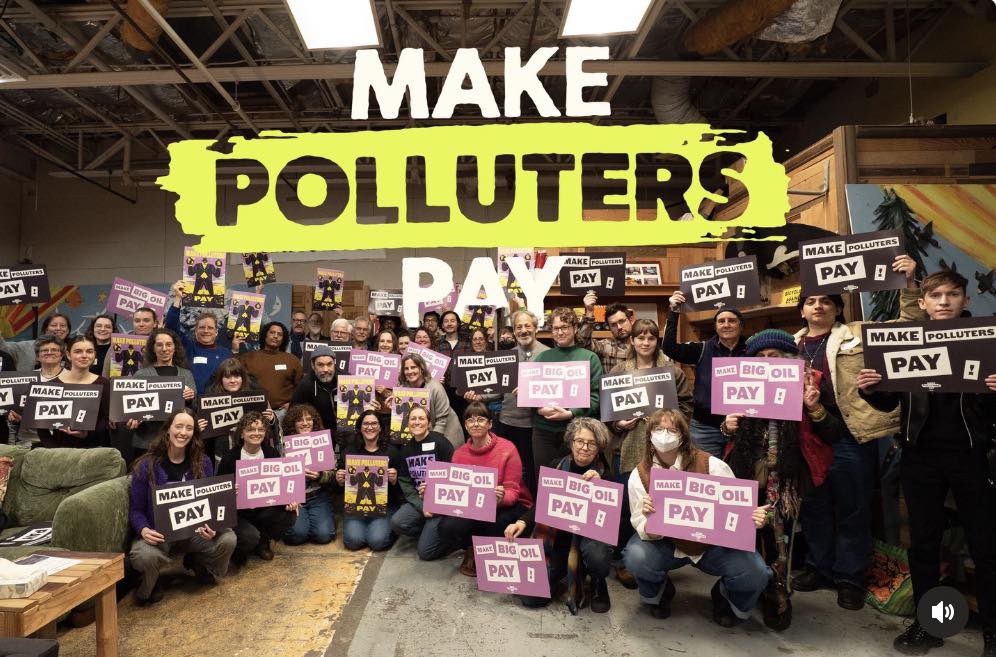
Brian Ettling pictured in the back left side of this group photo wearing a blue sweater. Photo taken at the 350PDX Make Polluters Pay Action night on January 22, 2026. Photo from the Oregon page of the Make Polluters Make website.

Many years earlier, I attended a training in San Francisco, California in 2012 led by former Vice President Al Gore to become a Climate Reality Leader. Thus, I have been involved with the Climate Reality Project since then. I am active in the Climate Reality Portland OR Chapter since it was founded in 2017. The Climate Reality Project had a national zoom call on January 28th to urge Climate Reality Leaders nationwide to contact their legislators to support Make Polluters Pay bills in their states. 

At the beginning of February, the Climate Reality Portland Chapter asked me to give oral testimony on behalf of the chapter soon after it was announced that the Oregon Legislative Senate Natural Resources and Wildfire Committee would hold a hearing on the Climate Resilience Superfund Bill, 1541, on February 5th. They figured I would probably be in Salem that day for some kind of environmental or climate lobby day. I planned to be in Salem for the Fight for Our Future Rally at noon that day. I was happy to give oral testimony presenting the chapter supporting the Make Polluters Pay Bill at the hearing on that afternoon of February 5th. The chapter leadership scripted the oral testimony for me for me to read to the Senate Committee. 

Just like my testimony for the Balcony Solar Bill HB 4080, I printed out my oral testimony at home two days before February 5th. I then practiced it several times so I was familiar with the words and to make sure I was under the typical 2 minutes allow for members of the public to give oral testimony to the legislative committees. 

After I gave the oral testimony on the Balcony Solar Bill on Thursday morning, February 5th, I had time that morning to catch up on emails, have an early lunch, and wander inside the building to chat with various legislative staff. I then left the Capitol Building just before noon to walk to the plaza on the north side of the Capitol to attend the Fight for Our Future Rally. I was there at noon when the rally was supposed to start. However, the rally still had not started at noon. I talked with several organizers from around Oregon that I knew already. 

I heard buzz that morning that many citizen advocates planned to attend the 1 pm hearing to give oral testimony to support the Make Polluters Pay Bill, SB 1541. Around 12:15 pm, I thought it was best for me to leave the rally, which still had not officially started yet, and head back inside the Capitol to try to get a good seat in the hearing room for the 1 pm Senate Committee hearing on SB 1541. 
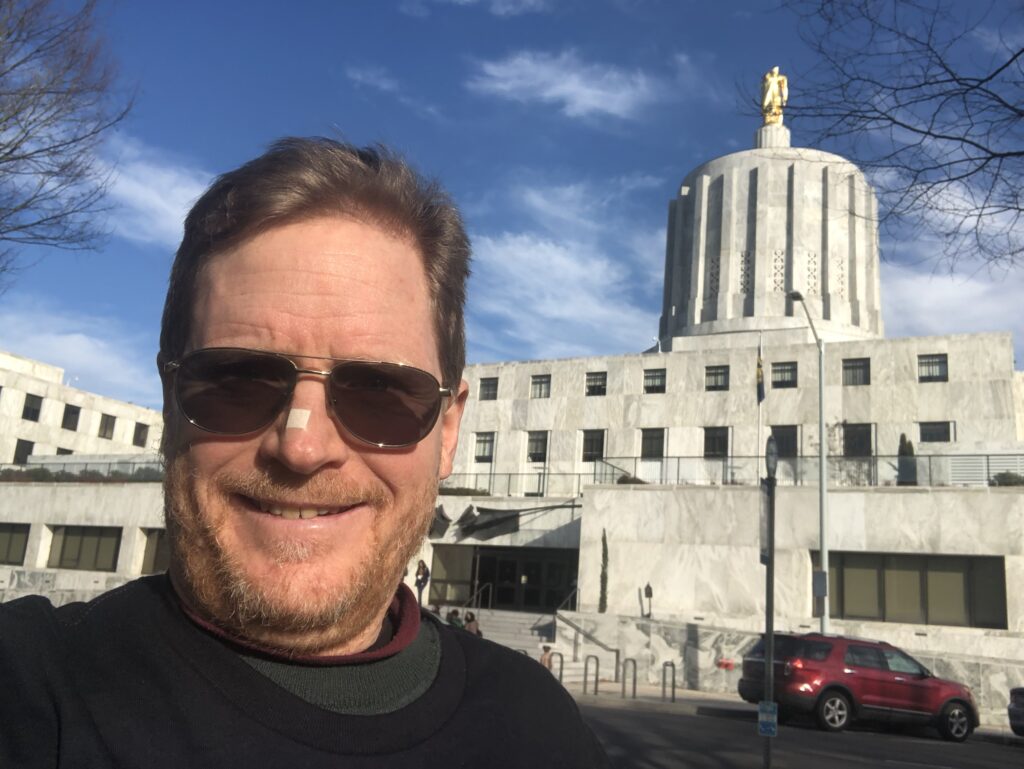
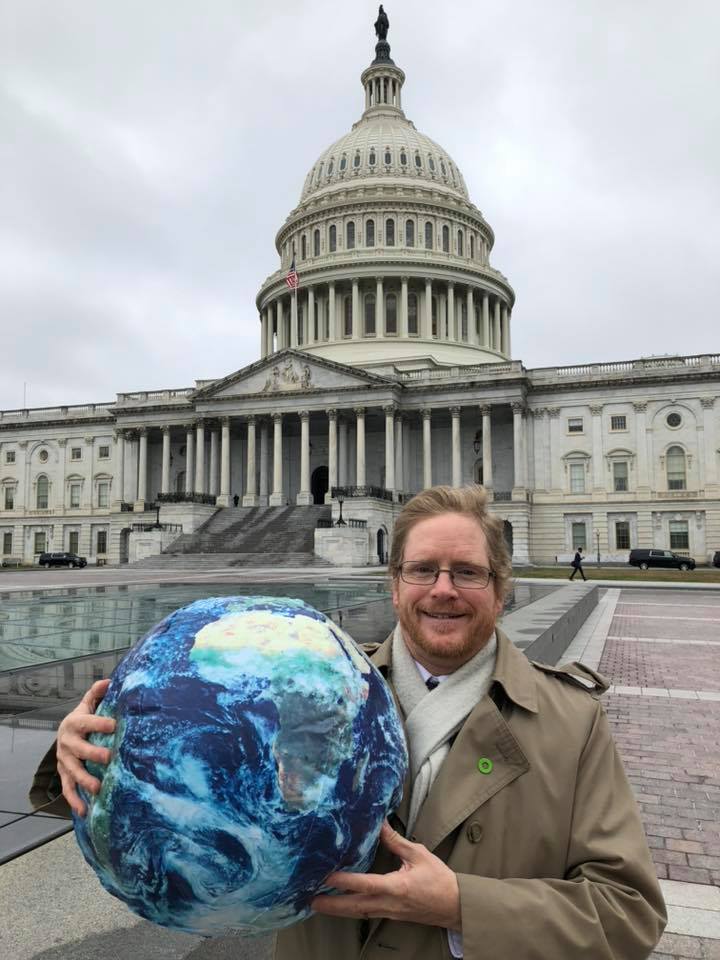
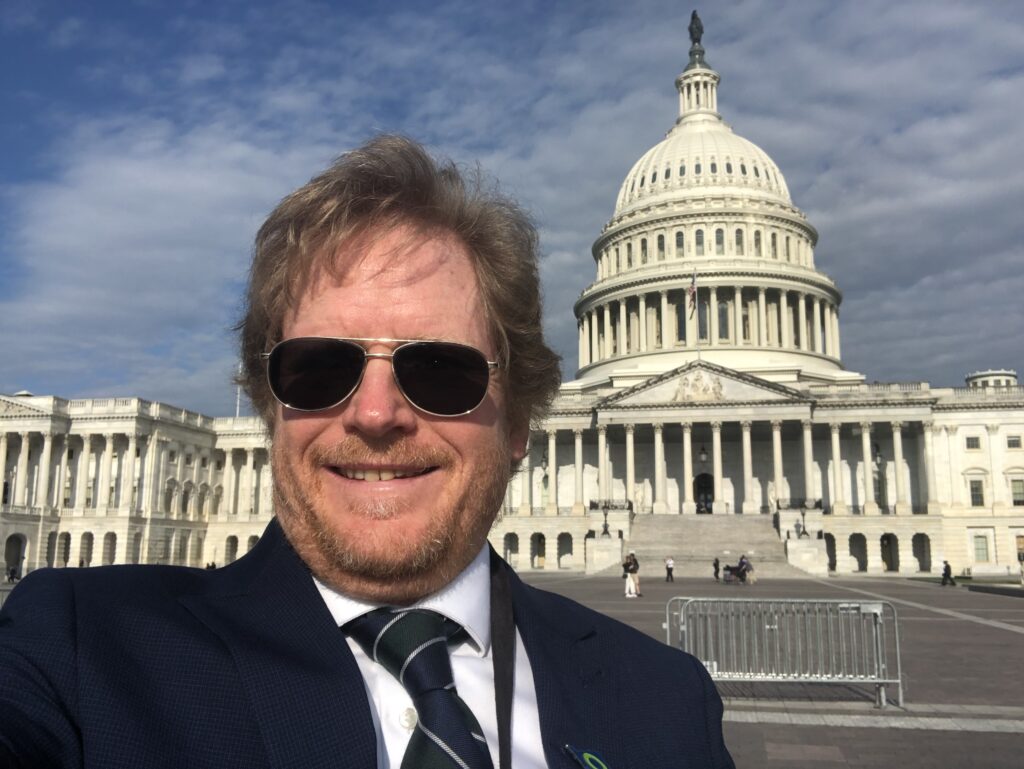
Brian Ettling in front of the Oregon State Capitol in Salem on February 5, 2026.

I encountered a long line of people which took around 10 minutes to get through the Capitol Security to go inside the Capitol Building. The good news was I arrived as soon as Capitol Security opened up the hearing room around 12:30 pm. I secured seats in the second row for Pat, Joe, and me. The gallery quickly filled up with citizen advocates hoping to give oral testimony on SB 1541. Not everyone would fit in this room. Capitol Security then opened an overflow room so people looking to attend and testify could still watch the hearing on a large video monitor. 

As the hearing gallery filled up with advocates just before the hearing started at 1 pm, Jacqui Treiger, Senior Campaign Manager for Oregon Environmental Council, was asking for people like me who signed up to give oral testimony to say, “Due to the large number of individuals who want to speak in favor of this bill, I will defer the rest of my allotted time to them.”  

Jacqui stated we had individuals who planned to speak who lost their homes to wildfires. We wanted to leave enough time for them to share their stories in their testimony. I gave oral testimony to OR Legislative committees numerous times over the years. Yet, I still get nervous when I am called forward by the Committee Chair to testify. Thus, I was relieved I could give that statement if called forward to testify to hopefully allow others the chance to testify. 

A few minutes after 1 pm, the Committee Chair, Senator Jeff Golden, gaveled in for the committee meeting to start. He informed the room: 

“We have a single bill to consider today: a public hearing on Senate Bill 1541. We have more people signed up to testify than we have more time to get to (them), so we have a panel in the first part of this that’s going to thoroughly explain the bill. Then I am going to be giving preference to people who are here in person and then, if we can, go to remote (oral testimony). And I always hate to say this, but we are going to be limiting testimony to 1 minute, and I know some of you have more to say than that. What’s really important to know is that we welcome your testimony in written form up to 48 hours from right now…

We know the level of interest here and we really do want to hear from you. Sorry that our time is as limited as it is. 

Opening the hearing on Senate Bill 1541…

I see myself as the first name to testify and I think I am going to really limit my remarks to try to get as many people in as possible. 

I will answer one question that I heard which is ‘Why do you bring a bill of this scale to the short session and my view is that in the last few years has proven that Oregon is on a path to complete disaster if something doesn’t change because of the scale of the costs of climate related damages and events, caused primarily from wildfires, of course. Those costs go into the billions already, and every indication is that they are going to increase. And unless we change direction and change our approach, I believe that Oregon local governments and special districts are headed to bankruptcy. State government itself might be headed towards bankruptcy. And what we know for sure is that Oregonians will be facing huge increases in their basis bills, primarily their insurance premiums and their utility bills. We have seen those double digit increases already and we are going to see more of them, so my view is that this bill needs to come to the table for serious consideration every session long or short until something changes.” 

About one hour into the hearing, I was called up to the front by Senator Golden to give oral testimony on SB 1541. To save on time to allow others to testify, especially those who lost homes to extreme wildfires, this is what I said in 30 seconds: 

“Chair Golden and members of the Committee, my name is Brian Ettling. I am speaking on behalf of the Climate Reality Portland Chapter to urge you to support the Climate Resilience Super Fund Bill, SB 1541. Due to the large number of individuals who yet want to speak in favor of this bill, I will defer the rest of my allotted time to them. Please refer to our written comments. Please support SB 1541. Thank you so much for your time.” 

A few days later, I found the video recording of this legislative hearing on OLIS. I created my own video of my oral testimony from the OLIS video. I then uploaded my oral testimony for SB 1541 on YouTube for others to see. Here is the video: 

I felt bad I did not read the full text of the oral testimony that Climate Reality Portland Chapter prepared for me. At the same time, I wanted to be a team player for the Make Polluters Pay coalition hoping to squeeze in as much oral testimony from advocates as possible. We especially wanted to lift the voices of the young and survivors of wildfires and other climate disasters. 

When I exchanged emails with the Climate Reality Portland Chapter Chair, Helena Birecki, later that day, she sent a gracious and appreciative email. She wrote: 

“I was able to (watch the hearing live on OLIS) just as you started speaking. Really appreciate you being there, And for ceding your time asking them to read our written testimony. You are wonderful.”

I will include at the end of this blog the prepared oral testimony from the Climate Reality Portland Chapter that they wanted me to read during the hearing. 

The next day, Oregon Public Broadcasting (OPB), reported about the hearing, “Roughly 60 audience members, including many hoping to give in-person testimony, filled the hearing room Thursday. Overall, more than 70 people signed up to provide in-person or online testimony. Many supported the bill, with advocates ranging from local government officials and religious leaders to wildland firefighters describing the impacts of extreme weather events in their backyards.” 

Unlike 2025, Senator Golden successfully got SB 1541 passed out of his committee on February 10, 2026. It passed on a party line vote of 3 to 2 with all 3 Democratic Senators in support and the 2 Republican Senators opposed. The bill went to Ways and Means where it died. I heard secondhand that Senator Golden thought it would take around $1 million dollars of state funds to enact the bill. However, at the MCAT Geneal meeting on March 25th, Ways and Means estimated the bill to cost $6 million dollars. Due to a huge budget shortfall, the Ways and Means Committee Chairs and members basically killed any bills requiring state funding or a “fiscal.” This is due to Oregon experiencing a massive budget shortfall because of the federal H.R. 1, known as the “Big Beautiful Bill.” 

Senator Golden remarked at the beginning of the February 5th hearing, because of the financial damage climate change is costing Oregon each year, “this bill needs to come to the table for serious consideration every session long or short until something changes.”

Unfortunately, Senator Jeff Golden announced in February 2026 that he was not running again for his Oregon Senate seat and he was retiring from the Oregon Legislature. In his absence in future legislative session, I hope another legislator will step forward to pass a Make Polluters Pay Bill, similar to SB 1541. 

I hope to be around and available to help lobby to get this bill passed in Oregon in the future. Although neither one of these bills passed the Oregon Legislature in 2026, they still gave me hope for the future. I am feeling optimism for a brighter day. It reminds me of what George Harrison sang in the Beatles song, “Here Comes the Sun,” 

“Here comes the sun
Here comes the sun
And I say, ‘It’s all right’”
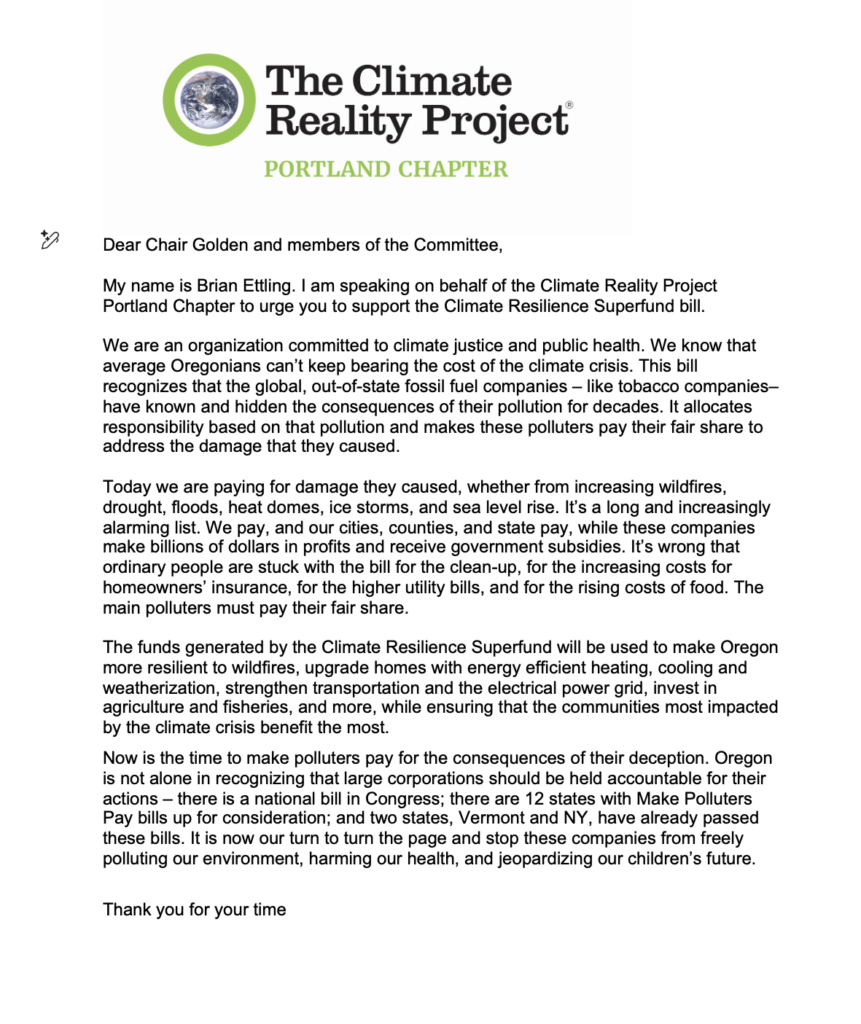
Copy of the prepared oral testimony text Brian Ettling planned to read on behalf the Climate Reality Project Portland OR Chapter for the public hearing for SB 1541, the Climate Resilience Super Fund Bill, held at the Oregon Senate Natural Resources and Wildfire Committee on February 5, 2026. Climate Reality Portland Leadership drafted the oral testimony, with Brian Ettling, making small edits, such as stating his name for the record and small edits so that the oral testimony would fit into the 2 minute time constraint.

For our democracy, helping to organize an Oregon Congressional Candidate Climate Forum in April 2024

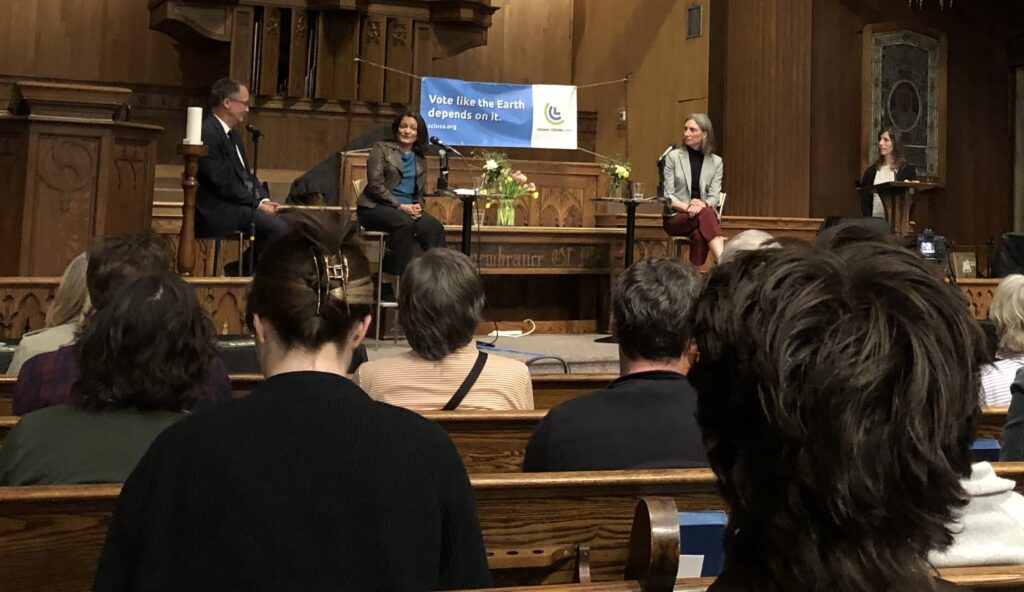
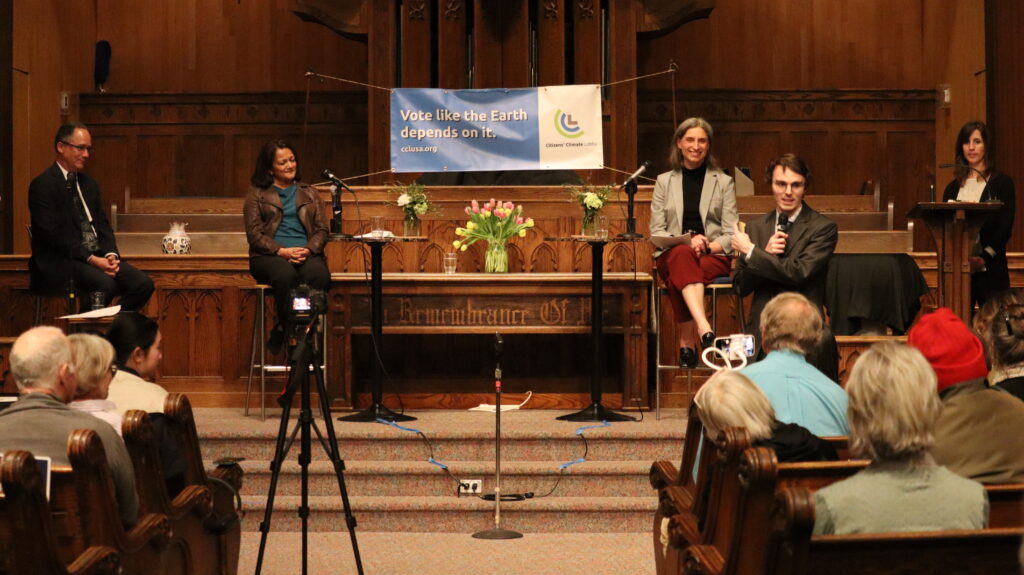
Photo from the Portland Citizens’ Climate Lobby Oregon Congressional Candidate 03 Climate Forum on April 18, 2024 at Taborspace in Portland, Oregon. On stage, from left to right, Moderator Matt Zaffino, Multnomah County Commissioner Susheela Jayapal, Oregon Representative Maxine Dexter, and Jana Gastellum, Executive Director of the Oregon Environmental Council.

“It is not the critic who counts: not the man who points out how the strong man stumbles or where the doer of deeds could have done better. The credit belongs to the man who is actually in the arena, whose face is marred by dust and sweat and blood, who strives valiantly, who errs and comes up short again and again, because there is no effort without error or shortcoming, but who knows the great enthusiasms, the great devotions, who spends himself in a worthy cause; who, at the best, knows, in the end, the triumph of high achievement, and who, at the worst, if he fails, at least he fails while daring greatly, so that his place shall never be with those cold and timid souls who knew neither victory nor defeat.”

—Theodore Roosevelt quote from the “Man in the Arena
Speech at the Sorbonne, Paris, April 23, 1910

On October 30, 2023, U.S. Rep. Earl Blumenauer, a Portland Democrat representing Oregon Congressional District 3, announced his retirement from Congress. In December 2023, Dylan Hinson, a volunteer with the Portland Chapter of Citizens’ Climate Lobby (CCL), came to me with an idea to have a CCL Congressional Candidate District 3 Climate Forum a month before the Tuesday, May 21st Democratic Primary. The goal of this forum was to interview the leading Democratic candidates to learn their positions for the top climate issues CCL prioritizes for lobbying Congress, such as a price on carbon, healthy forests, clean energy permitting reform, and building electrification & efficiency. 

Representative Earl Blumenauer was first elected to Congress to serve this Portland district in 1996. Portland CCL hoped that a good candidate forum would help establish a good rapport with the Democratic candidate that would succeed Blumenauer. Oregon Congressional District 3 is considered one of the bluest and safest Democratic seats in the U.S. Thus, a Congressional climate forum with the leading candidates before the May 21st primary election could help the undecided Democratic voters pick which candidate they would want to serve in this seat. 

Earl Blumenauer was my member of Congress since my wife Tanya and I moved to Portland in February 2017. I met Rep. Blumenauer several times while he served in Congress. I experienced only one occasion where he was friendly, Sunday July 14, 2019. Congressman Blumenauer held an outdoor event in front of the Oregon Sierra Club Office, located in inner southeast Portland. His office and other local climate and environmental groups organized a rally rolling out of his Climate Emergency Resolution.

Before this Portland event, Rep. Blumenauer introduced this resolution with Rep. Alexandria Ocasio-Cortez and Senator Bernie Sanders in Washington D.C on July 10, 2019. By the time of this Portland rally, It was co-sponsored by more than 50 House Members and 10 Senators. Later, this resolution reached up to 103 House co-sponsors. Thus, Blumenauer was in good spirits that Sunday July 14th rally in Portland, Oregon.

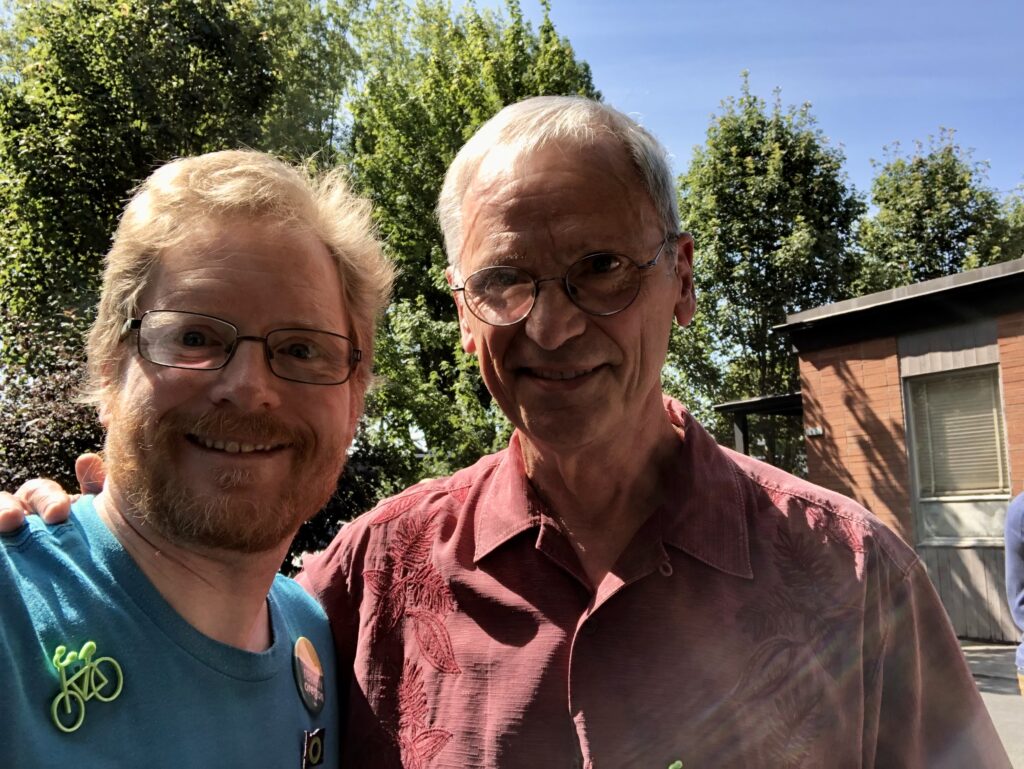
Just before this July 2019 event, the attendees and organizers stood around mingling waiting for the rally to start. At that moment, Blumenauer walked up to me. He was pleasant and lovely to have a conversation. He happily agreed to pose for a selfie photo with me.

Brian Ettling and Congressman Earl Blumenauer in southeast Portland, Oregon on July 14, 2019.

All the other times I engaged with Blumenauer, I found him to be grumpy and acted uninterested in talking with me. Just one week earlier, on July 8, 2019, I tried to strike up a conversation with him at a campaign event for Washington Governor Jay Inslee when he ran for President for the 2020 election. I introduced myself as a climate organizer and a volunteer with (CCL). I thanked Blumenauer for all his work in Congress for climate action, including his recently introduced climate emergency resolution. He acted cold and like I was beneath his time to talk with me. I left that event feeling disappointed and discouraged meeting him for the first time.

On October 4, 2019, a group of Portland CCL constituents and I met with Rep. Blumenauer at the Portland Greek Festival. He acted condescending and prickly when we asked him at that time to support the primarily bill that CCL was lobbying for at that time, the Energy Innovation and Carbon Dividend Act. He became irritated when we mentioned that bill and acted uninterested in supporting it. In nearly all my interactions with him over the years, he gave me the impression that he was burned out working in Congress and interacting with constituents like me. Frankly, with his negative attitude, I wanted him to retire from Congress for years. 

By February 2024, it was apparent that Multnomah County Commissioner Susheela Jayapal, Oregon Representative Maxine Dexter, and Gresham City Councilor Eddy Morales were the leading contenders for this Congressional seat. 

I first lobbied Dr. Maxine Dexter in December 2020 when she was elected to serve in the Oregon Legislature one month before. In my Zoom meeting with her, successfully lobbied her to endorse CCL’s federal bill Energy Innovation Carbon Dividend Act (EICDA), H.R.5744. In addition, I persuaded her sponsor a resolution in the Oregon Legislature later known as SJM 5 that urged Congress to pass bipartisan climate bill to price cardon such as the EICDA. I found her to be very helpful and supportive working on climate issues while she served in the Legislature.  

Eddy Morales and I knew each other for a couple of years. In 2022, I worked as a field organizer for the organization he founded in 2018, East County Rising. I found Eddy to be very friendly, caring, with a sincere interest to improve the lives of people around him. 

I enjoyed attending Eddy Morales’ Campaign Kick Off Event in southeast Portland at the Mexican restaurant Mi Cava & Cocina on November 12, 2013. The restaurant event room was packed full of friends, family, and supporters from around the Portland area. It was an impressive start to his campaign. At that point, I was undecided who I would support for this Congressional campaign. I wanted to see who else would enter this race. At the same time, I was amazed by the turnout and the show of support for Eddy that day. At that time, he looked liked a viable candidate and a serious contender for this Congressional seat.

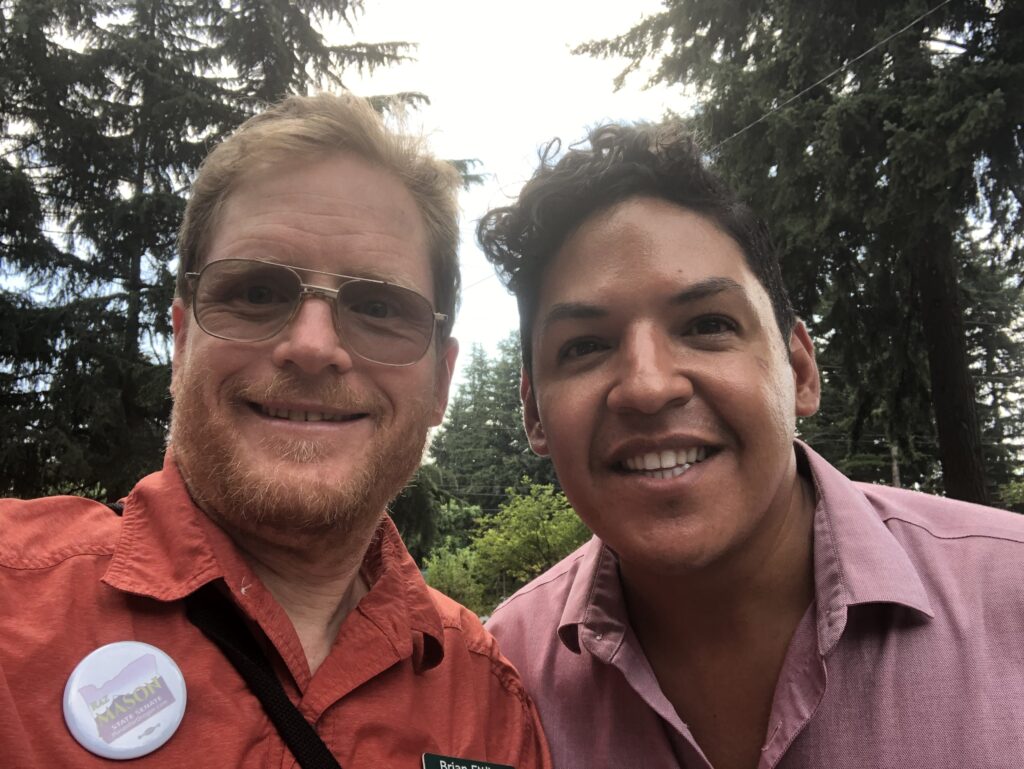
Brian Ettling and Eddy Morales. Photo taken at the East County Rising Picnic in Portland, Oregon on July 30, 2022.

I only knew about Susheela Jayapal from newspaper and media reports. She seemed to be a good County Commissioner. I don’t remember having any issues against her. She quickly positioned herself as the most progressive Democratic candidate running for this office. At that time, I thought she might win since Oregon District 3 is a very progressive district. She seemed to be well known as a County Commissioner. Plus, she was the sister of Congresswoman Pramila Jayapal, who represented neighboring state Washington’s 7th Congressional District. At that time, U.S. Rep. Jayapal was the leader of the Progressive Caucus in Congress. 

In the planning meetings for the Congressional Forum in February 2024, the Portland CCL planning team struggled with coming up with a date, event location, and which candidates to invite. After the filing deadline of March 12, 2024, seven candidates filed to run for this seat. We had much discussion if we should invite all the candidates. I highly encouraged the team to just invite the three leading candidates that would most likely win this race: Maxine Dexter, Susheela Jayapal, and Eddy Morales. Some of the group worried about offending the other candidates by not inviting them. The committee decided to invite all the candidates, but the candidates’ campaigns must demonstrate that they had received a total of at least $50,000 by March 8th 2024. 

The planning group struggled to find a location for the Candidate Climate Forum. They endlessly discussed different school auditoriums that would be ideal, but none of the options seemed good. I suggested the Sanctuary Room at Taborspace, a community event gathering space in southeast Portland. I helped organize a Climate Reality Portland Chapter event there in June 2019. The Sanctuary Room easily held 250 people. Some of the committee members were tepid if we could fill that space. My response was, “We are going to fill that space!” 

The team had uncertainty about what date to pick. I pushed to choose a date quickly so we could invite the candidates soon before their campaign scheduled was booked. Members of the committee reached out to the candidates in early February. Thursday, April 18th was the best date available for them. A committee member put down a deposit for the Tabor Space. Now was my favorite part: making sure that we get out the word to pack the room for the event. 

As the calendar turned to March, I volunteered to be the Marketing Coordinator for the event.  Dylan sent out an email among the committee members that role that was available and needed to be filled. After I claimed that role, Dylan informed me that they had three people helping with marketing, but no one leading or coordinating the efforts. I reached out to the three volunteers to see if any of them had created a graphic image for the event. They had not. I asked them if they could create something soon since we about a month away from the event. Their response was very slow, so I decided I would create a marketing image for the event. 

We received confirmations from the campaigns of Maxine Dexter and Susheela Jayapal that they could attend the event. However, we could not get a commitment from Eddy Morales’ campaign. The message we received from his campaign on February 16th was “Unfortunately we’re unable to commit to this event as we’re only scheduling events 2-3 weeks out at this time. We will, however, keep this on our radar and touch base as the date gets closer.” 

Several weeks went and we had not heard further from the Morales campaign. This was making it tough for me to create a graphic image for the event. Should I include Eddy or not? On March 11th, we received this email from his campaign, “I don’t think we’re going to be able to attend at the moment. If our calendar frees up, we will let you know.” 

The uncertainty if Eddy would attend created a lot of division among the committee members whether we should use his image or not. I created two separate images, one that included Susheela, Maxine, and Eddy and one that had Susheela and Maxine without Eddy. We determined in mid-March that he would probably be a no show. On March 15th, I then sent out over 65 emails and texts to friends and people I knew in the Portland area to invite them to attend this event. I included a graphic image of the event that photos of only Maxine and Susheela. I aimed to get a big crowd for this event. 

We finally heard back from Eddy’s campaign on March 28th that he would not be able to attend our forum. A few days later, I learned he could not attend because he was committed to a campaign fundraising event in Washington D.C. 

On March 12th, few days before I sent all those emails to friends inviting them to the candidate climate event, I sent an email to the campaigns of Susheela, Maxine, and Eddy. I wrote that I was an undecided voter alarmed about climate change. I stated that I was a CCL volunteer, and I looked forward to seeing them at the April 18th CCL Candidate Climate forum. I directly asked them this question: “Will you be willing to do the heavy lifting that many climate scientists and economists say that is required to reduce our dependence on fossil fuel fossils, such as a carbon fee & dividend, permitting reform, a carbon border adjustment, and other tools that are needed to truly reduce the threat of climate change?” 

I never heard back from Eddy Morales or his campaign about this email.

Maxine personally wrote to me and gave a long-detailed response. She shared how she was “As the only scientist and person who has passed large-scale environmental legislation in this race, I am uniquely qualified to tackle the climate crisis in Congress. As a physician, my job requires me to learn from data and distill complex science to patients. In Salem, I leveraged that strength to work with my colleagues and pass major environmental wins.”

She wrote her environmental accomplishments while working in the Oregon Legislature. I included the full email from Maxine to me from March 21, 2024 at the end of this blog.

A campaign staff person for Susheela’s campaign named Andrea emailed me back a few days later after I sent my email to them.

from: Susheela Jayapal campaign@susheelaforcongress.com
to: Brian Ettling
date: Mar 19, 2024, 4:42 PM

“Hey Brian, this is Andrea, a campaign staffer, responding here on behalf of the campaign! Thank you so much for reaching out and sharing your deep concerns about climate change, a cause very close to Susheela’s heart. I truly appreciate your long-standing commitment to environmental stewardship. 

Not sure if you saw the news but the Sierra Club and every other environmental organization (Climate Hawks, Food & Water Action, Friends of Earth, Sunrise PDX, more on our website), In Congress she will fight for a green new deal, phasing out fossil fuels (she’s also pledged not to take corporate PAC money or fossil fuel money), implementing a carbon fee & dividend, permitting reform, and a carbon border adjustment. 

That said – she really likes working with people who have a deeper and broader level of expertise on these issues to co-create policy – and I hope that is something you would be interested in? 

We are actually hosting our office opening this Saturday and we would love to have you come by and talk more about this if you’re interested

I signed up to attend and I went to Susheela’s gathering on March 23, 2024. I arrived just as the campaign took a group photo with everyone at their event. I stood in the far corner of the photo since I was still an uncommitted voter and unsure who I was voting for then. 

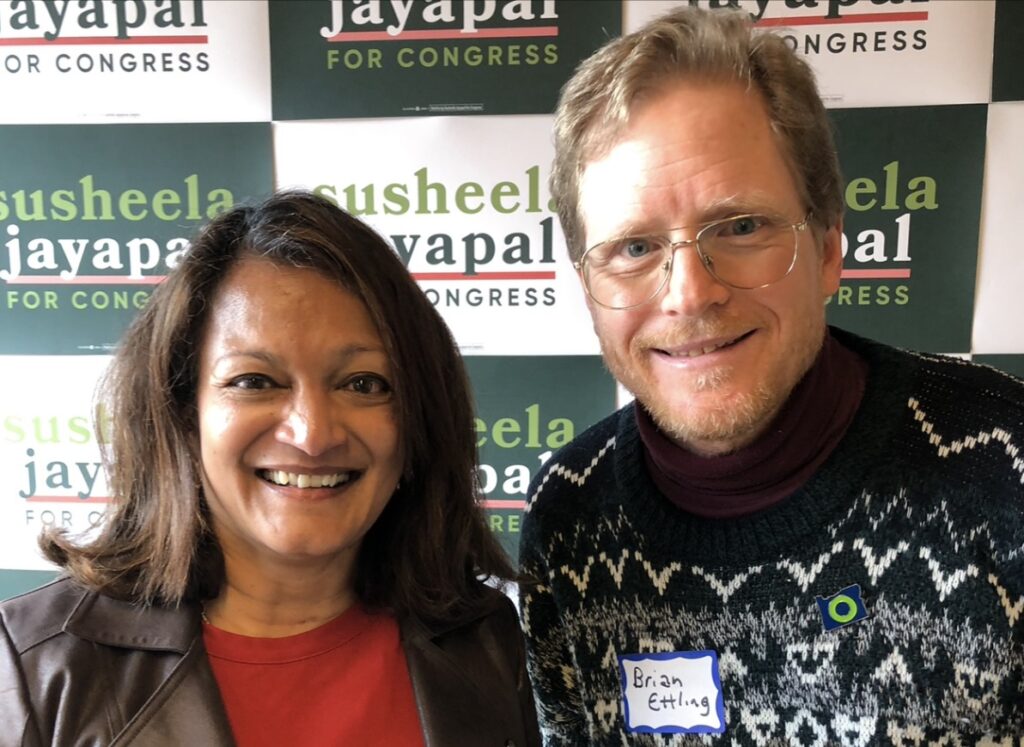
Susheela Jayapal and Brian Ettling at the opening of her Portland Congressional Campaign office on March 23, 2024.

I enjoyed mingling with her supporters and campaign staff. As the event started to wind down and some folks started to leave, I had an opportunity to talk with Susheela Jayapal. I thanked her for committing to attend the April 18th CCL climate forum. She acknowledged that she knew about the event and look forward to attending. 

Susheela confided to me that she was under a lot of pressure to make fundraising phone calls. Thus, she was eager to attend our forum for a chance to engage with voters. I informed her that many of these voters are still undecided like me, so this would be a great opportunity for her to connect with voters. I found her to be very gracious, personable, calm, and a great listener. I left the event still open minded who I would vote for. However, I thought she was an engaging conversationist and a caring individual that I would be proud to have as my member of Congress. 

April 2024 started amazing with a week-long trip back to St. Louis, Missouri for my wife Tanya and me to see family. This vacation centered around a day long road trip to southern Illinois to see the solar eclipse on April 8, 2024. Seeing the eclipse was one of the highlights of my life. In January 2025, I blogged about it: 2024 Solar Eclipse Renewed me to take Climate Action

As our St. Louis trip reached its final days, our CCL Portland planning team received an email from Michael Jonas on Friday, April 12th. Michael was a community advocate, businessman, and attorney who was a Democratic candidate for the Oregon 3rd Congressional District. He stated one of his supporters brought the forum to his attention. He wondered why he was not invited. He wrote he was available on April 18th. He asked us to remedy the situation and invite him. A member of our team emailed him back on Saturday, April 13th to say we were sorry at that time it was not be possible to include another candidate at our forum. He explained to Michael that our group created objective qualification criteria that candidates must prove they could meet to qualify for the forum. One of those criteria was for a response to our inquiry by March 8th.

Michael then provided an email from this campaign manager dated on Thursday, February 29th that they wanted to participate in the forum, and they put it on their calendar. In the email, they admitted that they would probably not reach a key criterion to attend. The stipulation was that received a total of at least $50,000 by March 8, 2024, as documented in the Campaign Finance Database of the Federal Elections Commission or by demonstrating through other documentation the financial viability of the campaign. They admitted that they only had over $12,000 in donations and would probably not reach the $50,000 limit by March 8th

Michael thought the donation threshold to attend was arbitrary. He believed he should still be allowed to participate in the forum. In fact, the idea of accumulating large donations as a top consideration as a serious candidate was something he was fighting against in his campaign for Congress. In a further email on Saturday, April 13th, Michael threatened with counter programming if we did not invite him. He relayed he had several supporters ask him why he was not included. He even offered to bring his own podium of reclaimed wood to attend. 

I thought it was the best decision to not include him the forum. My experience with political canvassing is that many voters are swayed by ads they see on TV. Raising donations for TV and media exposure does make a difference. Sadly, many voters are very busy living their lives and they do base their decisions on who they liked on TV, the 30 second ads, and who the people around them are voting for. Yes, money does matter in politics to run TV ads, pay people to get the message out, and recruit to hire canvassers. The fact he had not raised a lot of donations was a key factor for me. I did not see him getting an endorsement from the Oregonian, Tribune, or other prominent media sources. Even more, he has no legislative or government experience, unlike Maxine Dexter, Susheela Jayapal, or Eddy Morales.

On Tuesday, April 16th, our planning committee had our final planning meeting before the Thursday event. We decided that Michael’s campaign did not meet our fundraising criteria that we set back in February. Our decision was final and our primary contact with Michael sent him an email conveying our decision. Michael sent a very terse response rebuking our decision. 

At this point, I decided to act to send an email to Michael Jonas the day before the forum. His angry response showed me that he didn’t have the temperament for me to be my member of Congress. However, I worried how Michael and his supporters would see the Citizens’ Climate Lobby brand. CCL prides itself on empowering their supporters to build positive relationships with elected officials, the media and their local community to achieve effective climate change solutions. Thus, I reached out to him offering to meet to chat. 

In the email, I introduced myself to Michael as a climate organizer in Portland and I am part of the CCL planning committee that is putting together the April 18th Congressional 03 Candidate Climate Forum. I thanked him for running for office and shared how much I admired his dedication and effort to do that. I shared that Michael’s email was forwarded to me about his frustration having been left off the final selection process for the forum. While other committee members made the final decision, I agreed with their decision. On the other hand, I wanted to meet with him sometime to hear what he had to say. 

I emphasized in the email that All of us live in the Portland area. We love our community. We are very worried about climate change and want to be part of the solution. If we are going to make progress on issues that we all care about, we do need to find ways to communicate, listen, partner when we find common ground, and maintain an ongoing positive relationship. I offered to meet up with him for lunch or coffee sometime. He sent an immediate reply that he appreciated my email, and he was getting over his disappointment not being included in the forum. He was open to getting together with me in the coming weeks over coffee to chat. 

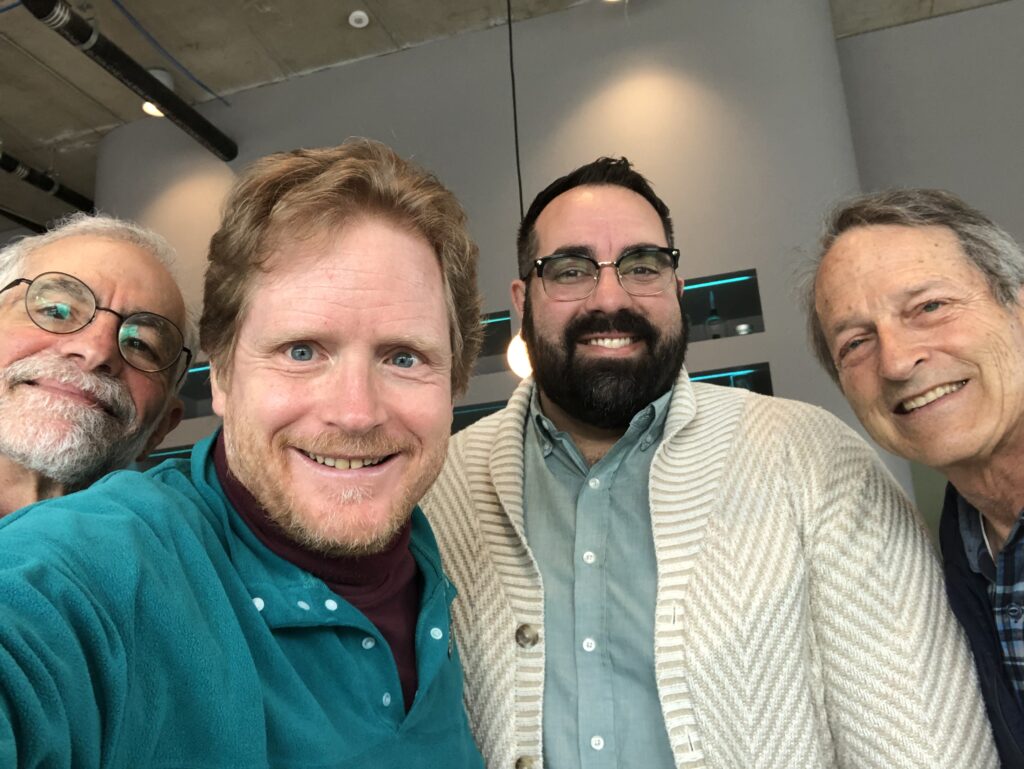
Jerry Porter, Brian Ettling, Michael Jonas, and Walt Mintkeski meeting at a cafe in east Portland, Oregon on May 2, 2024.

Michael Jonas, two Portland CCL volunteers, and I met for coffee on May 2, 2024, and had a productive conversation. He still felt frustrated that he was shut out of our event and some similar events like ours. He felt like only candidates with deep campaign donations and experience in government were getting the attention, while his candidacy was not taken seriously. My friend Walt who was in the meeting and involved in Democratic politics for years tried to advise Michael how to overcome his frustration. He encouraged him to follow the process of the Multnomah County Democrats to get involved in school boards and local politics to make more of a name for himself before jumping straight into a Congressional race like this. I thought it was excellent advice. Michael seemed unable to hear that message at that moment. The meeting ended well. Michael and I decided to stay in touch. We got a group photo from our meeting. 

As far as the April 18th event, it turned out to be a success. We had around 115 people attend this event. I thought that Susheela Jayapal and Maxine Dexter did a good job of answering the prepared questions how they would address various climate policies if they were elected to Congress. Most of my friends and I gave the edge to Dr. Dexter for providing more substantive answers to the questions. 

One friend Lea texted me the day after the event to tell me that she preferred Susheela’s answers Maxine’s. She thought that Susheela had a better of how the financial impact of climate change cannot be pushed onto “the masses” or onto the most disenfranchised. Lea thought that Maxine came across as elitest. Lea hoped Susheela would keep putting poor people at the forefront. Another friend of mine Katherine thought Susheela was out of touch and Maxine gave better answers. Katherine was swayed by the Oregonian’s endorsement of Maxine Dexter. The Oregonian is Oregon’s largest newspaper by circulation, and it is based in Portland. Katherine thought the endorsement aligned with how she perceived the candidates at the forum. 

The event was recorded for YouTube so anyone can still make their own judgements. Matt Zaffino, Chief Meteorologist for KGW TV – the NBC affiliate TV station for Portland OR, was the moderator for the forum. Because he moderated the event, it was featured on the 11 pm news. 

I enjoyed chatting with Maxine Dexter after the event and getting my photo with her. I thanked her for her time answering my March 12th email about what she would do about climate change if she was elected to Congress. She responded that she took personal time late at night to respond to emails from voters like me. I was dumbstruck that she was answering so many emails personally late at night to engage with voters. I told her I was worried hoping she was getting enough sleep. She remarked that she will get more sleep and rest after the May 21st election primary. I shared her sentiments that I hoped she would get more sleep after the election. I appreciated her time to chat with me after the climate forum.

Brian Ettling and Oregon Representative Maxine Dexter, a Democratic candidate for Oregon Congressional District 03. Photo taken at Taborspace in Portland OR on April 18, 2024.

Three days later, Tanya and I attended a Multnomah County Democratic Party Candidate-A-Palooza on April 21, 2024. This event had tables with many Democratic candidates running for statewide office and for Congress. The leading candidate for Attorney General Dan Rayfield recognized me and we had a friendly chat. I asked him how he knew who I was. He replied, “Brian you are all over social media!” 

I found him to be friendly and gregarious. I was amused that he knew me. I asked to get a selfie with him. He responded, “Are you kidding me? A selfie Brian Ettling! Absolutely!” 

At Candidate-A-Palooza, I chatted with all the major candidates running for OR Congressional District 3 seat. I met Michael Jonas for the first time. We promised to meet soon for coffee, which we did on May 2nd. Eddy Morales and I chatted about his campaign’s hectic schedule. Tanya and I next talked with Susheela Jayapal. I found her to be a kind, caring person, and an excellent listener. She seemed open to supporting carbon pricing. I was impressed with her as a person and as a candidate. I liked all three of the main candidates Eddy, Susheela, and Maxine. It was a choice between three great people where I had to carefully weigh how I would vote. 

I spoke with Maxine Dexter last. She asked me directly if I was voting for her. She shared after the event that a CCL friend of mine KB Mercer told Maxine that she was “all in” for voting for her. I told Maxine that I was leaning towards voting for her and probably would if the election was happening that day. It felt like we were the closest aligned politically. I really appreciated her sponsoring the SJM 5 climate change resolution that I organized in 2021. Plus, she was one of the 30 Oregon legislators who endorsed CCL’s Energy Innovation and Carbon Dividend Act. She said yes in December 2020 after a CCL volunteer and constituent of hers had a Zoom lobby meeting with her on October 29, 2020. I was impressed how she always responded positive to any of my lobbying requests. I thanked her for that during this conversation. 

I was candid with her that the thing that held me back was that I felt ignored when I engaged with then Congressman Earl Blumenauer about climate change. She was sad to hear that and expressed empathy. I wanted to vote for a candidate that would be accessible to lobbying them on climate policies. Maxine responded that her kids are very scared about climate change. They would not let her ignore the issue or disregard climate organizers such as me. Her answers, plus the endorsement from the Oregonian, sealed the deal that I would vote for Maxine. 

Maxine Dexter won the May 21st Oregon Democratic primary by a wide margin. She received over 51% of the vote, compared to 29% for former Multnomah County Commissioner Susheela Jayapal and 14% for Gresham City Councilor Eddy Morales. A majority of the voters agreed with me that Maxine was the strongest candidate to represent Oregon Congressional District 03. 

In the November 5, 2024 general election, Maxine Dexter easily won the Oregon Congressional 3rd District race with 67% of the vote. She was officially sworn in as a U.S. Representative in Washington D.C. on January 3, 2025. At the end of the month, on January 27th, I thought she was off to a good start. Congresswoman Dexter held a joint town hall with U.S. Senator Jeff Merkley at a high school gymnasium in east Portland that had a huge crowd in attendance.

In early February, Walt Mintkeski offered me to take his spot to attend a Portland in district swearing in ceremony for Maxine Dexter to become my member of Congress on February 20th. I chatted with her after the ceremony to congratulate her. I mentioned that I was the CCL Liaison for Oregon Congressional District 03. I then shared that CCL would have a lobby day on Capitol Hill in July. We hoped to meet with her then. She made no promises that she could meet with us then, but she indicated that she would make every effort if her schedule allowed.

My wife Tanya and I were impressed how much she made herself accessible in the district. She held an average of around one in person town hall each month. She had a massive crowd of people for her town hall at a high school gymnasium in Gresham, Oregon on March 1, 2025.

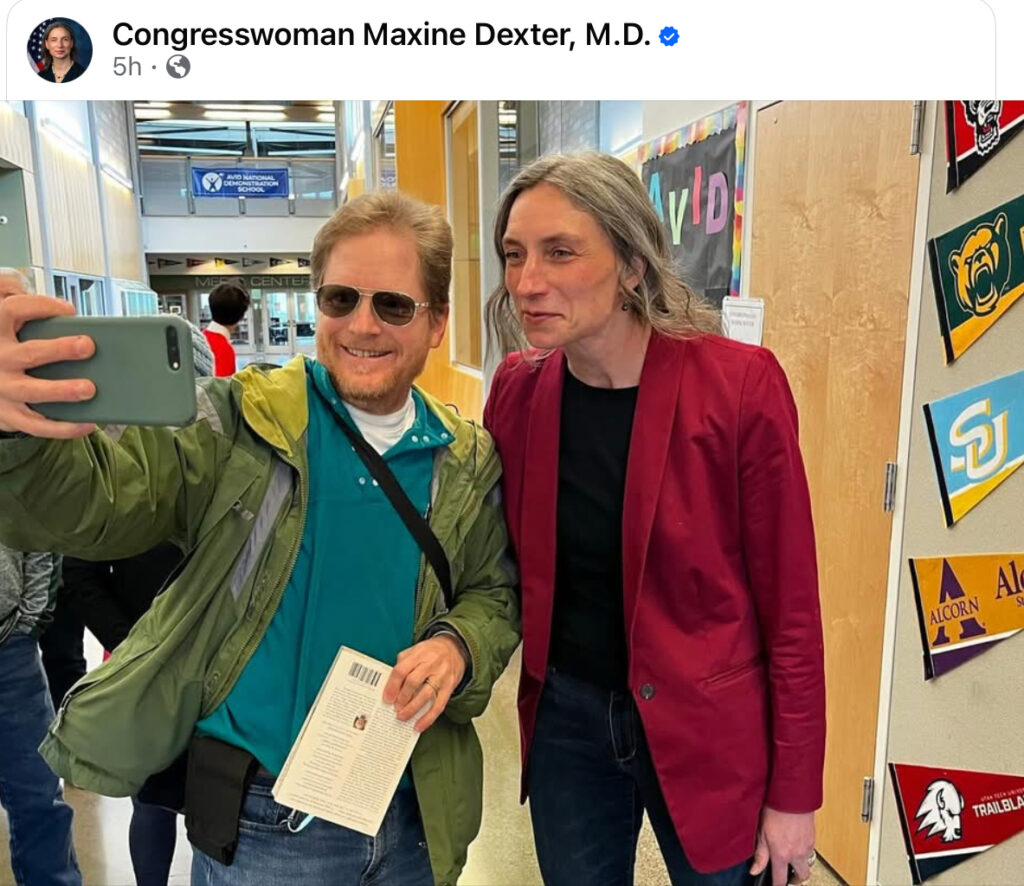
One month later, on April 6, 2025, Representative Dexter held a town hall at the gymnasium at Parkrose Middle School. This school is located only 2.5 miles east of where Tanya and I live in outer northeast Portland. I arrived an hour early to get a good seat. I also wanted to network with Rep. Dexter’s Congressional staff, fellow climate and community organizers, and other people in attendance. When I walked inside the lobby of the school, Congresswoman Dexter was personally greeting the earliest arrivals. She was happy to see me. When I asked if I could get a selfie with her, she laughed and responded, ‘Of course! Brian, you are known for your selfies and photos of you out in the community on social media.’

Congresswoman Maxine Dexter, M.D.’s staff took a photo of Brian Ettling taking a selfie with Rep. Dexter before her town hall on April 6, 2025.

The best part was that someone on Rep. Dexter’s staff snapped a photo of us when I took the selfie with her. They later posted it on social media. I learned a trick that day that if I arrived an hour early to her town halls that she talked with the first attendees. On September 6, 2025, she held a town hall at Reynolds High School in Troutdale, Oregon. I repeated my trick to arrive early. Sure enough, Maxine was in the lobby engaging with the early bird attendees like me.

On July 22, 2025, I led the CCL lobby team that met in her Washington D.C. office. I expected a meeting with her staff. I did not think she was available to meet with us. I lobbied in Washington D.C. in CCL Lobby days 10 previous times. I never had a member of Congress join us for a meeting. The good news was Rep. Dexter’s schedule changed and she could join us. The bad news was we had a CCL volunteer who was not a constituent that argued with her about one of the bills we supported. Even worse, at the beginning of the lobby meeting, I asked how much time she had to meet with us. She stated 15 minutes. At the 15 minute mark, some of my fellow CCL lobbyists were still asking questions while Congresswoman Dexter’s staff were pointing at their watches. Furthermore, Rep. Dexter and her staff shifted in their chairs, indicating with their body language that the meeting must end to get to their next scheduled event. I felt disappointed and irritated with my fellow CCL lobbyists.

On September 6th, it was a relief that I could share my frustration about the other lobbyists with Rep. Dexter. I apologized that one of the CCL team members became argumentative and we ran over time. I was relieved she did not recall any of that. She thought the July CCL lobby meeting when great. She shared it was common for constituents and citizens expressing strong emotions to her. She put me at ease I had nothing to worry about. She must have been a terrific pulmonologist (medical doctor specializing in the respiratory system) and critical car doctor with excellent bedside manners because she left me feeling happier after our interaction.

With her monthly in-person town halls, monthly telephone town halls, and her active presence on social media, Tanya and I, as well as other friends, in the east Portland area are proud and thrilled that Dr. Maxine Dexter is our member of Congress. She has worked hard to bring home immigrants wrongly detained by ICE (Immigration and Customs Enforcement), defending our democracy, protecting our veterans, fighting for access to affordable healthcare, demanding accountability for survivors of Jeffrey Epstein, and reducing the climate change threat.

Rep. Dexter currently serves as Ranking Member of the House Natural Resources Subcommittee on Oversight and Investigations, which is responsible for overseeing federal agencies within the Natural Resources jurisdiction. In CCL lobby meetings with her and her staff, she conveyed that she intends to work closely with us and other climate/environmental groups. She wants to keep a conversation going if Congress flips to Democratic control in 2027. She aims to be ready with climate and environmental protection bills since she will be the committee chair.

I am glad that Dr. Dexter represents me and my east Portland and east Multnomah County community in Congress. I feel that the April 18, 2024 CCL Oregon Congressional District 03 Climate Forum that she participated in and I helped organize may have played an important role in getting her elected to Congress. Thank you to Dylan Hinson and other Portland CCL volunteers for allowing me to get involved that Climate Candidate Forum.

From left to right: Matt Zaffino, Susheela Jayapal, Maxine Dexter, Dylan Hinson, and Jana Gastellum at the Portland Citizens’ Climate Lobby Oregon Congressional Candidates District 03 Climate Forum on April 18, 2025.

from: Info Maxine for Oregon info@maxinefororegon.com
to: Brian Ettling
date: Mar 21, 2024, 8:23 AM

Brian,

Thank you so much for reaching out and I hope you’ve been well, I am very much looking forward to your upcoming climate forum. Climate change is the existential threat facing our planet and a huge reason I first ran for office in 2020. I saw the anxiety my children were having over climate change, the lack of hope they had that “the adults” cared enough to make hard decisions and knew I needed to take action. I don’t just talk about it – I live it. I have been a vegetarian for climate reasons for 15 years, we stopped drinking cow milk over 10 years ago, I was the first person I knew to have a Chevy Bolt in 2017, we drive our electric car rather than fly whenever possible, I don’t use plastic to the greatest extent possible and we as a family don’t buy new things unless absolutely necessary. We have lived a thoughtful life and I believe others would as well if they knew the impacts of their actions and policymakers made it as easy as possible to make more climate-informed decisions.

As the only scientist and person who has passed large-scale environmental legislation in this race, I am uniquely qualified to tackle the climate crisis in Congress. As a physician, my job requires me to learn from data and distill complex science to patients. In Salem, I leveraged that strength to work with my colleagues and pass major environmental wins. I played a critical role in reviving the Environmental Caucus and ensuring it was staffed for the 2023 legislative session. This initiative was vital for forging strategic alliances and addressing the nexus between environmental justice and broad policy areas. Environmental policy is not an insular policy niche but deeply embedded in everything from health and labor policy to education funding and housing policy. 

As the Chair of the House Committee on Housing and Homelessness, I worked intimately with Republicans and more moderate members to pass an unprecedented $200 million investment in 2023 and $376M in 2024, directly tackling our pressing housing crisis. As a part of the 2023 package, I was the chief negotiator for the Oregon Housing Needs Analysis (OHNA) policy which was an iteration of our landmark land use policy, SB100 from 50 years ago. The OHNA policy fundamentally shifts how Oregon cities plan and meet their housing goals for the decades to come. I brought environmental leaders, land use advocates, developers, cities, counties and state agency experts together, facilitating a groundbreaking compromise to meet the moment we’re in to prioritize housing production while protecting sustainable and responsible development and strategic land use policies. The basic premise of these negotiations was we must build up and build in before we expand the UGB, create walkable, resilient communities and once it was clear we needed to expand the UGB, that we made it data-driven and efficient. 

As someone committed to living as sustainably as possible and ensuring Oregonians have access to sustainable living, one of the first bills I introduced in the legislature after winning election was a ban on single-use take out containers in 2021. Typical of initial bill introductions, refining the details with stakeholders to ensure equitable policy making took years, but in 2023 with the partnership of Senator Sollman and countless environmental organizations and advocates, we passed a ban on single-use styrofoam food containers and toxic “forever chemicals” known as PFAS.

Another win I am particularly proud of was legislation passed in 2021 to set Oregon on the path to reach 100% renewable energy by 2040. The bill holds electric companies accountable, increases our renewable portfolio standard, establishes new powers for Oregon’s Public Utility Commission and Public Purpose Fund Administrator, and requires the state to launch a thorough stakeholder engagement process with our tribal communities to expand tribal adoption of renewable energy.

My philosophy for working in Congress will be the same I use in the exam room and in Salem: I show up, listen, engage, and then act, grounded in science and data. As your next Congresswoman, hearing from and engaging with you and other constituents will be my top priority. I am courageous and this seat demands someone courageous is in it. I have repeatedly taken hard votes, sometimes being the only no in the chamber and I know that there will undoubtedly be hard votes in Congress. I will stand up for my values and the values of our district and I am clear that taking action demands that we don’t wait for others to lead, I need to make a clear path strategically and effectively on day one. My promise is to clearly articulate my position and also engage thoughtfully with you and other partners to learn and iterate my perspectives as more data and insight is shared and then incorporate it into future legislation.

Thank you, Brian, for reaching out, I look forward to the April forum and I hope I can earn your support for the May primary.

Best,

MaxineMaxine Dexter, M.D. (she/her)Candidate for Oregon’s 3rd Congressional District

MaxineforOregon.com 

For Climate Action, my process of becoming a writer

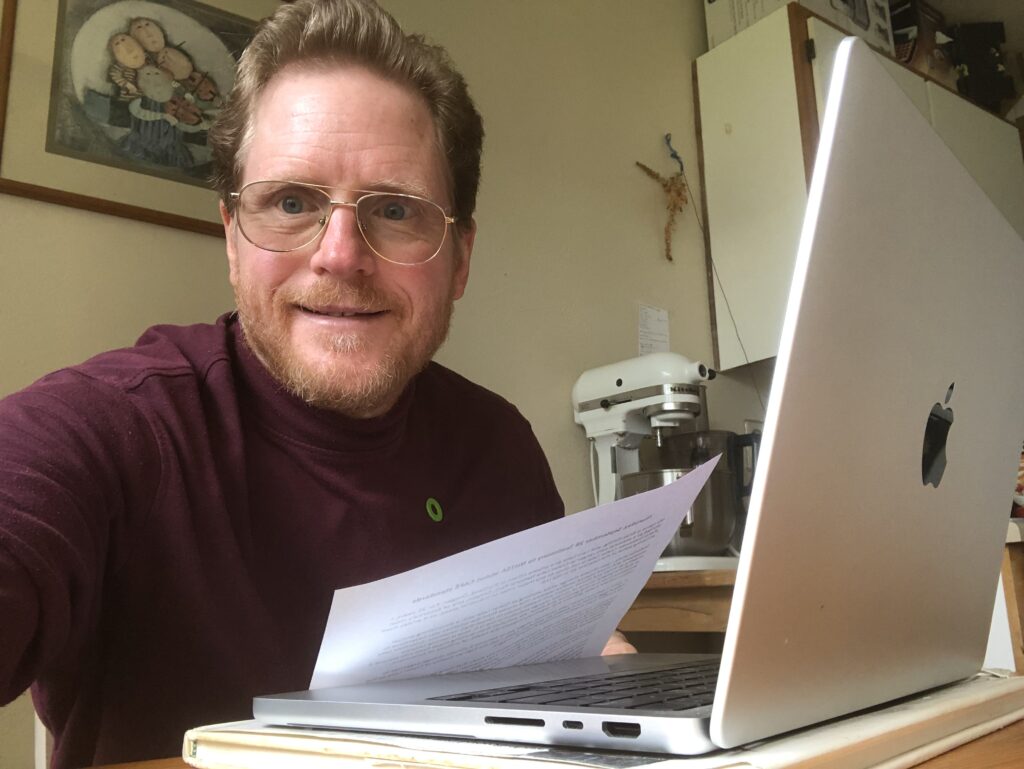
Photo of Brian Ettling from September 28, 2023.

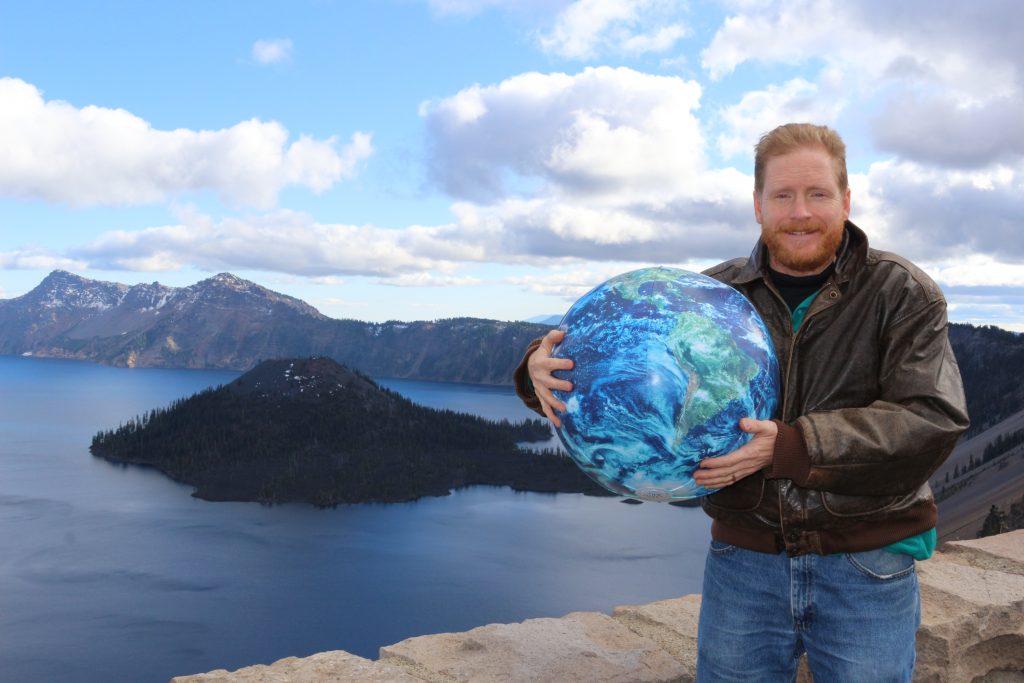
In November 2009, I took on the title of “The Climate Change Comedian” and grabbed the website domain www.climatechangecomedian.com on a dare from my friend Naomi while I temporarily housesitting in Ashland, Oregon. On April 10, 2010, I created the ideal brand photo of me to market myself. I had a friend take a photo of me holding up my inflatable Earthball on a clear late afternoon standing on the shoreline by Copper Harbor, Michigan in the Upper Peninsula with Lake Superior directly behind me. 

With owning the website domain and a suitable image to promote myself, I felt ready to create my climatechangecomedian.com website. My big problem: I had no idea how to create a website. While spending the winter in my hometown of St. Louis, Missouri, I asked a family friend, John Dantico, who was adept at internet technology, to help me build and launch my website. He readily agreed and asked me to be at his house around 9 pm on a weeknight.

We picture people considered to be night owls as staying up to around 1 am to work on projects and focus on tasks. I am a late-night person, and my body yearns to go to bed around that time. However, John liked to stay up to about 4 to 5 am working, reading, and contemplating life. We spent hours working on this website as I grew more tired, grumpy, and eager to head home to go to bed. Finally, John got the website good enough to launch around 3 am. He encouraged me to write a quick introduction on my website’s homepage to describe briefly myself and how my website will benefit the reader.

John then gave me advice that shook me to my core. He remarked, “Now you will need to consistently set aside time to write a blog for your website so you can create followers and draw attention to your website.” 

My swallowed hard and my stomach tensed up. I thought, “Me! Write regularly? There’s no way! I am not a writer.” I would freak out in high school and college when I had to write required essays and term papers. When I was a student, I would spend hours procrastinating and stressing out over writing assignments. I was a B student in high school and college because I had to force myself at the last minute to complete my class writings. Because these required writings were often rush and sometimes late, they had many grammar and punctuation errors. I would put a lot of pressure on myself to write something to submit to my teachers. As a result, I hated writing as a teenager and young adult. I wanted nothing to do with it! 

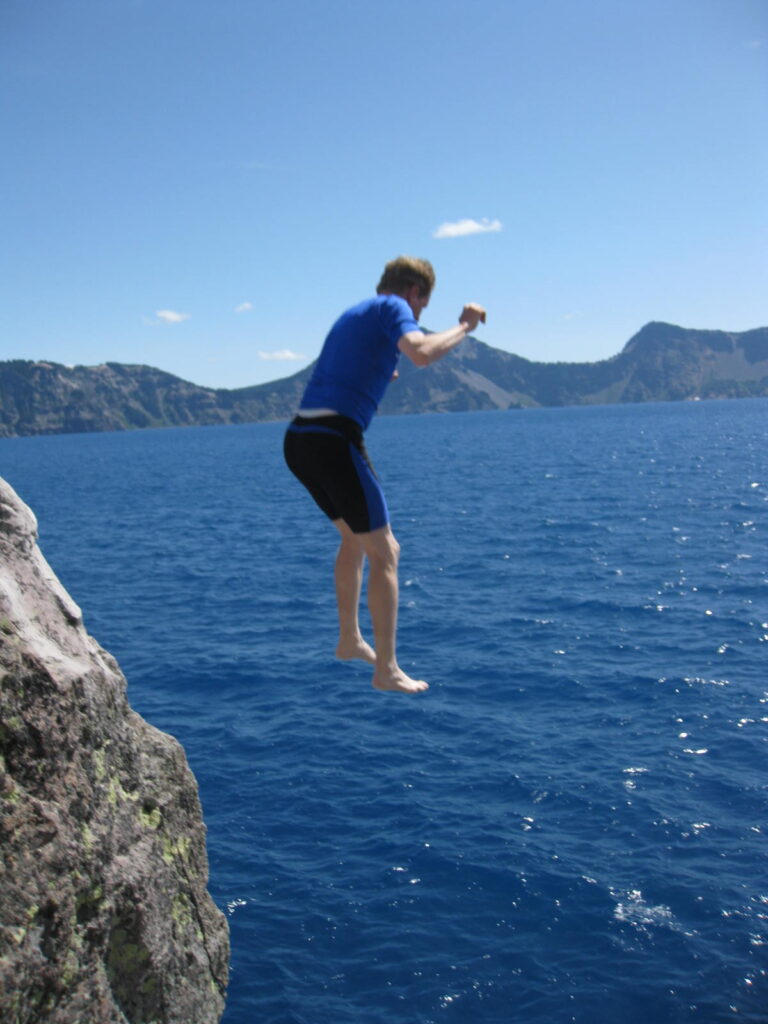
On the other hand, I always loved a good challenge. In the previous three years, I satisfied my sense of adventure by skydiving in Florida and Oregon in 2007. I went out of my comfort zone to try surfing, parasailing, and snorkeling on the Big Island of Hawaii in October 2008. I jumped of the diving rock to swim in Crater Lake to keep up with my friend Lizzy when she came to visit me there in August 2009. By doing those activities and others, I had briefly conquered my fear of heights and fear of swimming in deep water. Thus, after John gave me that guidance, I said to myself, ‘You have overcome your fears by participating in adventurous activities. You can rise above your fear of writing by writing. You can do this!’

Brian Ettling jumping off the jumping rock at Crater Lake National Park on August 13, 2009.

The problem was for that the next year, my fear of writing dominated over my eagerness to write to keep my website up to date. Days after John launched my website, it just sat there with no new writings. Towards the end of April, I drove across country from St. Louis to Crater Lake, Oregon. I planned to work another summer there as a seasonal park ranger at Crater Lake National Park. During the journey, I stopped near Vail, Colorado to try zip lining. Clearly, my craving for adventure seeking was not yet fully out of my system. 

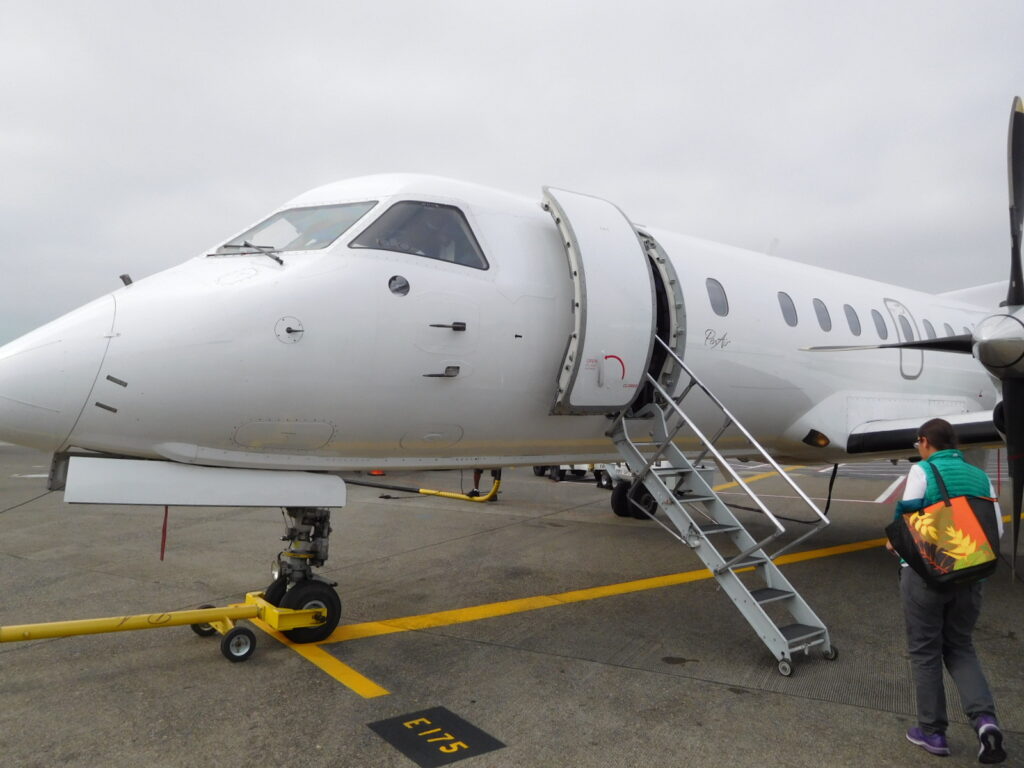
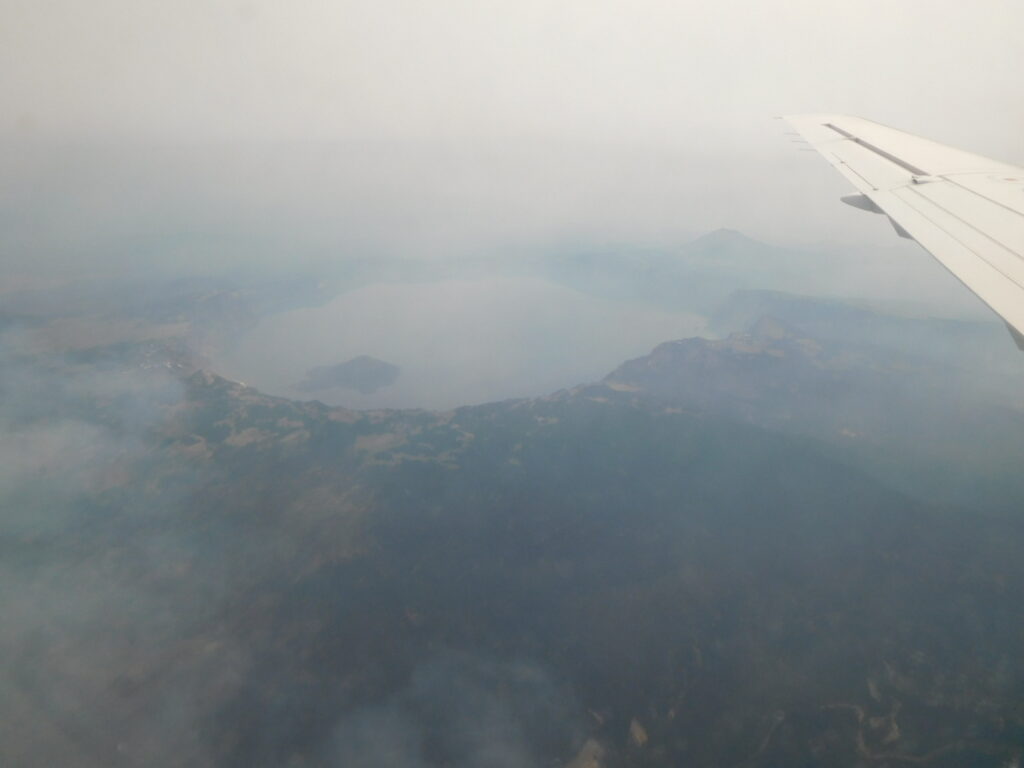
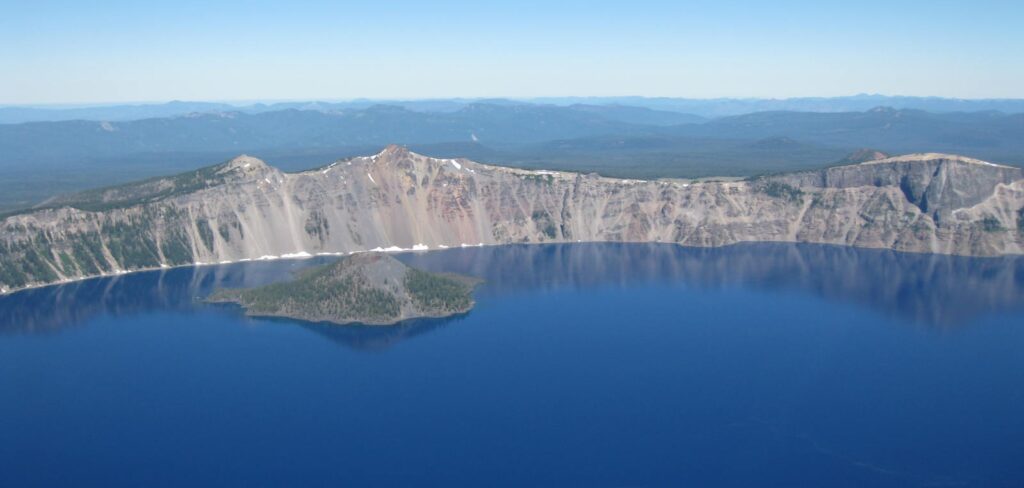
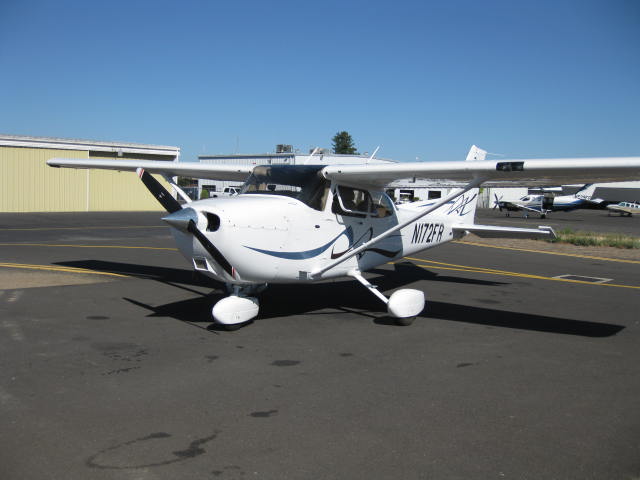
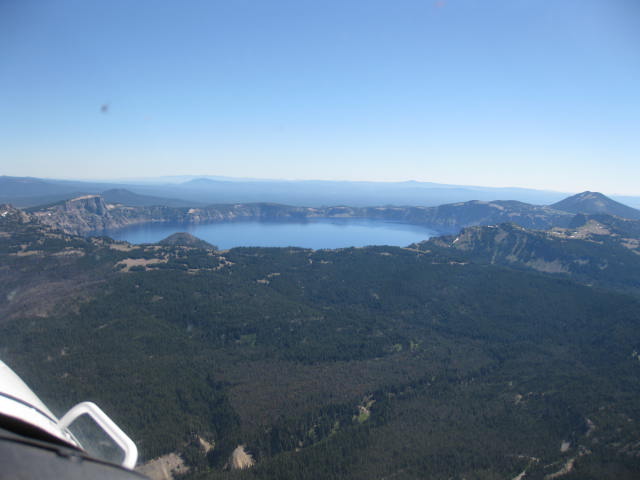
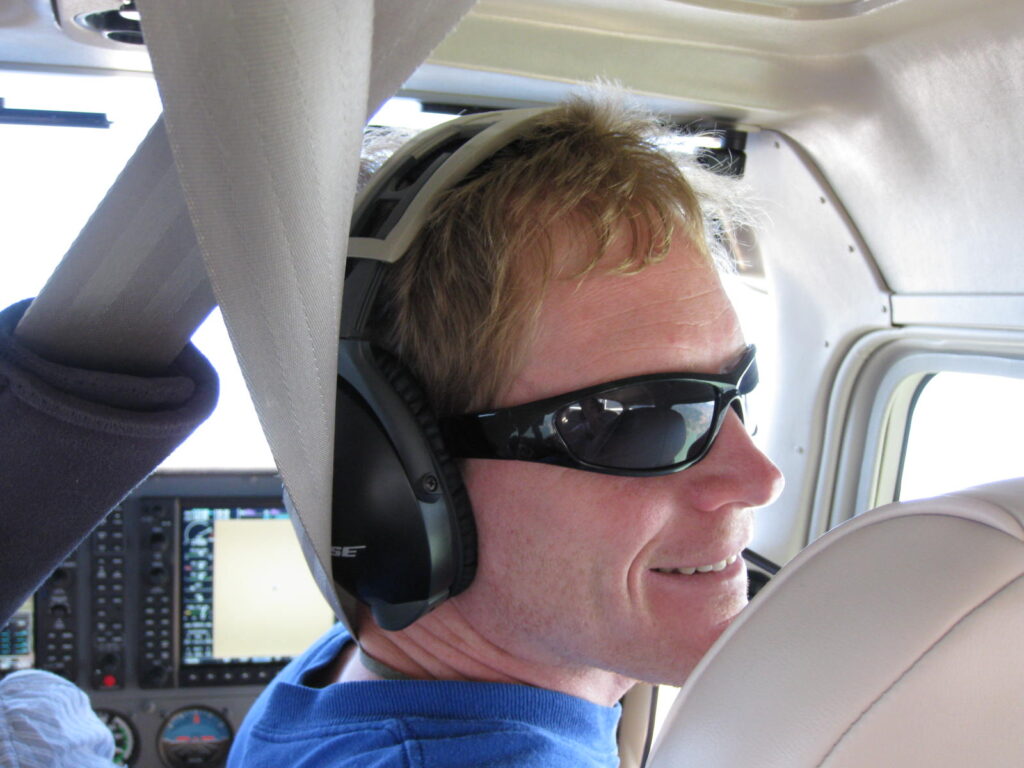
After I returned to Crater Lake, I focused on delivering my ranger talks, hiking in the park, and hanging with my ranger friends. In June, I paid an outfitter in Grants Pass, Oregon for my friend, Lise Wall, and I to go up in a hot air balloon. In July, I arranged for my friend David Grimes, and I for a local pilot friend to take us up in her small airplane to get aerial views of Crater Lake. 

At the end of July, I began dating my ranger co-worker Lesley. I was absolutely smitten by her. For the rest of that summer at Crater Lake, I just wanted to spend time with her hiking, socializing with our mutual friends, and camping in the woods with her near our ranger housing. She left for the season to return to her home in Berkeley, California near the end of August. I took the train from southern Oregon to Berkeley to visit her that Labor Day weekend. She came to stay with me at Crater Lake on a weekend trip in early October. When I completed my season at Crater Lake in mid-October, I drove to Berkeley to stay with her until the beginning of November. I then traveled back to St. Louis to spend time with family for the winter. In early December, I flew from St. Louis to the Bay Area to be with her to attend her brother’s wedding. 

My relationship with Lesley was all consuming and turbulent with frequent arguing. I thought at that time I had found the one person to be with for the rest of my life. However, she never seemed fully committed to the relationship. She was hesitant to get too deeply involved with me. She was in therapy for bipolar depression from trying to overcome childhood abuse and trauma. One day, she would be delighted to see me, the next day she was cold and distance. I put all my energy into trying to make the relationship work when it was clearly not working. She broke up with me in early January 2011.  

To say this relationship had been a distraction from pursuing my passion to be a full-time climate change public speaker, organizer, and comedian would be an understatement. My website sat idle the entire time I dated her. 

I felt devastated and deeply depressed by the breakup. I needed to rebuild my life outside of her. In January 2011, I volunteered to lead a historical ecological program in the spring for Missouri Botanical Garden’s Earthways Center. That same month, I joined the local Toastmasters Club, South County Toastmasters, to become a better public speaker and climate change communicator. For almost a year, I ignored my www.climatechangecomedian.com website. 

Brian Ettling at South County Toastmasters in St. Louis, Missouri. Photo taken on March 23, 2011.

On February 1, 2011, I still felt raw from my recent breakup. However, I decided I needed to adhere to my friend John Dantico’s advice to regularly blog and write on my website. I remember spending hours at my parents’ dining room table staring at my laptop to trying force myself to type up the first words for my blog. After hours of struggling what to write, I published a short blog on my website that day called, “My first Blog Ever.” It was only about three paragraphs long. It was a start. I forced myself to complete this blog. It was not fun. At the same time, I knew I needed to keep my website updated with writings. 

The next day, I wrote another blog, “Taking that First Step Forward.” It was about briefly describing myself and my climate change passion. It felt like a painful chore for me to write. I did not write more blogs until November 2011. I still felt a lot of pressure to blog for my website to motivate myself from overcoming writer’s block, I wrote my third blog on November 20, 2011, “Feeling Blue? Go Take a Hike!” It was a reminder to myself that I had always used hiking, spending time in nature, and working in the national parks to renew, discover, and inspire myself. 

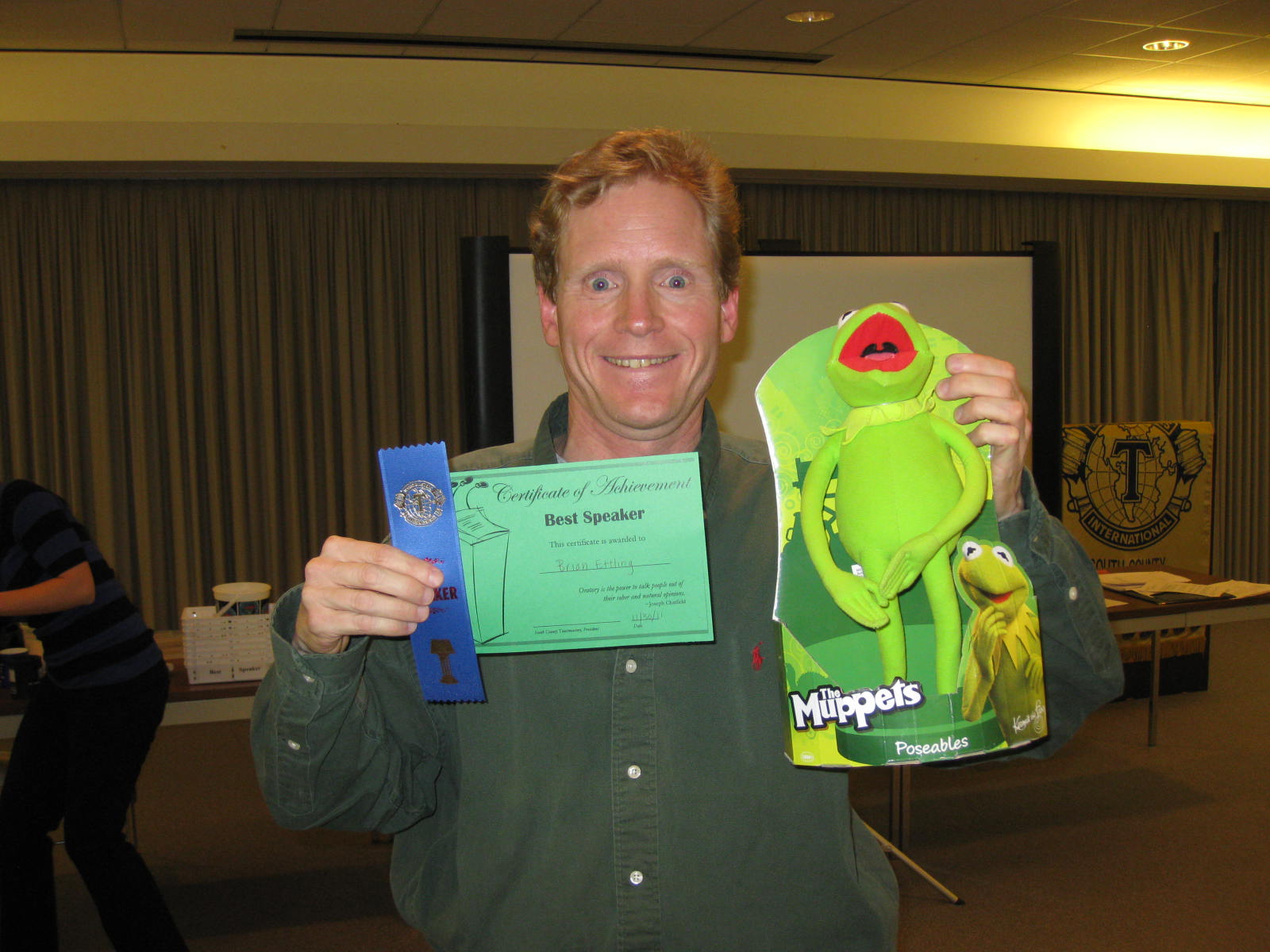
In December 2011, I wrote blogs about my Toastmaster speeches. On December 1, 2011, I gave a speech for my Toastmaster’s Club called, “It’s Easy to Be Green.” I referenced the Kermit the Frog song “It’s Not Easy to be Green” to show that Kermit was wrong. I argued that becoming more energy efficient in your home, basically becoming more environmentally green, was easy and it saved you money. The fellow Toastmasters who were climate deniers liked this speech. They complimented me on it. Some of them even told me, ‘I still don’t believe in climate change, but I like to save money.’ The club members voted me to be the Best Speaker of four club members who gave speeches that evening. 

I discovered that I liked to write the speeches I would give for me Toastmasters Club. I could then turn the text of those speeches into blogs. This was a way to help me overcome my stress of having to create blogs and writings for my website. 

Brian Ettling winning his 4th Toastmasters speech on November 30, 2011
with the help of Kermit the Frog

December 3 to 9, 2011, my friend Tom Smerling encouraged me to join him to attend the American Geophysical Union (AGU) Conference in San Francisco, California. It is one of the largest and more prestigious annual scientific conferences in the world. Nearly all the top climate scientists would present their latest findings there. He thought it would be an excellent opportunity for me to see these scientists up close, learn about climate change science from their presentations, and network with the climate scientists, as well as fellow climate change communicators. Tom’s advice to come to this AGU Conference was some of the best advice I received in my life. 

At the AGU conference, I met many renowned and respected climate scientists and communicators. One of them was Bud Ward, an environmental journalist and journalism educator. For 15 years, he was editor of Yale Climate Connections from 2007-2022. During this conference, I struck up a conversation with Bud about pursuing my passion of wanting to go to grad school and pursue a career as a climate change communicator. He gave me his business card and encouraged me to contact him after the conference. 

In the spring of 2012, I reached out to Bud to chat with him on the phone. I expressed my interest of wanting to go to grad school at possibly Yale University or elsewhere to devote myself to a career in climate change communications. 

As I explained my dream, Bud cut me off to bluntly say, “I don’t have any advice to help you with that. However, I do have something that is self-servicing that might benefit you. I was wondering if you could write something for my Yale Climate Communications website about how you were successful and your failures in communicating about climate change as a park ranger at Crater Lake National Park. If you can submit something soon, 800 to 1,000 words, within the next week or two, I will be happy to pay you for it.” 

I quickly jumped on this opportunity to submit a writing to a website associated to Yale University. Even more, it was exciting to know that Bud would pay me if he published my submission. That evening, I wrote out a 1,000-word essay for Bud about my experience communicating about climate change in the national parks. I wrote honestly about my high and low moments engaging with Crater Lake visitors about climate change. I submitted it to Bud the next day. 

Over the next two weeks, Bud and I exchanged emails about edits he wanted me to make with my writing submission. He corrected grammar and punctuation errors. He asked me to delete certain sections, and he wanted me to write more to expand my thoughts in other sections. When we agreed that the writing was to both of our satisfaction, Bud told me that my writing would be published several weeks later around the end of April 2012. 

On April 26, 2012, the excitement felt like Christmas Day when my essay, “Communicating Climate Change in a National Park” was published on the Yale Climate Communications website. Outside of my website, I had never seen my own writing in print before then. My parents, family, and many friends were very excited and happy for me. 

Weeks later, Bud mailed me the check for my writing submission. The amount of money was the equivalent to one of my paychecks working as a ranger at Crater Lake National Park. For the first time in my life, I was a paid writer! I never dreamed I could get paid for writing. I treasured receiving that check and getting paid for writing an article that I enjoyed creating. For the first time in my life, I could see writing could be fulfilling and I could even receive money doing that! 

I will always be grateful for Bud Ward for that opportunity to get published and paid contributing a writing piece to the Yale Climate Communications. It was the first time in my life that I started seeing that I could be a writer. In a sense, I have been writing ever since then on my www.climatechangecomedian.com website, I have written over 160 blogs. Several friends over the years, asked me to contribute writings to their blogs. 

On April 19, 2013, the St. Louis Post-Dispatch published my first opinion editorial, “For Earth Day a GOP Market Solution to Climate Change.” This published writing happened the same weekend my parents, family, and over a hundred of their friends came together to celebrate my parents’ 50th wedding anniversary. My first published newspaper commentary added to the joy of that occasion. On March 1, 2013, the Post-Dispatch published my first letter to the editor urging our local electric utility, Ameren, to close the nearby Meramec Coal Plant in South St. Louis County. 

On July 10, 2013, the St. Louis Post-Dispatch published my second opinion editorial, “What Keeps Me Up Late at Night.” Like my March letter to the editor, this opinion commentary asked Ameren to close the Meramec Power Plant. 

Those successes getting published in the St. Louis Post-Dispatch inspired me to submit opinion editorials to newspapers across Oregon in the fall of 2013 while I worked as a seasonal park ranger at Crater Lake National Park that summer. Ten Oregon newspapers published my opinion commentary, including The Oregonian, on October 4, 2013. I estimate my I have had around 20 opinion editorials published in Missouri and Oregon over the years. I had numerous letters to the editor published over the years, including most recent in The Oregonian last Sunday, March 15 asking Oregon Legislators to prioritize climate legislation. 

I cannot imagine life without regularly writing now. Since January 2023, I regularly took a “Writing Your Story” adult continuing education class through Mt. Hood Community College. My dream is to eventually compile and edit my blogs to write a book about my life as a park ranger turned climate organizer and wannabe comedian. My hope is that a major book publisher will want to publish my memoir. I want to inspire others through my writings and hopefully a published memoir someday to take action to reduce the threat of climate change, as well as pursuing their dreams, as I have in my life. 

I am amazed how far I have evolved in life from a child who hated writing for school assignments to someone who can’t imagine life without writing and blogging about it. 

Brian Ettling holding up his guest opinion in The Oregonian that was published on May 12, 2016.

Flying Over Crater Lake Inspired me to Act on Climate, Part 2

Photo by Brian Ettling of aerial view of Crater Lake National Park taken from a commercial airline flight on August 6, 2017.

From 1992 to 2017, I was a seasonal park ranger at Crater Lake National Park, Oregon.
 
Crater Lake is the deepest lake in the United States, and one of the deepest lakes in the world. No outside rivers or streams feed the lake. The lake received all its water and is replenished by snow and rain. Thus, it is considered one of the cleanest and purest bodies of water in the world, giving it a deep blue cobalt color on clear days. With the snow and pine trees on the mountains and in the caldera, the dramatic volcanic peaks and edges, plus the brilliant blue water, Crater Lake National Park is one of the more picturesque places you can behold. 

When I was at Crater Lake, I never tired of standing on the rim to admire the beauty. Even more, I loved hiking up the trails to the 8,000-foot mountains along the rim to get even more dramatic views of the lake and surrounding area. 

Spending time working and exploring Crater Lake, I regularly saw planes flying over the national park. Crater Lake was on a flight path of some commercial jets. During my time living there, my parents came from their home in St. Louis, Missouri to visit me several times. To this day, my mom and dad talk about viewing Crater Lake from one the flights they took. While l loved enjoying the scenery from the rim and hiking up the 8,000-foot peaks inside the park, I was curious to see how Crater Lake looked from a commercial jet or a small private plane. 

Part 1 of this blog was about flying over Crater Lake in a small private airplane on July 23, 2010. This blog, Part 2, focuses on my sad and heartbreaking experience flying over Crater Lake in a commercial airplane in August 2017.  

Becoming a Climate Change Speaker, Comedian, and lobbyist 2010-2017

After I flew over Crater Lake in July 2010, I slowly started to organize more for climate action. In April 2010, I created my website www.climatechangecomedian.com. In the early months of 2010, I created my first climate change PowerPoint, Let’s Have Fun Getting Serious About Taking Climate Action. I showed that presentation to my ranger friends at Crater Lake in early August 2010. I practiced that PowerPoint in a few more friends on my cross-country drive from Crater Lake, Oregon to St. Louis in November 2010. 

In February 2011, I joined South County Toastmasters to be a better climate change communicator and public speaker. That same month, I started this blog as an online journal shows my life’s evolution as a climate change communicator and speaker. In March 2011, I worked two months at the temporary Climate Change Exhibit at the St. Louis Science Center. In August 2011, I began giving my climate change ranger evening program at Crater Lake. 

In November 2011, St. Louis area businessman Larry Lazar and I co-created the St. Louis Climate Reality Meet Up group, known today as Climate Meetup-St. Louis. In early 2012, I met Tanya Couture at one of the meetings. In February 2013, we started dating. On November 2015, we got married.

In May 2012, I joined Citizens’ Climate Lobby (CCL) as a volunteer. In August 2012, I attended my first Climate Reality Training in San Francisco, California. At this training, former Vice President Al Gore trained me and over 800 attendees to become Climate Reality Leaders to give his climate change presentations.

In January 2014, Tanya and I made a joint video promoting me as the Climate Change Comedian. My mom, Fran Ettling, and I made a similar video in February 2014. My mom, dad, and I made a goofy video to showcase my climate change comedy in March 2015. This led to my first appearance on Comedy Central’s TV Show Tosh.o in August 2016. 

As a park ranger, Toastmaster, CCL volunteer, and Climate Reality Leader, I regularly gave climate change talks from 2011 to 2017 at Crater Lake in the summers and my hometown St. Louis Missouri in the winters. Even more, I attended the Climate Reality Project trainings as a mentor in Chicago, Illinois in August 2013; Cedar Rapids, Iowa in May 2015; Houston, Texas in August 2016; and Denver, Colorado in March 2017. In November 2015 and 2016, I attended a CCL Conference and lobbied Congressional Offices for climate action in Washington D.C. In addition, in November 2016, Tanya and I traveled to Ottawa, Canada where we attended a CCL Canada Conference and lobbied members of the Canadian Parliament for climate action. 

Tanya Couture and Brian Ettling in front of the Centre Block Canadian Parliament Building in Ottawa, Canada on November 28, 2016.

Returning to Work as a Crater Lake Park Ranger in May 2017

In February 2017, Tanya found a job that moved us to Portland, Oregon. By this time, I yearned to become a full-time climate change organizer and transition away from my summer job a Crater Lake park ranger. In May 2017, I blogged about this struggle as I returned to Crater Lake to work there temporarily for the month. Tanya and I were happy that I worked there that May. The park had its highest level of snowpack in 6 years. When we arrived at Crater Lake on April 30, 2017, Tanya and I were awestruck by the amount of snow we saw. 

The snow was so tall that it buried one story buildings almost up to the top of their roof. It looked like 15 to 18 feet on the ground the park headquarters and Rim Village, with snow drifts piling up the snow much higher. When I stood next to the snowbanks, especially on the roads where the snowplows removed the snow, I felt small. The height of some of the plowed road cuts made the snow look four times higher than me. The sky was a sharp bright blue with no pollution or haze. The lake had a deep blue color that was mesmerizing. The combination of the glistening white snow everywhere around the rim of Crater Lake, tall evergreen pine trees, crisp blue sky, and the sight of sacred lake waters made us feel like there was nowhere else Tanya and I wanted to be that day. 

We could not take enough photos of the towering snowpacks, the buildings nearly swallowed by the snow, the lake, and each other as we lived in the moment of this day. When we walked on top of the massive snow at Rim Village, the snow was piled up so high it almost felt like we were floating in the air. Tanya was dropping me off so I could start work at Crater Lake the next day. However, we wanted to enjoy this moment together in the park as long we could. 

Tanya left me with a large bag of homemade chocolate chip cookies to enjoy. She then had a five-hour drive back to our apartment in Portland OR. Even more, she needed to return early enough in the evening because she had to return to work that Monday morning. I missed her, but I was thrilled to return probably one last time this temporary ranger job at Crater Lake. 

Photo by Brian Ettling of Crater Lake National Park on April 30, 2017.

It was an honor and privilege to once again where my National Park Service ranger uniform. It was great to answer questions at the Visitor Center Desk, as well as respond to public emails and phone calls for folks curious about planning a visit to Crater Lake National Park. In the third week of May I started giving ranger talks at the Great Hall at Crater Lake Lodge. 

When I was off work each day from my ranger job, I found a way to travel to the rim to take in the glorious natural beauty of Crater Lake. I loved walking down the plowed portions of the West Rim Drive to among the walls of snow. I would hike a couple of miles down the road until I saw the parked snowplows at their resting spot of the evening. I was curious about their progress getting the West Rim Drive plowed for the season. Frequently, I journeyed on this road by myself emersed with just me in the great outdoors.

At the same time, I was busy working my Crater Lake ranger job and exploring the park in my free time, I was also devoting energy to regularly meeting online to plan for the two-week Oregon CCL tour I would lead at the end of October and early November. The planning committee and I were still trying to determine which Oregon towns and cities I would speak, who would host me, who could volunteer to assist me, etc. It was uncertain and daunting if this tour would happen when we were meeting by Zoom in May 2017. Many of the decisions we made at this time led to a successful CCL tour across I led in the autumn of 2017. 

Tanya and I liked that I worked at Crater Lake that May and her visits to come see me. She stayed me the weekend of her birthday, May 13th and 14th. She brought her skis and got to go cross country skiing at Rim Village. I had to work that Saturday. Tanya loves to cross country ski when the opportunity presents itself. It snowed about an inch or two overnight. It was partly cloudy when she went exploring on the Crater Lake Rim with her skis. The park had new overnight snow with the grey overhead clouds giving a fresh winter appearance. Tanya is a talented photographer. She inherited that interest from her dad. She brought back great photos from her excursion that day. I was so happy for her, even if I could not join her due to work. 

Tanya visited me Memorial Weekend so we could be together and enjoy Crater Lake. I saw it snow a few times that month, which was not unusual since May is still considered a winter month there. However, the weather was clear and balmy for Tanya and I to hike on top of the snow around Rim Village. We also walked on the West Rim Drive on a three mile hike to see the progress of the snowplows in their efforts to clear the road to open it up to traffic in late June. 

A highlight was when we ate dinner at Applebee’s in Klamath Falls, located over 60 miles south of Crater Lake. We chose to eat dinner there because it had a mural in the back of the restaurant of local people in action intermixed with the scenery of the area. This mural included a picture of me in my ranger uniform demonstrating how to put on a PFD (personal floatation devise) before narrating one of my boat tours at Crater Lake National Park. I learned about this mural from my supervisor Marsha on social media the previous winter when she randomly visited this Applebee’s one day. I had no idea that Applebee’s planned to include me in their mural. They did not ask me beforehand. However, I was honored to be included in this display. 

Brian Ettling pointing to an image of himself on a mural at the Klamath Falls OR Applebee’s. Photo taken on May 10, 2017.

Tanya and I sharing my car when I worked at Crater Lake in May 2017

Tanya and I shared a car, my 2002 Honda Civic. I talked her into getting rid of her car when we moved to Portland from St. Louis in February. While I worked at Crater Lake in May, we made it work. This was primarily because I stocked up on groceries for almost 2 weeks when she dropped me off at Crater Lake on April 30th. Some of my Crater Lake co-workers and friends picked up some food items for me when they went shopping in town. When Tanya visited me on May 13th, she took me out for groceries that weekend. I made sure Tanya had my car for all of May because she needed my car to commute to her job. However, we agreed she would take the car to come see me every two weeks so we could see each other and I could get groceries. 

The logistics became complicated in June. I needed my car to drive from Crater Lake back to Portland on Thursday evening June 8th. I had a early flight to catch to Washington D.C. to catch from Portland on Saturday, June 10th. I needed time to pack in our Portland apartment on Friday, June 9th. Thus, I needed to transport myself to Portland the weekend of June 3rd to retrieve my car to take to Crater Lake so I could quickly leave to head back to Portland on June 8th.  

I reserved a ticket to take the Amtrak Train from Klamath Falls to Portland on Friday, June 2nd so I could get my car. Fortunately, Tanya’s workplace is less than 2 miles where we lived. She bought a bike in April to help her commute when I would have the car at Crater Lake. 

The train ride from Klamath Falls to Portland on Friday, June 2nd turned out to be an adventure. It took me several days before this trip before I found a Crater Lake employee who could give me a ride to Klamath Falls. Laura, who worked for the Park Maintenance Administration, gave me a ride on Thursday evening, June 1st from Crater Lake. She dropped me off at the motel I where I had a reservation that was walking distance to the train station. 

Photo by Brian Ettling of the Amtrak Train arriving in Klamath Falls, Oregon on June 2, 2017.

The train was scheduled to depart around 7:30 am on Friday, June 2nd. However, I kept receiving voice messages on my phone that the train would be several hours late. It was a total bummer that the train was 6 hours late due to the train hitting a farm tractor in central California. We did not leave Klamath Falls until almost 2 pm. The good news was that it was a clear warm spring day to take a train ride across Oregon to get lovely glimpses of Mt. McLaughlin and Mt. Scott, which is the highest point in Crater Lake National Park. 

My time was limited on this quick weekend trip to spend the evening with Tanya. We were able to spend some time together on Saturday, June 3rd. I left that afternoon to start the over 5-hour drive to get groceries and return to Crater Lake that evening. I wanted to get a good night’s sleep at Crater Lake before returning to work on Sunday, June 4th.  

On Thursday afternoon, June 8th was a momentous day for me. I performed my climate change training to my fellow Crater Lake rangers how to talk to park visitors about global warming. I presented this climate change training to my ranger peers at Crater Lake since 2012. They gave my presentation a positive response. They were amazed I was driving back to Portland from Crater Lake to catch an early morning flight in two days to attend the CCL Conference and Lobby Day in Washington D.C. June 10-13. 

I had a wonderful time working as a ranger at Crater Lake in May. I did not feel ready to give it up yet, even though my true long-term passion was to find a way to organize for climate action. Towards the end of May, I asked my boss Marsha if I could work there for the summer. She readily agreed. I had already committed in June to attend the CCL Conference and Lobby Day in Washington D.C. Even more, at the end of June 2017, I participated in the Climate Reality Training in Bellevue, Washington as a mentor and a breakout speaker. We agreed that I would return to work at Crater Lake on Monday, July 10th

Traveling to solo Washington D.C. and locally with Tanya – June 2017

My month leave of absence from working at Crater Lake from June 9th to July 9th was a packed schedule for me. I traveled to the CCL conference and lobby day in Washington D.C. from June 10th to June 13th. I attended two previous November CCL conferences and lobby days in 2015 and 2016. This was my first summer CCL conference. The November conferences had several hundred people. This June 2017 conference had around 1,000 people in attendance. 

Adding to the excitement of this trip, I organized a breakout session “Protecting and Conserving Species in the Face of Climate Change” during the conference on Monday, June 12th. CCL staff and I recruited panelists from the National Park Service (NPS), Audubon Society, and the Alaska Wilderness League to discuss cause and effect linking climate change to ongoing disruptions in the natural world. We explored what was happening to vulnerable species populations. 

I asked my friend John Morris who works for NPS in Alaska to be one of the panelist speakers for this breakout session that I organized. When John canceled due to health reasons, I decided to step in to speak about the impacts of climate change on pikas living in the western mountainous national parks. It was a delightful experience for me to lead and participate on this panel. My friend Ashley Hunt-Martorano who was on the CCL staff at that time was able to record a minute and a half of the question-and-answer session with her smart phone, which I was later uploaded to YouTube and my social media. 

Brian Ettling holding up his toy Pika after his panel presentation that he led, “Protecting and Conserving Species in the Face of Climate Change” at the Citizens’ Climate Lobby conference in Washington D.C. on June 12, 2017.

I arrived back in Portland late in the afternoon on June 14th. From May 1st to June 14th, I had not spent much time with Tanya since I was away working at Crater Lake and traveling to Washington D.C. It was a blessing to spend the next week together. This was the first time in my adult life from mid-June into the first week of July that I was living in the Pacific Northwest but not working at Crater Lake. I wanted to take advantage of this time off to see the Northwest. 

On Sunday, June 18th, Tanya and I traveled into Washington state to see Mt. St. Helens National Volcanic Monument. It was an overcast day with the mountain shrouded behind the clouds. However, we had a great time exploring the displays in the visitor center and going on short hikes near the building. 

Trip to attend and speak at the Climate Reality Training in Bellevue WA

Monday, June 26th to Thursday, June 29th, I was scheduled to attend the Climate Reality Training in Bellevue, Washington. Even more, the Climate Reality Project selected me to be a mentor for this training. Climate Reality required the mentors to attend an all-day training on that Monday. I determined that Tanya would drop me off at the hotel in Bellevue were the conference was held on Sunday afternoon, June 25th.

I planned a weekend trip for Tanya and me in Washington state. We would drive from Portland to Mt. Rainier National Park on Saturday, June 24th. We would then head to spend the night with my friends Steve and Melissa who near Shelton, Washington, located on a 20-minute drive northwest of Olympia, WA. On Sunday morning, June 25th, Tanya and I would drive to Tacoma to meet up with my friends Brad and Maureen before Tanya would drop me off at the conference hotel on that Sunday afternoon.

It was a perfect clear summer day to see Mt. Rainier National Park on that Saturday. No clouds were in the sky, nor was there any haze from pollution or forest fires. The sky was perfect for outdoor scenic photography that day. Mt. Rainier still had its robust winter snowpack clinging to the mountain and the stately evergreen pine trees in the park looked at their finest. The weather conditions were magnificent to see the mountain and take lots of photographs. We arrived at the southwest Nisqually Entrance to the park around 10 am. We drove up to the Paradise Visitor Center at Mt. Rainier to have lunch around 1 pm. We stopped at every viewpoint along the way to get views and take photos of the mountain. 

Photo by Brian Ettling of Mt. Rainier taken at Mt. Rainier National Park on June 24, 2017.

Sadly, I was so enamored with viewing Mt. Rainier that day that I forgot to wear sunscreen. For days afterwards, my face was almost as red as a tomato and feeling painful to touch. I bought an aloe vera gel the next day at a nearby pharmacy in Bellevue to ease the discomfort on my face. I wanted the impacts of the sunburn on my face to diminish by the time I gave my breakout presentation on the Climate Reality Conference on Thursday, June 29th.

Before Tanya dropped me off at the Climate Reality Training on Sunday, we had a good visit with my friends Steve and Melissa on Saturday evening at their home near Shelton, Washington. On Sunday morning, Tanya and I met up with my friends Brad and Maureen to have brunch with them in Tacoma, Washington.

As far as the Climate Reality Training, the most memorable part for me was giving a joint presentation about “Reaching Your Audience: Tips and Techniques from Climate Reality Leaders” on Thursday, the last day of the conference. I gave this presentation with Maddie Adkins, one of the persons I mentored at the Climate Reality Houston Training from August 2016. Maddie and I brainstormed and created our presentation in Portland in mid-June. Plus, we practiced our talk several times before we gave it on that Thursday. The conference attendees gave us positive feedback on this talk. Climate Reality Project considered this presentation to be so successful that they invited me back to be a joint breakout speaker for their Climate Reality Trainings in Los Angeles, California in August 2018 and Atlanta, Georgia in March 2019.  

Sightseeing locally in Oregon with Tanya in July 2017 

After I got a ride to Portland from a fellow Climate Reality Mentor on Thursday evening, June 29th, Tanya and I had 10 days together before I went back to work at Crater Lake on July 9th.

On Saturday, July 1st at the start of the July 4th weekend, Tanya and I chose to drive to the Oregon Coast. Our first stop was Cannon Beach to see Haystack Rock, an irregular basalt rock formation that stands 235 feet above the beach. It was overcast when we admired Haystack Rock. The dark rock looked more ominous against the gloomy grey sky. Because it is a protected habitat for several bird species such as the Tufted Puffin, it is strictly prohibited to climb on Haystack Rock. It looked too steep and treacherous to climb. We were happy to walk on the sandy beach, but it felt chilly for summer. The high temperature was in the lower 60s. Brrrr! 

Tanya and I then took a fifteen-minute drive north to see Seaside, Oregon. This small city is known for its End of the Trail Lewis & Clark Statue where the edge of downtown meets the wide expansive beach. The statue is situated in a spot known as “The Turnaround.” It’s considered to be the official end point to the Lewis and Clark Expedition’s journey—the place where they “turned around” to return home. This beach was much larger and longer than the beach at Cannon Beach. At Seaside, it seemed like a quarter of a mile walk out to touch the Pacific Ocean. Somehow in that 9-mile distance from Cannon Beach to Seaside, the clouds found a way to dissipate. We had a brilliant blue sky contrasting to the vanilla-colored sandy beach, dark green steep coastal hills, and the vibrant blue color of the ocean to gaze upon.  

Photo by Brian Ettling of the beach at Seaside, Oregon. Image taken on July 1, 2017.

After walking around and at Seaside, Tanya and I were curious to drive north to see more of the Oregon Coast. We drove thirty minutes north to Astoria, Oregon. We stopped to admire the wide expansive mouth of the Columbia River as it met the Pacific Ocean. Without ever knowing about it before, we drove up to the highest point in Astoria to see the Astoria Column. This monument is a 125-foot-tall column tower that serves as a monument to the history Pacific Northwest. Tanya and I took the steps to the top of the Column to get an extra high sweeping bird’s eye view of Astoria, the Oregon Coastline, the Astoria Bridge that crosses the mouth of the Columbia River, and the lush green Pacific northwest pine forests located on the east and south view of us. We found a seafood restaurant to eat in downtown Astoria. We then had a two-hour drive back to our home in Portland.

On Sunday, July 2nd, Tanya and I decided to have a staycation day to explore Portland. It was another perfectly clear summer day in the Pacific Northwest. We traveled just south of downtown to take the Portland Aerial Tran. It transports passengers in an enclosed silver metallic gondola that travels on a steep cable from the South Waterfront neighborhood to the OHSU (Oregon Health & Science University) medical facilities. The Aerial Tran transports passengers to an outdoor deck at OHSU which provides panoramic views of the downtown Portland skyline to the north and a clear view of Mt. Hood to the east. After a very rainy weather for our first winter in Portland, Tanya and I were amazed how beautiful and pleasant the summer weather was in Portland for our first summer living there. The inviting gentle weather and magnificent scenery made us feel like we did not want to live anywhere else. 

For 4th of July, Tanya and I drove 20 minutes east of our residence to spend time hiking in the Columbia River Gorge. We saw the roaring waterfalls of Wahclella Falls, Horsetail Falls, Ponytail Falls, Middle Oneonta Falls, and several other scenic sights in the Columbia River Gorge. From the rainy winter, the trees and vegetation in the Gorge were an exuberant lively green color. It was another clear day. Portland and the surrounding area seemed to be the perfect place to spend the summer. It was so much fun to explore our surrounding home area with Tanya. 

Returning to work as a park ranger at Crater Lake in July 2017 

At the same time, Crater Lake was drawing me back. I made a commitment to return on July 9th. I loved working there during the summer and I wanted to enjoy being a ranger there for this one last season. When I returned to Crater Lake to work, I was already a different person. I had my eyes checked by an optometrist in mid-June. I was now wearing distance eyeglasses, reading glasses, and prescription sunglasses for the first time in my life. 

I left our apartment in Portland around 1:30 pm. I had to stop to buy groceries, plus stop to eat dinner along the route. The good news is that the North Entrance was open for the season. It opened sometime in late June, which greatly shortened the amount of time to drive into and through Crater Lake National Park. I arrived on the West Rim of Crater Lake around 7:20 pm. The sun was getting low in the sky for that time of day. It created some dramatic shadows on Wizard Island, the lake surface, and inside the crater. It looked a tad hazy like possible forest fires from northern California and southern Oregon were messing a bit with the visibility of the distance mountain vistas. I missed Tanya, but I was happy to jump back into performing my ranger talks and wear my ranger uniform again. 

Photo by Brian Ettling of Crater Lake National Park. Image was taken at the North Junction Lookout on July 9, 2017.

My first day back at work on July 10th, I gave my climate change evening ranger program for an audience of around 80 people. The audience liked the program, especially the kids who attended. I first started giving this campfire program in August 2011. My friend and Lead Crater Lake Interpretation Ranger David Grimes make a video recording of this talk in September 2012. I uploaded the video to YouTube one month later. I was proud to give this climate change ranger talk to large audiences of Crater Lake visitors. This was probably my last summer giving this talk, so I appreciated the times I got to perform it in July, August, and September 2017. 

I drove back to Portland the weekend of July 15th and 16th to spend time with Tanya, especially before my birthday on July 18th. We had a low-key weekend to hike and spend time together. I was glad I made the long 4-and-a-half-hour drive home each way from Crater Lake to Portland to be with her. Tanya gave me a terrific birthday gift: She bought a new driver’s side back tail/brake light for me to replace the broken one I taped up for the previous 7 years. It was easy to attach the new brake light to my car. My car felt restored again with this new part. 

On my birthday, July 18th, I narrated the boat tours on Crater Lake, my least favorite ranger program. Yes, it is beautiful to be on the water inside the caldera. I enjoyed narrating the tours on the lake. However, the sun beats down on you on the boats. There was no shade on the boat tours. The worst part was the 1.1-mile hike from the Rim to the lake shore. It was not a bad hike walking down hill in the morning when I was fresh with energy. But, after I would narrate two tours, it felt exhausting to walk back up that trail with that 700-foot elevation gain. 

The visitors would not make it any easier. Each of them would ask me, ‘Do you do this every day?’ The answer ‘no, only about once or twice a week.’ 

The weather was a calm breezy day on the lake. It turned into an adventure towards the end of the second boat tour. We had a full boat with about 38 passengers, plus the boat captain and me. The boat’s battery died and the engine would not start. We were about two miles in the water from the boat dock. Because the engine was dead, we were drifting towards a rocky shoreline with the water a bit choppy. The rocks and small wave action from the windy breezes could have made things dicey for us. However, we asked the passengers to wear PFDs (personal floatation devises) to be safe. Before we knew it, the park research boat met up with us and towed back us to the dock. I steered the boat while it was towed. The captain was in the back of the boat guiding the boat with a handheld rudder since we had no power to the rudders. 

Brian Ettling steering the passenger tour boat with a dead battery back to the dock while it was towed by a Crater Lake Park Research Boat on July 18, 2017.

We returned to the dock safely, which made me appreciate my birthday more. I did not want to part of any dangerous incident celebrating my birthday. 

Every day was a wonderful day leading some kind of ranger program at Crater Lake, such as narrating the two-hour trolley tours around the Crater Lake Rim Drive, leading the guiding hike at Sun Notch, giving my ranger talk about the Crater Lake National Park founder William Gladstone Steel at the Crater Lake Lodge, engaging with children at the Junior Ranger Program, etc. 

One week after my adventure with a dead boat battery on the Crater Lake boat tour, I had a terrific time I had leading 29 visitors on a ranger guided hike to Plaikni Falls at Crater Lake. The Plaikni Falls Trail is mostly flat with a one-mile hike to the Plaikni waterfalls, a 20-foot-high waterfall. The falls tumble over a glacier-carved cliff. It originates from a spring above the Crater Lake Rim nearly 7,000 feet (2,134 meters) above sea level. The waterfalls ran strong in late July and a lot of wildflowers were in bloom near the waterfalls and creek running from the base of the falls. That evening, I had 54 people at my climate change ranger evening program.

Appearing in Al Gore’s book An Inconvenient Sequel: Truth to Power 

On July 26th, I drove back to Portland for a long 4 day weekend. Tanya’s parents visited us for several days. When Tanya worked on that Thursday and Friday, I went on local sightseeing trips with my in-laws. We first went to see Willamette Falls in Oregon City, about a 30-minute drive south of where Tanya and I live in northeast Portland. Willamette Falls are 42-foot-high and 1,500-foot-wide. These falls are the second largest, by volume, waterfall in the United States. They are recognized as the end of the Oregon Trail for the 19thcentury pioneers. The falls were physically altered by the papermills built by it starting in 1866 and the site of the first successful plant in the United States for long distance transmission of electrical power in 1889.

We then traveled two miles up the road in Oregon City to see the End of the Oregon Trail Museum, which is shaped like a gigantic, covered wagon.  

On Saturday, July 29th, Tanya, her parents, and I took a day trip to Mt. Hood. We walked around the Timberline Lodge, and we took a sky lift to get a higher view from the mountain. We ate homemade lunches at a picnic table not far from the sky lift. It was a clear day with excellent visibility to be able to see Mt. Jefferson sticking out tall on the southern horizon. We then hiked on trails with an abundance of wildflowers near the Timberline Lodge. 

This same weekend, I made it a priority to stop by a local Portland bookstore. The book, An Inconvenient Sequel: Truth to Power by Al Gore was released. This was a companion book to An Inconvenient Sequel: Truth to Power film scheduled to be shown widely in movie theaters that August. The book was meant to be “Your action handbook to learn the science, find your voice, and help solve the climate crisis.” 

In April 2017, the Climate Reality Project contacted me for permission to use a photo of me giving a one of my Climate Reality presentations. I gladly signed the photo release form for them to legally use my photo. At the end of July, I was able to find the book in my nearby Barnes & Noble bookstore. Sure enough, I found a tiny photo of myself giving a climate change presentation on page 314 among the collage of photos of Climate Reality Leaders. It was exciting that my in-laws were staying with us and I was with Tanya when I had the thrill of seeing my image in a climate change book authored by Al Gore. 

Brian Ettling speaking at John Knox Presbyterian Church in Florissant, MO on April 26, 2015. This photo appears on page 314 of the 2017 book An Inconvenient Sequel: Truth to Power by Al Gore.

On Sunday, July 30th, Tanya’s parents departed Portland and I drove back to Crater Lake to start my next week of work. At the beginning of August, the weather changed at Crater Lake and throughout the Pacific Northwest. The weather became hot and very dry. Wildfires, primarily started by lightning, were igniting inside Crater Lake National Park and elsewhere. 

Seeing distant wildfires during my Crater Lake sunset guided ranger hike

On Wednesday, August 2nd, I led a ranger guided sunset hike at Crater Lake National Park up to the 8,000-foot Watchman Peak. When I drove along the West Rim Drive to trailhead for Watchman Peak, I could see a large column of wildfire smoke not far but at a safe distance from the Watchman Peak Trail. The Crater Lake Fire Crew named it the Spruce Lake Fire. They discovered it on July 29th along the western boundary of Crater Lake National Park. It was stunning to learn that this forest fire blew up to over 1,400 acres from over 100 acres the day before.

When visitors met me at the Watchman Pullout parking lot, I shared we would have a fabulous time hiking to the Watchman Fire Lookout Tower at the sunset. We warned that we might not see the sunset due to the wide column of wildfire smoke. At the same time, we would have the thrill of observing a wildfire from a safe distance. 

The Watchman Peak sits at a spot on the West Rim that gets some of the deepest snowbanks and snowdrifts in the park. Thus, we had to hike on top of the snow for part of the trail. The kids in this large group for my ranger hike were excited to throw snowballs at each other, as were some of the adults. It was surreal to walk on snow on a mountain while literally we had smoke from a large wildfire in the background. 

When we reached the fire lookout at the Watchman Peak summit, we had the wildfire smoke drifting high above our heads. It did not interfere from getting spectacular views of Crater Lake with Wizard Island in the middle as we looked towards the east. As we gazed towards the west, the large smoke column was polite to shift to the side as we could see a magnificent sunset from fire lookout summit. We were a safe distance from the fire, but we saw distance flames from when the forest fires torched some tall Douglas Fir or other pine trees. In my 10 seasons leading sunset hikes up the Watchman Peak, this was one of my most memorable and fantastic hikes. I took over 40 pictures that evening of the snow, visitors walking and standing on the snow with the forest fire in the distance, photos of the wildfires, and photos of Crater Lake. 

Photo by Brian Ettling on the Watchman Peak summit at Crater Lake National Park. A view of the sunset with smoke from a large wildfire in the forests in the western part of the park.

While I preached in my ranger talks about the importance of natural forest fires, I hoped this forest fire would go away soon from all the smoke it generated. Sadly, smoke from the wildfires inside and outside the park stayed with us for well over the next month. 

Watching An Inconvenient Sequel: Truth to Power documentary with Tanya 

On Friday, August 4th, I drove back to Portland to be with Tanya for the weekend. I was ecstatic because the documentary film An Inconvenient Sequel: Truth to Power was released in Portland theaters that weekend. I bought my tickets online on Sunday, July 30th while I was in Portland with Tanya. I made sure to print them out before I drove back to Crater Lake. On Saturday, August 5th , we went to a downtown Portland movie theatre to see the movie at the 5 pm showing. The theatre had just a few attendees besides us. Because of the threat of climate change, I thought it was a vital film to see. However, it looked like it was not going to be a box office smash like a Marvel superhero film or other summer popcorn thrillers. 

I attended the Climate Reality Training in Houston, Texas in August 2016 when the documentary crew filmed Al Gore giving his climate change presentation to a small studio audience. I sat in the front row hoping to appear in the movie. This might be my only chance to be in a Hollywood film in my life, so I wanted to be seen. Tanya and I thought we saw a glimpse of me for a second at the edge of the screen frame. During the videotaping for the documentary, Al Gore made a statement about climate change that caused me to say, “wow!” 

Al Gore turned in my direction and responded, “You can say that again, ‘Wow!’”
Sadly, that interaction did not make it into the movie. 

Towards the end of the film, Al Gore talked about how we must be more effective in communications to inspire the public to take climate action, including using humor. Tanya and I both thought he was looking in my direction when he said that. Just two weeks before sitting in the studio audience to film this scene with Al Gore, I was on August 2, 2016 episode of TV Comedy Central’s Tosh.o using comedy to talk about climate change. It was probably a coincidence that Al Gore looked in my direction. He may not have been aware of my appearance on the national TV show. Yet, Tanya and I thought it was a fun happenstance. 

Tanya Couture and Brian Ettling at a Portland, Oregon movie theater to watch the documentary An Inconvenient Sequel: Truth to Power on August 5, 2017.

Boarding for a commercial flight from Portland to Klamath Falls, Oregon 

On that previous Sunday, July 30th, I made a reservation on Horizon Air, a subsidiary of Alaska Airlines, for Sunday, August 6th to fly to Klamath Falls to so I could return to work at Crater Lake. I wanted Tanya to have a chance to enjoy my car during the summer. She basically gave it up for all of July, riding a bike to commute to work and other errands she took. My plan was to fly from Portland to Klamath Falls airport. I would have a ranger co-worker pick me up and I would get some groceries. We would then drive back to Crater Lake. I have always loved to fly commercial. The Klamath Falls Airport was not always available for commercial flights when I worked at Crater Lake over the years. Thus, I seemed lucky to have been able to book this flight. 

Tanya dropped me off at the Portland International Airport on Sunday morning, August 6th for my flight to Klamath Falls. I walked downstairs to what looked like a seldom used wing of the airport for flights on tiny commercial airplanes to nearby small regional cities. When I got to the gate, I saw one or two other people waiting for possibly this flight. 

The airline gate agents made the announcement that my flight was boarding. I waited for them to announce something like, ‘Now boarding for first class, then business class, then families with small children, then veterans, then the A Group, then the B Group, and then finally we will be boarding the individuals who waited until the last-minute check in on this flight.’ 

Instead, the airline agent just looks up and announces, “Brian Ettling.” 
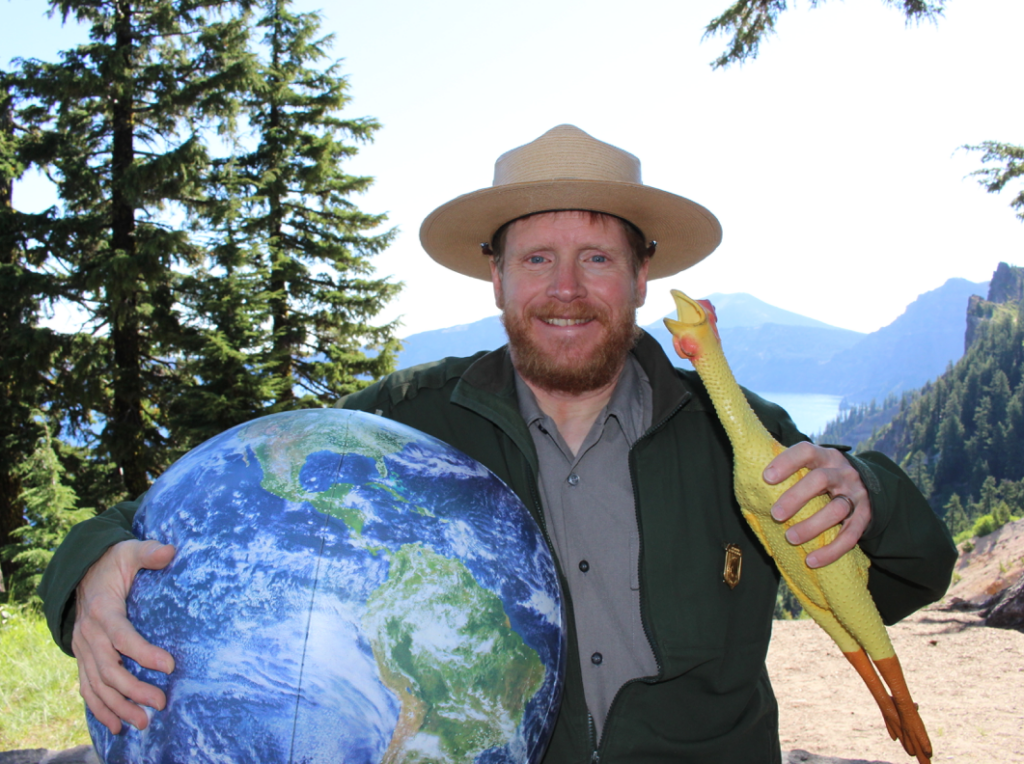
That was my only cue for me to board my flight. The airplane was so small that I took a photo of it as I walked outside the airline gate. I then strode down a ramp to walk on the tarmac and then take about step on board the airplane. We then took about 8 steps up to aircraft steps to board the airplane. This plane only had about 8 rows of seats with about 3 seats in each row. The plane was so small that the overhead bins were skimpy. Thus, all the luggage had to be placed in the checked bags storage area in the rear or tail section of the plane. It did not seem like any carryon bags could be carried into the airplane cabin, except for backpacks and items that could be stored under your feet. 

Photo by Brian Ettling of the commercial airplane he rode from Portland to Klamath Falls, Oregon on August 6, 2017.

I was amazed there was only 3 passengers on board this flight. This was probably the emptiest commercial flight I have ever taken or will ever take. In recent years, Tanya and I flew on Thanksgiving Day where the commercial jets were only about 30% full. This flight from Portland to Klamath Falls looked even more sparse than those more recent flights I took. It seemed like we had the same number of passengers, if not less than the pilots and flight attendants. Thus, we had our choice to sit anywhere in the airplane.

I sat in a window seat on the port or left side fasting the cockpit in the very back. I wanted to be where the airplane wing would not obstruct as much from any photos I intended to take of Crater Lake or other scenery. The great thing was that once the flight reached 10,000 feet and the fasten your seatbelt light came off, I could move to the window seat in the very back row on the other side of the aisle. The flight attendants did not notice. As long as I was not obstructing other passengers or their job duties, they did not care which side of the plane that I sat. I was not sure which side of the plane Crater Lake or other dramatic features I would see from the left or right side. Thus, I liked that freedom to shift from the port to starboard side to try to get looks out of the windows of each side. 

Trying to see Crater Lake from the window of a commercial flight 

It is normally about a 5-hour drive from Portland to Klamath Falls, but this flight completed the same distance in about 1 hour. For me, the best part of flying is sitting in a window seat getting aerial views of the scenery. It was a decades long dream to see Crater Lake from the window of a commercial plane. I was eager to take this flight to see what Crater Lake and the mountains of southern Oregon would look like from an airplane window. Sadly, it was not meant to be on this flight. My dreams were crushed. 

By this time in the first week of August, forest fires generating a lot of wildfire smoke were happening at Crater Lake, throughout Oregon, and even in much of the Pacific Northwest. As soon as the plane took off from the runaway from Portland International airport, the visibility looked terrible. I could hardly identify the St. John’s Bridge, downtown buildings, or any other features in the Portland area. My heart sank. I might not be able to see any dominant Oregon scenic features from the air, let alone Crater Lake. 

I remained optimistic that maybe the smoke was just obscuring any views of the Portland area. However, I knew better. Crater Lake was experiencing wildfires and smoke, as well as other areas in southern Oregon, when I left the park to come to Portland for the weekend. On the other hand, we had times at Crater Lake where the winds would come from certain directions to clear out the wildfire smoke. You just never know. 

Sadly, the horrid smoky visibility did not change at all as the airplane journeyed into central and southern Oregon. I could make out the dark silhouettes of the Three Sisters Mountains by Bend, Oregon, but that was it. The wildfire smoke and haze made all the land features in central Oregon made everything look like an uninspiring grey soup. 

Above the wildfire smoke, a blanket of clouds moved in as the plane ventured into southern Oregon. It looked bleak if I would see Crater Lake. Then the clouds then pulled back a bit and I could barely make out a shape. It was Crater Lake. I had to strain to see it through the wildfire smoke, but it was there. We were flying above around 10,000 feet when I got a peek of it. It looked nearly colorless with a slight hint of blue because of the wildfire smoke and high overhead clouds. Wizard Island was in the foreground since the plane flew close to the west rim. 

Photo by Brian Ettling of aerial view of Crater Lake National Park taken from a commercial airline flight on August 6, 2017.

It was interesting to see, yet so disappointing. I wanted to see it under better conditions than this on a commercial flight. It felt like I made a journey to see the Mona Lisa in Paris. Yet, when I landed in Paris and traveled straight to the Louve, I came to the room where the painting is displayed only to barely see it in a room filled with smoke. Even worse, it felt like the oil industry and climate deniers were laughing at me when I had a hard time seeing Crater Lake from the wildfire smoke. I organized for climate action for the previous 7 years. There’s a good chance that climate change made the fire season happening that August inside the park and throughout Oregon worse. Yet, the fossil fuel CEOs, managers, and stockholders, as well as the climate deniers, did not care about the damage to the planet and our environment that they caused. 

I was so lucky with all the beautiful clear weather I experienced at Crater Lake in May, Mt. Rainier in June, and the Columbia River Gorge in July. My luck finally ran out that summer with the heavy wildfire smoke in August. 

Showing the aerial smoky images of Crater Lake in my climate change talks 

Fifteen minutes after I saw Crater Lake from my airplane window, the airplane arrived at Klamath Falls. My Crater Lake ranger colleague Thomas picked me up at the airport. I shared my disappointment with him and anyone else that I looked at Crater Lake on a commercial flight. However, it was nearly hidden behind wildfire smoke. During the flight, I took 9 photos of Crater Lake obscured by the wildlife smoked. The images were seared in my memories. 

From that time forth, I used those photos for my climate change talks for years afterwards. They were in my climate change speaking tour talks I conducted across Oregon at the end of October and the beginning of November 2017. At the presentations I gave in the Portland area the next few years, I included that image. When I gave a climate talk in Tampa, Florida in February 2018, I included that photo. When I spoke across the state of Missouri at my college and high school alma maters in October 2018, I included one of those pictures. 

With those images, I wanted to show people that I loved working and living at Crater Lake National Park as a park ranger for 25 years. However, I saw climate change during my time there. I will never forget witnessing excessive smoke from wildfires standing on the rim and flying over the park in a commercial airplane in August 2017. Seeing climate change motivated to act every day since then. I hope knowing that climate change impacts our national parks and our most sacred wilderness areas will inspire you to take action.  

Brian Ettling leaving Crater Lake National Park after completing work there as a seasonal interpretation ranger for the summer of 2017. This was Brian’s final summer working at Crater Lake.

Flying Over Crater Lake Inspired me to Act on Climate, Part 1

An aerial photo Brian Ettling took while flying as a passenger on board a small private airplane on July 23, 2010.

“I want to fly like an eagle
To the sea
Fly like an eagle
Let my spirit carry me
I want to fly like an eagle
‘Til I’m free
Oh, Lord through the revolution”

– From the song “Fly Like an Eagle” 
Written by Steve Miller and performed by the Steve Miller Band

From 1992 to 2017, I was a seasonal park ranger at Crater Lake National Park, Oregon.

Crater Lake is the deepest lake in the United States, and one of the deepest lakes in the world. It is considered one of the cleanest and purest bodies of water in the world, giving it a deep blue cobalt color on clear days. 

The lake sits inside a collapsed volcano, known as Mt. Mazama. A series of eruptions over 420,000 years built the volcano to an estimated height around 12,000 feet. Mt. Mazama had a climatic massive eruption 7,700 years ago that caused the mountain to cave in leaving a 6-mile-wide bowl like basin, known as a caldera. The average height of the rim about 1,000 feet above the lake shore. Several peaks over 8,000 feet stand at or adjacent to the rim. Much of the year these rim mountain peaks are covered in snow. With the snow and pine trees on the mountains and in the caldera, the dramatic volcanic peaks and edges, plus the brilliant blue water, Crater Lake is one of the more picturesque places you can behold. 

When I was at Crater Lake, I never tired of standing on the rim to admire the beauty. Even more, I loved hiking up the trails to the 8,000-foot mountains along the rim to get even more dramatic views of the lake and surrounding area. 

Spending time working and exploring Crater Lake, I regularly saw planes flying over the national park. Crater Lake was on a flight path of some commercial jets. Occasionally, military jets flew way too close over the lake with their shrieking loud engines. These planes were irritating the way they would disrupt the quiet serenity of the national park The jets came from the nearby Kingsley Field Air Force Base in Klamath Falls, Oregon, located over 60 miles southeast of Crater Lake. Even more, it was not unusual to see small private planes fly over the lake now and then. 

During my time living and working at Crater Lake, my parents came from their home in St. Louis, Missouri to visit me. To this day, my mom and dad talk about viewing Crater Lake from one the commercial flights they took. While l loved enjoying the scenery from the rim and hiking up the 8,000-foot peaks inside the national park, I was curious to see how Crater Lake looked from a commercial jet or a small private plane. 

In the fall of 2009, I housesat at a friend’s house in Ashland, Oregon, a two-hour drive south of Crater Lake. The house had a separate garage unit. Above the garage was an apartment with a tenant, Cassie. Soon after I started housesitting, I would run into Cassie as she was leaving to go or come home from work. She worked in a veterinary clinic in Ashland. On her weekends, she had access to a small four passenger airplane which she flew regularly. When she was not flying the plane, she stored it in an indoor hanger at the Medford Airport, a 20-minute drive north of Ashland. With my curiosity to see Crater Lake from an airplane, I asked Cassie if she could give me a ride in her plane sometime. She replied that she would be happy to do that. 

Photo by Brian Ettling of the small private plane he rode in on July 23, 2010 to take aerial photos of Crater Lake National Park. Oregon.

Not long after my conversation with Cassie, the owner of the house decided to move back home. She did not need me to housesit for her anymore, so I unexpectedly spent the rest of the winter in my hometown St. Louis. I returned to work at Crater Lake in May 2010. I stayed in touch with Cassie. With our busy schedules, the earliest I could join her for a flight in her airplane was on July 23, 2010. I asked Cassie if my friend and co-worker, David Grimes, who was the lead naturalist ranger at Crater Lake could be with us for this flight. Cassie readily agreed that Grimes could join us. 

This was Grimes 8th year working at Crater Lake. He had never viewed Crater Lake from an airplane, so he was thrilled to join me. Grimes and I drove separately to meet Cassie at the Medford Airport at morning around 10:30 am. No clouds were in the sky and the visibility looked ideal for this warm summer day to see the lake from a plane. After we arrived and met up with Cassie, she had to get the airplane out of the secured hanger. After she opened the hanger doors, she inspected the plane for spiders and spider webs since she had not used the plane in weeks. She did not want us to be bitten by any spiders that made their way inside the hanger. 

Cassie pushed the plane carefully out of the hanger. She wanted to make sure that the plane wings did not bang against the hanger garage doors that were barely opened wide enough for the plane to be wheeled outside. Once the plane was outside, it was a bright white 4 passenger airplane that looked well maintained and would be a fun flying experience. 

Cassie then encouraged Grimes and I to enter the airplane. I decided to sit in the front passenger seat. Grimes sat in one of the back seats. Within minutes, Cassie had us slowly taxiing towards the runway. She had to radio the flight control tower for permission to take off, since commercial passenger and freight airplanes took off and landed from this airport. 

Once Cassie received permission from the control tower, the plane started picking up speed to take off from the runway. Like any flight, before we knew it, we were disconnecting from the ground and starting to fly in the skies above Medford, Oregon. 

It was stunning to see up in the plane the views of the tall mountains within the vicinity such as Mt. McLoughlin and Mt. Shasta in northern California. On my side of the airplane, I had a close view of the jagged Union Peak, which is in the southwest corner of Crater Lake National Park. It normally an hour and a half drive from Medford to Crater Lake. About 25 minutes into the flight, I started to see Crater Lake. It was definitely a different perspective looking at it standing on the rim. I could see the contours of the old Mt. Mazama rising above the nearby land with a giant blue lake sitting in the middle. The blue color of the lake matched the color of the sky. 

Aerial photo that Brian Ettling took of Crater Lake National Park on July 23, 2010.

Except seeing the highway leading up to the park and the Crater Lake Rim Drive, very little glimpses of civilization would be seen from the air. Cassie made sure we flew over Rim Village so we could identify the historic Crater Lake Lodge, the rim concession employee dormitory, and the Gift Store/Cafeteria building. We spotted the ranger employee seasonal and permanent employee housing through the vast forest of trees, that is a 3-mile drive but only 500 feet below Rim Village. Cassie generously circled around the Rim Village and ranger housing area twice so Grimes and I could get clear views of where we lived and worked. 

Cassie insisted though that she would be following FAA (Federal Aviation Administration) regulations to always fly 2,000 feet above any developed area like Rim Village and at least 1,000 feet above any natural area. Cassie flew several times above Crater Lake to make sure Grimes and I could fully appreciate the lake and national park from the air. The 6-mile-wide lake still looked huge from the air like the lake could still easily swallow up the airplane.

When Cassie would lean the airplane hard to the passenger side so I could get better views, I felt some vertigo like we might fall into Crater Lake. We were safely wearing seat belts and Cassie flew the airplane in a gentle smooth way. When she would tilt the airplane to get better views of the lake and the mountains around the rim, I felt enthralled seeing the aerial views of Crater Lake. Yet I also felt a bit uneasy flying at a weird angle. 

After close to an hour flying above Crater Lake, Cassie started veering the plane back to Medford. I will never forget seeing the forests in all directions leading away from the lake. In the distance, the snowy mountains north of the park poked above the horizon to the north, such as Mt. Bailey, Mt. Thiesen, Diamond Peak, and the Sisters Mountains of central Oregon. 

As we flew back towards Medford, Cassie offered to let me fly the airplane from the controls on the passenger side. I never thought I would fly a plane in my life. It was an exhilarating feeling briefly fly the airplane. 

A photo of Brian Ettling sitting in the front passenger seat of a small private airplane. Image taken by David Grimes, seated in the backseat, just after they flew over Crater Lake National Park.

By 12:30 pm, we were back on the ground in Medford and helping Cassie well the airplane back inside its hanger. Grimes and I both took many photos with our digital cameras. For years afterwards, Grimes used photos he shot from the airplane that day for various Crater Lake National Park Service publications. 

Crater Lake is a magnificent sight to look at standing on the rim in the national park. It was a peak life experience for me to view it from an airplane. It was another way for me to see that we live on a spectacular planet. In 2008, I decided to follow a passion to be a climate advocate. In November 2009, I took the title the “Climate Change Comedian” on a dare to try to protect our planet. In April 2010, I created the website www.climatechangecomedian.com to promote my advocacy. Seeing Crater Lake from an airplane made me more determined to do what I can to help protect our environment and planet. 

I hope you will also be inspired to protect the environment and our planet, even if you never get a chance to see Crater Lake or other natural areas from a small or commercial airplane. 

Stay tuned for Part 2 of this blog: My sad and scary experience flying over Crater Lake in a commercial airplane in August 2017.  

An aerial photo Brian Ettling took while flying as a passenger on board a small private airplane on July 23, 2010.

For Climate Action, why do I use rubber chickens?

Image of Brian Ettling taken on December 4, 2018.

In media interviews I participated in over the years, such as my 2016 appearance on TV Comedy Central’s Tosh.o, they often ask me: ‘Why do you use rubber chickens in your climate comedy videos?’ 

The short answer is: “I don’t know! It makes me laugh” 

However, in that 2016 Tosh.o interview, the TV host and comedian Daniel Tosh asked me bluntly, “But we’re supposed to just laugh when we see a rubber chicken?” 

My response, ‘I laugh.’ 

The long answer is that I don’t know what to do with the 3 rubber chickens I own since June 2009. At that time, I worked as a seasonal park ranger at Crater Lake National Park. I was a naturalist or interpretation ranger giving various park programs such as geology talks, historic lodge talks, guided sunset hikes, evening campfire programs, junior ranger activities, and narrating the boat tours. 

For the last three weeks in June each summer, the park required the interpretation rangers to complete 3 weeks of training to be knowledgeable about the park to answer visitor questions, how to prepare a ranger talk, and how to respond to medical emergencies that we might encounter. Each summer, our staff would attend one complete day of first aid and CPR (Cardiopulmonary Resuscitation) training so we could adequately act if we are the first rangers on scene in such emergencies. The park law enforcement or LE rangers, who were also trained as Emergency Medical Technicians or EMTs, led these medical trainings. 

On June 25, 2009, Cater Lake LE ranger Pieter Sween led this training. Thinking like a park ranger interpreter, he wanted this first aid training to be engaging, entertaining, but most important, informative. In particular, Pieter led a section of training known as triage. This training aimed at helping us make quick decisions if we come across an incident involving mass injuries or casualties of park visitors, such as a crowded bus or boat accident, a multi-vehicle collision, a mass shooting, explosion, building collapse, etc. A very heavy subject for a medical training. Pieter wanted to include humor to lighten the severity of the topic, but also to help cement the vital information of this training in our heads. 

This training could literally save someone’s life in a situation we need to make snap decisions. Thus, the topic was deadly serious, but it needed to be presented in a compelling way that the information would stick in our heads.

Pieter came up with the idea of me playing a snotty French waiter where I would introduce various rubber chickens. The chickens would be labeled with various conditions, such as broken leg, pregnant, unconscious, dead, head injury, or needing CPR. As a group, we then had to decide how we would treat the chickens. The categories were minor, delayed, immediate, or morgue.  

Brian Ettling performing a skit as a French waiter with rubber chickens to teach the skill of medical triage at the Crater Lake National Park ranger first aid and CRP training on June 25, 2009.

I guess Pieter figured with my animated, lively, and fun personality that I would be the perfect ranger to participate in this training as the uptight and arrogant French waiter. We had over 30 Crater Lake park rangers attend this training. I remember it being a big success and getting big laughs from the attendees as I brought out each chicken individually and I announced their medical ailments. Pieter wrote a good script for me to perform. I happened to have a fancy white shirt, a dress vest that I bought for a wedding years ago, and new black dress jeans I could wear to play this part. 

To prepare for this training skit, Pieter approached me to play this role in early June. He did not own any rubber chickens, so he needed to order some from Amazon. He was too shy to ask his boss, the Chief Law Enforcement Ranger at Crater Lake, to order 6 rubber chickens. 

Pieter humbly requested that I ask my boss to order the rubber chickens. At that time, my boss was Eric Anderson, the Supervisor of Interpretation at Crater Lake. Eric was originally from the Big Island of Hawaii. He had a nickname within the National Park Service as ‘The Mellow Hawaiian.’ Eric was a sweet and caring man with a great sense of humor. He was a tough boss with high expectations, but he had total faith in his staff and me that we could reach his and our goals. I loved working for him. He was one of the best supervisors I ever had in my work career. 

I thought it was a fun and hilarious challenge to inquire to Erik to order 6 rubber chickens. Pieter and I meekly went up to his office to meet with him. After we politely explained our skit and requested that he order 6 rubber chickens, Erik sighed and started looking where he could order rubber chickens on the internet. 

He was a bit worried about throwing away few of his department’s budget dollars on this rubber chicken order and how he might explain this expense to his boss. He then grumbled at us, “Please tell me that we will be using these rubber chickens again.” 

Without missing a beat, I blurted out, “Sure, we will be using these rubber chickens again!” 

Internally, I had no idea how I would be using those rubber chickens again. After this triage skit, they sat on my shelf for a year. I then used them on my ranger led trolley tours starting in 2010. I would pull one out to say, ‘Folks just to let you know this is a very serious ranger program.’ 

Brian Ettling holding up a rubber chicken at the start of his ranger narrated trolley tour at Crater Lake National Park, Oregon in September 2011.

I would also use the rubber chicken during the trolley tour when I pointed out Mt. Thielsen, a 9,100-foot prominent mountain located just north of Crater Lake National Park. I shared with visitors on the trolley that I twice hiked up that mountain in 1992 and 1994, but I only made it 10 feet from the summit. It was a place known as Chicken Point. I then held up the rubber chicken in my hand. It got a big laugh from the audience. 

That was my only uses of a rubber chicken at Crater Lake. Was it worth the park expense and our federal taxpayer dollars for Eric to order these 6 rubber chickens? Maybe. I still think so. 

In November 2009, my friend Naomi and I got into an argument when I was housesitting in Ashland, Oregon, located two hours south of Crater Lake National Park. She pressed me hard on what I wanted to do with my life since I struggled to give her a clear answer. Finally, I retorted, “Fine! If I could do anything, I would like to be ‘The Climate Change Comedian’!” 

She nearly fell out of her chair laughing and replied, “I want you to go home right now and grab that website domain!” I followed her advice and did just that. In April 2010, a friend helped me created the www.climatechangecomedian.com website to help promote me as an entertaining climate change speaker. 

Years later, I still had no idea what to do with that title and website. In January 2014, I made a short YouTube video with my then girlfriend, who later became my wife, Tanya, to promote her violin playing and to book me for events as ‘The Climate Change Comedian.’ In February 2014, I shot a video with my mom, Fran Ettling, to advertise her piano playing and me as ‘The Climate Change Comedian.’ One year later, my dad, LeRoy Ettling, complained that he was not in any of my YouTube videos that I created with Tanya or my mom. Thus, we created a video with featuring my Dad and I talking about climate change in March 2015. 

For all these videos, I used the rubber chicken to make the point, “I think I am very funny!” 

Each time, they immediately responded, “No! You are not!” 

These short videos using the rubber chickens caught the attention of Comedy Central’s Tosh.o. The show invited my mom and I to pay for us to fly to Los Angeles in April 2016 to do the video tapping with Daniel Tosh for the show that aired on August 2, 2016. 

Thus, those rubber chickens Eric bought at Crater Lake in 2009 as a humble request from Pieter Sween and me enabled my mom and me to briefly appear on national TV. As ‘The Climate Change Comedian,’ I doubt I will ever top that appearance on Tosh.o. The show invited me back to appear again in November 2020. 

I still don’t have an answer for Eric Anderson, Daniel Tosh, or anyone else why I still have 3 rubber chickens to this day or why I used them as a comedy tool to promote climate action. 

I don’t know. I don’t have answers for what I do what I do. I just do what I can to create a better world and have some fun along the way. 

Maybe we should ask the rubber chickens. Or a professional psychiatrist.

Brian Ettling working as a park ranger at Crater Lake National Park. Photo taken in August 2016.

For Our Democracy my thrill meeting U.S. Congressman Jamie Raskin

Brian Ettling and Congressman Jamie Raskin at the U.S. Capitol. Photo taken on June 11, 2024

On January 6, 2021, I was at home in Portland, Oregon that day writing when I saw strange alerts about an attack on the U.S. Capitol. As I turned on the TV to see what was happening, I had not felt so nauseous and heartbroken for the USA since the 9-11 terrorist attacks.

I wrote on Facebook during the insurrection, “As an American, I am feeling very sad right now. Donald Trump can’t face reality that he lost his re-election, so he instigated his followers to breech the U.S. Capitol security where Congress was supposed to finalize the Electoral College results. It’s just shocking to see so many people who claim to be patriotic. Yet (they) don’t believe in the rule of law, democracy, and honoring the results of a free & fair election.”

During that day, the news broke that a woman, later identified as Ashli Babbitt, was shot dead by Capitol Police as she attempted to climb through a broken door to enter the U.S. House of Representatives inside the Capitol Building.

I then posted: “Donald Trump’s political career is finished. No way he is the GOP nominee in 2024. He burned too many bridges now. This woman died because of his arrogance and mental issues that he can’t accept a free and fair election. The blood is on his hands. It is such a tragedy that this woman listened to Trump, right wing media, and her peers to be to participate with this unlawful mob today.”

Later that day on January 6th, I posted an old photo of me from November 2018 taken in front of the U.S. Capitol smiling with my Earthball. I then wrote, “My stomach felt like it was kicked in today. I have had the privilege of traveling to Washington D.C. and lobbying Congressional Offices for climate action 8 times in the past (6 years). It is one of my biggest thrills whenever I get to lobby Congress for #ClimateAction. If you ever get a chance to lobby Congress, I highly recommend it. This is a sacred place of our American democracy. It made me sick to see this unruly and unlawful mob desecrate this sacred and hollow ground. These are also sacred grounds to peacefully protest to speak truth to power in a way that respects and honors members of Congress and their staff while they try to do their jobs.”

Photo of Brian Ettling taken in from of the U.S. Capitol Building on November 13, 2018.

As an American who loves our democracy and U.S. Capitol Building, I felt assaulted by Donald Trump and his supporters by the violent insurrection on January 6th. It shook my faith that the America had a stable and solid democracy. As I watched live on TV, it looked like the American equivalent to the 1933 Reichstag Fire in Berlin that Adolf Hitler and the Nazis used to consolidate power in Germany that eventually led to World War II.

Fortunately, the U.S. Capitol Police and the U.S National Guard were able to reassert control over the U.S. Capitol on January 6th. Congress was able to complete its duties to certify the 2020 Presidential election. Joe Biden would still be inaugurated as President and Kamala Harris as Vice President on January 20, 2021.

As a result of his actions leading up to and on January 6th, the U.S. House of Representatives voted to impeach President Donald Trump on January 13, 2021. 

The U.S. Senate held this impeachment trial of President Trump from February 9-13, 2021. A clear majority of 57 U.S. Senators voted to convict Donald Trump. Sadly, that vote fell short of the two-thirds majority required by the U.S. Constitution to convict Trump. Thus, the Senate found Trump determined to be not guilty on the single article of impeachment. 

On January 30, 2021, the House of Representatives voted to establish the U.S. House Select Committee to Investigate the January 6th Attack on the United States Capitol that was responsible for investigating every aspect of the insurrection—including the role of the former President. Over the next 18 months, I followed closely this committee’s hearings and proceedings. 

On December 19, 2022, the committee released its final report. It listed a serious list of accusations against Trump: obstruction of an official proceeding; conspiracy to defraud the nation; conspiracy to make false statements; and most grave of all, inciting, assisting, aiding, or comforting an insurrection. For the first time in the history of the United States, Congress referred a former President to the Department of Justice for criminal prosecution. Unfortunately, the U.S. Department of Justice ran out of time to hold Donald Trump accountable for his crimes when he was elected President on November 5, 2024. 

As I watched the media coverage of the 2021 Senate Impeachment Trial of Donald Trump and the House January 6thSelect Committee, one man stood out to me who was involved with both proceedings, Congressman Jamie Raskin of Maryland. Before entering Congress, Rep. Raskin was a professor of constitutional law at American University’s Washington College of Law for more than 25 years.  in January 2021, then-Speaker Nancy Pelosi appointed him as the lead impeachment manager in the second impeachment trial of former president Donald Trump. Later in 2021, Rep. Raskin was subsequently appointed to serve on the bipartisan January 6th Select Committee and led its legal and constitutional team. With his actions in those situations to make the strong case why Donald Trump should be held legally accountable for January 6th, I was very impressed with the arguments and evidence he articulated against Trump.

Though I found I found the January 6th Insurrection to be a devastating blow to American democracy, I did not let it stop me from traveling to Washington D.C. in June 2023 and June 2024. I went there to attend the Citizens’ Climate Lobby (CCL) conference and lobby day on Capitol Hill to meet with Congressional Offices to urge them to pass strong climate legislation. 

On June 11, 2024, I attended the CCL Lobby Day on Capitol Hill to attend meetings with several Congressional Offices. As I traveled inside an underground tunnel connecting the Longworth to the Rayburn House Office Buildings, I heard a joyful commotion. A group of young CCL volunteers barely in their 20s were very gleeful and awe struck to run into Congressman Jamie Raskin. I was stunned to see him in person. I knew of him for years as the lead impeachment manager for the Senate impeachment trial held after Trump’s second impeachment. This was followed by then Speaker Nancy Pelosi appointing Raskin to serve on the House Select Committee investigating the January 6 Capitol attack in 2021 and 2022. For these last four years, Rep. Jamie Raskin is one of the top defenders of American democracy in the U.S. Congress. 

The young CCL volunteers eagerly took photos with him. Congressman Raskin seemed just as thrilled to get his photos with them. I don’t know who was more excited. I was just a couple of feet away. When he finished his photos with them, I found myself standing right next to him. I meekly said, “Can I get my photo with you?” 

He shot out a big grin, stomped his foot, and responded with an enthusiastic, “Yes!” 

I then quickly took a selfie meeting with him before he bolted to his next meeting. I squeezed in a very brief, “Thank you for all you have done to try to protect our democracy!” He seemed very appreciative to hear that. This very short less than a 30 second interaction made the whole trip from Portland Oregon to Washington D.C. worth it. Jamie Raskin was around my height of 5 feet 8 inches, if not an inch shorter. Yet, this is a man of a big stature. 

With all my canvassing and organizing for climate change over the years, it felt like a very positive reward to have this brief but spectacular moment with Congressman Jamie Raskin. Even more, meeting Representative Raskin was a peak moment of inspiration for me to meet someone who has worked so hard in Congress to protect our democracy. My brief interaction with him inspired me to do more to uphold our democracy and to keep lobbying Congress to pass effective climate policies. 

Thank you, Congressman Raskin, for all your public service. Even more, I will always be grateful how kind you were to those students and me when we interacted with you at the U.S. Capitol.  

Brian Ettling in front of of the U.S. Capitol Building. Photo taken on June 11, 2024.

For Climate Action, renting an EV for a 2025 Florida Vacation 

Brian Ettling and Tanya Couture with their Hyundai Ionia 5 electric car rental at Fort De Soto Park, Florida. Photo taken on November 5, 2025.

For many years, I have felt weird as an American because I don’t like to drive a car. For many of my fellow citizens, it seems to be the American dream to own a car and drive it everywhere. I am always amazed by all the people who drive in the gridlock traffic of rush hour every day, especially to commute to their jobs. I realize that they have limited say in the location of their jobs, homes, and route to work and home. However, the congestion of rush hour traffic each day has always seemed like insanity. This was one of the reasons why I spent 25 years working and living in the national parks. I wanted to live and work close to the outdoors with a very easy commute where I could walk, bicycle, or had a short drive with no traffic to go to work.

I loved the 25 years spending my summers at Crater Lake National Park, Oregon and my winters in Everglades National Park, Florida. Part of me wanted to spend the rest of my life living in these pristine locations. Then something shifted in me. Over 25 years ago, I loved waking up and watching the morning NBC news Today Show on TV while living in the Everglades. Thus, I woke up on September 11, 2001 to watch TV. I saw the terrorist attack of the commercial airplanes hitting the World Trade Center in New York City live on TV. It shook me to the core. To this day, I shudder when I hear a large jet fly low in the sky above me.

According to the FBI 9/11 Investigation, 15 of the 19 terrorists suspected to have carried out the attacks were from Saudi Arabia. They were funded by dark networks of money in Saudi Arabia and the Middle East that financed Saudi national Osama Bin Ladin and Al-Qaeda to commit these horrible acts. Where does Saudi Arabia make most of its money? Drilling oil on their lands and selling it on the global market. Who was one of their biggest customers? The United States. After the 9/11 attacks, I wanted buy and use the least amount of gasoline possible so I would not fund terrorism that killed so many Americans on 9/11.

At the same time, I felt stuck in the Everglades. I worked there for four years straight. I missed working at Crater Lake and spending my summers in southern Oregon. In the spring of 2001, my girlfriend Sheila and I broke up after an eight-year relationship. For months afterwards, she still generously let me use her Ford Ranger pickup truck to get groceries and complete errands in Miami, Florida on my weekends from work. However, I needed my own car to be completely independent. I did not want a big pick-up truck like she owned. I wanted a small compact green car which gave me the best gas mileage possible in 2002.

On February 22, 2002, I bought my brand-new green Honda Civic that I still own to this day, 24 years later! Because of how much I hated the U.S. dependance on Middle East oil, I probably would have liked to have bought an electric car then. However, I knew of no electric vehicles or EVs that were available to purchase back then.

Brian Ettling and his mom Fran Ettling with his brand new 2002 Honda Civic. Photo taken in St. Louis, MO in May 2002.

Discovering my passion for climate change advocacy

As the years progressed, I developed another reason to hate buying gasoline for my car. Besides the U.S. dependance on oil leading to Middle Eastern terrorism, plus the disastrous 2003 U.S. invasion of Iraq, the oil industry spent millions of dollars in advertising, lobbying, and public relations campaigns to deceive many Americans that climate change was a hoax.

In 1998, I started giving ranger talks in Everglades National Park. Visitors then asked me about this global warming thing. Visitors hate when park rangers tell you, “I don’t know.” Visitors expect park rangers to know everything. Don’t you?

Soon afterwards, I rushed to the nearest Miami bookstore and to the park library to read all I the scientific books I could find on climate change.

The information I learned really scared me, specifically sea level rise along our mangrove coastline in Everglades National Park. Sea level rose 8 inches in the 20th century, four times more than it had risen in previous centuries for the past three thousand years. Because of climate change, sea level is now expected to rise at least three feet in Everglades National Park by the end of the 21st century. The sea would swallow up most of the park and nearby Miami since the highest point of the park road less than three feet above sea level.

It shocked me that crocodiles, alligators, and beautiful Flamingos I enjoyed seeing in the Everglades could lose this ideal coastal habitat because of sea level rise caused by climate change.

I became so worried about climate change that I quit my winter job in Everglades National Park in 2008. I moved back to St. Louis in the winters to give speeches and organized about climate change. In November 2011, I co-founded the St. Louis Climate Reality Meet Up (now called Climate Meetup-St. Louis) group to discuss, learn, and take climate action.

Brian Ettling giving a ranger talk in Everglades City in the spring of 2004.

Meeting my wife Tanya while I organized for climate action

At one of the Climate Reality-St. Louis Meet Ups in early 2012, a beautiful slender woman with long blonde hair sat at the bar drinking a birch beer. Her name was Tanya. We slowly became friends. We started dating in February 2013 and we got married in November 2015. She is always 100% supportive of my climate change organizing.

In December 2015, just one month after we got married, I expressed my frustration to Tanya. I felt like I was not doing enough to organize and write on climate change. To boost my morale, my wife surprised me by booking an appointment with the nearby Tesla store to test drive the 100% electric Tesla Model S. We had a blast test driving this car. Tanya’s action lifted my spirits to see this could be the future for automobiles: 100% electric with no carbon tailpipe emissions.

In 2015, very few EVs were seen on the roads, and they seemed to be too expensive to own. Because of my frugal lifestyle as a summer seasonal park ranger at Crater Lake and a winter climate organizer in St. Louis, we could not afford to own a Tesla or any EV at that time.

In February 2017, Tanya found a job in Portland, Oregon, so we moved here. I worked one more summer as a seasonal park ranger at Crater Lake, but I decided to become a full-time climate organizer in October 2017. Ever since we test drove the Tesla in December 2015, Tanya and I dreamed of buying an EV. However, my 2002 Honda Civic is still a reliable car to this day. Tanya primarily uses it as a short commute to her job. I nearly always use the TriMet buses and MAX light rail commuter trains to get around Portland to do my climate organizing.

We often talk about purchasing an EV, but we have no need right now. My 2002 Honda Civic still works for all our driving needs.

Brian Ettling and Tanya Couture after they test drove a Tesla Model S on December 26, 2015 at the Tesla Center in Creve Coeur, Missouri.

Traveling to Florida in November 2025 and choosing to rent an electric car

November 1, 2025, was our 10th wedding anniversary. Tanya and I wanted to do something special to celebrate. She wanted us to go to Tampa, Florida for several days to visit her best friend, Bertha. Tanya had not seen Bertha in over 30 years since they attended high school in St. Louis. I was excited because I lived and worked for 16 years in Everglades National Park, Florida. I was eager to show Florida to Tanya since she had never been there before.

It was a long day of flying from Portland, Oregon to Tampa, Florida. We had to leave our apartment around 5:30 am to catch our 7:30 am flight. After a 3-hour layover in Phoenix, Arizona, we arrived at the Tampa airport around 7:30 pm. We found the Tampa airport to be very convoluted to reach the location where my rental car reservation was booked. It was after 8 pm when Tanya and I stood in a line for several minutes to obtain our rental car.

By the time, we walked up to the rental car desk, we were bone tired from flying all day. The rental car agent gave us lots of choices for cars. However, I didn’t care. I just wanted to get in a rental car, drive to Bertha’s house, and fall into a bed. I felt overwhelmed and indecisive with the rental car options. Then the rental agent offered, ‘I tell you what: I have a Hyundai Ioniq 5 EV that I have available for you to rent. This would be great for me if you could rent it. I will include in the agreement that you won’t have to bring it back on a full charge.’

My ears perked up: Rent an EV! Not use and gasoline on this vacation! Get the experience for a few days of driving an EV. I enthusiastically told the rental car agent, ‘Yes! I will do it! Please sign me up to rent the EV!’

After we signed the paperwork, it took Tanya and I a few minutes to find the car in the cavernous parking garage at the Tampa Airport. When we found the car, it looked like a lovely and ideal car for us to rent. It was a grayish blue color. However, when the sun shined on the car during our trip, we noticed that the car looked like it had a touch of a greenish hue.

Photo of the Hyundai Ioniq 5 that Brian Ettling and Tanya Couture rented during their November 2025 trip to Florida. Photo take at Siesta Key, Florida on November 3, 2025.

It was a mid-sized car roomier than my Honda Civic. Tanya and I noticed after we got into the car that it had a battery charge of over 270 miles. As we started driving the car through the maze of the parking garage and then outside on the Tampa streets, we were amazed that the car was much quieter to drive than my Honda Civic. It drove with the silence of being inside a library, unlike the more vocal engine of my Civic.

We had about a 35-minute drive from the airport to Bertha’s house. Overall, it was a smooth ride. It was impressive for us how zippy the car picked up speed when I pressed on the accelerator. This car felt like an uncaged bird at how fast it traveled compared to my 4-cylinder stick shift Honda Civic. I normally travel around 60 to 65 mph in my car because it feels a bit harder on the engine when I go above 70 mph. However, this EV easily traveled at 70 to 75 mph or even at higher speeds. The catch though was that I could see on the dashboard that the miles remaining on the battery charge decreased more rapidly at higher speeds.

At the same time, when I took my foot off the accelerator to slow the EV speed down or apply the brakes, the battery regenerative recharge icons would light up on the dashboard. It let me know that I was gaining few miles back from the regenerative recharge when I needed to slow this car down. I tried to pay close attention to driving at high speeds to the other cars on the road and the curves in the road when I traveled on I-75 on the way to Bertha’s house. However, I found the dashboard indicators of the miles left on the battery charge and the battery regenerate charge continuously updated information to be fascinating. It was even a bit distracting.

Tanya and I made it to Bertha and Gene’s house around 10 pm. Tanya and Bertha stayed up late talking since they had not seen each other in over 30 years. The last time they were together was when they graduated high school in St. Louis in 1993.

November 2, 2025 – Our day trip to Homosassa Springs Wildlife State Park

When we woke up the next morning, I was eager to show Tanya some sights in Florida. She had never seen a Florida Manatee. I saw them numerous times when I worked in the Everglades. The closest relative of the manatee is the elephant. They have the grey thick skin like an elephant. Plus, they are a large mammal like an elephant. Adult manatees are usually 9-10 feet long from snout to tail and weigh around 1,000 pounds. But they can grow to over 13 feet long and weigh more than 3,500 pounds.

A photo of a Florida Manatee taken by Brian Ettling from the underwater observatory deck at Homosassa Springs State Park, Florida on November 2, 2025.

I knew the ideal place to take Tanya where we had a great chance to see manatees: Ellie Schiller Homosassa Springs Wildlife State Park. To drive there, it would take about an hour or a 50-mile drive north of Bertha’s house. The Hyundai Ioniq 5 EV was a fun car to drive us up there that day. However, we started noticing some odd quirks with the car that we had to deal with while we rented it. First, the side mirrors would automatically fold in whenever we parked the EV and shut off the engine. The catch was that the side mirrors would not naturally fold back out when we started the car and began driving it down the road. Thus, Tanya and I had to roll down the windows and push the mirrors out with our hands. That was the only way I could see the mirrors when driving the EV.

The other annoyance with the EV is that we could not figure out how to get the air conditioning to work properly. November in Florida is still hot and humid with temperatures in the 80s. Car interiors in Florida warm up further as they trap the heat of the sun’s rays. Car air conditioning (AC) is still beneficial to use in the winter in Florida to stay cool while driving. If Tanya and I had more time, we probably would have read the vehicle manual thoroughly enough to understand how the AC properly worked or call a Hyundai service hotline to get answers. However, we were only renting the EV for a few days. Plus, we wanted to focus on doing as much sightseeing as we could. The good news is that on the second day of our trip, the AC started working properly on its own accord. We did not know what we did to get it functioning correctly. The joke between Tanya and me became “Don’t touch anything!” when it came to the touch screen buttons on the dashboard involving temperature controls.

Despite these frustrations, the Hyundai Ioniq 5 got us safely to Homosassa Springs. It was not long after we arrived that Tanya and I walked to a large lagoon that had an enclosed exterior platform a few feet above the water. In addition, the platform had an underwater enclosed observatory with large windows to observe possible sightings of manatees, fish, turtles, etc.

Tanya stayed on the outside observation deck while I moseyed down below to see what I could discover. In just a few minutes, a large manatee swam in front of the windows on the below deck observatory. I was ecstatic to see the 6–7-foot manatee gently swim in front of the window. After I watched it for about a minute and took some photos great photos, I bolted up to the upper observation deck to inform Tanya that I saw a manatee below. I did not have to tell her because she was observing the same manatee. She was looking down on the manatee swimming below the water surface. Tanya was thrilled seeing this animal species for the first time. She took lots of photos.

We then had a wonderful afternoon strolling around on the boardwalk trails to see more wildlife at Homosassa Springs. For the first time, Tanya saw and photographed colorful birds that were showcased and even rehabilitated at the refuge, such as Roseate Spoonbills, Snowy Egrets, American Wood Storks, Brown Pelicans, White Pelicans, and Greater Flamingos. I have great memories seeing all these bird species when I worked in Everglades National Park from 1992 to 2008. I was delighted that Tanya saw these birds for the first time. Judging by the photos she took and the conversations we had that day, she enjoyed looking at these birds.

Late in the afternoon, we decided to drive back to our host Bertha’s house to visit with her and her husband Gene. We wanted to get there in time to have dinner with them. As we drove back from Homosassa Springs State Park to her home in Wesley Chapel, Florida, we noticed that we only had about a third of a charge left or about 80 miles. We decided it was time we learned how to charge this EV, especially since we wanted to have a full charge for our sightseeing the next day. Using the electronic dashboard map inside the vehicle, it routed us to a Flying J Truck Stop on the north side of Wesley Chapel that had EV charging.

When we arrived at the Flying J to see the EV charging stations, we had to quickly figure out which side of the vehicle we needed to plug in the charging connector or plug. We spotted that the vehicle plug in outlet was on the passenger side near the rear of the car. We then had to determine how to pay for the charging. Tanya downloaded an app on her smart phone and inputted her credit card number so we could charge the Ioniq 5 rental car. It took about 10 to 15 minutes to fully charge the car to about 80%, which is the optimal battery charge. Charging this EV probably took more time than to put gas in a car or large truck. However, the went by quickly as I ate a snack and we took turns using the nearby restroom.

When we were happy with the range of around 270 miles and over 80% full, we went to Bertha’s home for the evening. Bertha and Gene took Tanya and me out for a nearby Japanese sushi restaurant. The food was tasty. Tanya and Bertha reminisced about their high school years. Gene and I connected over our fondness of jazz and 80s pop music, as well as 70s rock music.

November 3, 2025 – Our day trip to Siesta Beach and Myakka River State Park

For our excursion the next day, Tanya and longed to go to the beach to go swimming and spend time there. Bertha recommended Siesta Key Beach as one of her favorite Florida beaches near her home. This beach was located about 80 miles or about an hour and a half drive south of Wesley Chapel. It turned to be well worth the drive to go there. It was one of the most gorgeous beaches I had seen in Florida. Tanya and I were grateful for Bertha’s recommendation.

Brian Ettling and Tanya Couture at Siesta Beach, Florida. Photo taken on November 3, 2025.


It was a glistening white sandy beach. We had a sunny day, without a cloud in the sky with an outdoor temperature near 80 degrees Fahrenheit. The soft sand was easy and soothing to walk on, but the brightness of the color with the sun made it a bit hot on our bare feet. It was easy to cool off our feet and bodies though once we went into the water. The small waves crashing on the shoreline were pleasant to watch. We liked spending time absorbing their refreshing gentle impact when we swam in the water. After a couple hours at the beach and eating our packed lunches there, we felt that we wanted to explore more nearby parks in Florida that day.

When we turned off Interstate 75 to head to Siesta Key Beach earlier that morning, I saw a sign for Myakka River State Park. I had never been there before. When I lived in Everglades National Park back in 1998, I stumbled across a lecture by famed Florida nature photographer Clyde Butcher. I distinctly remember been raving about Myakka River State Park as one of his favorite places to photograph in Florida. I recalled him referring to this park as ‘the Yosemite Valley of Florida’ with its natural beauty and opportunities to photograph wildlife. I asked Tanya if we could drive from Siesta Key to Myakka River. She was open to experience this park.

It was a 30-minute drive directly east from Siesta Key to Myakka River. We arrived there around 3 pm. Visiting the park was one of the peak experiences for our trip to Florida. Soon after we crossed the park boundary, we saw a sign that warned:

“CAUTION
Alligators are present along the trails and waterways of
this park. They usually eat fish, turtles, and other small
animals but may attack larger animals such as deer.
Alligators have been known to attack humans.

FOR YOUR SAFETY
Alligators are dangerous
Do not approach, frighten, or feed
by state law 372.667FS”

Point well taken! I had a healthy fear of alligators from my time in Everglades National Park. I never saw them be aggressive with humans. However, one time I was walking around a corner on a trail at the Flamingo Outpost in Everglades National Park. Suddenly, I saw a large alligator out of the corner of my eye just a couple of feet from me. It was just lying there trying to warm up from the Florida sun to get energy. After seeing this unexpected sight way too close to me. I jumped up in the air and screamed. I ended up starling the alligator, which jumped up frightened from my reaction. It did not try to lung or attack me. But, that experience of being unexpectedly walking too close to an alligator is something that I never forgot.

Since this was her first time in Florida, Tanya certainly noticed the sign and made a mental note. Driving less than a mile into the park, we crossed a bridge over a large shallow pond. At the edges of the pond, around ten alligators were spread out along the edges to sun themselves. Check! I succeeded in showing Tanya her first wild alligators in Florida. Tanya and I took lots of photos of them just lying there.

Photo by Brian Ettling of an alligator sunning itself by the edge of a large pond at Myakka River State Park. Image taken on November 3, 2025.

Almost right underneath the bridge was a Limpkin. It’s a small marsh bird that stands around two feet tall that has brown feathers with some white streaks of feathers on its upper back, underbelly, neck and head. It has a sharp spear like bill for capturing its favorite food apple snails, as well as other snails, mussels, frogs, crustaceans, and insects. I never saw that bird when I lived in Flamingo, but I saw it several times when I visited other areas in Everglades National Park. It was another one of my favorite Florida birds that I was happy I could show Tanya.

We then chose to walk down a dirt trail through a grove of palm trees. It led further down to the edge the same pond where we could see a few more alligators. The trail was roughly a half a mile one way or a mile out and back.

Tanya and I then drove a mile down the road to another hiking trail. We walkied down the path which led us to the Myakka Canopy Walkway. Before we started walking up the canopy walkway, we read the wayside exhibits listing the 74 other known canopy walkways throughout the world. This canopy walkway with a tower at one end was an impressive sight to admire in the middle of Myakka River State Park.

Myakka River Park website stated this canopy walkway was “Completed in 2000, this structure is the first public treetop trail in North America. The walkway is suspended 25 feet above the ground and extends 100 feet through the hammock canopy. The taller tower soars 74 feet in the air to present a spectacular view of treetops, wetlands and the prairie/hammock interface. You can look down on eagles, hawks, vultures, and the tops of live oak and sabal palm trees.”

The website informs that to walk to the top of the tower “requires walking over 100 stairs.”

Photo by Brian Ettling of the view from the Myakka River State Park Canopy Walkway Tower. Image taken on November 3, 2025.

Florida is the flattest state in the United States. When I worked in Everglades National Park in south Florida for 16 years, I missed seeing any kind of prominent rising hills that gave a dramatic view of the landscape. A friend and I had to pay for a small airplane ride to get a bird eye’s view of south Florida and the Everglades. Thus, I was joyful to walk on this elevated walkway and take many flights of steps to the top of this tower to get a panoramic view of Myakka River State Park. It was fascinating to see palm trees in every direction to the horizon with a few grassy open meadows mixed in between the forests of tropical trees.

Tanya then took the many flights of steps down the tower. We then walked a mile more on the loop trail past the canopy tower walkway. We had the trail all to ourselves. We don’t recall seeing other people. It was a gift to be in the serenity of natural Florida to lose ourselves in the outdoors and the sounds of our own footsteps, thoughts, and an occasional birdcall.

The trail was completely flat, which enabled us to walk at a quick pace since we hiked the trail around 5 pm. We had less than an hour of daylight left. Even with the flatness, Tanya and I found ourselves taking photos of the groves of palm trees bunched together tightly, The tallest of the Florida Palm trees standing up to 20 to 30 feet above the ground, creating its own shady canopy as we walked through this forest. Intermixed in this palm forest were thick sprawling oak trees extending in every direction wanting to state their dominance in this forest and at the edges of the open meadows.

One open meadow with tall grasses with the forest palm trees and oak trees at the edge caught my attention. I noticed a large full moon that seemed to be wanted to be included in any scenic photo. I took a panoramic photo with my iPhone of the grassy prairie, and the forest in the background of the photo. My long shadow was in the middle of the image with Tanya standing on the boardwalk off to one side of the photo looked pleased to be there.

That evening, I showed my photos of the day to Tanya’s friend Bertha. She loved the panoramic photo and asked for a copy of it. One month later in December, I ordered an 8×24 inch version of that photo on an aluminum backing. A local Portland friend recommended a place in Vancouver, Washington that could print it for me with a high gloss finish on this metal surface. The photo did not arrive in time for Christmas day. However, it was delivered during the Holidays. Bertha was elated to receive it.

Panoramic photo by Brian Ettling at Myakka River State Park, Florida with Tanya Couture standing on the right side. Image taken on November 3, 2025.

After we hiked on this trail, Tanya and I were not finished with Myakka Park. We returned to the car to drive further to Upper Myakka Lake to find out what else we could see with the limited amount of daylight we had left.

When the road converged near the lake, I saw something moving in the tall grasses between the road and the lake. It was a slam on the brakes moment as I drove the rental EV. I even told Tanya, “I am seeing something so beautiful that it is a ‘slam on the breaks moment!’”

I noticed a small group of pink Roseate Spoonbills swishing their bills back and forth in the water trying to feed. They were feeding as a group walking along the water’s edge to make the most of the remaining sunlight. It was hard to get a good photograph of the Spoonbills with the tall Cattails and other tall marshy grasses in the way. At the same time, they were plain to see with the naked eye with their bright pink colors on their backs and sides. I could spot their white heads and distinct feeding style which looked like someone moving a flattened wooden spoon back and forth in a mixing bowl.

While we observed and tried to photograph the Roseate Spoonbills, I spotted the full moon above the palm trees daring me to also try to capture that image in photographs. I never got a satisfying image of the Spoonbills feeding or threatening to take off flying if I got too close to them. At the same time, it was a thrill to see a Limpkin walking behind the Spoonbills seeing what it could feed on with the Spoonbills stirring up life along the shoreline.

The next thing we observed was the sunset happening behind the Upper Myakka Lake. The sun was slipping below the forest along the horizon which made for a great view of the sunset to try to photograph. Even after the sunset, Tanya and I had more to see in this state park. I spotted wild pigs in a meadow by the lake as Tanya and I drove back to the park entrance to start the journey back to Bertha’s house for the evening. Even more, as Tanya and I headed in the EV towards the park entrance, I saw a flock of Wild Turkeys feeing in a meadow. I had times where I saw a lot of wildlife working and living in Everglades National Park. However, with all the wildlife we saw at Myakka River State Park, it felt like Tanya and I spent the day at the African Serengeti.

Photo by Brian Ettling of the sunset at Myakka River State Park, Florida. Image taken on November 3, 2025.

By the time Tanya and I left Myakka River State Park, the daylight was nearly gone, and the evening darkness started to settle in. Driving back to Sarasota, Florida to connect with I-75 to go back to Bertha’s house, Tanya and I needed a restaurant to have dinner for the evening. Without knowing the good restaurants of Sarasota or knowing what we were in the mood to eat, we ended up going to a Chili’s to eat our evening meal.

After dinner, it was around 8 pm. We still had over an hour’s drive to Bertha’s home in Welsey Chapel, Florida. The Hyundai Ioniq 5 EV drove so much faster and smoother than my 4-cylinder stick shift 2002 Honda Civic. I normal drive around 60 to 65 mph in my Honda Civic since the car feels loud when I drive it faster and it gets to a higher RPM, which seems like it is a bit harder on the engine. Thus, I drive my Civic at slower speeds to be safer, quieter, and get a bater gas mileage than at faster speeds.

On the other hand, I was eager to get back to Bertha’s place to relax and possibly hang out with Bertha and Gene. Thus, I drove the car at consistent speeds of 70 to 75 mph, and even over 80 mph at times. The EV was still quieter than my Honda Civic when I drove it at higher speeds. With its much higher horsepower, the EV did not mind the higher speeds. At same time, I noticed that the remaining charge on the EV charger was dropping fast as I pushed the car to drive at higher speeds. Looks like we were going to need to fast charge this Ioniq 5 Hyundai EV soon.

On her smart phone EV charging App, Tanya found an EVgo charging station at an upscale fancy shopping mall known as The Shops at the Wiregrass. When we arrived, we saw at least 8 charging ports. This charging station was busy at 9 pm at night, so we had a wait about 5 minutes for a charging port to become available. It was our second day learning how to charge an EV. We were amazed how friendly and helpful the other EV owners were as Tanya and I still had some uncertainties how to charge our EV rental car. The Florida EV owners looked like their own friendly community. This was no typical gas station experience where everyone keeps to themselves and does not chat with strangers.

It then dawned on me that Tanya and I were the only white people charging our EV at this charging station. In my climate organizing in Portland, Oregon, many of my white retired friends who advocate for climate action have electric vehicles. Thus, I have tended to categorize EV owners that I met as white liberal middle to upper income retired Americans. I was too bashful to ask probing questions to these gracious Florida EV drivers. However, they did not seem like they were driving EVs because they were tree-hugging, granola eating, Birkenstock wearing, Save-the-Earth progressives. These looked primarily like prosperous African Americans that just wanted a fun, dependable, fast, and comfortable car to drive.

I wish I had another day or two to be brave enough to ask these EV owners why they chose to drive electric cars. They seemed open to conversation and willing to answer questions. It took around 15 to 20 minute to charge our EV to around an 80% charge. But, the time went fast for Tanya and I to take turns using the nearby restrooms and checking the internet on our phones.

While we were waiting, I had time to walk to a nearby overpriced Belgian ice cream shoppe. I wanted my usual chocolate shake with vanilla ice cream and chocolate or hot fudge syrup blended in. The servers said they could not alter their shake ingredients because their boss would get upset with them. I was craving a chocolate milkshake, so I gave into their refusal to alter their ingredients. The shake ended up costing me over $10. It tasted good, but it was way too expensive. Anyway, by the time they completed my order, I paid for it, and walked back to our car, Tanya was finishing up charging our EV.

We then made it to Bertha’s house to chat with her and see if she had any suggestions for our next day visiting Florida. She suggested another of her favorite beaches: Fort De Soto Park.

November 4, 2025 – Our day trip to Fort De Soto Park

The next day, November 4th, it took Tanya and me about an hour and a half to drive from Bertha’s home in Wesley Chapel to Fort De Soto Park. It is located at the very southern tip of the of Pinellas Peninsula. The park is located directly south of St. Petersburg. It is on a tiny spit of land where Tampa Bay meets the Gulf of Mexico.

Photo by Brian Ettling of Fort De Soto State Park, Florida. Image taken on November 4, 2025.

When I worked in Everglades National Park from 1992 to 2008, I read positive things about Fort De Soto as a birding hotspot. It is the kind of place for migrating birds in the fall to notice that it is the last tiny piece of land to take a break traveling south on the Pinellas Peninsula before they are traveling for hundreds of miles in the open waters of the Atlantic. Even more, in the spring, it is the first sliver of land that tired birds migrating north see where they could use as a rest area as they are crossing the open Gulf of Mexico waters to enter central Florida to start heading north. Thus, I was intrigued to see it.

When Tanya and I arrived at Fort De Soto Park, it was definitely a slow day for Florida tourists. Hardly anyone was there. It was the first Tuesday in November. I remember working in the Everglades that the peak of tourist season in south Florida was from around Christmas Day in December to Easter in the spring. Another day where Tanya and I did not have to worry about big crowds of tourists in Florida. The huge parking lot was nearly empty when we arrived.

After we parked the car, Tanya and I had to find our way to the beach which was hidden behind a coastal ridge bank or berm. It looked to be up to 15 to 20 feet tall with some trees and vegetation on it further shielding the view from the parking lot. Once we walked on top of the ridge, the bright white sandy beach seemed to stretch down the coast for many miles. We could see very few people walking around or lounging around on the beach. It was the kind of isolated beach that one dreams of seeing when they go on vacation.

Tanya and I wanted to get some walking in to immerse ourselves in this park. We walked down the long concrete pier among the men and women recreational fishing there as well as seeing the Brown Pelicans, seagulls, and other birds trying to beg and steal fish from the fishermen.

As we started walking down the beach, I noticed the presence of one of my favorite birds, American Oystercatchers. They have a long straight bright orange bill, black head, black feathers on their backside, and snowy white underbelly. I loved seeing these birds when I worked in the Everglades. I only saw them a few times. Primarily it was when I worked and visited in Everglades City. As their name suggests, these birds like to pry open the shells of oysters and other mollusks, shelled beach organisms, to get to the soft tasty organisms living on the inside of the shells. The presence of the Oystercatchers was an alarm bell to me that there were oysters and other sharp shells on this beach, especially in the shallow water if we went swimming.

American Oystercatcher walking on the beach at Fort De Soto State Park, Florida. Photo taken by Brian Ettling on November 4, 2025.

As we walked on the beach, I started noticing the menacing looking shells scattered sporadically on the beach. I really wanted to go swimming in this every inviting Gulf of Mexico ocean waters that day. We were only a few days away from attending my niece’s wedding in Kansas City, Missouri. I promised my mom we would transport her there. The last thing I needed was to slice up my feet and need to get medical attention on the sharp shells of the beach. I noticed a concession store and café by the pier at Fort De Soto. They just happened to sell overpriced beach water shoes with hard soles that could protect my feet. I splurged to buy the shoes rather than risk doing any dumb avoidable injuries.

Before Tanya and I went swimming we looked at the Fort De Soto concrete bunkers, which were accessible from the parking lot side of the beach. The fort was built around 1900, when Tampa citizens demand coastal defenses after the United States entered the Spanish American war. We thought it was interesting to see the 12-inch mortar battery that housed some of the fort’s weaponry, was completed on May 10, 1900. Incidentally, the fort nor the weapons never saw any combat in the Spanish American War or any war since then. It seemed like too remote and sleepy for any area to be involved in any war.

After we walked around the fort, Tanya and ate the snack lunches we brought. We then walked up the beach to a spot where there were a few other people, mostly of retirement age. We thought it would be safe to go swimming in the water near them. We took turns swimming in the Gulf of Mexico, like we did the day before, so one of us could protect our valuables. The water felt fairly warm in the 70-to-80-degree range. I felt safe to swim with my feet covered in my brand-new beach water shoes. Tanya was not worried about any sharp shells tearing at feet and she was fine. Maybe I would have been ok not blowing almost $30 on those shoes. I just did not want to take any chances.

Now that my feet were safe, I still worried about my exposed calf and thigh getting stung by a jellyfish or a random rip current carrying me out to sea. It seems like I can never fully relax when I am on vacation. At the same time, I worked 25 years as a park ranger in the national parks. Therefore, I know that bad things can happen in paradise or in any scenic outdoor areas.

While we spent time swimming and laying on the beach at Fort De Soto, we got good looks of a Black Skimmer. This was another one of my favorite birds when I used to work at Everglades National Park. It looks a bit like an American Oystercatcher. However, a Black Skimmer has a wider bill. The front half is black with the lower mandible longer than the upper mandible. Similar to the Oystercatcher, the Skimmer has a black head and bright white underbelly. However, the Skimmer has a white forehead. I was excited to point out this bird to Tanya. I used to enjoy watching these birds feed when I lived in the Everglades. Like the name suggests, they skim across the surface of ocean waters for their food, mostly tiny fish.

While Tanya and I strolled around the Fort De Soto Beach, we saw other intriguing wildlife, such as a leopard crab, with very distinguishable spots. Plus, we saw a gopher tortoise walking on a sandy path, hoping not to be noticed by people, overly energetic dogs, or other animals.

Photo by Brian Ettling of a gopher tortoise taken at Fort De Soto State Park, Florida. Image taken on November 4, 2025.

We had a wonderful exploring Fort De Soto Park. Before we left, we took a selfie with our Hyundai Ioniq 5 EV rental car. We were still giddy that we were sightseeing around the central Gulf Coast of Florida without using gasoline in a spry electric vehicle. We finally left the parking lot at Fort De Soto around 4:30 pm. We knew that it would take us a few hours to get back to Bertha’s home in Wesley Chapel since we would be fighting rush hour traffic. Even more, we had no idea where we would eat dinner. We ended up getting lost in north Tampa Florida before we agreed upon a safe choice of a Cracker Barrel Restaurant for dinner.

When we finally returned to Wesley Chapel around 8 pm, we went EVgo charging station shopping mall known as The Shops at the Wiregrass. This was the second day in a row that we went to this location to recharge our rental EV. Tanya and I felt like we were starting to get a handle on this EV recharging thing. We found that the experience of recharging an EV was not bad. This charging station was also not as busy as the night before. We then stopped at a nearby Publix grocery store since we felt like we needed to replace some of the food items we were eating at Bertha’s house. We got back around 9 pm. Since Bertha is a night owl, Tanya and Bertha had plenty of time to chat about the day and life.

November 5, 2025 – Our day trip to Crystal River National Wildlife Refuge

The next day, November 5th, was our final full day of vacation in Florida. I asked Tanya if she would like to go up to Crystal River National Wildlife Refuge to try to see more manatees. She readily agreed. Tanya was still curious about manatees. She did not have any other location in mind to visit that day. Crystal River was in the vicinity of Homosassa Springs Wildlife Park. They were about 12 miles apart, with Crystal River located about a 20-minute drive north of Homosassa Springs Park. It would take close to an hour and a half drive to get to Crystal River from Wesley Chaptel. However, because we drove up to Homosassa Springs just a few days before, we have some familiarity with the route.

After we paid the entrance fee for Crystal River State Park, we started walking to see the crystal-clear river springs that gives the park its name. When we arrived on scene, we were impressed with the clarity of the water to see all the way to the bottom. The watercolor varied from emerald green by the shallow edge to turquoise blue in the deeper sections in the middle. We observed several tourists in kayaks in the middle of the lagoon looking for manatees. However, neither they or Tanya or me could spot any manatees.

Tanya and I then hiked to the Crystal River at the end of the park. We noticed a large group of manatees swimming together there. We saw some people snorkeling and paddling towards the manatees with their kayaks. The rule is that people are not supposed to total surround the manatees nor approach them too close. A snorkeler or kayaker must leave an opening where the manatees don’t feel trapped and they can leave at any time.

We then strolled further down the hiking path where I saw a mother manatee and calf swimming in the Crystal River. Tanya was in her own thoughts shuffling down the park perimeter trail. I successfully waved her over to where I was standing so she could see the mother and baby manatee swimming together. The water was murkier in the Crystal River than it was in the lagoon that we first went to see in this park in the morning. However, we could still see their large round grey bodies in the water as they would come up to breathe air on the surface.

Tanya and I then took the perimeter trail around the park. It was an easy flat trail only about one mile long. We had some nice views of some interior freshwater ponds with a Great Blue Heron, a Snowy Egret, and a White Ibis standing at the water’s edge waiting to catch fish. Bright green cattail plants standing up to 4 feet tall on the other side of the ponds reminded me of some of the natural scenes I used to see working in Everglades National Park.

We then chose to head back to the super clear lagoon to see if we could spot more manatees. A narrow shallow clear water canal connected the Crystal River to the lagoon. Tanya and I stood on the wooden observation deck boardwalk where the canal met the river to look for manatees. In the river, people were in some kayaks and paddleboards, as well as snorkelers in the water trying to get close views of the manatees swimming nearby in the river. Some of the manatees decided to swim into the canal right by the boardwalk where Tanya and I stood. It felt magical because we were safely only a few feet away from these very large mystical mammals looking down on them as they swam in this water that had total clarity.

Photo by Brian Ettling of a kayaker next to a baby and adult female manatee at Crystal River National Wildlife Refuge. Image taken on November 5, 2025.

Some of the kayakers that were paddling with a high concentration to try to see them had a hard time spotting the manatees as they swam submerged next to but almost underneath the kayaks. The park volunteers sharing the boardwalk with Tanya and me yelled at some of the kayakers to keep their distance from the manatees as these animals wandered into and out of the canal. I felt some regret that I did not organize for Tanya and me to go snorkeling or kayaking to see the manatees like these tourists we were observing. On the other hand, Tanya and I concluded that we had the best views of the manatees to fully view them from the wooden observation deck rather than snorkeling or kayaking with them that day.

We then walked on the wooden boardwalk that encircled the lagoon to attempt to get other looks of the manatees. Eventually, as the afternoon progress, Tanya and I felt like we were not going to get any better manatee sightings than we had already seen. We started walking back to our rental EV. Like the previous day, the bright sun shining on the car made its greyish blueish color looked like it had a hint of green. Green is my favorite color. I have owned a dark green Honda Civic for 24 years. We were so proud of renting this Hyundai Ioniq 5 electric car during this vacation. Tanya and I both took more pictures of this car, like we did on previous days on this trip. We hoped to be able to post photos about this EV on a future social media post. Even more, I wanted to blog about this fun adventure renting this EV together with Tanya for this Florida vacation at some point in the future.

We left Crystal River National Wildlife Preserve around 1:45 pm. We still needed to stop somewhere in the town Crystal River for a late lunch. After we ate some food, we left Crystal River around 2:30 pm. We wanted to give ourselves a couple of hours to return to Bertha’s house in Welsey Chapel. In addition, we set aside time to charge the EV at the Flying J Truck Stop just north of Wesley Chapel so we would have enough of a charge when we returned our rental to the Tampa Airport the next day.

Bertha planned for a big family dinner with her parents, Gene, Tanya and me around 6 pm. We aimed to return to her home in plenty of time so we could take showers since we were out in the warm sun, wearing sunscreen, and working up a sweat walking around the Crystal River Wildlife Refuge. Bertha organized a wonderful holiday like dinner for all of us. We enjoyed to meet her parents. Gene and Bertha were fantastic hosts for the trip Tanya and I took to Florida. I was so happy for Tanya and Bertha that they got to spend time visiting after not seeing each other in over 30 years. Bertha has a very kind heart. I felt like I made a new friend meeting her. I liked my conversations with Gene hearing about his expertise in high quality audio equipment.

Conclusion

Thursday morning, November 6th, our trip to Florida was over. Tanya and I headed to the Budget Rental Car Returns at Tampa International Airport to drop off our vehicle and then catch our flight. We were excited to fly to St. Louis, Missouri to see Tanya’s parents and brother, plus meet up with my mom. The next day, Friday, November 7th, Tanya, my mom, and me planned to drive to Kansas City, Missouri to attend my niece Bailey’s wedding. We looked forward to spending time with family. However, we were sad to stop driving our Hyundai Ioniq 5 EV.

Photo of the Hyundai Ioniq 5 that Brian Ettling and Tanya Couture rented during their November 2025 trip to Florida. Photo take at Siesta Key, Florida on November 3, 2025.

Tanya and I could not wait to tell family and friends about our Florida vacation and renting an EV. Nearly every day since then, Tanya and I talk about eventually owning an EV.

The fabulous memories of this trip did not last long. Late November 2025, I read the crushing news that the United Nations COP30 Climate Summit held in Brazil was a failure.

For background, COP stands for Conference of the Parties, basically international countries that agreed to participate in and be bound by the UNFCCC (United Nations Framework Convention on Climate Change). Today there are 198 Parties or countries participating in the Convention.

The UNFCCC is a multilateral treaty adopted in 1992 – shortly after the first assessment report by the Intergovernmental Panel on Climate Change (IPCC) in 1990 – to stabilize greenhouse gas concentrations “at a level that would prevent dangerous anthropogenic (human-induced) interference with the climate system.”

The 30 in COP30 refers to the 30 of these international conferences held over the years. Berlin Germany held the first COP in 1995. COP30 was held in Belém, Brazil, in November 2025.

According to Reuters, the host of the conference, “Brazil’s President Luiz Inácio Lula da Silva had launched the summit calling for countries to agree on a “roadmap” for advancing a COP28 pledge to shift away from fossil fuels. 

The result was similar to Egypt’s COP27 and Azerbaijan’s COP29, where countries agreed to spend more money to address climate dangers while ignoring their primary cause.

Nearly three-fourths of the world’s greenhouse gas emissions since 2020 have come from coal, oil and gas. Demand for these fuels is likely to rise through 2050, the International Energy Agency said in a report midway through the COP30 summit that reversed expectations of a rapid shift to clean energy.” 

For the first time, the U.S. did not send a delegation after President Donald Trump said the country will leave the landmark Paris treaty that committed countries to act on climate change in 2015. He has branded climate change “a con”. In May 2024, Trump pressed oil executives to give $1 billion for his campaign. In return, he promised ‘to do what they wanted.’ 

Many climate advocates felt like this was another Cop wrecked by fossil fuel interests, autocratic petro-states such as Russia and Saudi Arabia, and our leaders’ cowardice.

After I saw this news, I told Tanya that I was done driving a gasoline-powered car. I really wanted us to get an EV. This was a shift in thinking for me because I love my 2022 green Honda Civic. It is over 24 years old now and still running well. For years, I wanted to see how long Tanya and I could drive it before it died. If possible, I wanted to even drive for another 6 years so that I could say that I owned the same car for over 30 years or close to half of my life.

Locally, climate change is showing more of an impact on our weather. In December 2025, record rainfalls from ‘atmospheric river’ weather conditions brought flooding to the Portland, Oregon area. So far in 2026, the opposite happened, Oregon experienced very little rain or snow. We are now projected to have a record low snowpack for this winter.

Locally the red warning lights are flashing, and the alarm bells are ringing loudly that we must act quickly and effectively to reduce the climate change threat. What’s causing climate change? For many decades, climate scientists say it is because of humanity, collectively and individually, burning fossil fuels, such as oil, coal, and natural gas, which emits carbon dioxide and other greenhouse gases. Throwing all that dirty fossil fuel pollution into our air supply is warming up and destabilizing our global and local climate. Most climate scientists think if we act quickly, together and personally, we can reduce the damage we are doing to our planet and to ourselves.

For over 17 years, I have spoken out for the urgent need for effective climate action. I gave climate change ranger talks, lobbied Congressional offices in Washington D.C. over 10 times, organized for an Oregon legislative climate resolution, created comedy videos that led to an appearance on TV Comedy Central’s Tosh.o, was a plaintiff in a Missouri Sierra Club lawsuit against my local electric utility for their over reliance on dirty coal energy, led two speaking tours across my home state of Missouri and one in Oregon, and I gave over 200 climate change talks in 12 U.S. states, Washington D.C. and Ottawa Canada. Even more, locally I use public transportation on almost a daily basis to reduce my car’s tailpipe emissions. 

Driving a gasoline powered car when it is not feasible to use public transportation really bothers me. My wife Tanya and I are eager to buy an electric vehicle when the timing is right for us. Our recent visit to Florida, November 1-6, 2025, showed us that driving an EV is fun and it is easy to recharge it. That trip inspired us that we want our next car to be an EV! 

Thank you Bertha and Gene for allowing us to come visit you in Florida to see the wildlife, natural areas, and beaches near you. Even more, we got the experience that it is a joy to drive an EV and not use a gasoline powered car for transportation. We will always be grateful to you! 

Brian Ettling and Tanya Couture. Photo taken at Homosassa Springs State Park on November 2, 2025.