For many years, I have felt weird as an American because I don’t like to drive a car. For many of my fellow citizens, it seems to be the American dream to own a car and drive it everywhere. I am always amazed by all the people who drive in the gridlock traffic of rush hour every day, especially to commute to their jobs. I realize that they have limited say in the location of their jobs, homes, and route to work and home. However, the congestion of rush hour traffic each day has always seemed like insanity. This was one of the reasons why I spent 25 years working and living in the national parks. I wanted to live and work close to the outdoors with a very easy commute where I could walk, bicycle, or had a short drive with no traffic to go to work.
I loved the 25 years spending my summers at Crater Lake National Park, Oregon and my winters in Everglades National Park, Florida. Part of me wanted to spend the rest of my life living in these pristine locations. Then something shifted in me. Over 25 years ago, I loved waking up and watching the morning NBC news Today Show on TV while living in the Everglades. Thus, I woke up on September 11, 2001 to watch TV. I saw the terrorist attack of the commercial airplanes hitting the World Trade Center in New York City live on TV. It shook me to the core. To this day, I shudder when I hear a large jet fly low in the sky above me.
According to the FBI 9/11 Investigation, 15 of the 19 terrorists suspected to have carried out the attacks were from Saudi Arabia. They were funded by dark networks of money in Saudi Arabia and the Middle East that financed Saudi national Osama Bin Ladin and Al-Qaeda to commit these horrible acts. Where does Saudi Arabia make most of its money? Drilling oil on their lands and selling it on the global market. Who was one of their biggest customers? The United States. After the 9/11 attacks, I wanted buy and use the least amount of gasoline possible so I would not fund terrorism that killed so many Americans on 9/11.
At the same time, I felt stuck in the Everglades. I worked there for four years straight. I missed working at Crater Lake and spending my summers in southern Oregon. In the spring of 2001, my girlfriend Sheila and I broke up after an eight-year relationship. For months afterwards, she still generously let me use her Ford Ranger pickup truck to get groceries and complete errands in Miami, Florida on my weekends from work. However, I needed my own car to be completely independent. I did not want a big pick-up truck like she owned. I wanted a small compact green car which gave me the best gas mileage possible in 2002.
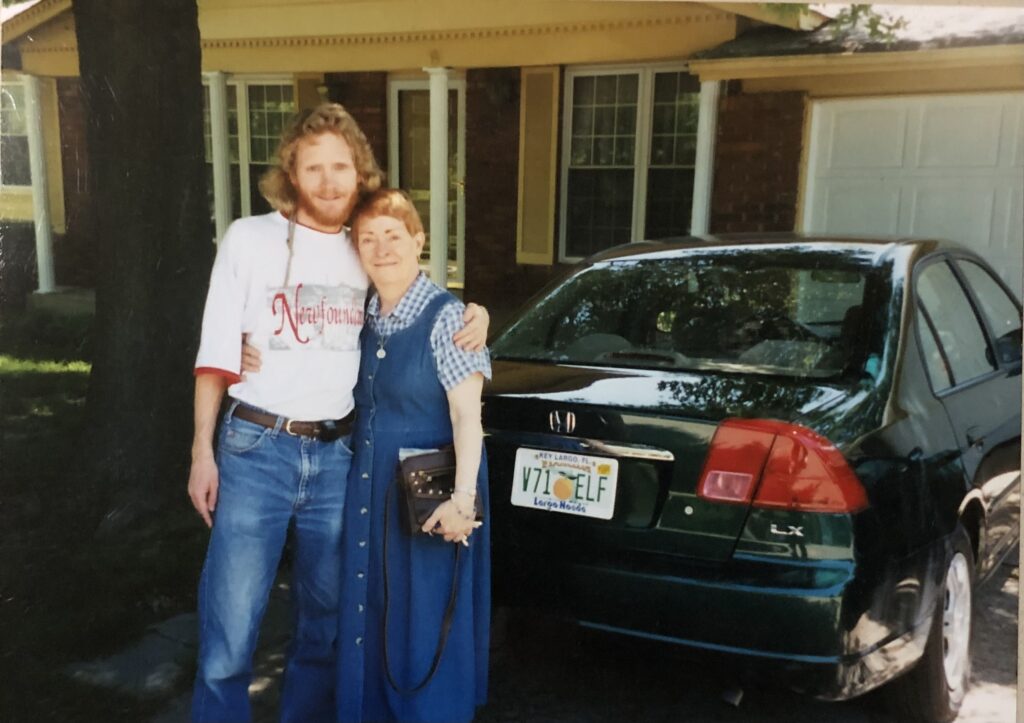
On February 22, 2002, I bought my brand-new green Honda Civic that I still own to this day, 24 years later! Because of how much I hated the U.S. dependance on Middle East oil, I probably would have liked to have bought an electric car then. However, I knew of no electric vehicles or EVs that were available to purchase back then.
Discovering my passion for climate change advocacy
As the years progressed, I developed another reason to hate buying gasoline for my car. Besides the U.S. dependance on oil leading to Middle Eastern terrorism, plus the disastrous 2003 U.S. invasion of Iraq, the oil industry spent millions of dollars in advertising, lobbying, and public relations campaigns to deceive many Americans that climate change was a hoax.
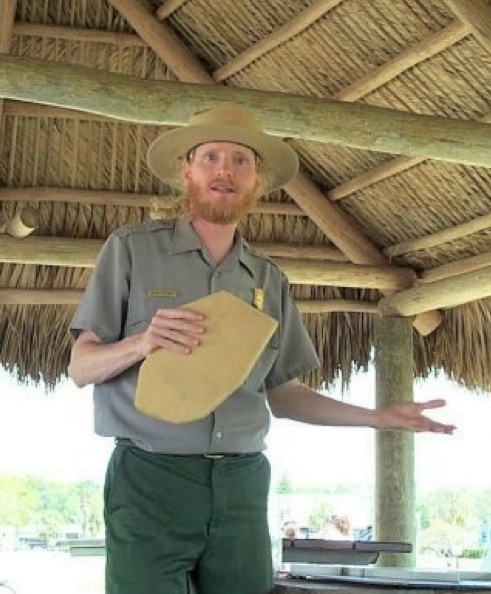
In 1998, I started giving ranger talks in Everglades National Park. Visitors then asked me about this global warming thing. Visitors hate when park rangers tell you, “I don’t know.” Visitors expect park rangers to know everything. Don’t you?
Soon afterwards, I rushed to the nearest Miami bookstore and to the park library to read all I the scientific books I could find on climate change.
The information I learned really scared me, specifically sea level rise along our mangrove coastline in Everglades National Park. Sea level rose 8 inches in the 20th century, four times more than it had risen in previous centuries for the past three thousand years. Because of climate change, sea level is now expected to rise at least three feet in Everglades National Park by the end of the 21st century. The sea would swallow up most of the park and nearby Miami since the highest point of the park road less than three feet above sea level.
It shocked me that crocodiles, alligators, and beautiful Flamingos I enjoyed seeing in the Everglades could lose this ideal coastal habitat because of sea level rise caused by climate change.
I became so worried about climate change that I quit my winter job in Everglades National Park in 2008. I moved back to St. Louis in the winters to give speeches and organized about climate change. In November 2011, I co-founded the St. Louis Climate Reality Meet Up (now called Climate Meetup-St. Louis) group to discuss, learn, and take climate action.
Meeting my wife Tanya while I organized for climate action
At one of the Climate Reality-St. Louis Meet Ups in early 2012, a beautiful slender woman with long blonde hair sat at the bar drinking a birch beer. Her name was Tanya. We slowly became friends. We started dating in February 2013 and we got married in November 2015. She is always 100% supportive of my climate change organizing.
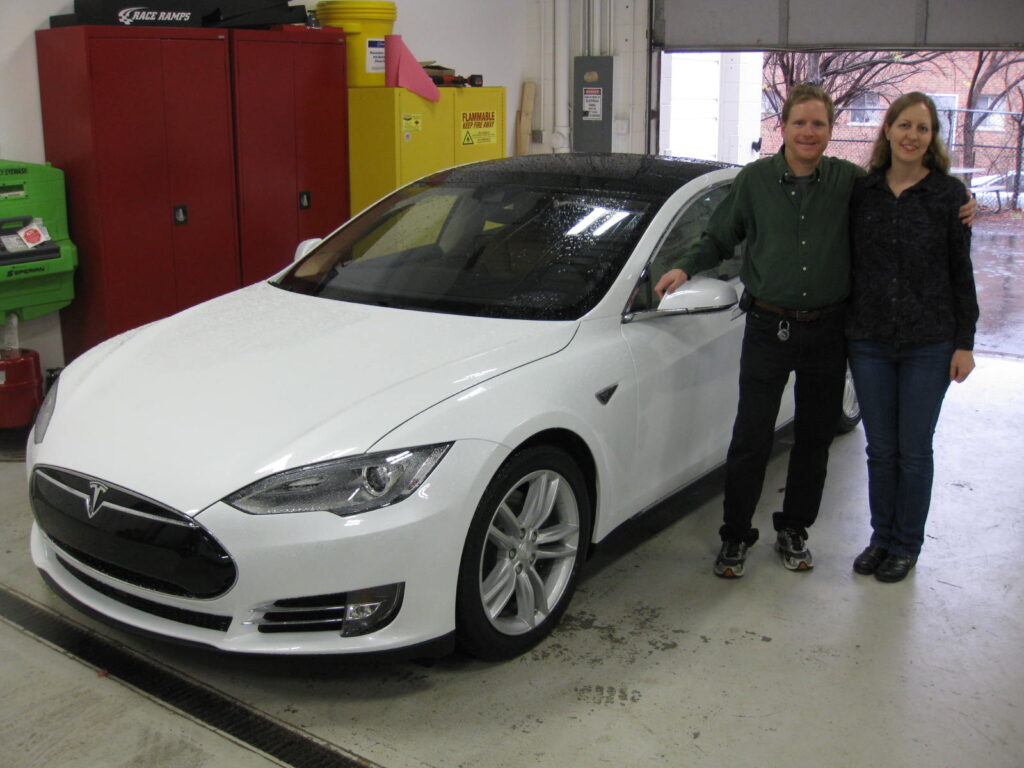
In December 2015, just one month after we got married, I expressed my frustration to Tanya. I felt like I was not doing enough to organize and write on climate change. To boost my morale, my wife surprised me by booking an appointment with the nearby Tesla store to test drive the 100% electric Tesla Model S. We had a blast test driving this car. Tanya’s action lifted my spirits to see this could be the future for automobiles: 100% electric with no carbon tailpipe emissions.
In 2015, very few EVs were seen on the roads, and they seemed to be too expensive to own. Because of my frugal lifestyle as a summer seasonal park ranger at Crater Lake and a winter climate organizer in St. Louis, we could not afford to own a Tesla or any EV at that time.
In February 2017, Tanya found a job in Portland, Oregon, so we moved here. I worked one more summer as a seasonal park ranger at Crater Lake, but I decided to become a full-time climate organizer in October 2017. Ever since we test drove the Tesla in December 2015, Tanya and I dreamed of buying an EV. However, my 2002 Honda Civic is still a reliable car to this day. Tanya primarily uses it as a short commute to her job. I nearly always use the TriMet buses and MAX light rail commuter trains to get around Portland to do my climate organizing.
We often talk about purchasing an EV, but we have no need right now. My 2002 Honda Civic still works for all our driving needs.
Traveling to Florida in November 2025 and choosing to rent an electric car
November 1, 2025, was our 10th wedding anniversary. Tanya and I wanted to do something special to celebrate. She wanted us to go to Tampa, Florida for several days to visit her best friend, Bertha. Tanya had not seen Bertha in over 30 years since they attended high school in St. Louis. I was excited because I lived and worked for 16 years in Everglades National Park, Florida. I was eager to show Florida to Tanya since she had never been there before.
It was a long day of flying from Portland, Oregon to Tampa, Florida. We had to leave our apartment around 5:30 am to catch our 7:30 am flight. After a 3-hour layover in Phoenix, Arizona, we arrived at the Tampa airport around 7:30 pm. We found the Tampa airport to be very convoluted to reach the location where my rental car reservation was booked. It was after 8 pm when Tanya and I stood in a line for several minutes to obtain our rental car.
By the time, we walked up to the rental car desk, we were bone tired from flying all day. The rental car agent gave us lots of choices for cars. However, I didn’t care. I just wanted to get in a rental car, drive to Bertha’s house, and fall into a bed. I felt overwhelmed and indecisive with the rental car options. Then the rental agent offered, ‘I tell you what: I have a Hyundai Ioniq 5 EV that I have available for you to rent. This would be great for me if you could rent it. I will include in the agreement that you won’t have to bring it back on a full charge.’
My ears perked up: Rent an EV! Not use and gasoline on this vacation! Get the experience for a few days of driving an EV. I enthusiastically told the rental car agent, ‘Yes! I will do it! Please sign me up to rent the EV!’
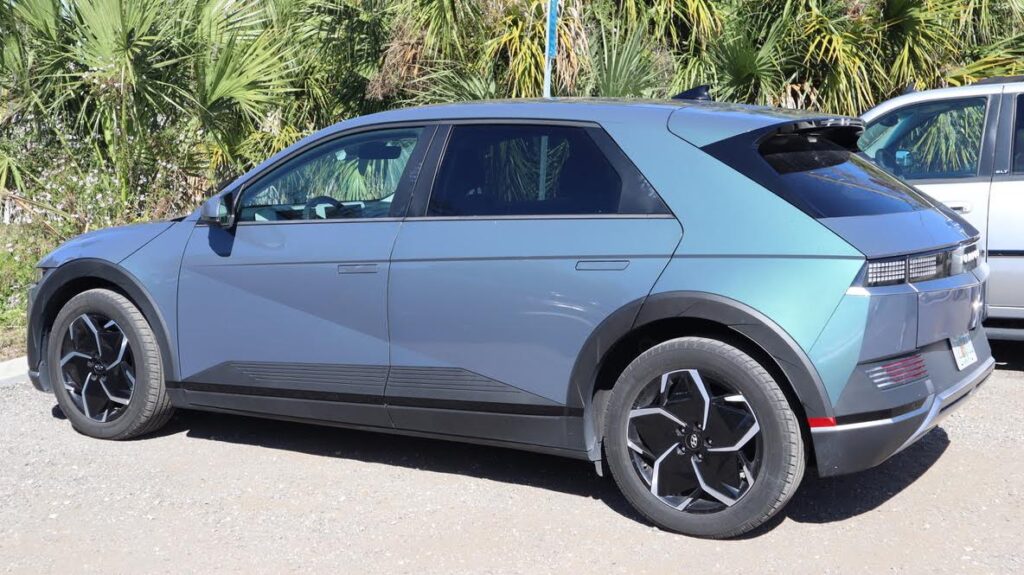
After we signed the paperwork, it took Tanya and I a few minutes to find the car in the cavernous parking garage at the Tampa Airport. When we found the car, it looked like a lovely and ideal car for us to rent. It was a grayish blue color. However, when the sun shined on the car during our trip, we noticed that the car looked like it had a touch of a greenish hue.
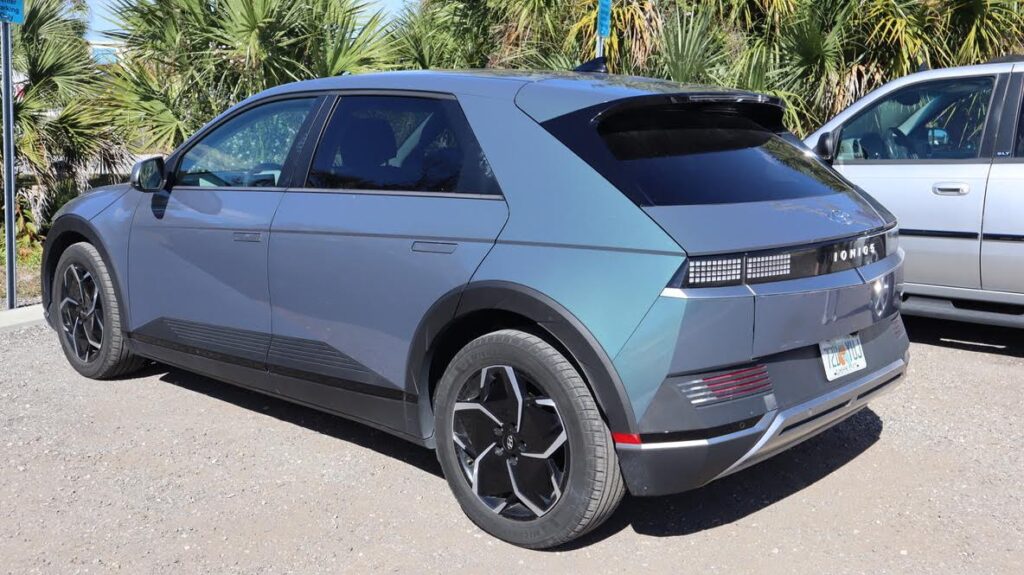
It was a mid-sized car roomier than my Honda Civic. Tanya and I noticed after we got into the car that it had a battery charge of over 270 miles. As we started driving the car through the maze of the parking garage and then outside on the Tampa streets, we were amazed that the car was much quieter to drive than my Honda Civic. It drove with the silence of being inside a library, unlike the more vocal engine of my Civic.
We had about a 35-minute drive from the airport to Bertha’s house. Overall, it was a smooth ride. It was impressive for us how zippy the car picked up speed when I pressed on the accelerator. This car felt like an uncaged bird at how fast it traveled compared to my 4-cylinder stick shift Honda Civic. I normally travel around 60 to 65 mph in my car because it feels a bit harder on the engine when I go above 70 mph. However, this EV easily traveled at 70 to 75 mph or even at higher speeds. The catch though was that I could see on the dashboard that the miles remaining on the battery charge decreased more rapidly at higher speeds.
At the same time, when I took my foot off the accelerator to slow the EV speed down or apply the brakes, the battery regenerative recharge icons would light up on the dashboard. It let me know that I was gaining few miles back from the regenerative recharge when I needed to slow this car down. I tried to pay close attention to driving at high speeds to the other cars on the road and the curves in the road when I traveled on I-75 on the way to Bertha’s house. However, I found the dashboard indicators of the miles left on the battery charge and the battery regenerate charge continuously updated information to be fascinating. It was even a bit distracting.
Tanya and I made it to Bertha and Gene’s house around 10 pm. Tanya and Bertha stayed up late talking since they had not seen each other in over 30 years. The last time they were together was when they graduated high school in St. Louis in 1993.
November 2, 2025 – Our day trip to Homosassa Springs Wildlife State Park
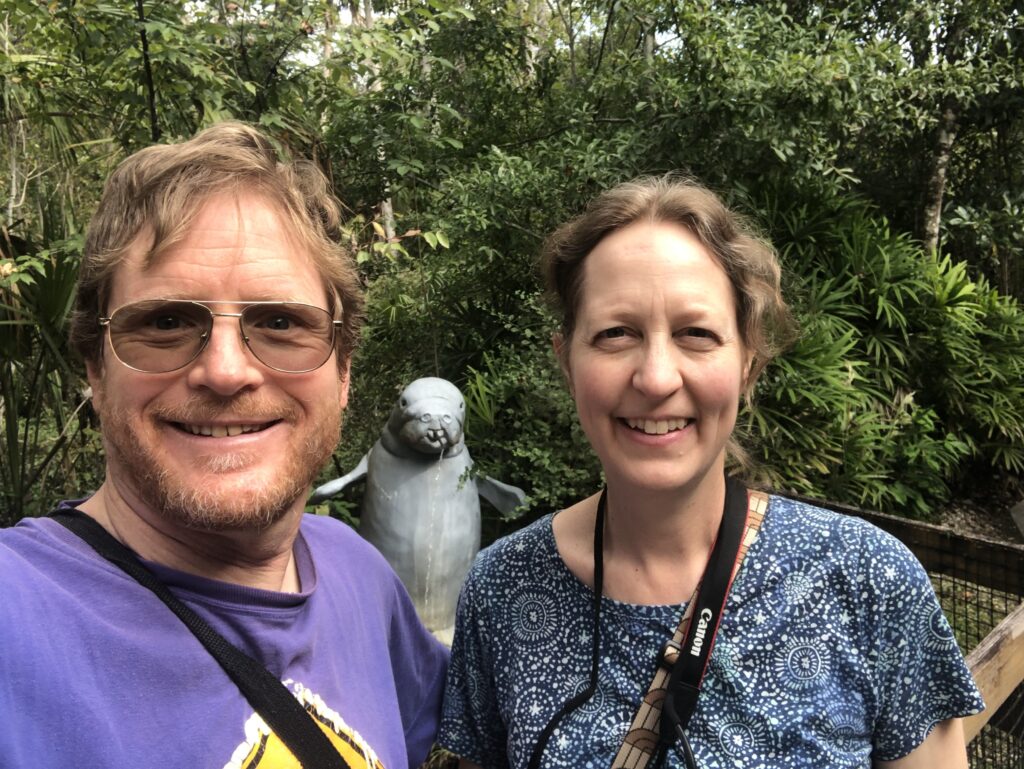
When we woke up the next morning, I was eager to show Tanya some sights in Florida. She had never seen a Florida Manatee. I saw them numerous times when I worked in the Everglades. The closest relative of the manatee is the elephant. They have the grey thick skin like an elephant. Plus, they are a large mammal like an elephant. Adult manatees are usually 9-10 feet long from snout to tail and weigh around 1,000 pounds. But they can grow to over 13 feet long and weigh more than 3,500 pounds.
I knew the ideal place to take Tanya where we had a great chance to see manatees: Ellie Schiller Homosassa Springs Wildlife State Park. To drive there, it would take about an hour or a 50-mile drive north of Bertha’s house. The Hyundai Ioniq 5 EV was a fun car to drive us up there that day. However, we started noticing some odd quirks with the car that we had to deal with while we rented it. First, the side mirrors would automatically fold in whenever we parked the EV and shut off the engine. The catch was that the side mirrors would not naturally fold back out when we started the car and began driving it down the road. Thus, Tanya and I had to roll down the windows and push the mirrors out with our hands. That was the only way I could see the mirrors when driving the EV.
The other annoyance with the EV is that we could not figure out how to get the air conditioning to work properly. November in Florida is still hot and humid with temperatures in the 80s. Car interiors in Florida warm up further as they trap the heat of the sun’s rays. Car air conditioning (AC) is still beneficial to use in the winter in Florida to stay cool while driving. If Tanya and I had more time, we probably would have read the vehicle manual thoroughly enough to understand how the AC properly worked or call a Hyundai service hotline to get answers. However, we were only renting the EV for a few days. Plus, we wanted to focus on doing as much sightseeing as we could. The good news is that on the second day of our trip, the AC started working properly on its own accord. We did not know what we did to get it functioning correctly. The joke between Tanya and me became “Don’t touch anything!” when it came to the touch screen buttons on the dashboard involving temperature controls.
Despite these frustrations, the Hyundai Ioniq 5 got us safely to Homosassa Springs. It was not long after we arrived that Tanya and I walked to a large lagoon that had an enclosed exterior platform a few feet above the water. In addition, the platform had an underwater enclosed observatory with large windows to observe possible sightings of manatees, fish, turtles, etc.
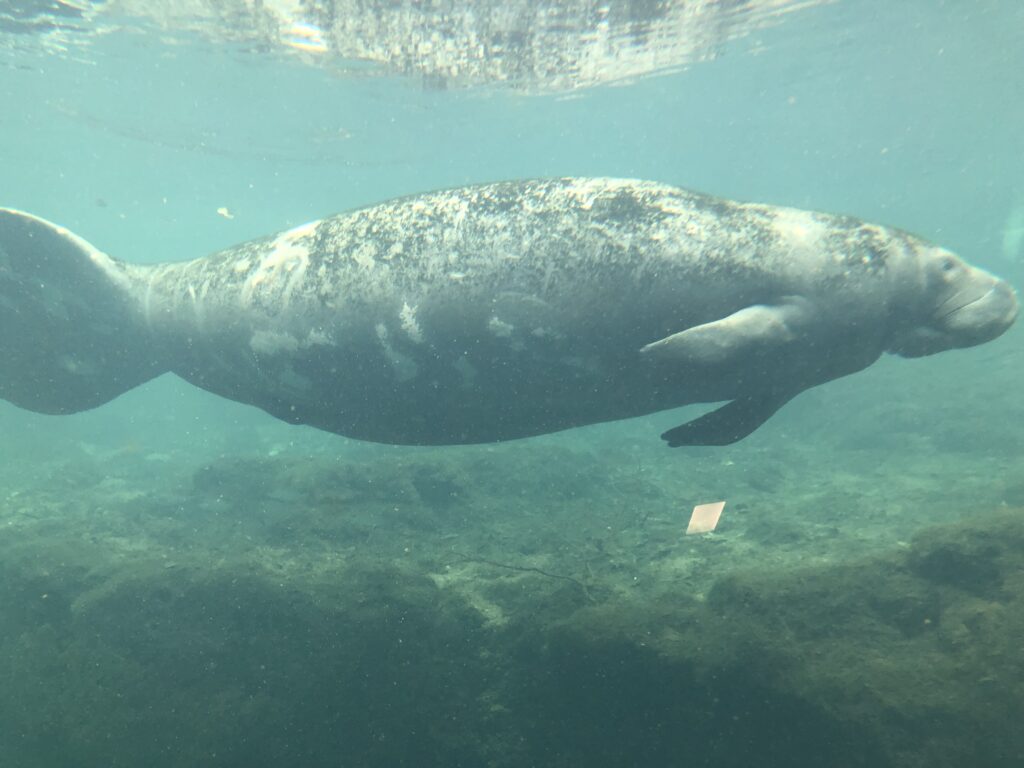
Tanya stayed on the outside observation deck while I moseyed down below to see what I could discover. In just a few minutes, a large manatee swam in front of the windows on the below deck observatory. I was ecstatic to see the 6–7-foot manatee gently swim in front of the window. After I watched it for about a minute and took some photos great photos, I bolted up to the upper observation deck to inform Tanya that I saw a manatee below. I did not have to tell her because she was observing the same manatee. She was looking down on the manatee swimming below the water surface. Tanya was thrilled seeing this animal species for the first time. She took lots of photos.
We then had a wonderful afternoon strolling around on the boardwalk trails to see more wildlife at Homosassa Springs. For the first time, Tanya saw and photographed colorful birds that were showcased and even rehabilitated at the refuge, such as Roseate Spoonbills, Snowy Egrets, American Wood Storks, Brown Pelicans, White Pelicans, and Greater Flamingos. I have great memories seeing all these bird species when I worked in Everglades National Park from 1992 to 2008. I was delighted that Tanya saw these birds for the first time. Judging by the photos she took and the conversations we had that day, she enjoyed looking at these birds.
Late in the afternoon, we decided to drive back to our host Bertha’s house to visit with her and her husband Gene. We wanted to get there in time to have dinner with them. As we drove back from Homosassa Springs State Park to her home in Wesley Chapel, Florida, we noticed that we only had about a third of a charge left or about 80 miles. We decided it was time we learned how to charge this EV, especially since we wanted to have a full charge for our sightseeing the next day. Using the electronic dashboard map inside the vehicle, it routed us to a Flying J Truck Stop on the north side of Wesley Chapel that had EV charging.
When we arrived at the Flying J to see the EV charging stations, we had to quickly figure out which side of the vehicle we needed to plug in the charging connector or plug. We spotted that the vehicle plug in outlet was on the passenger side near the rear of the car. We then had to determine how to pay for the charging. Tanya downloaded an app on her smart phone and inputted her credit card number so we could charge the Ioniq 5 rental car. It took about 10 to 15 minutes to fully charge the car to about 80%, which is the optimal battery charge. Charging this EV probably took more time than to put gas in a car or large truck. However, the went by quickly as I ate a snack and we took turns using the nearby restroom.
When we were happy with the range of around 270 miles and over 80% full, we went to Bertha’s home for the evening. Bertha and Gene took Tanya and me out for a nearby Japanese sushi restaurant. The food was tasty. Tanya and Bertha reminisced about their high school years. Gene and I connected over our fondness of jazz and 80s pop music, as well as 70s rock music.
November 3, 2025 – Our day trip to Siesta Beach and Myakka River State Park
For our excursion the next day, Tanya and longed to go to the beach to go swimming and spend time there. Bertha recommended Siesta Key Beach as one of her favorite Florida beaches near her home. This beach was located about 80 miles or about an hour and a half drive south of Wesley Chapel. It turned to be well worth the drive to go there. It was one of the most gorgeous beaches I had seen in Florida. Tanya and I were grateful for Bertha’s recommendation.
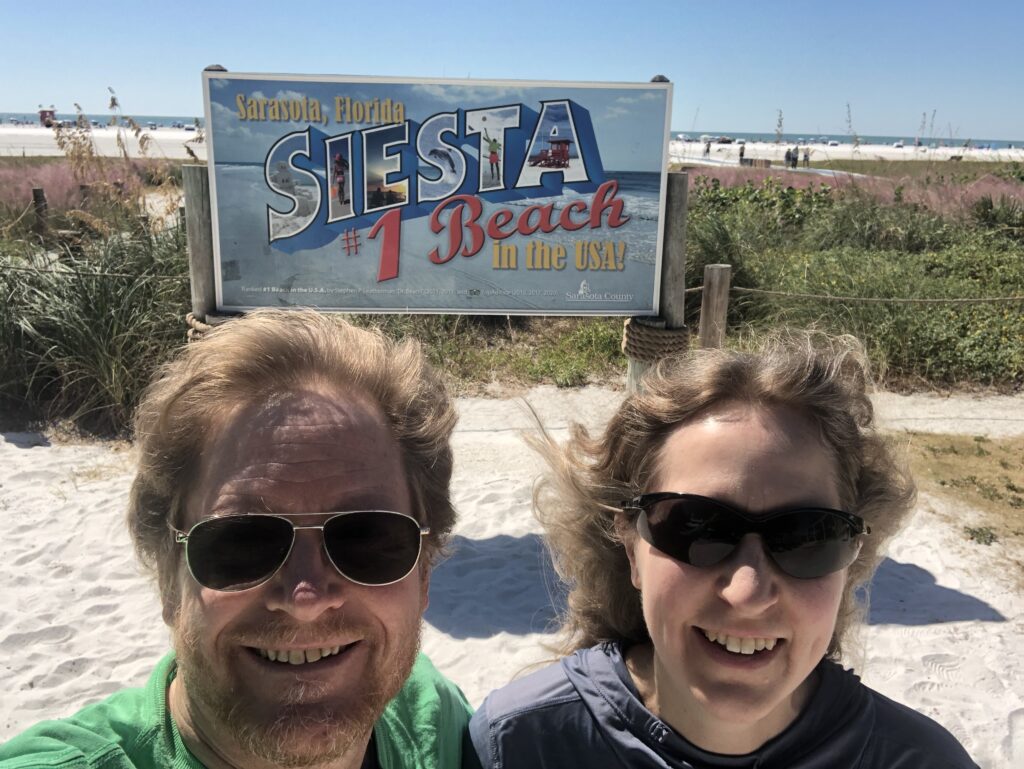
It was a glistening white sandy beach. We had a sunny day, without a cloud in the sky with an outdoor temperature near 80 degrees Fahrenheit. The soft sand was easy and soothing to walk on, but the brightness of the color with the sun made it a bit hot on our bare feet. It was easy to cool off our feet and bodies though once we went into the water. The small waves crashing on the shoreline were pleasant to watch. We liked spending time absorbing their refreshing gentle impact when we swam in the water. After a couple hours at the beach and eating our packed lunches there, we felt that we wanted to explore more nearby parks in Florida that day.
When we turned off Interstate 75 to head to Siesta Key Beach earlier that morning, I saw a sign for Myakka River State Park. I had never been there before. When I lived in Everglades National Park back in 1998, I stumbled across a lecture by famed Florida nature photographer Clyde Butcher. I distinctly remember been raving about Myakka River State Park as one of his favorite places to photograph in Florida. I recalled him referring to this park as ‘the Yosemite Valley of Florida’ with its natural beauty and opportunities to photograph wildlife. I asked Tanya if we could drive from Siesta Key to Myakka River. She was open to experience this park.
It was a 30-minute drive directly east from Siesta Key to Myakka River. We arrived there around 3 pm. Visiting the park was one of the peak experiences for our trip to Florida. Soon after we crossed the park boundary, we saw a sign that warned:
“CAUTION
Alligators are present along the trails and waterways of
this park. They usually eat fish, turtles, and other small
animals but may attack larger animals such as deer.
Alligators have been known to attack humans.
FOR YOUR SAFETY
Alligators are dangerous
Do not approach, frighten, or feed
by state law 372.667FS”
Point well taken! I had a healthy fear of alligators from my time in Everglades National Park. I never saw them be aggressive with humans. However, one time I was walking around a corner on a trail at the Flamingo Outpost in Everglades National Park. Suddenly, I saw a large alligator out of the corner of my eye just a couple of feet from me. It was just lying there trying to warm up from the Florida sun to get energy. After seeing this unexpected sight way too close to me. I jumped up in the air and screamed. I ended up starling the alligator, which jumped up frightened from my reaction. It did not try to lung or attack me. But, that experience of being unexpectedly walking too close to an alligator is something that I never forgot.
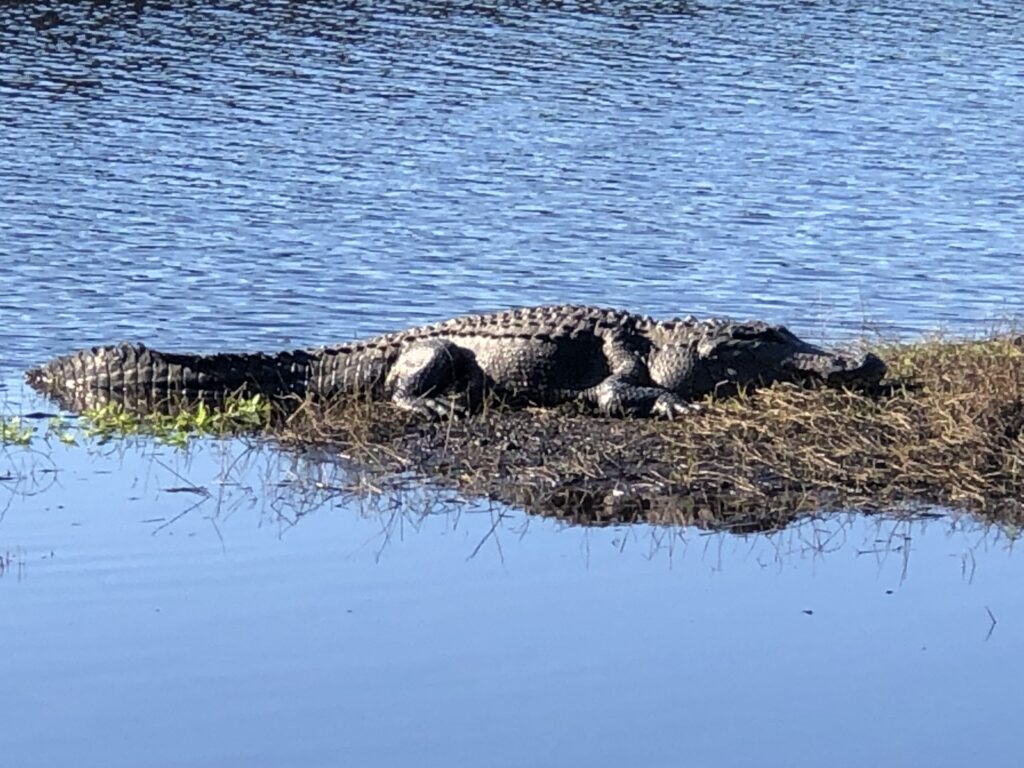
Since this was her first time in Florida, Tanya certainly noticed the sign and made a mental note. Driving less than a mile into the park, we crossed a bridge over a large shallow pond. At the edges of the pond, around ten alligators were spread out along the edges to sun themselves. Check! I succeeded in showing Tanya her first wild alligators in Florida. Tanya and I took lots of photos of them just lying there.
Almost right underneath the bridge was a Limpkin. It’s a small marsh bird that stands around two feet tall that has brown feathers with some white streaks of feathers on its upper back, underbelly, neck and head. It has a sharp spear like bill for capturing its favorite food apple snails, as well as other snails, mussels, frogs, crustaceans, and insects. I never saw that bird when I lived in Flamingo, but I saw it several times when I visited other areas in Everglades National Park. It was another one of my favorite Florida birds that I was happy I could show Tanya.
We then chose to walk down a dirt trail through a grove of palm trees. It led further down to the edge the same pond where we could see a few more alligators. The trail was roughly a half a mile one way or a mile out and back.
Tanya and I then drove a mile down the road to another hiking trail. We walkied down the path which led us to the Myakka Canopy Walkway. Before we started walking up the canopy walkway, we read the wayside exhibits listing the 74 other known canopy walkways throughout the world. This canopy walkway with a tower at one end was an impressive sight to admire in the middle of Myakka River State Park.
Myakka River Park website stated this canopy walkway was “Completed in 2000, this structure is the first public treetop trail in North America. The walkway is suspended 25 feet above the ground and extends 100 feet through the hammock canopy. The taller tower soars 74 feet in the air to present a spectacular view of treetops, wetlands and the prairie/hammock interface. You can look down on eagles, hawks, vultures, and the tops of live oak and sabal palm trees.”
The website informs that to walk to the top of the tower “requires walking over 100 stairs.”
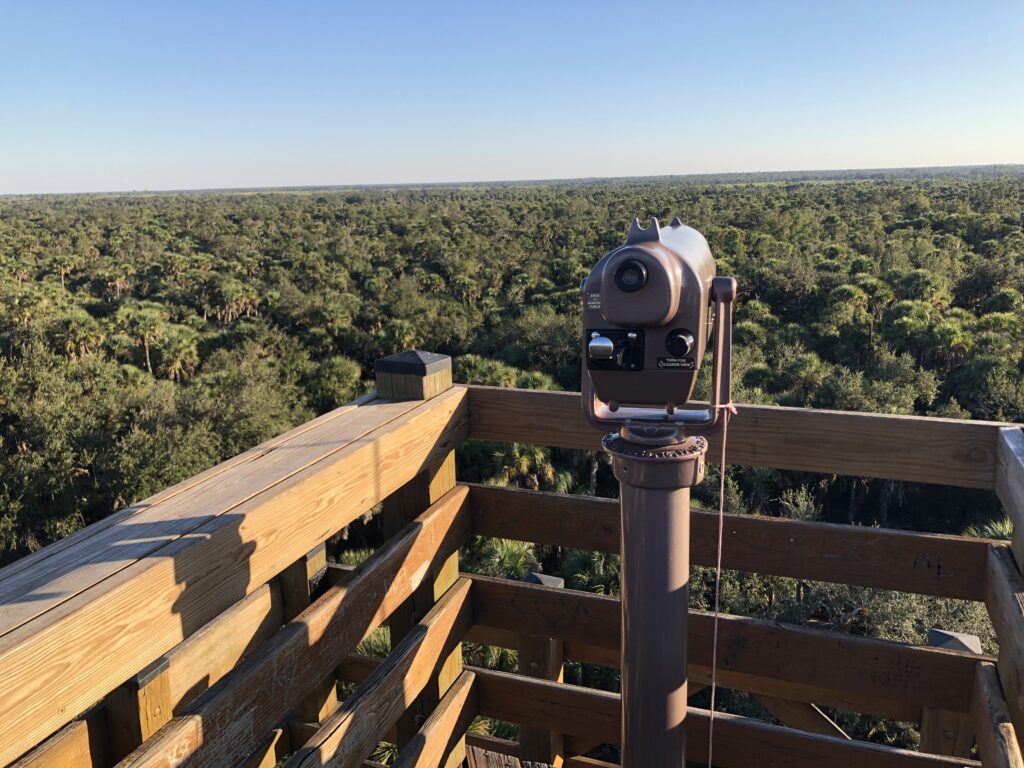
Florida is the flattest state in the United States. When I worked in Everglades National Park in south Florida for 16 years, I missed seeing any kind of prominent rising hills that gave a dramatic view of the landscape. A friend and I had to pay for a small airplane ride to get a bird eye’s view of south Florida and the Everglades. Thus, I was joyful to walk on this elevated walkway and take many flights of steps to the top of this tower to get a panoramic view of Myakka River State Park. It was fascinating to see palm trees in every direction to the horizon with a few grassy open meadows mixed in between the forests of tropical trees.
Tanya then took the many flights of steps down the tower. We then walked a mile more on the loop trail past the canopy tower walkway. We had the trail all to ourselves. We don’t recall seeing other people. It was a gift to be in the serenity of natural Florida to lose ourselves in the outdoors and the sounds of our own footsteps, thoughts, and an occasional birdcall.
The trail was completely flat, which enabled us to walk at a quick pace since we hiked the trail around 5 pm. We had less than an hour of daylight left. Even with the flatness, Tanya and I found ourselves taking photos of the groves of palm trees bunched together tightly, The tallest of the Florida Palm trees standing up to 20 to 30 feet above the ground, creating its own shady canopy as we walked through this forest. Intermixed in this palm forest were thick sprawling oak trees extending in every direction wanting to state their dominance in this forest and at the edges of the open meadows.
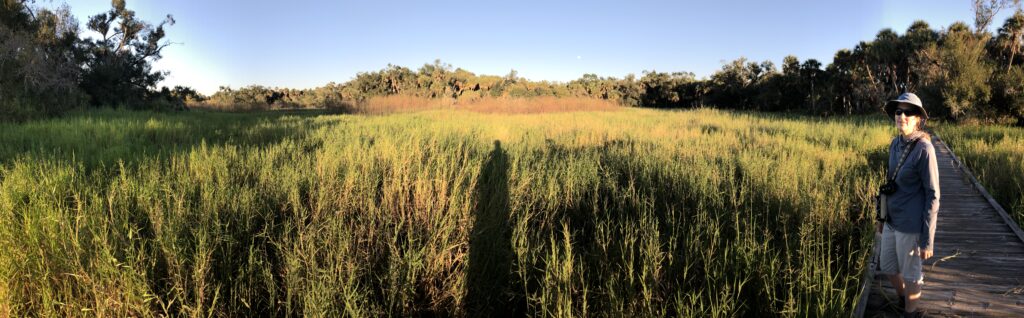
One open meadow with tall grasses with the forest palm trees and oak trees at the edge caught my attention. I noticed a large full moon that seemed to be wanted to be included in any scenic photo. I took a panoramic photo with my iPhone of the grassy prairie, and the forest in the background of the photo. My long shadow was in the middle of the image with Tanya standing on the boardwalk off to one side of the photo looked pleased to be there.
That evening, I showed my photos of the day to Tanya’s friend Bertha. She loved the panoramic photo and asked for a copy of it. One month later in December, I ordered an 8×24 inch version of that photo on an aluminum backing. A local Portland friend recommended a place in Vancouver, Washington that could print it for me with a high gloss finish on this metal surface. The photo did not arrive in time for Christmas day. However, it was delivered during the Holidays. Bertha was elated to receive it.
After we hiked on this trail, Tanya and I were not finished with Myakka Park. We returned to the car to drive further to Upper Myakka Lake to find out what else we could see with the limited amount of daylight we had left.
When the road converged near the lake, I saw something moving in the tall grasses between the road and the lake. It was a slam on the brakes moment as I drove the rental EV. I even told Tanya, “I am seeing something so beautiful that it is a ‘slam on the breaks moment!’”
I noticed a small group of pink Roseate Spoonbills swishing their bills back and forth in the water trying to feed. They were feeding as a group walking along the water’s edge to make the most of the remaining sunlight. It was hard to get a good photograph of the Spoonbills with the tall Cattails and other tall marshy grasses in the way. At the same time, they were plain to see with the naked eye with their bright pink colors on their backs and sides. I could spot their white heads and distinct feeding style which looked like someone moving a flattened wooden spoon back and forth in a mixing bowl.
While we observed and tried to photograph the Roseate Spoonbills, I spotted the full moon above the palm trees daring me to also try to capture that image in photographs. I never got a satisfying image of the Spoonbills feeding or threatening to take off flying if I got too close to them. At the same time, it was a thrill to see a Limpkin walking behind the Spoonbills seeing what it could feed on with the Spoonbills stirring up life along the shoreline.
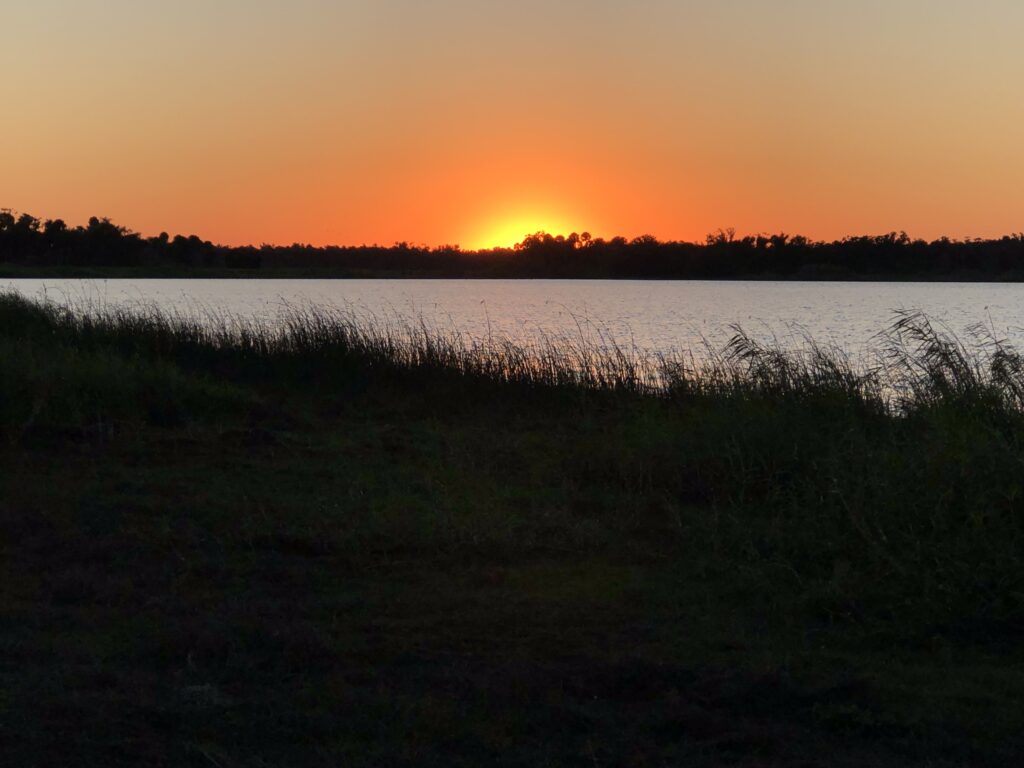
The next thing we observed was the sunset happening behind the Upper Myakka Lake. The sun was slipping below the forest along the horizon which made for a great view of the sunset to try to photograph. Even after the sunset, Tanya and I had more to see in this state park. I spotted wild pigs in a meadow by the lake as Tanya and I drove back to the park entrance to start the journey back to Bertha’s house for the evening. Even more, as Tanya and I headed in the EV towards the park entrance, I saw a flock of Wild Turkeys feeing in a meadow. I had times where I saw a lot of wildlife working and living in Everglades National Park. However, with all the wildlife we saw at Myakka River State Park, it felt like Tanya and I spent the day at the African Serengeti.
By the time Tanya and I left Myakka River State Park, the daylight was nearly gone, and the evening darkness started to settle in. Driving back to Sarasota, Florida to connect with I-75 to go back to Bertha’s house, Tanya and I needed a restaurant to have dinner for the evening. Without knowing the good restaurants of Sarasota or knowing what we were in the mood to eat, we ended up going to a Chili’s to eat our evening meal.
After dinner, it was around 8 pm. We still had over an hour’s drive to Bertha’s home in Welsey Chapel, Florida. The Hyundai Ioniq 5 EV drove so much faster and smoother than my 4-cylinder stick shift 2002 Honda Civic. I normal drive around 60 to 65 mph in my Honda Civic since the car feels loud when I drive it faster and it gets to a higher RPM, which seems like it is a bit harder on the engine. Thus, I drive my Civic at slower speeds to be safer, quieter, and get a bater gas mileage than at faster speeds.
On the other hand, I was eager to get back to Bertha’s place to relax and possibly hang out with Bertha and Gene. Thus, I drove the car at consistent speeds of 70 to 75 mph, and even over 80 mph at times. The EV was still quieter than my Honda Civic when I drove it at higher speeds. With its much higher horsepower, the EV did not mind the higher speeds. At same time, I noticed that the remaining charge on the EV charger was dropping fast as I pushed the car to drive at higher speeds. Looks like we were going to need to fast charge this Ioniq 5 Hyundai EV soon.
On her smart phone EV charging App, Tanya found an EVgo charging station at an upscale fancy shopping mall known as The Shops at the Wiregrass. When we arrived, we saw at least 8 charging ports. This charging station was busy at 9 pm at night, so we had a wait about 5 minutes for a charging port to become available. It was our second day learning how to charge an EV. We were amazed how friendly and helpful the other EV owners were as Tanya and I still had some uncertainties how to charge our EV rental car. The Florida EV owners looked like their own friendly community. This was no typical gas station experience where everyone keeps to themselves and does not chat with strangers.
It then dawned on me that Tanya and I were the only white people charging our EV at this charging station. In my climate organizing in Portland, Oregon, many of my white retired friends who advocate for climate action have electric vehicles. Thus, I have tended to categorize EV owners that I met as white liberal middle to upper income retired Americans. I was too bashful to ask probing questions to these gracious Florida EV drivers. However, they did not seem like they were driving EVs because they were tree-hugging, granola eating, Birkenstock wearing, Save-the-Earth progressives. These looked primarily like prosperous African Americans that just wanted a fun, dependable, fast, and comfortable car to drive.
I wish I had another day or two to be brave enough to ask these EV owners why they chose to drive electric cars. They seemed open to conversation and willing to answer questions. It took around 15 to 20 minute to charge our EV to around an 80% charge. But, the time went fast for Tanya and I to take turns using the nearby restrooms and checking the internet on our phones.
While we were waiting, I had time to walk to a nearby overpriced Belgian ice cream shoppe. I wanted my usual chocolate shake with vanilla ice cream and chocolate or hot fudge syrup blended in. The servers said they could not alter their shake ingredients because their boss would get upset with them. I was craving a chocolate milkshake, so I gave into their refusal to alter their ingredients. The shake ended up costing me over $10. It tasted good, but it was way too expensive. Anyway, by the time they completed my order, I paid for it, and walked back to our car, Tanya was finishing up charging our EV.
We then made it to Bertha’s house to chat with her and see if she had any suggestions for our next day visiting Florida. She suggested another of her favorite beaches: Fort De Soto Park.
November 4, 2025 – Our day trip to Fort De Soto Park
The next day, November 4th, it took Tanya and me about an hour and a half to drive from Bertha’s home in Wesley Chapel to Fort De Soto Park. It is located at the very southern tip of the of Pinellas Peninsula. The park is located directly south of St. Petersburg. It is on a tiny spit of land where Tampa Bay meets the Gulf of Mexico.
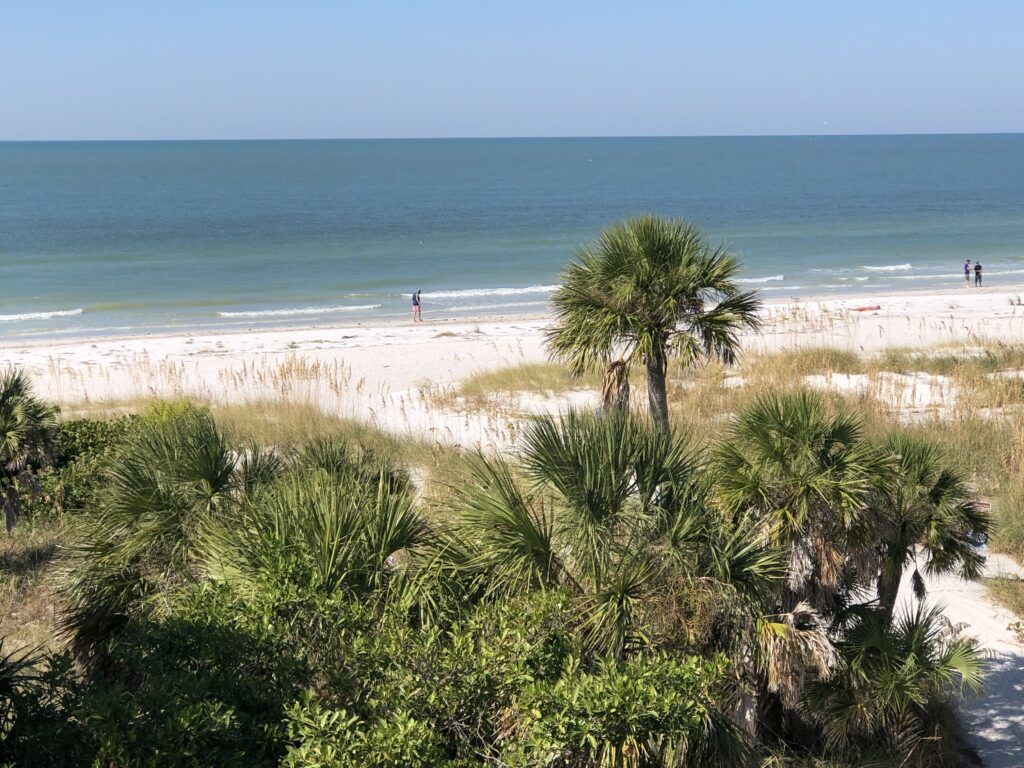
When I worked in Everglades National Park from 1992 to 2008, I read positive things about Fort De Soto as a birding hotspot. It is the kind of place for migrating birds in the fall to notice that it is the last tiny piece of land to take a break traveling south on the Pinellas Peninsula before they are traveling for hundreds of miles in the open waters of the Atlantic. Even more, in the spring, it is the first sliver of land that tired birds migrating north see where they could use as a rest area as they are crossing the open Gulf of Mexico waters to enter central Florida to start heading north. Thus, I was intrigued to see it.
When Tanya and I arrived at Fort De Soto Park, it was definitely a slow day for Florida tourists. Hardly anyone was there. It was the first Tuesday in November. I remember working in the Everglades that the peak of tourist season in south Florida was from around Christmas Day in December to Easter in the spring. Another day where Tanya and I did not have to worry about big crowds of tourists in Florida. The huge parking lot was nearly empty when we arrived.
After we parked the car, Tanya and I had to find our way to the beach which was hidden behind a coastal ridge bank or berm. It looked to be up to 15 to 20 feet tall with some trees and vegetation on it further shielding the view from the parking lot. Once we walked on top of the ridge, the bright white sandy beach seemed to stretch down the coast for many miles. We could see very few people walking around or lounging around on the beach. It was the kind of isolated beach that one dreams of seeing when they go on vacation.
Tanya and I wanted to get some walking in to immerse ourselves in this park. We walked down the long concrete pier among the men and women recreational fishing there as well as seeing the Brown Pelicans, seagulls, and other birds trying to beg and steal fish from the fishermen.
As we started walking down the beach, I noticed the presence of one of my favorite birds, American Oystercatchers. They have a long straight bright orange bill, black head, black feathers on their backside, and snowy white underbelly. I loved seeing these birds when I worked in the Everglades. I only saw them a few times. Primarily it was when I worked and visited in Everglades City. As their name suggests, these birds like to pry open the shells of oysters and other mollusks, shelled beach organisms, to get to the soft tasty organisms living on the inside of the shells. The presence of the Oystercatchers was an alarm bell to me that there were oysters and other sharp shells on this beach, especially in the shallow water if we went swimming.
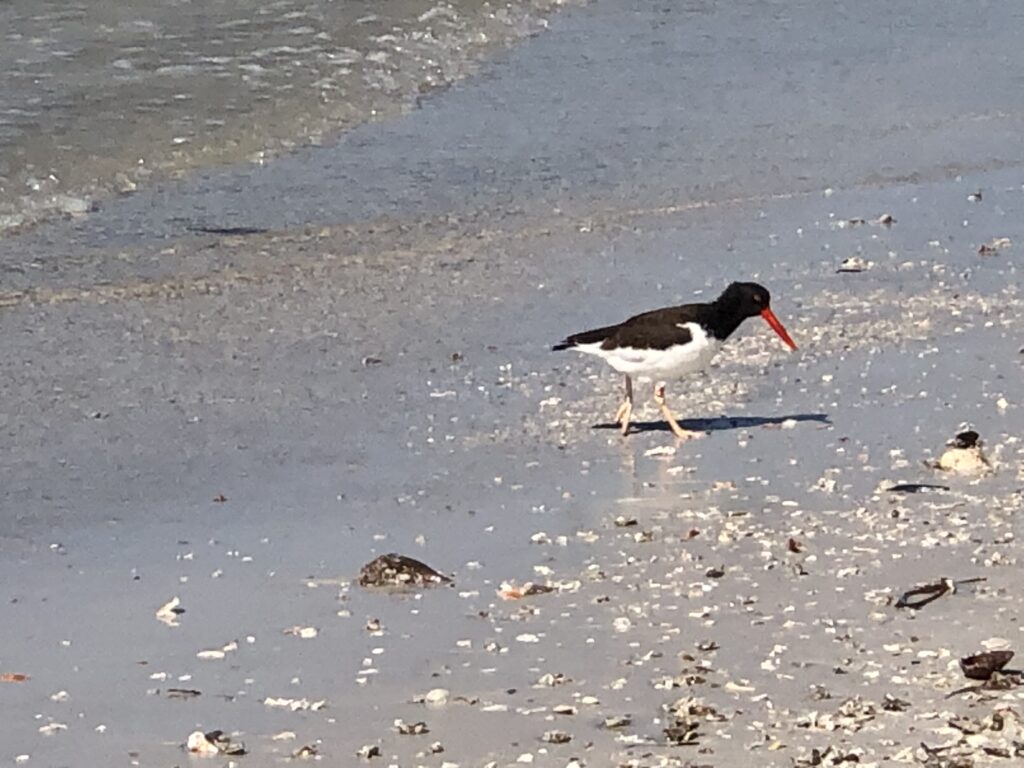
As we walked on the beach, I started noticing the menacing looking shells scattered sporadically on the beach. I really wanted to go swimming in this every inviting Gulf of Mexico ocean waters that day. We were only a few days away from attending my niece’s wedding in Kansas City, Missouri. I promised my mom we would transport her there. The last thing I needed was to slice up my feet and need to get medical attention on the sharp shells of the beach. I noticed a concession store and café by the pier at Fort De Soto. They just happened to sell overpriced beach water shoes with hard soles that could protect my feet. I splurged to buy the shoes rather than risk doing any dumb avoidable injuries.
Before Tanya and I went swimming we looked at the Fort De Soto concrete bunkers, which were accessible from the parking lot side of the beach. The fort was built around 1900, when Tampa citizens demand coastal defenses after the United States entered the Spanish American war. We thought it was interesting to see the 12-inch mortar battery that housed some of the fort’s weaponry, was completed on May 10, 1900. Incidentally, the fort nor the weapons never saw any combat in the Spanish American War or any war since then. It seemed like too remote and sleepy for any area to be involved in any war.
After we walked around the fort, Tanya and ate the snack lunches we brought. We then walked up the beach to a spot where there were a few other people, mostly of retirement age. We thought it would be safe to go swimming in the water near them. We took turns swimming in the Gulf of Mexico, like we did the day before, so one of us could protect our valuables. The water felt fairly warm in the 70-to-80-degree range. I felt safe to swim with my feet covered in my brand-new beach water shoes. Tanya was not worried about any sharp shells tearing at feet and she was fine. Maybe I would have been ok not blowing almost $30 on those shoes. I just did not want to take any chances.
Now that my feet were safe, I still worried about my exposed calf and thigh getting stung by a jellyfish or a random rip current carrying me out to sea. It seems like I can never fully relax when I am on vacation. At the same time, I worked 25 years as a park ranger in the national parks. Therefore, I know that bad things can happen in paradise or in any scenic outdoor areas.
While we spent time swimming and laying on the beach at Fort De Soto, we got good looks of a Black Skimmer. This was another one of my favorite birds when I used to work at Everglades National Park. It looks a bit like an American Oystercatcher. However, a Black Skimmer has a wider bill. The front half is black with the lower mandible longer than the upper mandible. Similar to the Oystercatcher, the Skimmer has a black head and bright white underbelly. However, the Skimmer has a white forehead. I was excited to point out this bird to Tanya. I used to enjoy watching these birds feed when I lived in the Everglades. Like the name suggests, they skim across the surface of ocean waters for their food, mostly tiny fish.
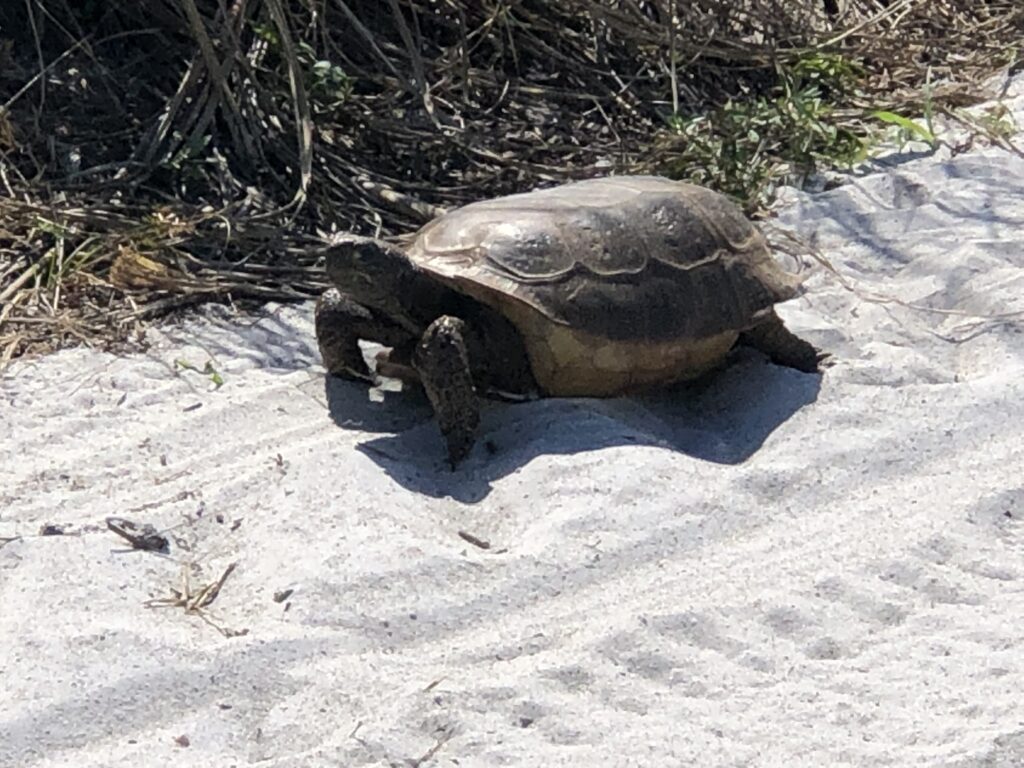
While Tanya and I strolled around the Fort De Soto Beach, we saw other intriguing wildlife, such as a leopard crab, with very distinguishable spots. Plus, we saw a gopher tortoise walking on a sandy path, hoping not to be noticed by people, overly energetic dogs, or other animals.
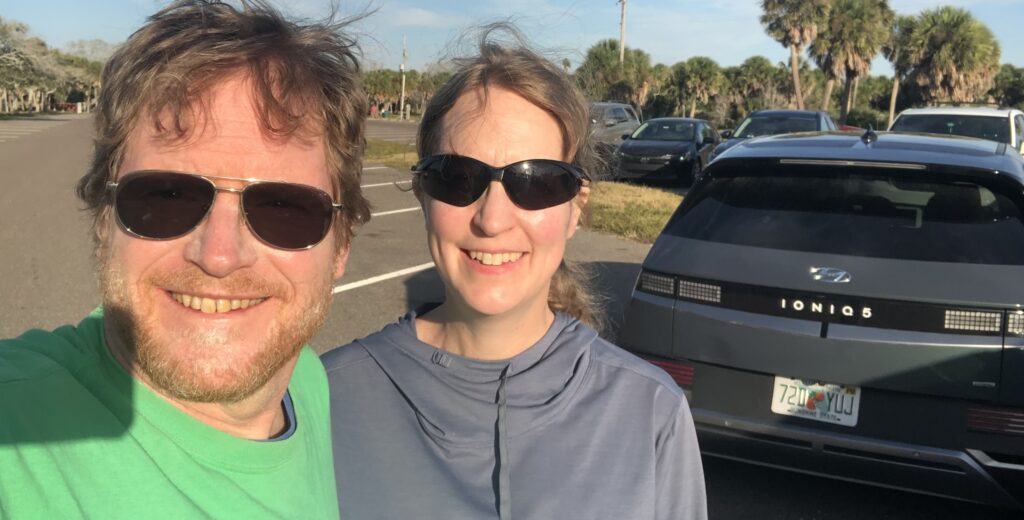
We had a wonderful exploring Fort De Soto Park. Before we left, we took a selfie with our Hyundai Ioniq 5 EV rental car. We were still giddy that we were sightseeing around the central Gulf Coast of Florida without using gasoline in a spry electric vehicle. We finally left the parking lot at Fort De Soto around 4:30 pm. We knew that it would take us a few hours to get back to Bertha’s home in Wesley Chapel since we would be fighting rush hour traffic. Even more, we had no idea where we would eat dinner. We ended up getting lost in north Tampa Florida before we agreed upon a safe choice of a Cracker Barrel Restaurant for dinner.
When we finally returned to Wesley Chapel around 8 pm, we went EVgo charging station shopping mall known as The Shops at the Wiregrass. This was the second day in a row that we went to this location to recharge our rental EV. Tanya and I felt like we were starting to get a handle on this EV recharging thing. We found that the experience of recharging an EV was not bad. This charging station was also not as busy as the night before. We then stopped at a nearby Publix grocery store since we felt like we needed to replace some of the food items we were eating at Bertha’s house. We got back around 9 pm. Since Bertha is a night owl, Tanya and Bertha had plenty of time to chat about the day and life.
November 5, 2025 – Our day trip to Crystal River National Wildlife Refuge
The next day, November 5th, was our final full day of vacation in Florida. I asked Tanya if she would like to go up to Crystal River National Wildlife Refuge to try to see more manatees. She readily agreed. Tanya was still curious about manatees. She did not have any other location in mind to visit that day. Crystal River was in the vicinity of Homosassa Springs Wildlife Park. They were about 12 miles apart, with Crystal River located about a 20-minute drive north of Homosassa Springs Park. It would take close to an hour and a half drive to get to Crystal River from Wesley Chaptel. However, because we drove up to Homosassa Springs just a few days before, we have some familiarity with the route.
After we paid the entrance fee for Crystal River State Park, we started walking to see the crystal-clear river springs that gives the park its name. When we arrived on scene, we were impressed with the clarity of the water to see all the way to the bottom. The watercolor varied from emerald green by the shallow edge to turquoise blue in the deeper sections in the middle. We observed several tourists in kayaks in the middle of the lagoon looking for manatees. However, neither they or Tanya or me could spot any manatees.
Tanya and I then hiked to the Crystal River at the end of the park. We noticed a large group of manatees swimming together there. We saw some people snorkeling and paddling towards the manatees with their kayaks. The rule is that people are not supposed to total surround the manatees nor approach them too close. A snorkeler or kayaker must leave an opening where the manatees don’t feel trapped and they can leave at any time.
We then strolled further down the hiking path where I saw a mother manatee and calf swimming in the Crystal River. Tanya was in her own thoughts shuffling down the park perimeter trail. I successfully waved her over to where I was standing so she could see the mother and baby manatee swimming together. The water was murkier in the Crystal River than it was in the lagoon that we first went to see in this park in the morning. However, we could still see their large round grey bodies in the water as they would come up to breathe air on the surface.
Tanya and I then took the perimeter trail around the park. It was an easy flat trail only about one mile long. We had some nice views of some interior freshwater ponds with a Great Blue Heron, a Snowy Egret, and a White Ibis standing at the water’s edge waiting to catch fish. Bright green cattail plants standing up to 4 feet tall on the other side of the ponds reminded me of some of the natural scenes I used to see working in Everglades National Park.
We then chose to head back to the super clear lagoon to see if we could spot more manatees. A narrow shallow clear water canal connected the Crystal River to the lagoon. Tanya and I stood on the wooden observation deck boardwalk where the canal met the river to look for manatees. In the river, people were in some kayaks and paddleboards, as well as snorkelers in the water trying to get close views of the manatees swimming nearby in the river. Some of the manatees decided to swim into the canal right by the boardwalk where Tanya and I stood. It felt magical because we were safely only a few feet away from these very large mystical mammals looking down on them as they swam in this water that had total clarity.
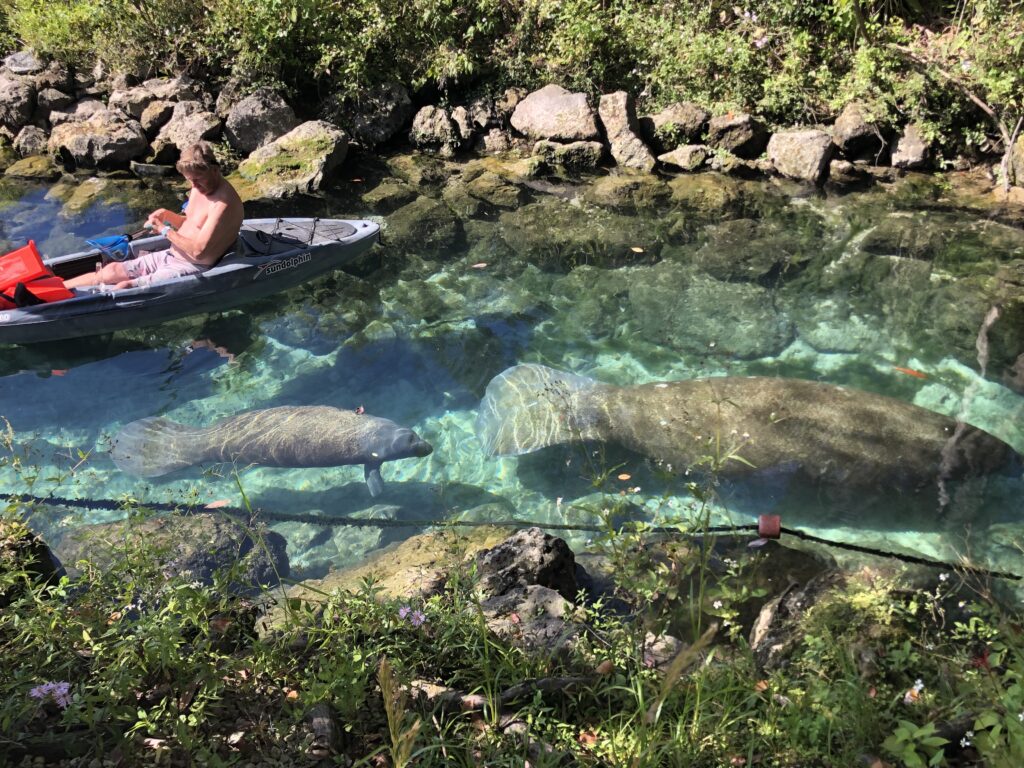
Some of the kayakers that were paddling with a high concentration to try to see them had a hard time spotting the manatees as they swam submerged next to but almost underneath the kayaks. The park volunteers sharing the boardwalk with Tanya and me yelled at some of the kayakers to keep their distance from the manatees as these animals wandered into and out of the canal. I felt some regret that I did not organize for Tanya and me to go snorkeling or kayaking to see the manatees like these tourists we were observing. On the other hand, Tanya and I concluded that we had the best views of the manatees to fully view them from the wooden observation deck rather than snorkeling or kayaking with them that day.
We then walked on the wooden boardwalk that encircled the lagoon to attempt to get other looks of the manatees. Eventually, as the afternoon progress, Tanya and I felt like we were not going to get any better manatee sightings than we had already seen. We started walking back to our rental EV. Like the previous day, the bright sun shining on the car made its greyish blueish color looked like it had a hint of green. Green is my favorite color. I have owned a dark green Honda Civic for 24 years. We were so proud of renting this Hyundai Ioniq 5 electric car during this vacation. Tanya and I both took more pictures of this car, like we did on previous days on this trip. We hoped to be able to post photos about this EV on a future social media post. Even more, I wanted to blog about this fun adventure renting this EV together with Tanya for this Florida vacation at some point in the future.
We left Crystal River National Wildlife Preserve around 1:45 pm. We still needed to stop somewhere in the town Crystal River for a late lunch. After we ate some food, we left Crystal River around 2:30 pm. We wanted to give ourselves a couple of hours to return to Bertha’s house in Welsey Chapel. In addition, we set aside time to charge the EV at the Flying J Truck Stop just north of Wesley Chapel so we would have enough of a charge when we returned our rental to the Tampa Airport the next day.
Bertha planned for a big family dinner with her parents, Gene, Tanya and me around 6 pm. We aimed to return to her home in plenty of time so we could take showers since we were out in the warm sun, wearing sunscreen, and working up a sweat walking around the Crystal River Wildlife Refuge. Bertha organized a wonderful holiday like dinner for all of us. We enjoyed to meet her parents. Gene and Bertha were fantastic hosts for the trip Tanya and I took to Florida. I was so happy for Tanya and Bertha that they got to spend time visiting after not seeing each other in over 30 years. Bertha has a very kind heart. I felt like I made a new friend meeting her. I liked my conversations with Gene hearing about his expertise in high quality audio equipment.
Conclusion
Thursday morning, November 6th, our trip to Florida was over. Tanya and I headed to the Budget Rental Car Returns at Tampa International Airport to drop off our vehicle and then catch our flight. We were excited to fly to St. Louis, Missouri to see Tanya’s parents and brother, plus meet up with my mom. The next day, Friday, November 7th, Tanya, my mom, and me planned to drive to Kansas City, Missouri to attend my niece Bailey’s wedding. We looked forward to spending time with family. However, we were sad to stop driving our Hyundai Ioniq 5 EV.
Tanya and I could not wait to tell family and friends about our Florida vacation and renting an EV. Nearly every day since then, Tanya and I talk about eventually owning an EV.
The fabulous memories of this trip did not last long. Late November 2025, I read the crushing news that the United Nations COP30 Climate Summit held in Brazil was a failure.
For background, COP stands for Conference of the Parties, basically international countries that agreed to participate in and be bound by the UNFCCC (United Nations Framework Convention on Climate Change). Today there are 198 Parties or countries participating in the Convention.
The UNFCCC is a multilateral treaty adopted in 1992 – shortly after the first assessment report by the Intergovernmental Panel on Climate Change (IPCC) in 1990 – to stabilize greenhouse gas concentrations “at a level that would prevent dangerous anthropogenic (human-induced) interference with the climate system.”
The 30 in COP30 refers to the 30 of these international conferences held over the years. Berlin Germany held the first COP in 1995. COP30 was held in Belém, Brazil, in November 2025.
According to Reuters, the host of the conference, “Brazil’s President Luiz Inácio Lula da Silva had launched the summit calling for countries to agree on a “roadmap” for advancing a COP28 pledge to shift away from fossil fuels.
The result was similar to Egypt’s COP27 and Azerbaijan’s COP29, where countries agreed to spend more money to address climate dangers while ignoring their primary cause.
Nearly three-fourths of the world’s greenhouse gas emissions since 2020 have come from coal, oil and gas. Demand for these fuels is likely to rise through 2050, the International Energy Agency said in a report midway through the COP30 summit that reversed expectations of a rapid shift to clean energy.”
For the first time, the U.S. did not send a delegation after President Donald Trump said the country will leave the landmark Paris treaty that committed countries to act on climate change in 2015. He has branded climate change “a con”. In May 2024, Trump pressed oil executives to give $1 billion for his campaign. In return, he promised ‘to do what they wanted.’
Many climate advocates felt like this was another Cop wrecked by fossil fuel interests, autocratic petro-states such as Russia and Saudi Arabia, and our leaders’ cowardice.
After I saw this news, I told Tanya that I was done driving a gasoline-powered car. I really wanted us to get an EV. This was a shift in thinking for me because I love my 2022 green Honda Civic. It is over 24 years old now and still running well. For years, I wanted to see how long Tanya and I could drive it before it died. If possible, I wanted to even drive for another 6 years so that I could say that I owned the same car for over 30 years or close to half of my life.
Locally, climate change is showing more of an impact on our weather. In December 2025, record rainfalls from ‘atmospheric river’ weather conditions brought flooding to the Portland, Oregon area. So far in 2026, the opposite happened, Oregon experienced very little rain or snow. We are now projected to have a record low snowpack for this winter.
Locally the red warning lights are flashing, and the alarm bells are ringing loudly that we must act quickly and effectively to reduce the climate change threat. What’s causing climate change? For many decades, climate scientists say it is because of humanity, collectively and individually, burning fossil fuels, such as oil, coal, and natural gas, which emits carbon dioxide and other greenhouse gases. Throwing all that dirty fossil fuel pollution into our air supply is warming up and destabilizing our global and local climate. Most climate scientists think if we act quickly, together and personally, we can reduce the damage we are doing to our planet and to ourselves.
For over 17 years, I have spoken out for the urgent need for effective climate action. I gave climate change ranger talks, lobbied Congressional offices in Washington D.C. over 10 times, organized for an Oregon legislative climate resolution, created comedy videos that led to an appearance on TV Comedy Central’s Tosh.o, was a plaintiff in a Missouri Sierra Club lawsuit against my local electric utility for their over reliance on dirty coal energy, led two speaking tours across my home state of Missouri and one in Oregon, and I gave over 200 climate change talks in 12 U.S. states, Washington D.C. and Ottawa Canada. Even more, locally I use public transportation on almost a daily basis to reduce my car’s tailpipe emissions.
Driving a gasoline powered car when it is not feasible to use public transportation really bothers me. My wife Tanya and I are eager to buy an electric vehicle when the timing is right for us. Our recent visit to Florida, November 1-6, 2025, showed us that driving an EV is fun and it is easy to recharge it. That trip inspired us that we want our next car to be an EV!
Thank you Bertha and Gene for allowing us to come visit you in Florida to see the wildlife, natural areas, and beaches near you. Even more, we got the experience that it is a joy to drive an EV and not use a gasoline powered car for transportation. We will always be grateful to you!