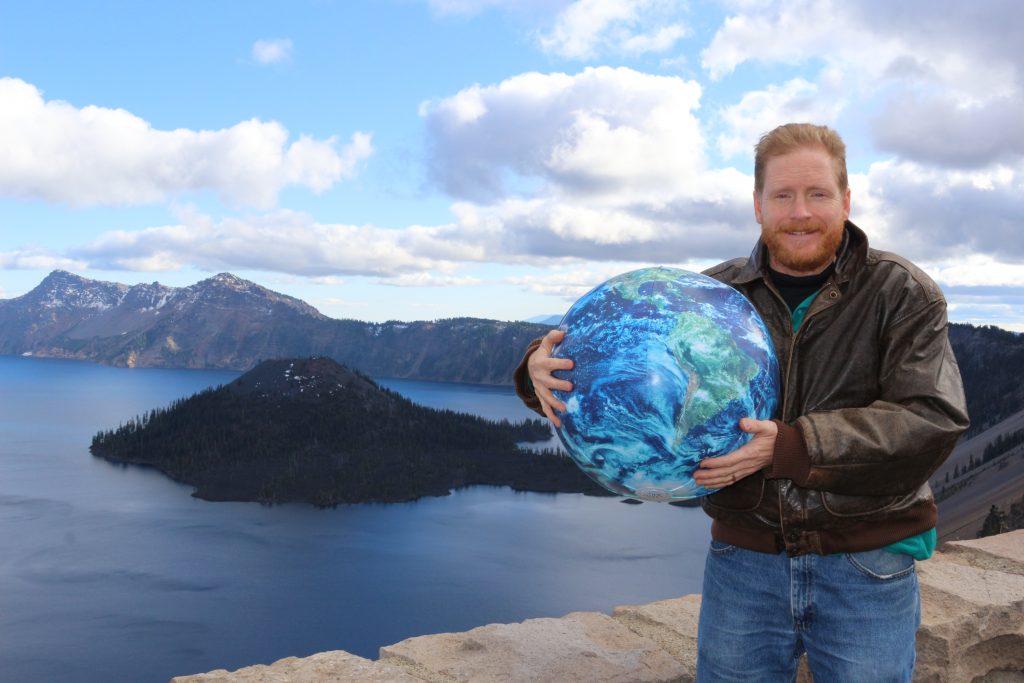
From 1992 to 2017, I was a seasonal park ranger at Crater Lake National Park, Oregon.
Crater Lake is the deepest lake in the United States, and one of the deepest lakes in the world. No outside rivers or streams feed the lake. The lake received all its water and is replenished by snow and rain. Thus, it is considered one of the cleanest and purest bodies of water in the world, giving it a deep blue cobalt color on clear days. With the snow and pine trees on the mountains and in the caldera, the dramatic volcanic peaks and edges, plus the brilliant blue water, Crater Lake National Park is one of the more picturesque places you can behold.
When I was at Crater Lake, I never tired of standing on the rim to admire the beauty. Even more, I loved hiking up the trails to the 8,000-foot mountains along the rim to get even more dramatic views of the lake and surrounding area.
Spending time working and exploring Crater Lake, I regularly saw planes flying over the national park. Crater Lake was on a flight path of some commercial jets. During my time living there, my parents came from their home in St. Louis, Missouri to visit me several times. To this day, my mom and dad talk about viewing Crater Lake from one the flights they took. While l loved enjoying the scenery from the rim and hiking up the 8,000-foot peaks inside the park, I was curious to see how Crater Lake looked from a commercial jet or a small private plane.
Part 1 of this blog was about flying over Crater Lake in a small private airplane on July 23, 2010. This blog, Part 2, focuses on my sad and heartbreaking experience flying over Crater Lake in a commercial airplane in August 2017.
Becoming a Climate Change Speaker, Comedian, and lobbyist 2010-2017
After I flew over Crater Lake in July 2010, I slowly started to organize more for climate action. In April 2010, I created my website www.climatechangecomedian.com. In the early months of 2010, I created my first climate change PowerPoint, Let’s Have Fun Getting Serious About Taking Climate Action. I showed that presentation to my ranger friends at Crater Lake in early August 2010. I practiced that PowerPoint in a few more friends on my cross-country drive from Crater Lake, Oregon to St. Louis in November 2010.
In February 2011, I joined South County Toastmasters to be a better climate change communicator and public speaker. That same month, I started this blog as an online journal shows my life’s evolution as a climate change communicator and speaker. In March 2011, I worked two months at the temporary Climate Change Exhibit at the St. Louis Science Center. In August 2011, I began giving my climate change ranger evening program at Crater Lake.
In November 2011, St. Louis area businessman Larry Lazar and I co-created the St. Louis Climate Reality Meet Up group, known today as Climate Meetup-St. Louis. In early 2012, I met Tanya Couture at one of the meetings. In February 2013, we started dating. On November 2015, we got married.
In May 2012, I joined Citizens’ Climate Lobby (CCL) as a volunteer. In August 2012, I attended my first Climate Reality Training in San Francisco, California. At this training, former Vice President Al Gore trained me and over 800 attendees to become Climate Reality Leaders to give his climate change presentations.
In January 2014, Tanya and I made a joint video promoting me as the Climate Change Comedian. My mom, Fran Ettling, and I made a similar video in February 2014. My mom, dad, and I made a goofy video to showcase my climate change comedy in March 2015. This led to my first appearance on Comedy Central’s TV Show Tosh.o in August 2016.
As a park ranger, Toastmaster, CCL volunteer, and Climate Reality Leader, I regularly gave climate change talks from 2011 to 2017 at Crater Lake in the summers and my hometown St. Louis Missouri in the winters. Even more, I attended the Climate Reality Project trainings as a mentor in Chicago, Illinois in August 2013; Cedar Rapids, Iowa in May 2015; Houston, Texas in August 2016; and Denver, Colorado in March 2017. In November 2015 and 2016, I attended a CCL Conference and lobbied Congressional Offices for climate action in Washington D.C. In addition, in November 2016, Tanya and I traveled to Ottawa, Canada where we attended a CCL Canada Conference and lobbied members of the Canadian Parliament for climate action.

Returning to Work as a Crater Lake Park Ranger in May 2017
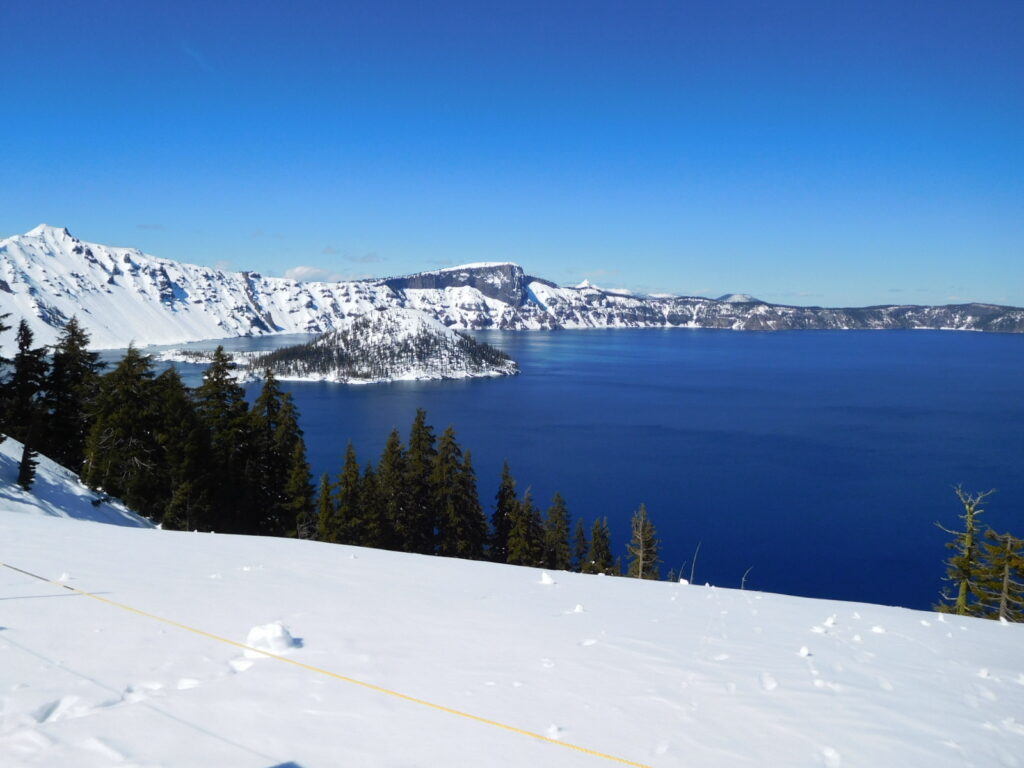
In February 2017, Tanya found a job that moved us to Portland, Oregon. By this time, I yearned to become a full-time climate change organizer and transition away from my summer job a Crater Lake park ranger. In May 2017, I blogged about this struggle as I returned to Crater Lake to work there temporarily for the month. Tanya and I were happy that I worked there that May. The park had its highest level of snowpack in 6 years. When we arrived at Crater Lake on April 30, 2017, Tanya and I were awestruck by the amount of snow we saw.
The snow was so tall that it buried one story buildings almost up to the top of their roof. It looked like 15 to 18 feet on the ground the park headquarters and Rim Village, with snow drifts piling up the snow much higher. When I stood next to the snowbanks, especially on the roads where the snowplows removed the snow, I felt small. The height of some of the plowed road cuts made the snow look four times higher than me. The sky was a sharp bright blue with no pollution or haze. The lake had a deep blue color that was mesmerizing. The combination of the glistening white snow everywhere around the rim of Crater Lake, tall evergreen pine trees, crisp blue sky, and the sight of sacred lake waters made us feel like there was nowhere else Tanya and I wanted to be that day.
We could not take enough photos of the towering snowpacks, the buildings nearly swallowed by the snow, the lake, and each other as we lived in the moment of this day. When we walked on top of the massive snow at Rim Village, the snow was piled up so high it almost felt like we were floating in the air. Tanya was dropping me off so I could start work at Crater Lake the next day. However, we wanted to enjoy this moment together in the park as long we could.
Tanya left me with a large bag of homemade chocolate chip cookies to enjoy. She then had a five-hour drive back to our apartment in Portland OR. Even more, she needed to return early enough in the evening because she had to return to work that Monday morning. I missed her, but I was thrilled to return probably one last time this temporary ranger job at Crater Lake.
It was an honor and privilege to once again where my National Park Service ranger uniform. It was great to answer questions at the Visitor Center Desk, as well as respond to public emails and phone calls for folks curious about planning a visit to Crater Lake National Park. In the third week of May I started giving ranger talks at the Great Hall at Crater Lake Lodge.
When I was off work each day from my ranger job, I found a way to travel to the rim to take in the glorious natural beauty of Crater Lake. I loved walking down the plowed portions of the West Rim Drive to among the walls of snow. I would hike a couple of miles down the road until I saw the parked snowplows at their resting spot of the evening. I was curious about their progress getting the West Rim Drive plowed for the season. Frequently, I journeyed on this road by myself emersed with just me in the great outdoors.
At the same time, I was busy working my Crater Lake ranger job and exploring the park in my free time, I was also devoting energy to regularly meeting online to plan for the two-week Oregon CCL tour I would lead at the end of October and early November. The planning committee and I were still trying to determine which Oregon towns and cities I would speak, who would host me, who could volunteer to assist me, etc. It was uncertain and daunting if this tour would happen when we were meeting by Zoom in May 2017. Many of the decisions we made at this time led to a successful CCL tour across I led in the autumn of 2017.
Tanya and I liked that I worked at Crater Lake that May and her visits to come see me. She stayed me the weekend of her birthday, May 13th and 14th. She brought her skis and got to go cross country skiing at Rim Village. I had to work that Saturday. Tanya loves to cross country ski when the opportunity presents itself. It snowed about an inch or two overnight. It was partly cloudy when she went exploring on the Crater Lake Rim with her skis. The park had new overnight snow with the grey overhead clouds giving a fresh winter appearance. Tanya is a talented photographer. She inherited that interest from her dad. She brought back great photos from her excursion that day. I was so happy for her, even if I could not join her due to work.
Tanya visited me Memorial Weekend so we could be together and enjoy Crater Lake. I saw it snow a few times that month, which was not unusual since May is still considered a winter month there. However, the weather was clear and balmy for Tanya and I to hike on top of the snow around Rim Village. We also walked on the West Rim Drive on a three mile hike to see the progress of the snowplows in their efforts to clear the road to open it up to traffic in late June.
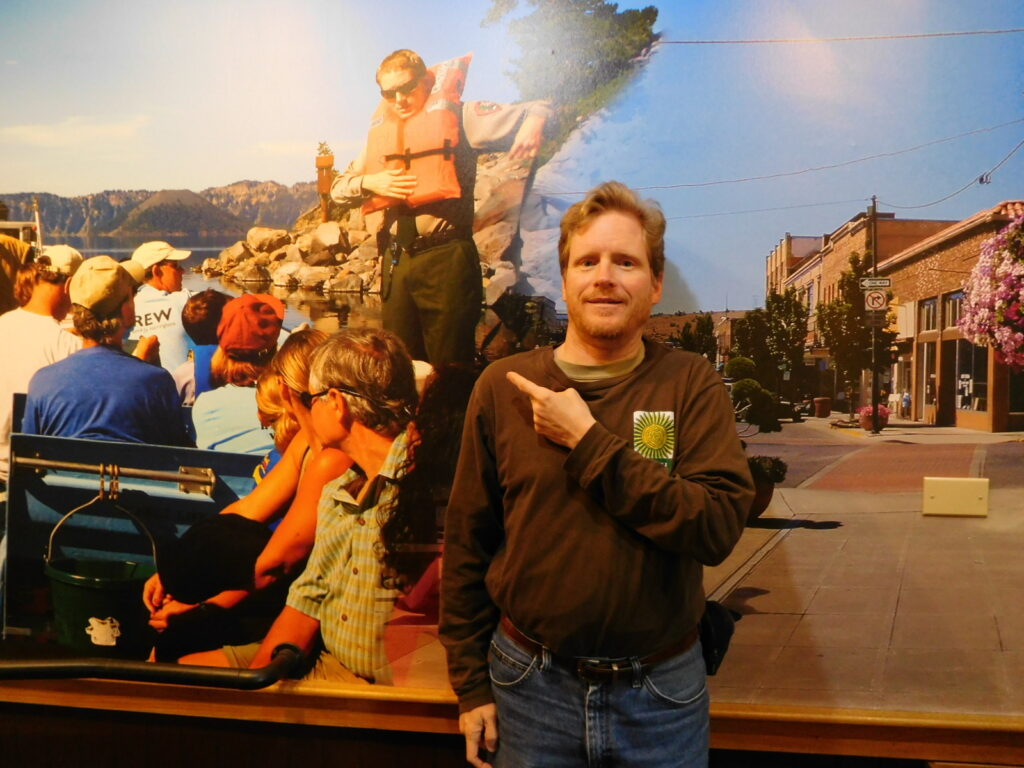
A highlight was when we ate dinner at Applebee’s in Klamath Falls, located over 60 miles south of Crater Lake. We chose to eat dinner there because it had a mural in the back of the restaurant of local people in action intermixed with the scenery of the area. This mural included a picture of me in my ranger uniform demonstrating how to put on a PFD (personal floatation devise) before narrating one of my boat tours at Crater Lake National Park. I learned about this mural from my supervisor Marsha on social media the previous winter when she randomly visited this Applebee’s one day. I had no idea that Applebee’s planned to include me in their mural. They did not ask me beforehand. However, I was honored to be included in this display.
Tanya and I sharing my car when I worked at Crater Lake in May 2017
Tanya and I shared a car, my 2002 Honda Civic. I talked her into getting rid of her car when we moved to Portland from St. Louis in February. While I worked at Crater Lake in May, we made it work. This was primarily because I stocked up on groceries for almost 2 weeks when she dropped me off at Crater Lake on April 30th. Some of my Crater Lake co-workers and friends picked up some food items for me when they went shopping in town. When Tanya visited me on May 13th, she took me out for groceries that weekend. I made sure Tanya had my car for all of May because she needed my car to commute to her job. However, we agreed she would take the car to come see me every two weeks so we could see each other and I could get groceries.
The logistics became complicated in June. I needed my car to drive from Crater Lake back to Portland on Thursday evening June 8th. I had a early flight to catch to Washington D.C. to catch from Portland on Saturday, June 10th. I needed time to pack in our Portland apartment on Friday, June 9th. Thus, I needed to transport myself to Portland the weekend of June 3rd to retrieve my car to take to Crater Lake so I could quickly leave to head back to Portland on June 8th.
I reserved a ticket to take the Amtrak Train from Klamath Falls to Portland on Friday, June 2nd so I could get my car. Fortunately, Tanya’s workplace is less than 2 miles where we lived. She bought a bike in April to help her commute when I would have the car at Crater Lake.
The train ride from Klamath Falls to Portland on Friday, June 2nd turned out to be an adventure. It took me several days before this trip before I found a Crater Lake employee who could give me a ride to Klamath Falls. Laura, who worked for the Park Maintenance Administration, gave me a ride on Thursday evening, June 1st from Crater Lake. She dropped me off at the motel I where I had a reservation that was walking distance to the train station.
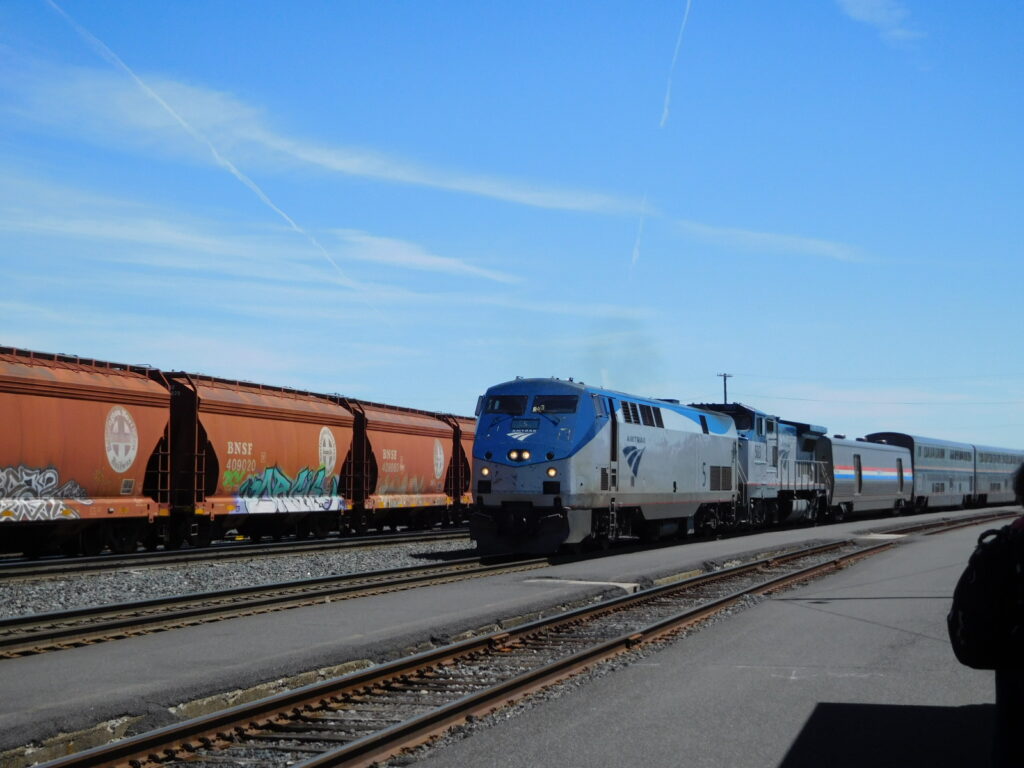
The train was scheduled to depart around 7:30 am on Friday, June 2nd. However, I kept receiving voice messages on my phone that the train would be several hours late. It was a total bummer that the train was 6 hours late due to the train hitting a farm tractor in central California. We did not leave Klamath Falls until almost 2 pm. The good news was that it was a clear warm spring day to take a train ride across Oregon to get lovely glimpses of Mt. McLaughlin and Mt. Scott, which is the highest point in Crater Lake National Park.
My time was limited on this quick weekend trip to spend the evening with Tanya. We were able to spend some time together on Saturday, June 3rd. I left that afternoon to start the over 5-hour drive to get groceries and return to Crater Lake that evening. I wanted to get a good night’s sleep at Crater Lake before returning to work on Sunday, June 4th.
On Thursday afternoon, June 8th was a momentous day for me. I performed my climate change training to my fellow Crater Lake rangers how to talk to park visitors about global warming. I presented this climate change training to my ranger peers at Crater Lake since 2012. They gave my presentation a positive response. They were amazed I was driving back to Portland from Crater Lake to catch an early morning flight in two days to attend the CCL Conference and Lobby Day in Washington D.C. June 10-13.
I had a wonderful time working as a ranger at Crater Lake in May. I did not feel ready to give it up yet, even though my true long-term passion was to find a way to organize for climate action. Towards the end of May, I asked my boss Marsha if I could work there for the summer. She readily agreed. I had already committed in June to attend the CCL Conference and Lobby Day in Washington D.C. Even more, at the end of June 2017, I participated in the Climate Reality Training in Bellevue, Washington as a mentor and a breakout speaker. We agreed that I would return to work at Crater Lake on Monday, July 10th.
Traveling to solo Washington D.C. and locally with Tanya – June 2017
My month leave of absence from working at Crater Lake from June 9th to July 9th was a packed schedule for me. I traveled to the CCL conference and lobby day in Washington D.C. from June 10th to June 13th. I attended two previous November CCL conferences and lobby days in 2015 and 2016. This was my first summer CCL conference. The November conferences had several hundred people. This June 2017 conference had around 1,000 people in attendance.
Adding to the excitement of this trip, I organized a breakout session “Protecting and Conserving Species in the Face of Climate Change” during the conference on Monday, June 12th. CCL staff and I recruited panelists from the National Park Service (NPS), Audubon Society, and the Alaska Wilderness League to discuss cause and effect linking climate change to ongoing disruptions in the natural world. We explored what was happening to vulnerable species populations.
I asked my friend John Morris who works for NPS in Alaska to be one of the panelist speakers for this breakout session that I organized. When John canceled due to health reasons, I decided to step in to speak about the impacts of climate change on pikas living in the western mountainous national parks. It was a delightful experience for me to lead and participate on this panel. My friend Ashley Hunt-Martorano who was on the CCL staff at that time was able to record a minute and a half of the question-and-answer session with her smart phone, which I was later uploaded to YouTube and my social media.
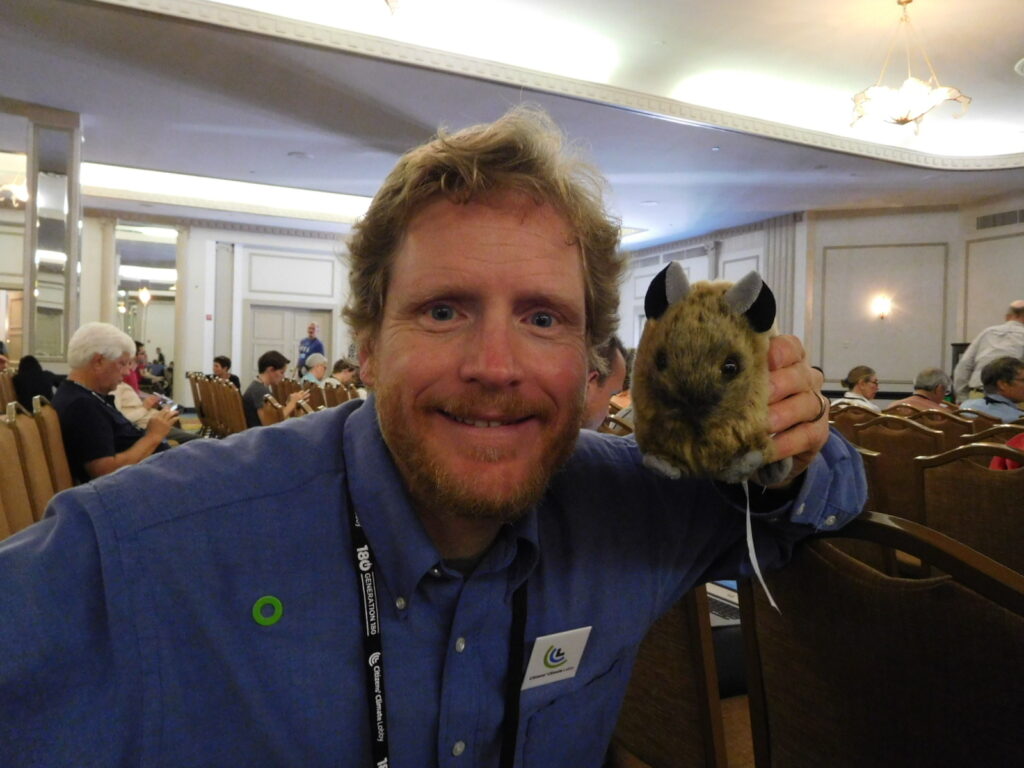
I arrived back in Portland late in the afternoon on June 14th. From May 1st to June 14th, I had not spent much time with Tanya since I was away working at Crater Lake and traveling to Washington D.C. It was a blessing to spend the next week together. This was the first time in my adult life from mid-June into the first week of July that I was living in the Pacific Northwest but not working at Crater Lake. I wanted to take advantage of this time off to see the Northwest.
On Sunday, June 18th, Tanya and I traveled into Washington state to see Mt. St. Helens National Volcanic Monument. It was an overcast day with the mountain shrouded behind the clouds. However, we had a great time exploring the displays in the visitor center and going on short hikes near the building.
Trip to attend and speak at the Climate Reality Training in Bellevue WA
Monday, June 26th to Thursday, June 29th, I was scheduled to attend the Climate Reality Training in Bellevue, Washington. Even more, the Climate Reality Project selected me to be a mentor for this training. Climate Reality required the mentors to attend an all-day training on that Monday. I determined that Tanya would drop me off at the hotel in Bellevue were the conference was held on Sunday afternoon, June 25th.
I planned a weekend trip for Tanya and me in Washington state. We would drive from Portland to Mt. Rainier National Park on Saturday, June 24th. We would then head to spend the night with my friends Steve and Melissa who near Shelton, Washington, located on a 20-minute drive northwest of Olympia, WA. On Sunday morning, June 25th, Tanya and I would drive to Tacoma to meet up with my friends Brad and Maureen before Tanya would drop me off at the conference hotel on that Sunday afternoon.
It was a perfect clear summer day to see Mt. Rainier National Park on that Saturday. No clouds were in the sky, nor was there any haze from pollution or forest fires. The sky was perfect for outdoor scenic photography that day. Mt. Rainier still had its robust winter snowpack clinging to the mountain and the stately evergreen pine trees in the park looked at their finest. The weather conditions were magnificent to see the mountain and take lots of photographs. We arrived at the southwest Nisqually Entrance to the park around 10 am. We drove up to the Paradise Visitor Center at Mt. Rainier to have lunch around 1 pm. We stopped at every viewpoint along the way to get views and take photos of the mountain.
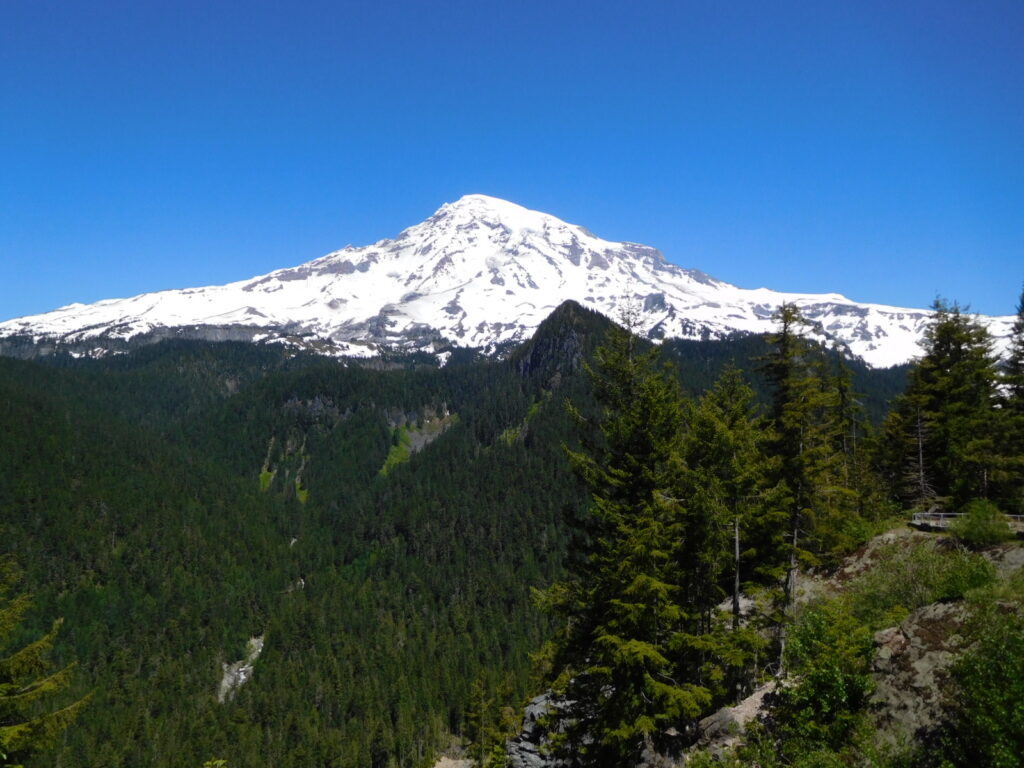
Sadly, I was so enamored with viewing Mt. Rainier that day that I forgot to wear sunscreen. For days afterwards, my face was almost as red as a tomato and feeling painful to touch. I bought an aloe vera gel the next day at a nearby pharmacy in Bellevue to ease the discomfort on my face. I wanted the impacts of the sunburn on my face to diminish by the time I gave my breakout presentation on the Climate Reality Conference on Thursday, June 29th.
Before Tanya dropped me off at the Climate Reality Training on Sunday, we had a good visit with my friends Steve and Melissa on Saturday evening at their home near Shelton, Washington. On Sunday morning, Tanya and I met up with my friends Brad and Maureen to have brunch with them in Tacoma, Washington.
As far as the Climate Reality Training, the most memorable part for me was giving a joint presentation about “Reaching Your Audience: Tips and Techniques from Climate Reality Leaders” on Thursday, the last day of the conference. I gave this presentation with Maddie Adkins, one of the persons I mentored at the Climate Reality Houston Training from August 2016. Maddie and I brainstormed and created our presentation in Portland in mid-June. Plus, we practiced our talk several times before we gave it on that Thursday. The conference attendees gave us positive feedback on this talk. Climate Reality Project considered this presentation to be so successful that they invited me back to be a joint breakout speaker for their Climate Reality Trainings in Los Angeles, California in August 2018 and Atlanta, Georgia in March 2019.
Sightseeing locally in Oregon with Tanya in July 2017
After I got a ride to Portland from a fellow Climate Reality Mentor on Thursday evening, June 29th, Tanya and I had 10 days together before I went back to work at Crater Lake on July 9th.
On Saturday, July 1st at the start of the July 4th weekend, Tanya and I chose to drive to the Oregon Coast. Our first stop was Cannon Beach to see Haystack Rock, an irregular basalt rock formation that stands 235 feet above the beach. It was overcast when we admired Haystack Rock. The dark rock looked more ominous against the gloomy grey sky. Because it is a protected habitat for several bird species such as the Tufted Puffin, it is strictly prohibited to climb on Haystack Rock. It looked too steep and treacherous to climb. We were happy to walk on the sandy beach, but it felt chilly for summer. The high temperature was in the lower 60s. Brrrr!
Tanya and I then took a fifteen-minute drive north to see Seaside, Oregon. This small city is known for its End of the Trail Lewis & Clark Statue where the edge of downtown meets the wide expansive beach. The statue is situated in a spot known as “The Turnaround.” It’s considered to be the official end point to the Lewis and Clark Expedition’s journey—the place where they “turned around” to return home. This beach was much larger and longer than the beach at Cannon Beach. At Seaside, it seemed like a quarter of a mile walk out to touch the Pacific Ocean. Somehow in that 9-mile distance from Cannon Beach to Seaside, the clouds found a way to dissipate. We had a brilliant blue sky contrasting to the vanilla-colored sandy beach, dark green steep coastal hills, and the vibrant blue color of the ocean to gaze upon.
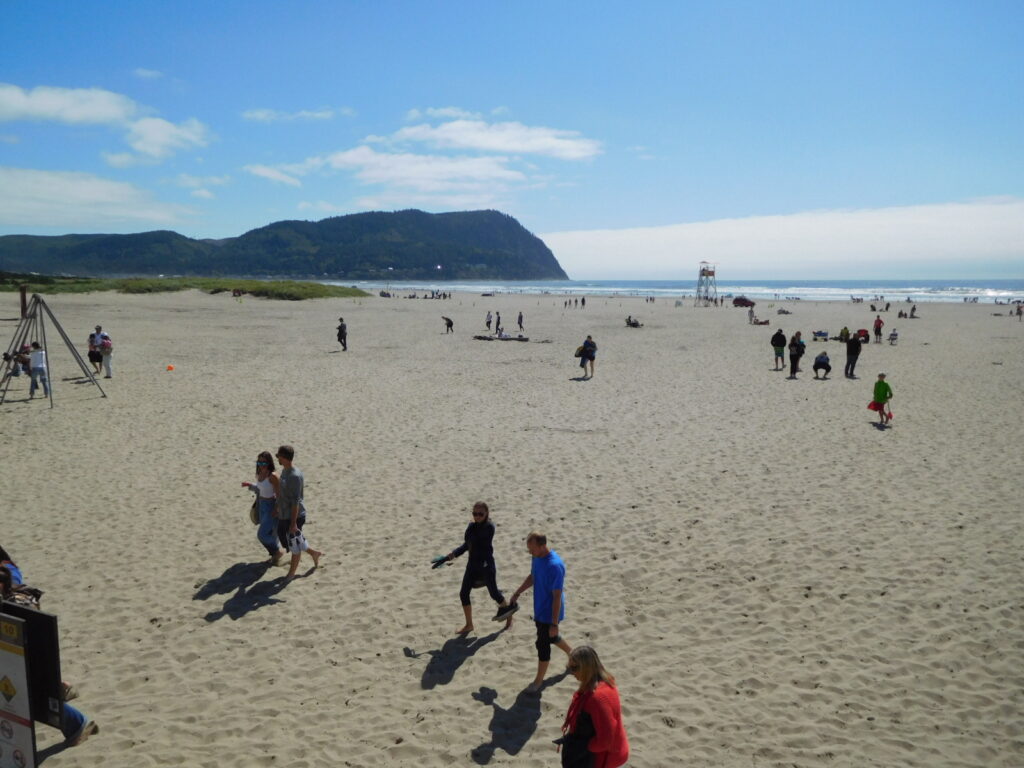
After walking around and at Seaside, Tanya and I were curious to drive north to see more of the Oregon Coast. We drove thirty minutes north to Astoria, Oregon. We stopped to admire the wide expansive mouth of the Columbia River as it met the Pacific Ocean. Without ever knowing about it before, we drove up to the highest point in Astoria to see the Astoria Column. This monument is a 125-foot-tall column tower that serves as a monument to the history Pacific Northwest. Tanya and I took the steps to the top of the Column to get an extra high sweeping bird’s eye view of Astoria, the Oregon Coastline, the Astoria Bridge that crosses the mouth of the Columbia River, and the lush green Pacific northwest pine forests located on the east and south view of us. We found a seafood restaurant to eat in downtown Astoria. We then had a two-hour drive back to our home in Portland.
On Sunday, July 2nd, Tanya and I decided to have a staycation day to explore Portland. It was another perfectly clear summer day in the Pacific Northwest. We traveled just south of downtown to take the Portland Aerial Tran. It transports passengers in an enclosed silver metallic gondola that travels on a steep cable from the South Waterfront neighborhood to the OHSU (Oregon Health & Science University) medical facilities. The Aerial Tran transports passengers to an outdoor deck at OHSU which provides panoramic views of the downtown Portland skyline to the north and a clear view of Mt. Hood to the east. After a very rainy weather for our first winter in Portland, Tanya and I were amazed how beautiful and pleasant the summer weather was in Portland for our first summer living there. The inviting gentle weather and magnificent scenery made us feel like we did not want to live anywhere else.
For 4th of July, Tanya and I drove 20 minutes east of our residence to spend time hiking in the Columbia River Gorge. We saw the roaring waterfalls of Wahclella Falls, Horsetail Falls, Ponytail Falls, Middle Oneonta Falls, and several other scenic sights in the Columbia River Gorge. From the rainy winter, the trees and vegetation in the Gorge were an exuberant lively green color. It was another clear day. Portland and the surrounding area seemed to be the perfect place to spend the summer. It was so much fun to explore our surrounding home area with Tanya.
Returning to work as a park ranger at Crater Lake in July 2017
At the same time, Crater Lake was drawing me back. I made a commitment to return on July 9th. I loved working there during the summer and I wanted to enjoy being a ranger there for this one last season. When I returned to Crater Lake to work, I was already a different person. I had my eyes checked by an optometrist in mid-June. I was now wearing distance eyeglasses, reading glasses, and prescription sunglasses for the first time in my life.
I left our apartment in Portland around 1:30 pm. I had to stop to buy groceries, plus stop to eat dinner along the route. The good news is that the North Entrance was open for the season. It opened sometime in late June, which greatly shortened the amount of time to drive into and through Crater Lake National Park. I arrived on the West Rim of Crater Lake around 7:20 pm. The sun was getting low in the sky for that time of day. It created some dramatic shadows on Wizard Island, the lake surface, and inside the crater. It looked a tad hazy like possible forest fires from northern California and southern Oregon were messing a bit with the visibility of the distance mountain vistas. I missed Tanya, but I was happy to jump back into performing my ranger talks and wear my ranger uniform again.
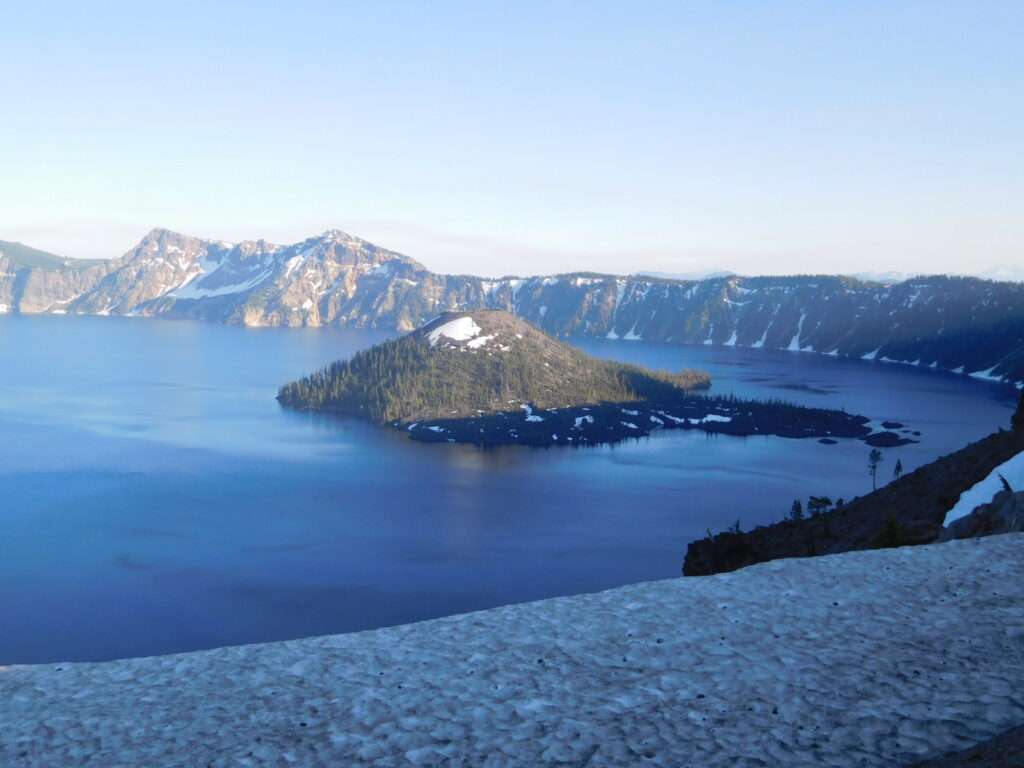
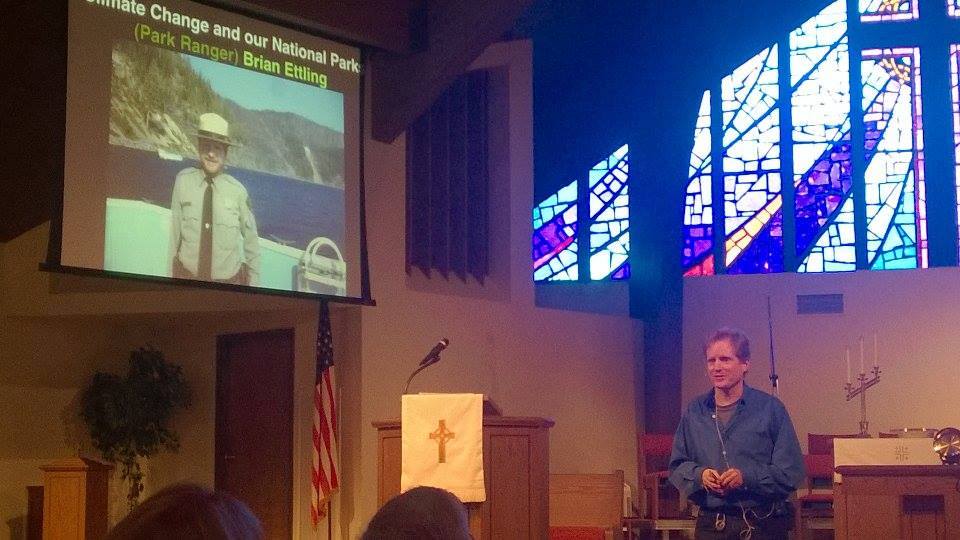
My first day back at work on July 10th, I gave my climate change evening ranger program for an audience of around 80 people. The audience liked the program, especially the kids who attended. I first started giving this campfire program in August 2011. My friend and Lead Crater Lake Interpretation Ranger David Grimes make a video recording of this talk in September 2012. I uploaded the video to YouTube one month later. I was proud to give this climate change ranger talk to large audiences of Crater Lake visitors. This was probably my last summer giving this talk, so I appreciated the times I got to perform it in July, August, and September 2017.
I drove back to Portland the weekend of July 15th and 16th to spend time with Tanya, especially before my birthday on July 18th. We had a low-key weekend to hike and spend time together. I was glad I made the long 4-and-a-half-hour drive home each way from Crater Lake to Portland to be with her. Tanya gave me a terrific birthday gift: She bought a new driver’s side back tail/brake light for me to replace the broken one I taped up for the previous 7 years. It was easy to attach the new brake light to my car. My car felt restored again with this new part.
On my birthday, July 18th, I narrated the boat tours on Crater Lake, my least favorite ranger program. Yes, it is beautiful to be on the water inside the caldera. I enjoyed narrating the tours on the lake. However, the sun beats down on you on the boats. There was no shade on the boat tours. The worst part was the 1.1-mile hike from the Rim to the lake shore. It was not a bad hike walking down hill in the morning when I was fresh with energy. But, after I would narrate two tours, it felt exhausting to walk back up that trail with that 700-foot elevation gain.
The visitors would not make it any easier. Each of them would ask me, ‘Do you do this every day?’ The answer ‘no, only about once or twice a week.’
The weather was a calm breezy day on the lake. It turned into an adventure towards the end of the second boat tour. We had a full boat with about 38 passengers, plus the boat captain and me. The boat’s battery died and the engine would not start. We were about two miles in the water from the boat dock. Because the engine was dead, we were drifting towards a rocky shoreline with the water a bit choppy. The rocks and small wave action from the windy breezes could have made things dicey for us. However, we asked the passengers to wear PFDs (personal floatation devises) to be safe. Before we knew it, the park research boat met up with us and towed back us to the dock. I steered the boat while it was towed. The captain was in the back of the boat guiding the boat with a handheld rudder since we had no power to the rudders.
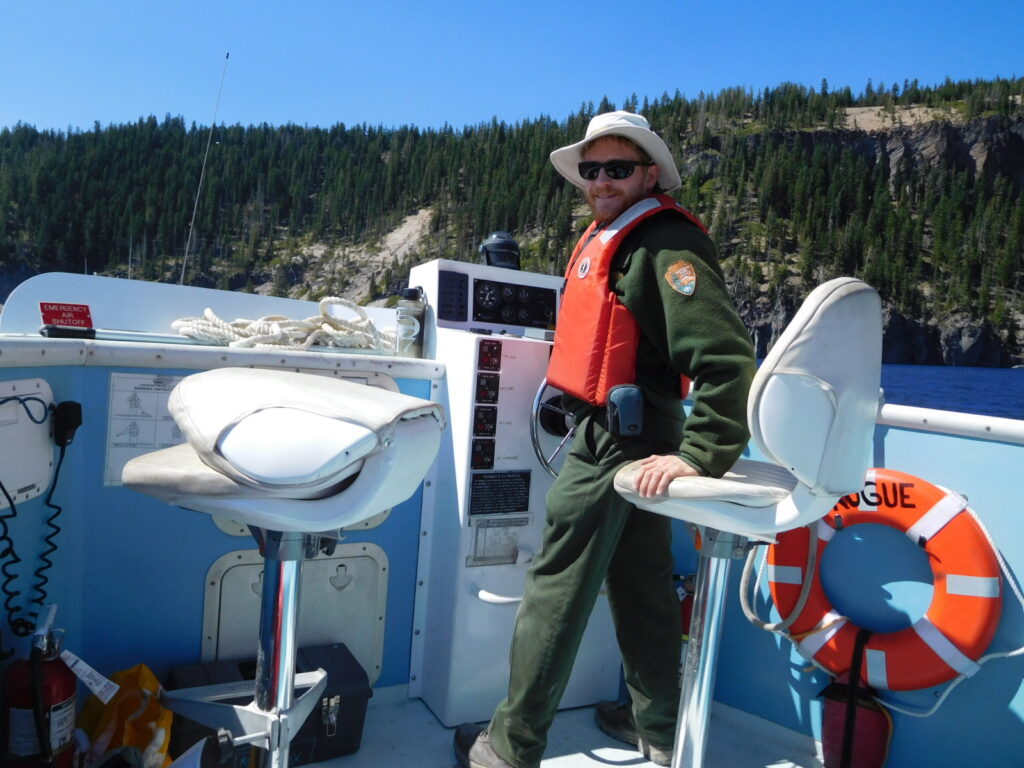
We returned to the dock safely, which made me appreciate my birthday more. I did not want to part of any dangerous incident celebrating my birthday.
Every day was a wonderful day leading some kind of ranger program at Crater Lake, such as narrating the two-hour trolley tours around the Crater Lake Rim Drive, leading the guiding hike at Sun Notch, giving my ranger talk about the Crater Lake National Park founder William Gladstone Steel at the Crater Lake Lodge, engaging with children at the Junior Ranger Program, etc.
One week after my adventure with a dead boat battery on the Crater Lake boat tour, I had a terrific time I had leading 29 visitors on a ranger guided hike to Plaikni Falls at Crater Lake. The Plaikni Falls Trail is mostly flat with a one-mile hike to the Plaikni waterfalls, a 20-foot-high waterfall. The falls tumble over a glacier-carved cliff. It originates from a spring above the Crater Lake Rim nearly 7,000 feet (2,134 meters) above sea level. The waterfalls ran strong in late July and a lot of wildflowers were in bloom near the waterfalls and creek running from the base of the falls. That evening, I had 54 people at my climate change ranger evening program.
Appearing in Al Gore’s book An Inconvenient Sequel: Truth to Power
On July 26th, I drove back to Portland for a long 4 day weekend. Tanya’s parents visited us for several days. When Tanya worked on that Thursday and Friday, I went on local sightseeing trips with my in-laws. We first went to see Willamette Falls in Oregon City, about a 30-minute drive south of where Tanya and I live in northeast Portland. Willamette Falls are 42-foot-high and 1,500-foot-wide. These falls are the second largest, by volume, waterfall in the United States. They are recognized as the end of the Oregon Trail for the 19thcentury pioneers. The falls were physically altered by the papermills built by it starting in 1866 and the site of the first successful plant in the United States for long distance transmission of electrical power in 1889.
We then traveled two miles up the road in Oregon City to see the End of the Oregon Trail Museum, which is shaped like a gigantic, covered wagon.
On Saturday, July 29th, Tanya, her parents, and I took a day trip to Mt. Hood. We walked around the Timberline Lodge, and we took a sky lift to get a higher view from the mountain. We ate homemade lunches at a picnic table not far from the sky lift. It was a clear day with excellent visibility to be able to see Mt. Jefferson sticking out tall on the southern horizon. We then hiked on trails with an abundance of wildflowers near the Timberline Lodge.
This same weekend, I made it a priority to stop by a local Portland bookstore. The book, An Inconvenient Sequel: Truth to Power by Al Gore was released. This was a companion book to An Inconvenient Sequel: Truth to Power film scheduled to be shown widely in movie theaters that August. The book was meant to be “Your action handbook to learn the science, find your voice, and help solve the climate crisis.”
In April 2017, the Climate Reality Project contacted me for permission to use a photo of me giving a one of my Climate Reality presentations. I gladly signed the photo release form for them to legally use my photo. At the end of July, I was able to find the book in my nearby Barnes & Noble bookstore. Sure enough, I found a tiny photo of myself giving a climate change presentation on page 314 among the collage of photos of Climate Reality Leaders. It was exciting that my in-laws were staying with us and I was with Tanya when I had the thrill of seeing my image in a climate change book authored by Al Gore.
On Sunday, July 30th, Tanya’s parents departed Portland and I drove back to Crater Lake to start my next week of work. At the beginning of August, the weather changed at Crater Lake and throughout the Pacific Northwest. The weather became hot and very dry. Wildfires, primarily started by lightning, were igniting inside Crater Lake National Park and elsewhere.
Seeing distant wildfires during my Crater Lake sunset guided ranger hike
On Wednesday, August 2nd, I led a ranger guided sunset hike at Crater Lake National Park up to the 8,000-foot Watchman Peak. When I drove along the West Rim Drive to trailhead for Watchman Peak, I could see a large column of wildfire smoke not far but at a safe distance from the Watchman Peak Trail. The Crater Lake Fire Crew named it the Spruce Lake Fire. They discovered it on July 29th along the western boundary of Crater Lake National Park. It was stunning to learn that this forest fire blew up to over 1,400 acres from over 100 acres the day before.
When visitors met me at the Watchman Pullout parking lot, I shared we would have a fabulous time hiking to the Watchman Fire Lookout Tower at the sunset. We warned that we might not see the sunset due to the wide column of wildfire smoke. At the same time, we would have the thrill of observing a wildfire from a safe distance.
The Watchman Peak sits at a spot on the West Rim that gets some of the deepest snowbanks and snowdrifts in the park. Thus, we had to hike on top of the snow for part of the trail. The kids in this large group for my ranger hike were excited to throw snowballs at each other, as were some of the adults. It was surreal to walk on snow on a mountain while literally we had smoke from a large wildfire in the background.
When we reached the fire lookout at the Watchman Peak summit, we had the wildfire smoke drifting high above our heads. It did not interfere from getting spectacular views of Crater Lake with Wizard Island in the middle as we looked towards the east. As we gazed towards the west, the large smoke column was polite to shift to the side as we could see a magnificent sunset from fire lookout summit. We were a safe distance from the fire, but we saw distance flames from when the forest fires torched some tall Douglas Fir or other pine trees. In my 10 seasons leading sunset hikes up the Watchman Peak, this was one of my most memorable and fantastic hikes. I took over 40 pictures that evening of the snow, visitors walking and standing on the snow with the forest fire in the distance, photos of the wildfires, and photos of Crater Lake.
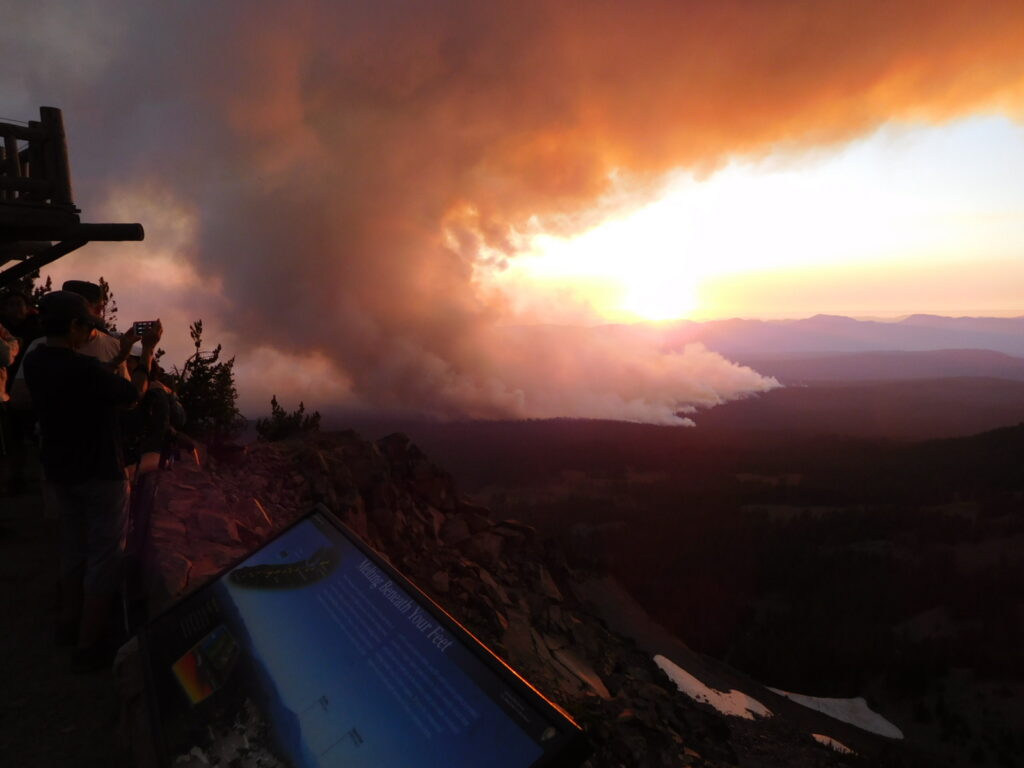
While I preached in my ranger talks about the importance of natural forest fires, I hoped this forest fire would go away soon from all the smoke it generated. Sadly, smoke from the wildfires inside and outside the park stayed with us for well over the next month.
Watching An Inconvenient Sequel: Truth to Power documentary with Tanya
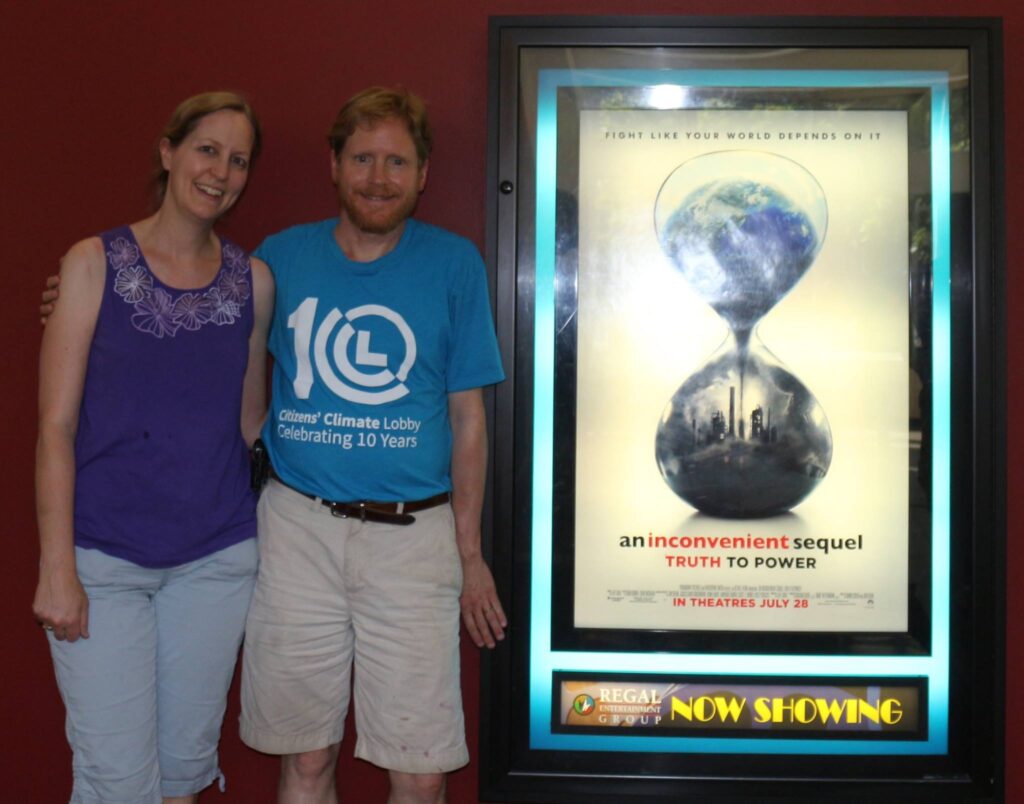
On Friday, August 4th, I drove back to Portland to be with Tanya for the weekend. I was ecstatic because the documentary film An Inconvenient Sequel: Truth to Power was released in Portland theaters that weekend. I bought my tickets online on Sunday, July 30th while I was in Portland with Tanya. I made sure to print them out before I drove back to Crater Lake. On Saturday, August 5th , we went to a downtown Portland movie theatre to see the movie at the 5 pm showing. The theatre had just a few attendees besides us. Because of the threat of climate change, I thought it was a vital film to see. However, it looked like it was not going to be a box office smash like a Marvel superhero film or other summer popcorn thrillers.
I attended the Climate Reality Training in Houston, Texas in August 2016 when the documentary crew filmed Al Gore giving his climate change presentation to a small studio audience. I sat in the front row hoping to appear in the movie. This might be my only chance to be in a Hollywood film in my life, so I wanted to be seen. Tanya and I thought we saw a glimpse of me for a second at the edge of the screen frame. During the videotaping for the documentary, Al Gore made a statement about climate change that caused me to say, “wow!”
Al Gore turned in my direction and responded, “You can say that again, ‘Wow!’”
Sadly, that interaction did not make it into the movie.
Towards the end of the film, Al Gore talked about how we must be more effective in communications to inspire the public to take climate action, including using humor. Tanya and I both thought he was looking in my direction when he said that. Just two weeks before sitting in the studio audience to film this scene with Al Gore, I was on August 2, 2016 episode of TV Comedy Central’s Tosh.o using comedy to talk about climate change. It was probably a coincidence that Al Gore looked in my direction. He may not have been aware of my appearance on the national TV show. Yet, Tanya and I thought it was a fun happenstance.
Boarding for a commercial flight from Portland to Klamath Falls, Oregon
On that previous Sunday, July 30th, I made a reservation on Horizon Air, a subsidiary of Alaska Airlines, for Sunday, August 6th to fly to Klamath Falls to so I could return to work at Crater Lake. I wanted Tanya to have a chance to enjoy my car during the summer. She basically gave it up for all of July, riding a bike to commute to work and other errands she took. My plan was to fly from Portland to Klamath Falls airport. I would have a ranger co-worker pick me up and I would get some groceries. We would then drive back to Crater Lake. I have always loved to fly commercial. The Klamath Falls Airport was not always available for commercial flights when I worked at Crater Lake over the years. Thus, I seemed lucky to have been able to book this flight.
Tanya dropped me off at the Portland International Airport on Sunday morning, August 6th for my flight to Klamath Falls. I walked downstairs to what looked like a seldom used wing of the airport for flights on tiny commercial airplanes to nearby small regional cities. When I got to the gate, I saw one or two other people waiting for possibly this flight.
The airline gate agents made the announcement that my flight was boarding. I waited for them to announce something like, ‘Now boarding for first class, then business class, then families with small children, then veterans, then the A Group, then the B Group, and then finally we will be boarding the individuals who waited until the last-minute check in on this flight.’
Instead, the airline agent just looks up and announces, “Brian Ettling.”
That was my only cue for me to board my flight. The airplane was so small that I took a photo of it as I walked outside the airline gate. I then strode down a ramp to walk on the tarmac and then take about step on board the airplane. We then took about 8 steps up to aircraft steps to board the airplane. This plane only had about 8 rows of seats with about 3 seats in each row. The plane was so small that the overhead bins were skimpy. Thus, all the luggage had to be placed in the checked bags storage area in the rear or tail section of the plane. It did not seem like any carryon bags could be carried into the airplane cabin, except for backpacks and items that could be stored under your feet.
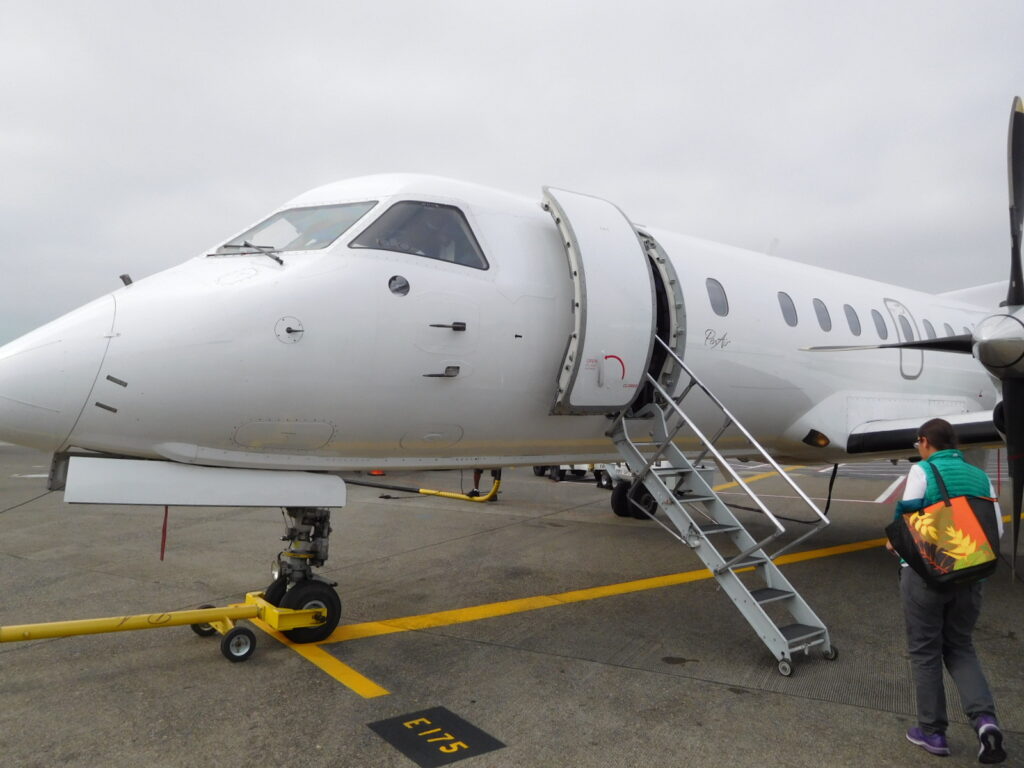
I was amazed there was only 3 passengers on board this flight. This was probably the emptiest commercial flight I have ever taken or will ever take. In recent years, Tanya and I flew on Thanksgiving Day where the commercial jets were only about 30% full. This flight from Portland to Klamath Falls looked even more sparse than those more recent flights I took. It seemed like we had the same number of passengers, if not less than the pilots and flight attendants. Thus, we had our choice to sit anywhere in the airplane.
I sat in a window seat on the port or left side fasting the cockpit in the very back. I wanted to be where the airplane wing would not obstruct as much from any photos I intended to take of Crater Lake or other scenery. The great thing was that once the flight reached 10,000 feet and the fasten your seatbelt light came off, I could move to the window seat in the very back row on the other side of the aisle. The flight attendants did not notice. As long as I was not obstructing other passengers or their job duties, they did not care which side of the plane that I sat. I was not sure which side of the plane Crater Lake or other dramatic features I would see from the left or right side. Thus, I liked that freedom to shift from the port to starboard side to try to get looks out of the windows of each side.
Trying to see Crater Lake from the window of a commercial flight
It is normally about a 5-hour drive from Portland to Klamath Falls, but this flight completed the same distance in about 1 hour. For me, the best part of flying is sitting in a window seat getting aerial views of the scenery. It was a decades long dream to see Crater Lake from the window of a commercial plane. I was eager to take this flight to see what Crater Lake and the mountains of southern Oregon would look like from an airplane window. Sadly, it was not meant to be on this flight. My dreams were crushed.
By this time in the first week of August, forest fires generating a lot of wildfire smoke were happening at Crater Lake, throughout Oregon, and even in much of the Pacific Northwest. As soon as the plane took off from the runaway from Portland International airport, the visibility looked terrible. I could hardly identify the St. John’s Bridge, downtown buildings, or any other features in the Portland area. My heart sank. I might not be able to see any dominant Oregon scenic features from the air, let alone Crater Lake.
I remained optimistic that maybe the smoke was just obscuring any views of the Portland area. However, I knew better. Crater Lake was experiencing wildfires and smoke, as well as other areas in southern Oregon, when I left the park to come to Portland for the weekend. On the other hand, we had times at Crater Lake where the winds would come from certain directions to clear out the wildfire smoke. You just never know.
Sadly, the horrid smoky visibility did not change at all as the airplane journeyed into central and southern Oregon. I could make out the dark silhouettes of the Three Sisters Mountains by Bend, Oregon, but that was it. The wildfire smoke and haze made all the land features in central Oregon made everything look like an uninspiring grey soup.
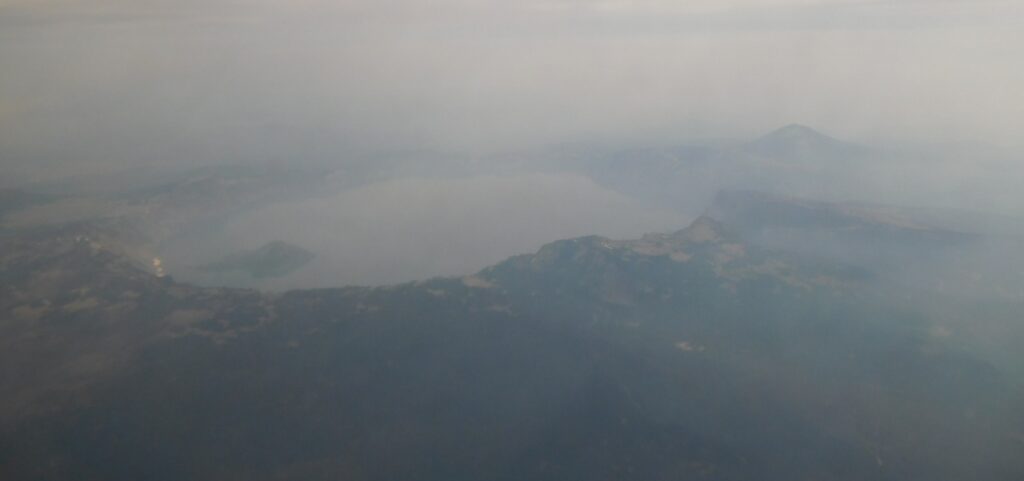
Above the wildfire smoke, a blanket of clouds moved in as the plane ventured into southern Oregon. It looked bleak if I would see Crater Lake. Then the clouds then pulled back a bit and I could barely make out a shape. It was Crater Lake. I had to strain to see it through the wildfire smoke, but it was there. We were flying above around 10,000 feet when I got a peek of it. It looked nearly colorless with a slight hint of blue because of the wildfire smoke and high overhead clouds. Wizard Island was in the foreground since the plane flew close to the west rim.
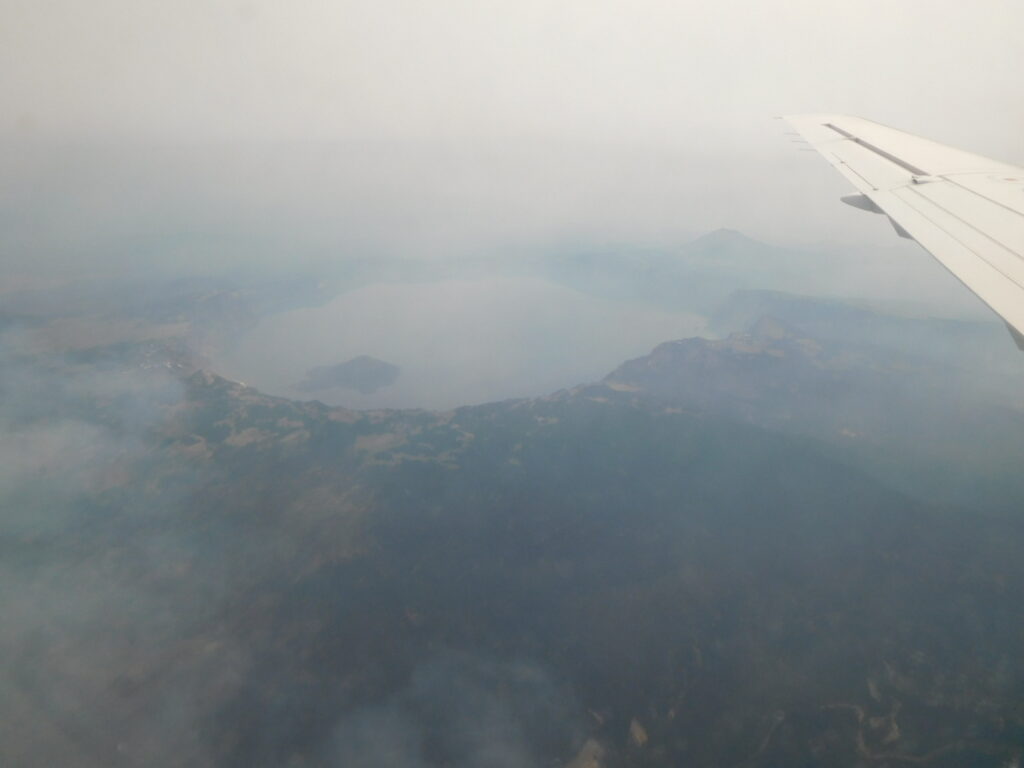
It was interesting to see, yet so disappointing. I wanted to see it under better conditions than this on a commercial flight. It felt like I made a journey to see the Mona Lisa in Paris. Yet, when I landed in Paris and traveled straight to the Louve, I came to the room where the painting is displayed only to barely see it in a room filled with smoke. Even worse, it felt like the oil industry and climate deniers were laughing at me when I had a hard time seeing Crater Lake from the wildfire smoke. I organized for climate action for the previous 7 years. There’s a good chance that climate change made the fire season happening that August inside the park and throughout Oregon worse. Yet, the fossil fuel CEOs, managers, and stockholders, as well as the climate deniers, did not care about the damage to the planet and our environment that they caused.
I was so lucky with all the beautiful clear weather I experienced at Crater Lake in May, Mt. Rainier in June, and the Columbia River Gorge in July. My luck finally ran out that summer with the heavy wildfire smoke in August.
Showing the aerial smoky images of Crater Lake in my climate change talks
Fifteen minutes after I saw Crater Lake from my airplane window, the airplane arrived at Klamath Falls. My Crater Lake ranger colleague Thomas picked me up at the airport. I shared my disappointment with him and anyone else that I looked at Crater Lake on a commercial flight. However, it was nearly hidden behind wildfire smoke. During the flight, I took 9 photos of Crater Lake obscured by the wildlife smoked. The images were seared in my memories.
From that time forth, I used those photos for my climate change talks for years afterwards. They were in my climate change speaking tour talks I conducted across Oregon at the end of October and the beginning of November 2017. At the presentations I gave in the Portland area the next few years, I included that image. When I gave a climate talk in Tampa, Florida in February 2018, I included that photo. When I spoke across the state of Missouri at my college and high school alma maters in October 2018, I included one of those pictures.
With those images, I wanted to show people that I loved working and living at Crater Lake National Park as a park ranger for 25 years. However, I saw climate change during my time there. I will never forget witnessing excessive smoke from wildfires standing on the rim and flying over the park in a commercial airplane in August 2017. Seeing climate change motivated to act every day since then. I hope knowing that climate change impacts our national parks and our most sacred wilderness areas will inspire you to take action.