

“It is in your hands, to make a better world for all who live in it.”
– Nelson Mandela
This is part 2 of my 6 part blog from 2004-2010 how the EarthBall became my symbol. I conclude these multi-part story how my April 10, 2010 photo of me with my EarthBall at Copper Harbor, Michigan with Lake Superior behind me became my favorite Earth Ball photo.
Part 1: Everglades National Park, Florida in 2004 to Crater Lake Nat. Park, Oregon in 2009
Part 2: My Pacific Northwest spring travels to living in Ashland, Oregon in Autumn 2009
Part 3: December 2009 cross country travels to spending winter in St. Louis, MO in 2010
Part 4: Seeing Door County, Wisconsin in April 2010
Part 5: Exploring the Upper Peninsula of Michigan in April 2010
Part 6: Getting my ideal EarthBall photo in Copper Harbor, Michigan in April 2010
My Pacific Northwest spring travels in at the end of May and the beginning of June 2009
In the last week of May and the first week of June, I had a two-week vacation from Crater Lake National Park. I visited friends in Salem, Oregon. On Saturday of Memorial weekend, my friends Gary and Melissa Martin, as well as their daughter Shelby, took me on an excursion to Silver Falls State Park, located on a 35-minute drive east of Salem. I was eager to hike on the 10 Falls Trail to see the numerous tall waterfalls in that park. Some of the falls you can hike behind on the trail. It was a goal of my mine for years to see this park since I saw pictures of it in scenic photography coffee table books about Oregon.
The length of the 10 Falls Trail is around 8 miles with an elevation variation of almost 1,600 feet. It took most of the day to complete, especially to take photos and admire each of the waterfalls. This trail was up there with the scenic grandeur of any national park trail. In fact, after I visited Silver Falls, it felt overlooked that it was never made into a national park.
From Salem, I spent a day driving up to see best friend from high school, Scott Manthey. He lives across from Seattle in Grapeview, Washington. I stayed a couple of nights with him and lovely wife Nikki. I then headed to the Port Angeles area on the Olympic Peninsula. I camped a for several nights the Heart O’ the Hills Campground at Olympic National Park. The campground is located just 7 miles south of Port Angeles at the northern Hurricane Ridge entrance in Olympic. I camped there for two nights to fulfill my plans to see Hurricane Ridge, the Hoh Rain Forest, and other sights in the Olympic area.
It was May 27th and I planned to stay in national park campgrounds while visiting Washington State during this two week vacation. I figured it would probably still be chilly at night to camp, so I bought a cold weather sleeping bag. Oddly, the weather was unseasonably warm and clear for this trip. It was perfect weather to photograph mountains with their spring snowpack and spend my days hiking. I quickly had to return my cold weather sleeping bag and use my summer sleeping bag to sleep more comfortably for this trip. The weather felt like summer, but it was not the summer tourist season yet. Thus, I had this Olympic Campground all to myself.
A highlight was seeing Hurricane Ridge with the panoramic view of the Olympic Mountains. These mountains are not tall compared to the Cascade Mountains, Rocky Mountains, or the Sierra Nevada Mountains in Southern California. Some of the mountains in those ranges are over 14,000 feet tall. The highest mountain in the Olympics is Mount Olympus, just under 8,000 feet tall. Yet, since these mountains lie next to the Pacific Ocean, they get hammered with snow. The winter snowpack clung strongly to the mountains at the end of May. It gave me a terrific opportunity to admire and photograph these mountains from Hurricane Ridge.

The next day, May 28th, I crammed in as much as I could to see the highlights of Olympic National Park. Just west of Port Angeles, I drove into the Elwha Valley Entrance to see another partial view of the Olympic Mountains and view the Madison waterfalls located near the park road. I was surprised to see manmade dams in a national park. They were so ugly in this otherwise pristine mountain valley that I did not photograph them. The good news though was the wayside signs announcing the dams would soon be removed to restore the natural habitat. The damns were later deconstructed in 2011.
From the Elwha Valley Entrance, I had a two hour drive south and west on the Olympic Peninsula to see the Hoh Rain Forest at the western edge of Olympic National Park. It was a sunny clear day when I visited the rain forest. No mist, fog, or rain for me to see that day that is present there much of the year. However, the robust moisture and mild year round temperatures allowed the Sitka Spruce, Red Cedar, Big Leaf Maple and Douglas Fir to thrive. The ideal growing conditions there allowed the trees to be giants in their height and width, almost similar to a Redwood Forest. The long and winding park lot there that was almost empty was an indication that summer brought huge crowds of tourists to this area. However, the opportunity was nearly all mine to absorb this peaceful, quiet, lush green, vibrant area all to myself.
It was well after 3 pm that I left the Hoh Rain Forest and I had about a two and a half hour drive back to my camp spot in Olympic National Park near Port Angeles. Fortunately, the summer solstice was over 3 weeks away, the daylight is nice and long this time of year at the end of May for sightseeing. After the Hoh Rain Forest, I drove almost 3 hours, getting stopped several times for road construction. My next destination that day Sol Duc Valley Entrance, at the northwestern entrance to Olympic National Park. With the robust Douglas Firs and other evergreen trees in the Sol Duc area, the location felt a little dark and menacing with the limited amount of daylight peaking through the trees in this area. This was especially true since I arrived in this area around 6:30 pm, with the sun much lower in the sky. The Sol Duc waterfalls were impressed as they roared and cascaded over the rocks of this small river.
From this diversion to Sol Duc, I still had over a 2 hour drive back to my campsite at the Heart O’ the Hills Campground. It was after 8 pm with the sun setting soon when I arrived at the pullout for Marymere Falls off of Highway 101. It was a 1.8 mile round trip trail to see this slender waterfall with a 90 foot drop. Even though I had very little daylight left to enjoy the sight of this waterfall, it still felt worth it to cap off this very full sightseeing day.
The following day, on May 29th, I took a ferry that morning from Port Townsend, Washington to Whidbey Island. It was another clear and sunny day during this Washington State trip, a perfect day to take the 36 minute ferry ride with calm ocean water in the Admiralty Inlet. As the ferry left the coastal town of Port Townsend, known for its charming 19th century Victorian architecture for its downtown buildings, I could see the snowcapped Olympic Mountains coming into full view. Since the campground I stayed was basically at the base of the mountain range, I felt like I got my best views of the mountains on the ferry. They appeared to be waving goodbye to me as I left them behind to head towards Whidbey Island and then onward to North Cascades National Park. As the ferry carried my car and I to the other port, the white ghost of Mt. Baker appeared in its winter glory. I hoped get excellent views of Mt. Baker later that day. I was glad to see that the mountain was indicating to me that I may get good views of her and other North Cascades Mountains later that day.
Once I drove off the ferry, I was mesmerized just a few miles up the highway by the tall and long Deception Pass Bridge that connected Fidalgo and Whidbey Islands. I then drove to the Mt. Baker Ski Area to fulfill a lifelong dream to see Mt. Shuksan in North Cascades National Park. I spent a night camping in a forest service campground near the Canadian border in Glacier, WA. I next journeyed on Washington Hwy 20 through the middle of North Cascades National Park. I spent two nights at the Colonial Creek campground off Hwy 20 in the middle of the park and hiked to the top of Thunder Knob.
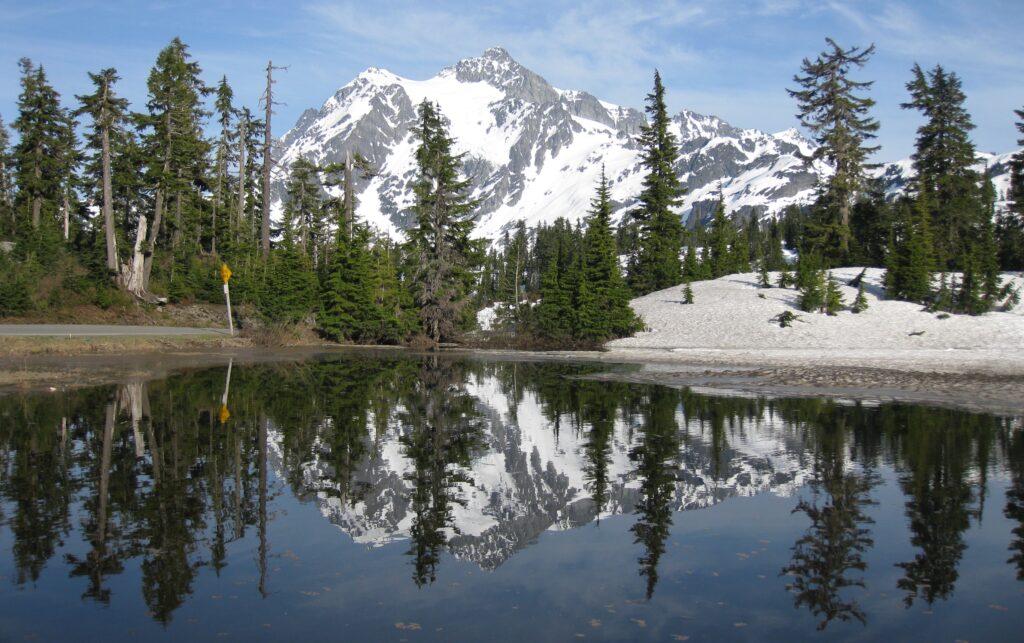
The next day I continued my adventure east driving to see the eastern jagged Cascades Mountains in the eastern side of the park. The weather was unseasonally clear this entire trip, so I intended to immerse myself in seeing the North Cascade Mountains. From the eastern park boundary, I drove east WA Highway 20 all the way Winthrop, Washington. It was a town that looked like it could be a set in an old western movie, I was so blown away by the beauty of North Cascades National Park that I did the reverse route of Hwy 20 through the park to see all the splendid snowcapped mountains in North Cascades. For the second time in a week, I camped at the Douglas Fir Campground outside of Glacier, Washington.
Mt. Shuksan enticed me to return before sunset to get more views of the jagged pointy mountain with a healthy winter snowpack and lots of glaciers clinging to it. It is considered one of the most photographed mountains in the world, and I was drawn to take numerous photographs of it. The next day I snowshoed around the Mt. Baker Ski Area to take in views of Mt. Shuksan, Mt. Baker and the nearby mountains. It was a bright sunny day. I wore sunglasses, but I still got some snow blindness from the bright sunshine on that clear day reflecting off the snow.
The next couple nights, I camped at Mt. Rainier National Park to enjoy photographing that mountain and walk on some of the hiking trails in that national park. While I was at Paradise in Mt. Rainier, the sky was overcast, but the clouds were generous to be high enough to be all to see all the mountain in its full winter snowpack glory. This was my first time seeing Mt. Rainier up close. The previous times I went to Mt. Rainier, it was raining and the clouds were too socked in to see the mountain. The sun was not shining on the mountain, but the winter snow and glaciers clinging to the mountain looked like a glorious sight.
For the first time, I wanted to get a photo of myself with the mountain behind me in the photo. I asked one tourist to get photos of me with the mountain over my shoulder. However, he just took some photos of me. It was not what I wanted. Finally, I was able to find another park visitor to get a good photo of me with Mt. Rainier also framed in the photo.

This was my third time visiting Mt. Rainier. Unlike the previous two visits, the weather cooperated enough to be able to see the mountain. The snow, towering rocks, and ice from the glaciers of the mountain dominated over the area. This two-week vacation also felt like a victory to be able to fully admire Mt. Rainier inside the national park. I find I frequently experience serendipitous moments when I visit national parks. Not far from the Paradise Inn, a fluffy red fox stared and observed the visitors. With its hint of red fur on top of his head and shoulders and black fur on its neck, breast, underbelly, and legs, it looked like it was putting on its own fashion show for the park visitors. It looked too calm and unafraid to be totally wild. It looked like someone might have fed it at some point because it had an interest to be around people.
In the second week of June, I headed back to Crater Lake National Park to work for the summer. In between giving ranger talks for the summer, I traveled to Lassen Volcanic National Park in northern California in the last weekend of July. Lassen is a four-hour drive south of Crater Lake National Park in northern California. It has an impressive 10,457-foot volcanic mountain that dominates the park, Lassen Peak. One can hike up to the summit of this volcano in the summer. It has active steam vents and boiling mud pots, so it feels like a miniature Yellowstone. Lassen Peak is still an active volcano. It had an explosive eruption in 1914 and then more sporadic volcanic outbursts for the next 7 years.
My friend Lizzy, who worked at Redwoods National Park, California came up for a weekend to visit me at Crater Lake in the second week of August. She proudly grew up as a ‘river rat’ swimming in the cold mountain streams in Three Rivers, California, near Sequoia National Park. Her top priority was taking a swim in Crater Lake when she came to visit me. Gulp! I hate swimming in cold water. However, when she wore a tiny bikini to swim in the lake, even on a cold windy summer day in the upper 60s, I had to put on my full swimming suit and go swimming with her. I also hate swimming in deep water where I cannot touch the bottom. I jumped off the jumping off rock at the bottom of the Cleetwood Cove Trail after she did to show that I was a macho guy. However, I probably did not look that attractive failing around in the water with water coming out of my nose. Still, it was fun to take her hiking to see my favorite parts of the Crater Lake rim.
For years afterwards, I joked with park visitors that Crater Lake water is so cold, just a few degrees above freezing all year, that I only swam in it once. I would elaborate that a beautiful ranger friend came up to see me wearing a tiny bikini to jump in the lake. Therefore, I had to jump in the lake also. This story always got a chuckle from the audience.
The next weekend I visited Lizzy in the Redwoods. She lived by herself in a park house off U.S. Highway 199, surrounded by Redwood Trees. We hiked a short distance from her ranger house to see nearby gigantic redwood trees in Jedediah Smith Redwoods State Park, located in the northern end of the Redwoods National Park. We swam to hang out on a large rock in the middle of the Smith River.
Lizzy and I talked at length during these weekend trips how both of us were alarmed about climate change. She impressed me that she created a climate change evening campfire program at Redwoods National Park. I wanted to create a climate change evening program at Crater Lake, but I did not feel brave or knowledgeable enough to create such a program at that time. She took time to show me her PowerPoint slides during the Redwood trip and generously allowed me to have a copy of her talk. I used her talk as one of my templates when I finally assembled my own climate change evening program at Crater Lake National Park in August 2011.
I hoped to pursue her romantically on this trip. However, she gave me dreadful news that she just started to a relationship with a man in Portland, Oregon. Thus, any kind of romantic interlude between us was not going to happen. I felt down like I would never end up having a girlfriend or romantic fling.
One week later, I visited my friend my friend Lise Wall who worked at the Illahee Fire Lookout. It was a steep long gravel road to drive up there. It was one of the most remote locations I have been in my life. When I arrived at the fire lookout, which stood erect at least three stories above this 5,300-foot mountain, it was just Lise and her friendly cats. There was not another person for miles around. From the lookout, the view was 360 degrees of evergreen mountains with a few prominent mountains with patches of snow poking out in the distant horizon. I was awestruck to be surrounded by this much wilderness with ridges upon ridges of mountains going into the distance. No signs of human civilization was visible from the bird’s eye view on top of Illahee Rock, except for the lookout tower itself. No sounds of civilization either, just the light wind blowing through the trees now and then.

I did not want to go to sleep at night. The light pollution from any nearby Oregon cities was minimal, so the stars and Milky Way gave a spectacular dazzling show when it got dark. Way too many stars to count. It was jaw dropping and stunning to admire all the heavenly stars with trail of the Milky Way clearly visible on this moonless cloudless night. I didn’t want to miss the stars, nor the ever-brightening glow of the eastern dawn, and the first rays of the sunlight peaking over the distant mountain edge horizon. It was such a sublime wilderness experience that I slept terribly not wanting to miss a thing.
On top of that, Lise and I seemed to have an attraction to each other, but neither of us said anything or pursued it. Sometimes you just don’t want to mess up a good thing with a cherished friend. That was another factor that made it hard to sleep. Even more, after Lizzy told me the previous weekend she was in a relationship. I just could not bear Lise telling me the same thing, we kept things on an unspoken platonic level.
Discovering my Climate Change Comedian Title
When I was at Crater Lake in between my weekend travels, my friend Graham talked me into housesitting in Ashland, Oregon for the winter at his mom, Barbara’s house. I had no plans that winter, except to possibly return to St. Louis to stay with my parents. When I arrived in Ashland, Oregon in early October, the autumn colors were spectacular. I took many photos on long walks around town of the trees with the bright red, orange, and yellow leaves. It was a joy taking care of his mother’s cat Poppy. The cat was very loving with its very long poofy hairy. It would touch my face with its claws extended in the mornings to demand the fresh tuna it was in the habit receiving from Barbara. It insisted to go out into the garden each morning to get a hit from the wild catnip. The cat bonded well with me. I took many photos admiring its beauty and serene personality. It liked to curl up on my lap in the afternoons and evenings.
At the same time, I was restless and bored housesitting. I needed a job, but I was not sure what to do. I tried working at the Ashland Co-op supermarket. It was a disaster. I did not make it past my first day. The new supervisor and I had terrible chemistry. On the first day of work, he insisted on giving me very long lectures to explain all the procedures of the job. However, he would not allow me to ask questions or repeat any responses to make sure I hear him correctly. He kept saying, “Don’t interrupt me!” when I wanted to say anything.
I lost all interest in learning that job and quit at the end of the day. He seemed flabbergasted that I quit. At the same time, he was oblivious to my seething anger throughout the day that he just wanted me to stay quiet while he talked at me about the job. It felt liberating to quit, yet so damn demoralizing that I did not have a job. I went to Taco Bell and ordered a bunch of tacos to consol myself with food that evening. My dad worked 40 years part time in a grocery store and he loved it. That experience soured me from ever wanting to work in the grocery industry.
While I was living in Ashland, my friend Tess who lived in Phoenix, Arizona was in regular contact with me. It felt like we had a great chemistry between us. I was becoming more attracted to her even though it would best be a long-distance relationship. I sent her an email a day before asking if she would like to do a date with me sometime where we both see the same movie around the same day or two and discuss it afterwards. She said she would think about it. I emailed her when I got the job at the Ashland Co-op and she was happy for me. I then contacted her when my first day at work was a disaster and felt I had to quit.
Tess immediately called me to tell me in a very terse tone that she was not interested in dating me. I was in disbelief how curt and abrupt she sounded on the phone. She was always caring and kind in my previous conversations with her. I felt stung and like I had been kicked in the stomach. She did not seem to want to be friends with me anymore. At the same time, she was cold and negative when we chatted. She gave me a very unpleasant feeling talking to her that I did not want to be friends with her either. I had never seen that side of her before that it caught me off guard. Losing my Co-op job and Tess’s phone call was nearly too much to bear for one day. It reminded me of the old expression, ‘To add insult to injury.’

With no job and feeling lonely, I needed to find something productive to do while living in Ashland. I went stir crazy just sitting in Barbara’s home and strolling around town photographing the fall colors. I walked to Southern Oregon University, which was a 10 block walk from where I lived. I was curious to learn what academic programs they had. Before I knew it, I was registered in their master’s program in business management and attending a class. It seemed too rash and crazy for not knowing what I jumped into. The idea seemed great for a day. My undergraduate degree is in Business Administration. However, I quickly realized this was not what I wanted. I made sure to unregister from the grad program as fast as I had registered.
I felt like I dodged a bullet almost committing myself to a master’s program in management, but I really needed to figure out something for my life while I was housesitting in Ashland. I still knew I wanted to do something about climate change, but I had no idea what to do.
I decided to go to SOU and meet Dr. Greg Jones, an SOU professor and climatologist. He specializes in the study of climate structure and suitability for viticulture. Specifically, he studies how climate variability and climate change influence grapevine growth, wine production, and quality. At that time, I was interested in attending grad school to learn more about climate change. I was eager to see if he had any advice for me. Even more, I was curious to see if maybe I could get my master’s degree studying under him at SOU.
My meeting with Dr. Jones did not go well. I shared my background of seeing climate change in the Everglades, plus watching the 2006 documentary about Al Gore, An Inconvenient Truth. He immediately let me know he did not like Al Gore. He believed Gore was a bad spokesperson to explain to the public about climate change. That did not sit well with me because it was Al Gore and his advocacy that brought me to meet with him in his office. I left this awkward meeting I not knowing what my next step would be to pursue my climate change vision.
My one-day job at the Ashland Co-op, one day of enrollment in the business master’s program at SOU, and my meeting with Dr. Greg Jones were all a disaster. I felt depressed and uneasy about my lack of a clear life direction, especially to do something meaningful to reduce the threat of climate change. I loved the beauty and small college town urban hippie vibe of living in Ashland, but I hated feeling so adrift being there.

Besides traveling, giving ranger talks, housesitting, and trying to find a girlfriend, I wanted to find meaning to my life. I went to see my friend and spiritual advisor Naomi to brainstorm about what I should do with my life. We had a heated discussion about my hemming and hawing about what I really wanted to achieve in my life. She kept pressing me for an answer.
I finally snapped, “Fine! If I could do anything, I would like to be The Climate Change Comedian!”
She fell off her chair laughing. She responded, “I want you to go home and grab that website domain now!”
I followed her orders and did just that. I bought the website domain, www.climatechangecomedian.com. Naomi then advised me to develop a website, work on creating my presentation, and think about ways to market myself.
In late November, I met up with Lise Wall at the Wildlife Safari in Roseburg, Oregon. We had a terrific time driving in my car to see the wildlife roaming there, such as zebras, bison, giraffes, camels, rams, musk ox, reindeer, leopards, wild turkeys, elk, llamas, rhinoceros, black bears, and other animals. It was a joyful day hanging out with Lise and admiring the animals.
I was tempted to hold hands with her or even reach forward to kiss her, but I did not want to ruin our friendship. I still felt sensitive after the awful phone call with Tess that happened just a few weeks before. I could not bear Lise rejecting me either.
Even though we had a great friendship bond, but I was skeptical how we could ever make a romantic relationship work. Lise spent her summers working at the fire lookout at Illahee Fire Lookout and winters in a remote area of Idleyld Park, located almost 30 miles east of Roseburg. I was too bashful to ask and discuss with her if we were compatible to date. Like many men in these situations, I might have totally misread the signs. Maybe Lise just wanted to be friends, and I was reading signals that were not there. Too often I misread the signs with women and got my heart broken. My life was at a very turbulent place at that time. The last thing I needed was a broken heart when I was making decisions about my life.
With trying to find my passion with climate change and pursue a life path in that direction, I was not in the mindset of dating someone at that time. At the same time, I was desperate for a girlfriend. I felt too unstable on my life path to be in a relationship at that time. Lise and I stayed as friends over the years. I was so blessed to hang out with her as a friend during that period of uncertainty in my life. I did not feel like I found true, lasting, sustainable and compatible love until I met Tanya in 2012 and we started dating in 2013. Tanya and I then got married in 2015.
It was not long after that life changing conversation with Naomi that Barbara came back to her home for the winter in early November. She was not cut out for traveling in an RV across the U.S. At first, she told me I could stay at her home for the winter until I returned to work at Crater Lake National Park the next summer. Then she told me she needed me out of her home by early December. This was infuriating and depressing since Graham and Barbara had initially talked me into staying in Ashland for the winter.
The good news was that my parents moved to a new home in St. Louis, Missouri. They wanted me to come visit them for the winter and stay in a new room in the basement they set up for me. It felt like a bit of a downer to go back to live with my parents, but my expenses would be minimal, and I could work on developing the Climate Change Comedian thing.
Stay tuned for Part 3 of this 6 part blog: my December 2009 cross country travels to spending winter in St. Louis, MO in 2010 to develop my Climate Change Comedian image.
