“Here comes the sun
Here comes the sun
And I say, ‘It’s all right’”
From The Beatles song “Here Comes the Sun,”
lyrics by George Harrison
This is my update to oral testimony I gave to the Oregon Legislature over the years. Here I document the two times I gave oral testimony to the OR Legislature during its 2026 short session.
This blog can be considered as a continuation of the 3 previous times I blogged about giving oral testimony to the Oregon Legislature:
1. For Climate Action, my oral testimony to legislative committees Part III, focused on the 9 times I gave oral testimony in 2025. It was primarily giving testimony to various Oregon Legislative committees. I also included the oral testimony I gave to the Oregon Environmental Quality Commission on March 11, 2025.
2. For Climate Action, my oral testimony to legislative committees Part II” was about my oral testimonies to the Oregon Legislature from September 2023 to March 2024.
3. “For Climate Action, giving oral testimony to legislative committees,” detailed the times I gave oral testimony to the Oregon Legislature from 2019 to 2023.
This blog focuses on the two bills in the Oregon Legislature for the 2026 short session where I gave oral testimony: The Balcony/Plug-In Solar Bill (House Bill or HB 4080) and the Make Polluter Pays/Climate Resilience Superfund Bill (Senate Bill or SB 1541).
Balcony/Plug-In Solar Testimony Story
In autumn 2025, I first hear about the concept of balcony solar, also known as plug-in solar. I heard Oregon legislator, Representative Sarah Finger McDonald from Corvallis, planned to introduce a balcony solar bill in the 2026 OR Legislative session. For the last 9 years in Portland OR, my wife Tanya and I have lived in an apartment. The chances were slim that the apartment complex where we live would ever install solar panels. Thus, I was immediately enthusiastic when I heard about this bill for apartment dwellers to be able to install solar panels on their balconies to create their own source of electricity to offset a portion of their electricity bill.
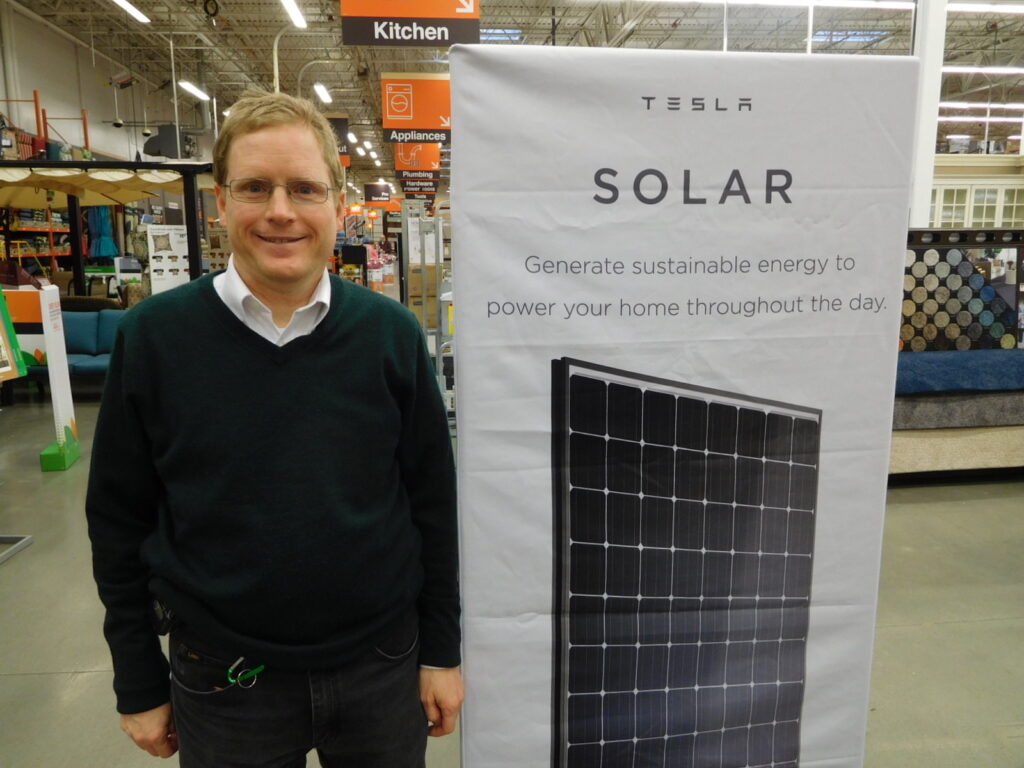
As a climate organizer, I was an enthusiastic supporter of residential solar panels for years. In the spring of 2018, I worked for Tesla Energy selling solar panels to home owners at Home Depots in the east Portland area.
Balcony solar first became poplar in Germany. According to one source, “As of late June (2025), 1,009,390 balcony solar systems were registered with the German Federal Network Agency, including more than 220,000 added in the first half of 2025 alone. Given many haven’t been officially registered, Müller says that the real figure is likely to be two or three times higher.”
Some estimates note as many as 4 million households in Germany have installed the systems, which people can order through Ikea.
The demand for plug-in solar is growing in Germany with “A quarter of Germans want solar systems on their balcony or garden” in the findings of one survey.
In December 2024, The Guardian reported, “Next in line after Germany in the solar stakes are Spain, Italy and Poland, while balcony power is gaining in popularity in France. Meanwhile, Belgium, which outlawed plug-in solar devices over fears of having unregistered systems feeding into the grid, will lift its ban.”
In May 2025, Utah enacted the first law supporting plug-in solar, and now over 30 pieces of similar legislation were introduced around the U.S. The bad news is that Balcony Solar bills were delayed in Arizona, New Mexico, Washington and Wyoming. The good news is that Plug-Solar bills recently passed the Maine and Virginia Legislatures. They now sitting on the desk of state governors of those states waiting for those governors to sign those bills into law.
The 2026 Oregon legislative session ran for 5 weeks from Monday, February 2nd to Friday, March 6th. The Oregon Constitution stipulates that “The Oregon State Legislature convenes annually in January at the State Capitol in Salem, but sessions may not exceed 160 days in odd-numbered years and 35 days in even-numbered years.” Since the even number years legislative sessions are compressed to 5 weeks, Oregon’s 90 lawmakers are allowed to introduce two bills apiece, and legislative committees can introduce three. This meant Rep. Finger McDonald would spend half of her personal political capital on this bill for the 2026 OR Legislative session. Therefore, it was vital that climate advocates, including me, showed strong support for this bill.
On February 5th, a coalition of labor unions, Oregon Food Bank, Oregon Working Families Party, environmentalists, and teachers organized a Fight for Our Future Rally at Oregon State Capitol State Park. This rally was a loud message to OR Legislators that massive federal tax breaks for corporations and the ultra-wealthy threatened funding for Oregon schools, healthcare, and other critical community services. They called on lawmakers to step up and fight for Oregon families during the session by reigning in giveaways that only enrich the wealthy.
As a climate organizer, I volunteer with Oregon League of Conservation Voters (OLCV) and Mobilizing for Climate Action Together (MCAT). I like to attend OLCV and MCAT’s lobby days at the Oregon Capitol to urge legislators to support strong climate and environmental bills. OLCV urged its volunteers like me to attend this rally on February 5th. I told OLCV that I would be there. However, I needed to find a ride since Tanya and I share my 2002 Honda Civic. She needs that car for work, and I like to carpool to Salem to network with fellow climate organizers. Plus, I don’t like to drive, especially if I can save on gas and wear & tear on my car. Oh, I like to drive less so I am not polluting the air with more carbon emissions contributing to climate change.
I found two friends from MCAT, Pat DeLaquil and Joseph (Joe) Stenger, who were carpooling to Salem on Thursday, February 5th. The catch was that they were leaving early that morning to give oral testimony for Rep. Finger McDonald’s Balcony Solar Bill (HB 4080). That bill was scheduled for a public hearing for the House Committee on Climate, Energy, and Environment at 8 am. That meant that we would have to meet at a TriMet park and ride lot at 6:30 am to beat the morning commute traffic from Portland to Salem to arrive in plenty of time for the hearing.
When I learned that Pat and Joe planned to give oral testimony for the Balcony Solar Bill, I decided to sign up in advance on the Oregon Legislative Information System (OLIS) to give oral testimony. In my many years of preparing oral testimony to give to legislators in Salem, I knew they would be limiting the public comments to 2 minutes. The day before the hearing, I drafted my testimony, printed it out, and practiced it several times with a stopwatch on my Ipad to make sure I would be comfortably under 2 minutes.
On Thursday, February 5th, I got up super early before 5 am take the bus and a MAX train to meet Pat and Joe at a southeast Portland Park and Ride lot at 6:30 pm. It typically takes around an hour to drive from Portland to Salem, depending upon traffic. The morning commute traffic was not bad to arrive in Salem around 7:40 am. That was plenty of time to try to find a place to park near the Capitol Building, pay for street parking, go through the security check point to enter the Capitol, and walk to the hearing room. The Committee meeting was held in a hearing room in the basement or now known as the “concourse” of the Capitol.
Hearing rooms and a new restaurant in the brand new “concourse” were in use for the first time during January legislative meeting days. This portion of the capitol was closed for over three years for construction for a seismic retrofit to make the Capitol Building safer in the event of a severe Cascadia Zone earthquake. When I walked into the basement hearing room, it had a glowing ultra-modern look. I heard Oregon Senator Lew Frederick say later at his monthly town hall that the new concourse committee hearing rooms looked like “something out of Star Trek.”
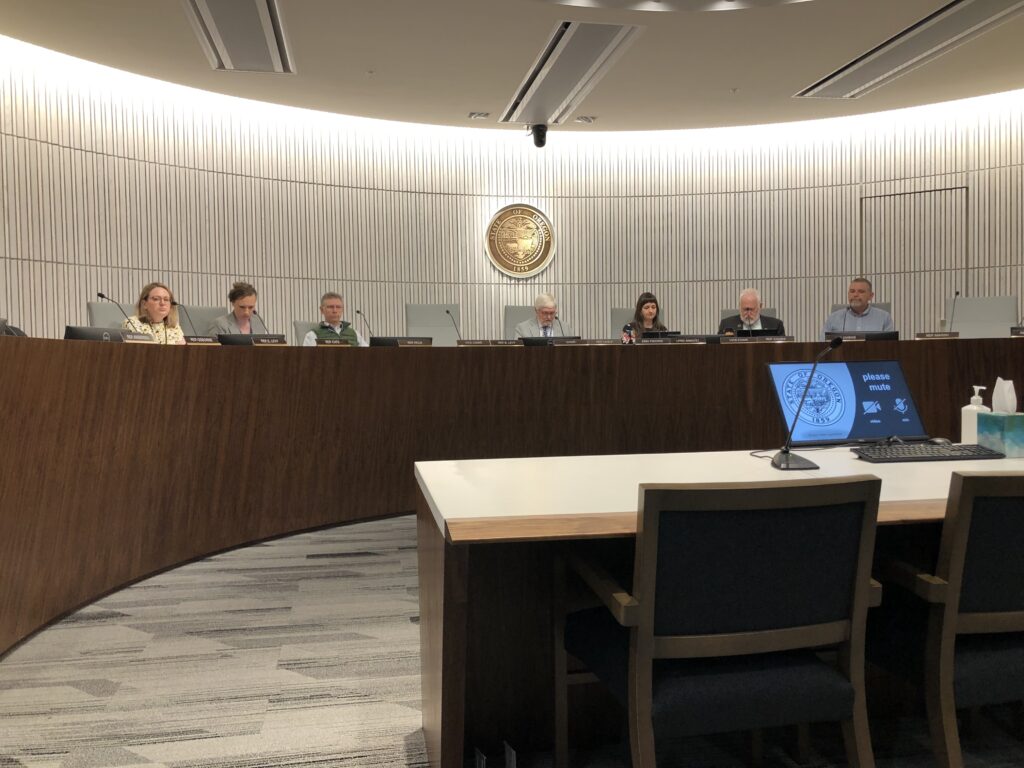
Pat, Joe, and I arrived at the Hearing Room just before 8 am. The gallery was full of people seated eager to give oral testimony for the Balcony Solar Bill. The committee hearings typically last around an hour and a half. The Committee Chair tries to keep a tight schedule so the legislators can leave the committee meetings at the end of the scheduled times to arrive in time for their next committee hearings or other scheduled meetings. The House Committee on Climate, Energy, and Environment had hearings on several other bills that morning. In addition, this committee meeting had work sessions where they voted on bill amendments and/or takes a final vote to pass the bill out of committee to the House Floor or send to a Joint Ways and Means Committee if it required state money or a “fiscal” in order for each legislative chamber to pass the bill.
The Chair of the House Committee on Climate, Energy, and Environment was Rep. John Lively of Springfield, Oregon. Fortunately, the other bills in consideration for this meeting had only a few citizens signed up to give oral testimony in person or online. The work sessions for the other bills took only minutes to complete. Thus, Chair Lively was able to open the last 50 minutes of the meeting to the Balcony Solar Bill, (House Bill) HB 4080. For the next 25 minutes, the Chief Sponsors who sat on this Committee, Reps. Sarah Finger McDonald and Mark Gamba, gave oral testimony supporting the bill and answered questions from their committee colleagues. That left about 25 minutes for the public to provide oral testimony to the committee. 15 people, including me, signed up to give oral testimony.
Chair Lively remarked that he was limiting testimony to 2 minutes to try to “accommodate the majority of people (who signed up to testify) to give them a chance to speak.”
At this point, I was not sure if there was enough time remaining for me to give oral testimony to support this bill. Not everyone who signed up in person to testify, such as my friends, Pat DeLaquil and Joe Stenger, were able to testify. The good news was that with 9 minutes left in the committee meeting, Chair Lively called my name to give oral testimony to the committee to support HB 4080, the Balcony Solar Bill.
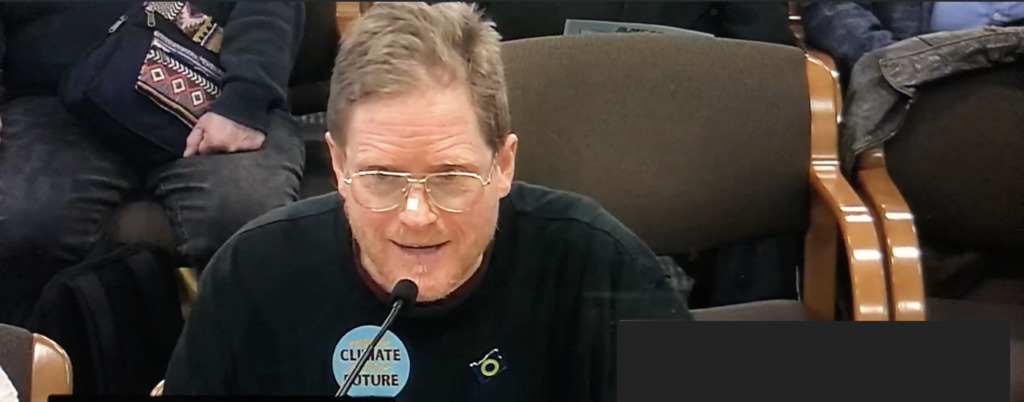
My Balcony Solar (HB 4080) Oral Testimony for February 5, 2026
Members of the Committee, my name is Brian Ettling. For the last 9 years, my wife and I live in outer northeast Portland in an apartment complex.
For many years, I dreamed of living at a location where I could have solar panels on my roof generating some if not most of the electricity that we use. I like the apartment complex where I live. They are very quick at fixing maintenance issues in our apartment. But, my apartment complex is owned by a large corporation that is not interested nor has any financial incentives to put solar panels on the roofs our apartment buildings. It’s sad because I have a perfectly exposed south facing roof that would be ideal installing solar panels.
This is why I love balcony solar. It will help renters like me. If you fully support it and fight hard to pass it, you would be following the lead of the Utah Legislature that it passed unanimously in 2025 with very strong Republican and Democratic support.
Plug-in solar opens solar to over 70% of us Oregonians who can’t benefit from rooftop solar today, such as renters and homeowners who can’t afford rooftop or have shady or unsuitable roofs. Even more, passing this bill would be a cushion against rising electric bills in Oregon.
This bill could make solar more widely available, push down the costs, and make solar even more affordable for Oregon homeowners.
If you support this bill and pass it, it will remind me of one of the happiest songs from my teenage years from way back in 1986, 40 years ago! The song was “The future’s so bright, I gotta wear shades.”
Thank you for your time!
The next day, I found the video recording of this legislative hearing on OLIS. I created my own video of my oral testimony from the OLIS video. I then uploaded my oral testimony for HB 4080 on YouTube for others to see. Here is the video:
As I wrapped by my oral testimony quoting the Timbuk 3 song “The future’s so bright, I gotta wear shades,” I put on a pair a dark sunglass. As I hoped would happen, it received a big laugh from the legislators, the audience in the gallery, and basically everyone in the room. Republican Representative Bobbi Levy loudly chuckled and enthusiastically responded, “Great visual!”
Only one other person had time to give oral testimony after me. His name was Karl Koening, President of the Oregon State Firefighters Council. He opposed the bill and legislators asked him questions about his opposition. The meeting adjourned after Karl spoke. Thus, I was lucky to speak to the committee to support this solar bill.
Unfortunately, some Oregon electricians and fire marshals gave oral testimony and submitted written testimony against the Balcony Solar Bill. They primarily cited safety concerns of the balcony/plug-in solar panels potentially causing residential fires. Sadly, the testimony from the fire marshals and electricians led to Chair Lively killing the bill later in the session by not allowing it to come to the committee for a work session or final vote.
It still felt rewarding for that chance to publicly advocate for solar power for renters like me.
My Oral Testimony for the Make Polluters Pay or Climate Resilience Superfund Bill
The same day I testified to support the Balcony solar Bill, I also gave oral testimony in support of the Make Polluters Pay or Climate Resilience Superfund Bill, SB 1541. This was a Senate Natural Resources and Wildfire Committee bill put forward by the Chair, Senator Jeff Golden.
This 2026 bill was similar to a Climate Resilience Superfund Bill that Senator Golden introduced in the 2025 Oregon Legislative session, SB 1187. That 2025 bill was referred to the Senate Committee on Energy and the Environment. At that time, the chair of the committee was Senator Janeen Sollman. She held a hearing this bill on April 7 and 9, 2025.
In writing this blog, I forgot I gave oral testimony for SB 1187 on April 7, 2025. Fortunately, I found the one minute video clip of my oral testimony I made that I posted on my social media on April 9, 2025. I created that video clip from OLIS video recording from the April 7th Senate Energy and Environment Committee hearing. While creating this blog, I posted it to YouTube. Here is the video:
Sadly, Senator Sollman did not schedule a work session for the bill, so the 2025 bill died in her committee. Senator Golden thought it was important to introduce the bill into the 2026 OR Legislative session. Even more, he made sure the bill was assigned to the Senate Natural Resources and Wildfire Committee. He was the Chair of that committee. Thus, he could schedule a public hearing and work session to guide it forward out of his committee.
The Oregonian described SB 1541 as establishing “a climate disaster fund, allowing the state to recoup the costs of responding to wildfires, droughts and heat domes and help respond and prepare for extreme weather. The bill is named and modeled after the 1980s-era federal Superfund program that requires polluters to pay for cleaning up the nation’s most contaminated land.
The ‘Climate Superfund’ bill targets multi-national companies that produce and sell crude oil, natural gas and coal – such as Exxon or Chevron – based on their historical greenhouse gas emissions. Just 32 companies have been linked to over half of global fossil fuel and cement CO2 emissions in 2024, according to a database of historical production data from 178 of the world’s largest fossil fuel and cement producers.”
The SB 1541 was modeled after the Climate Superfund Bills that already passed in states such as New York and Vermont, plus considered recently by other state legislatures.
Nearly every Oregon climate and environmental group that I volunteered with or had partnered in the past made it their top priority for the Oregon Legislature to try to pass this bill for the Oregon 2026 Legislative session. These groups included OLCV, MCAT, Building Resilience Coalition, 350PDX, Third Act Oregon, Oregon Environmental Council, and others that made up the Make Polluters Pay Coalition.
I attended the 350PDX Make Polluters Pay Action Night on January 22, 2026, to energize Oregon climate and environmental advocates to contact their legislators, sign up to give oral and written testimony supporting the bill to the Oregon Legislature, and attend the Make Polluters Pay Lobby Day in Salem on Monday, February 16th. Many of the environmental and climate groups from the Make Polluters Pay Coalition were in attendance that evening. Third Act Oregon had their own Zoom Call to organize volunteers for Make Polluters Pay on January 28th. MCAT had their general meeting on January 22nd requesting their volunteers to contact legislators to support the Make Polluters Pay or Climate Resilience Superfund bill.
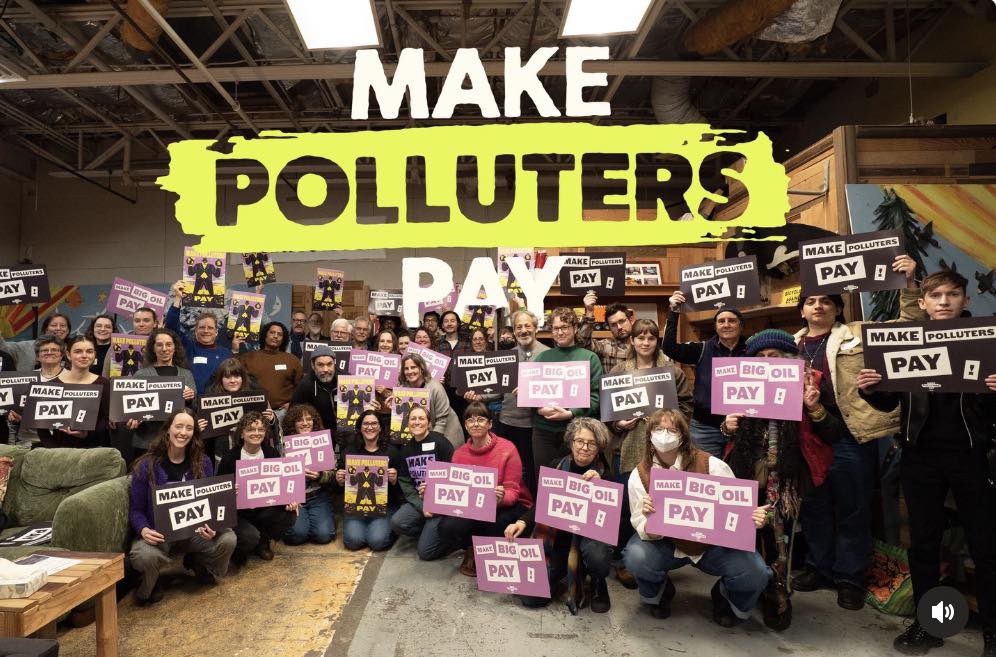
Many years earlier, I attended a training in San Francisco, California in 2012 led by former Vice President Al Gore to become a Climate Reality Leader. Thus, I have been involved with the Climate Reality Project since then. I am active in the Climate Reality Portland OR Chapter since it was founded in 2017. The Climate Reality Project had a national zoom call on January 28th to urge Climate Reality Leaders nationwide to contact their legislators to support Make Polluters Pay bills in their states.
At the beginning of February, the Climate Reality Portland Chapter asked me to give oral testimony on behalf of the chapter soon after it was announced that the Oregon Legislative Senate Natural Resources and Wildfire Committee would hold a hearing on the Climate Resilience Superfund Bill, 1541, on February 5th. They figured I would probably be in Salem that day for some kind of environmental or climate lobby day. I planned to be in Salem for the Fight for Our Future Rally at noon that day. I was happy to give oral testimony presenting the chapter supporting the Make Polluters Pay Bill at the hearing on that afternoon of February 5th. The chapter leadership scripted the oral testimony for me for me to read to the Senate Committee.
Just like my testimony for the Balcony Solar Bill HB 4080, I printed out my oral testimony at home two days before February 5th. I then practiced it several times so I was familiar with the words and to make sure I was under the typical 2 minutes allow for members of the public to give oral testimony to the legislative committees.
After I gave the oral testimony on the Balcony Solar Bill on Thursday morning, February 5th, I had time that morning to catch up on emails, have an early lunch, and wander inside the building to chat with various legislative staff. I then left the Capitol Building just before noon to walk to the plaza on the north side of the Capitol to attend the Fight for Our Future Rally. I was there at noon when the rally was supposed to start. However, the rally still had not started at noon. I talked with several organizers from around Oregon that I knew already.
I heard buzz that morning that many citizen advocates planned to attend the 1 pm hearing to give oral testimony to support the Make Polluters Pay Bill, SB 1541. Around 12:15 pm, I thought it was best for me to leave the rally, which still had not officially started yet, and head back inside the Capitol to try to get a good seat in the hearing room for the 1 pm Senate Committee hearing on SB 1541.
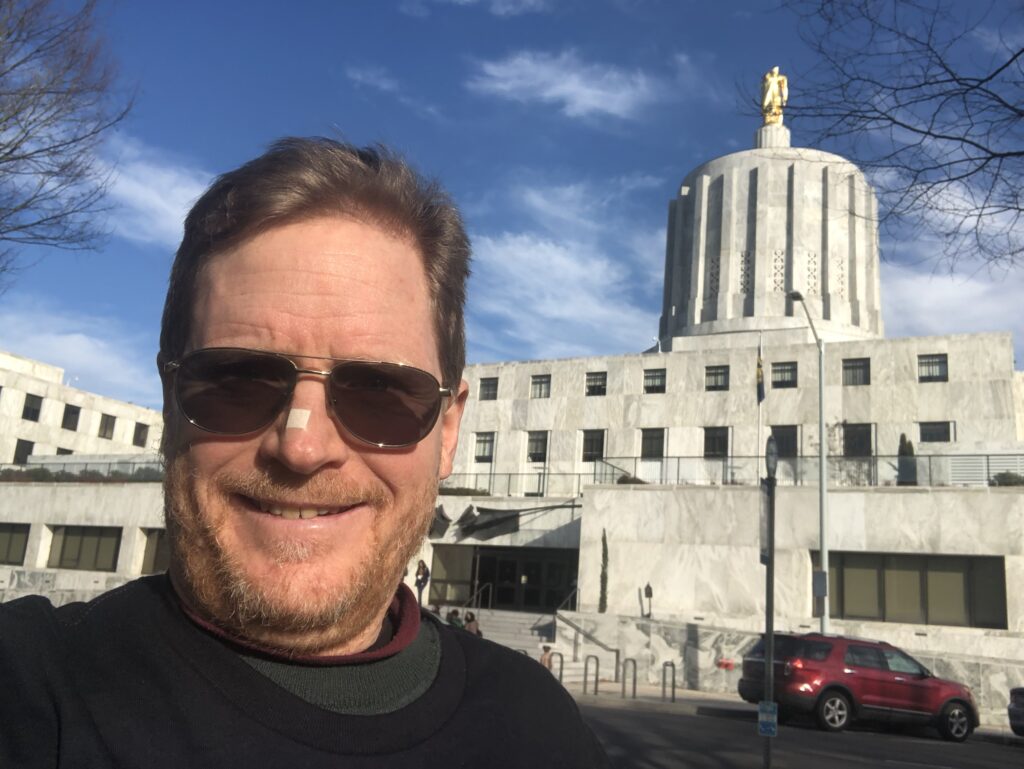
I encountered a long line of people which took around 10 minutes to get through the Capitol Security to go inside the Capitol Building. The good news was I arrived as soon as Capitol Security opened up the hearing room around 12:30 pm. I secured seats in the second row for Pat, Joe, and me. The gallery quickly filled up with citizen advocates hoping to give oral testimony on SB 1541. Not everyone would fit in this room. Capitol Security then opened an overflow room so people looking to attend and testify could still watch the hearing on a large video monitor.
As the hearing gallery filled up with advocates just before the hearing started at 1 pm, Jacqui Treiger, Senior Campaign Manager for Oregon Environmental Council, was asking for people like me who signed up to give oral testimony to say, “Due to the large number of individuals who want to speak in favor of this bill, I will defer the rest of my allotted time to them.”
Jacqui stated we had individuals who planned to speak who lost their homes to wildfires. We wanted to leave enough time for them to share their stories in their testimony. I gave oral testimony to OR Legislative committees numerous times over the years. Yet, I still get nervous when I am called forward by the Committee Chair to testify. Thus, I was relieved I could give that statement if called forward to testify to hopefully allow others the chance to testify.
A few minutes after 1 pm, the Committee Chair, Senator Jeff Golden, gaveled in for the committee meeting to start. He informed the room:
“We have a single bill to consider today: a public hearing on Senate Bill 1541. We have more people signed up to testify than we have more time to get to (them), so we have a panel in the first part of this that’s going to thoroughly explain the bill. Then I am going to be giving preference to people who are here in person and then, if we can, go to remote (oral testimony). And I always hate to say this, but we are going to be limiting testimony to 1 minute, and I know some of you have more to say than that. What’s really important to know is that we welcome your testimony in written form up to 48 hours from right now…
We know the level of interest here and we really do want to hear from you. Sorry that our time is as limited as it is.
Opening the hearing on Senate Bill 1541…
I see myself as the first name to testify and I think I am going to really limit my remarks to try to get as many people in as possible.
I will answer one question that I heard which is ‘Why do you bring a bill of this scale to the short session and my view is that in the last few years has proven that Oregon is on a path to complete disaster if something doesn’t change because of the scale of the costs of climate related damages and events, caused primarily from wildfires, of course. Those costs go into the billions already, and every indication is that they are going to increase. And unless we change direction and change our approach, I believe that Oregon local governments and special districts are headed to bankruptcy. State government itself might be headed towards bankruptcy. And what we know for sure is that Oregonians will be facing huge increases in their basis bills, primarily their insurance premiums and their utility bills. We have seen those double digit increases already and we are going to see more of them, so my view is that this bill needs to come to the table for serious consideration every session long or short until something changes.”
About one hour into the hearing, I was called up to the front by Senator Golden to give oral testimony on SB 1541. To save on time to allow others to testify, especially those who lost homes to extreme wildfires, this is what I said in 30 seconds:
“Chair Golden and members of the Committee, my name is Brian Ettling. I am speaking on behalf of the Climate Reality Portland Chapter to urge you to support the Climate Resilience Super Fund Bill, SB 1541. Due to the large number of individuals who yet want to speak in favor of this bill, I will defer the rest of my allotted time to them. Please refer to our written comments. Please support SB 1541. Thank you so much for your time.”
A few days later, I found the video recording of this legislative hearing on OLIS. I created my own video of my oral testimony from the OLIS video. I then uploaded my oral testimony for SB 1541 on YouTube for others to see. Here is the video:
I felt bad I did not read the full text of the oral testimony that Climate Reality Portland Chapter prepared for me. At the same time, I wanted to be a team player for the Make Polluters Pay coalition hoping to squeeze in as much oral testimony from advocates as possible. We especially wanted to lift the voices of the young and survivors of wildfires and other climate disasters.
When I exchanged emails with the Climate Reality Portland Chapter Chair, Helena Birecki, later that day, she sent a gracious and appreciative email. She wrote:
“I was able to (watch the hearing live on OLIS) just as you started speaking. Really appreciate you being there, And for ceding your time asking them to read our written testimony. You are wonderful.”
I will include at the end of this blog the prepared oral testimony from the Climate Reality Portland Chapter that they wanted me to read during the hearing.
The next day, Oregon Public Broadcasting (OPB), reported about the hearing, “Roughly 60 audience members, including many hoping to give in-person testimony, filled the hearing room Thursday. Overall, more than 70 people signed up to provide in-person or online testimony. Many supported the bill, with advocates ranging from local government officials and religious leaders to wildland firefighters describing the impacts of extreme weather events in their backyards.”
Unlike 2025, Senator Golden successfully got SB 1541 passed out of his committee on February 10, 2026. It passed on a party line vote of 3 to 2 with all 3 Democratic Senators in support and the 2 Republican Senators opposed. The bill went to Ways and Means where it died. I heard secondhand that Senator Golden thought it would take around $1 million dollars of state funds to enact the bill. However, at the MCAT Geneal meeting on March 25th, Ways and Means estimated the bill to cost $6 million dollars. Due to a huge budget shortfall, the Ways and Means Committee Chairs and members basically killed any bills requiring state funding or a “fiscal.” This is due to Oregon experiencing a massive budget shortfall because of the federal H.R. 1, known as the “Big Beautiful Bill.”
Senator Golden remarked at the beginning of the February 5th hearing, because of the financial damage climate change is costing Oregon each year, “this bill needs to come to the table for serious consideration every session long or short until something changes.”
Unfortunately, Senator Jeff Golden announced in February 2026 that he was not running again for his Oregon Senate seat and he was retiring from the Oregon Legislature. In his absence in future legislative session, I hope another legislator will step forward to pass a Make Polluters Pay Bill, similar to SB 1541.
I hope to be around and available to help lobby to get this bill passed in Oregon in the future. Although neither one of these bills passed the Oregon Legislature in 2026, they still gave me hope for the future. I am feeling optimism for a brighter day. It reminds me of what George Harrison sang in the Beatles song, “Here Comes the Sun,”
“Here comes the sun
Here comes the sun
And I say, ‘It’s all right’”