

“I see skies of blue
And clouds of white
The bright blessed day
The dark sacred night
And I think to myself
What a wonderful world”
– From the song “What a Wonderful World”
Song by Louis Armstrong
Songwriters: Harold Adamson / Jan Savitt / John Watson
This is my 6 part blog from 2004-2010 how the EarthBall became my symbol. I conclude these multi-part story how my April 10, 2010 photo of me with my EarthBall at Copper Harbor, Michigan with Lake Superior behind me became my favorite Earth Ball photo.
Part 1: Everglades National Park, Florida in 2004 to Crater Lake Nat. Park, Oregon in 2009
Part 2: My Pacific Northwest spring travels to living in Ashland, Oregon in Autumn 2009
Part 3: December 2009 cross country travels to spending winter in St. Louis, MO in 2010
Part 4: Seeing Door County, Wisconsin in April 2010
Part 5: Exploring the Upper Peninsula of Michigan in April 2010
Part 6: Getting my ideal EarthBall photo in Copper Harbor, Michigan in April 2010
Part 1: Everglades National Park, Florida in 2004 to Crater Lake Nat. Park, Oregon in 2009.
Since 2004, I consider the inflatable EarthBall as my symbol for protecting the environment and tackle climate change to reduce its threat on planet Earth. In 2004, I led ranger programs at the Everglades City Visitor Center in Everglades National Park. One day, the lead ranger in Everglades City, Sue Reece, brought out an inflatable Earth Ball that she said park naturalists and I could use for our ranger talks. I immediately started using it for my outdoor ranger talk or Chickee Chat called “Keep the Water Flowing” that I gave from 2004 to 2008.
Towards the beginning of my talk, I used the quote from Marjory Stoneman Douglas, who was known as “The Mother of Everglades National Park.” This was the first sentence in her landmark 1947 book, The Everglades: River of Grass:
“There are no other Everglades in the world. The are, they have always been, one of the unique regions of the earth, remote, never wholly known. Nothing anywhere else is like them…”
This ranger talk focused on the ecological damage with draining the Everglades and the federal and state efforts to restore it. I ended my talk with the Joe Podger quote: “The Everglades is a test. If we pass it, we get to keep the planet.”
I proudly held up the EarthBall in the opening and closing segments of my Everglades talks. For nearly all the first decade of the 21st century or the “aughts,” I was angry with the United States. I felt the U.S. Supreme Court decision, poor counting of votes in Florida, and the spoiler third party candidate Ralph Nader robbed Al Gore of winning the 2000 election over George W. Bush.
I was livid that the President George W. Bush and his administration ignored the warning signs of 9/11. President Bush and his top officials used 9/11 as a bogus excuse to declare war on Iraq. The invasion and occupation of Iraq turned into a mess, especially with the torture of Iraqi prisoners by the U.S. military guards at the Abu Ghraib prison in 2004. I thought George W. Bush was a dumb annoying egotistical liar. It crushed me that he was re-elected in 2004. I sat in my car and cried my eyes out when I heard the news on the radio in November 2004 that he won re-election. I felt numb in the years 2001-2007 and not patriotic. Officially, I was supposed to be non-political as a park ranger. The EarthBall gave me something to hang onto.
At that time, I liked to say that my patriotism was for the planet and did not stop at the Canadian and Mexican border. I came up with my own expressions around 2000 narrating the boat tours in the Everglades. My first was
“Think Globally, Act Daily.”
It was my own spin on the common environmental expression, “Think Globally, Act Locally.” Although I became active in the local Miami Sierra Club and attended a couple of Friends of the Everglades meetings, I did not really connect with thinking locally at that time. However, I could get jazzed though about ‘acting daily” to make a difference in the world.
The other expression I created with my time narrating the boat tours in the Everglades and reflecting on my time there was
“Each and every one of us can change the world.
We can do that by:
1. The things we do
2. The products we buy
3. The attitudes we share with each other.”
The Earthball fit perfectly with my outlook at that time. It still is my symbol today. With my lack of patriotism in the 2000s, my favorite quote at that time was American Founding Father Thomas Paine: “my country is the world, and my religion is to do good.”

Besides the Everglades, I used the EarthBall in 2006 when I began giving ranger talks in Crater Lake National Park. I would hold it up when I talked about how Crater Lake was the 9th deepest lake in the world. Plus, it is considered one of the cleanest and purest bodies of world in the world. I delighted in using my 18-inch EarthBall because it always grabbed the attention of the audience and fixed their eyes on me whenever I held it up.
Around 2006, after the Academy Award winning documentary An Inconvenient Truth premiered in theatres, I became obsessed to do something about climate change. For years, I did not know what to do. By 2008, I decided to quit my winter job in the Everglades to try to figure out some way to organize for climate action. I had no plan of action at that time.
Too distracted by traveling and wanting to date to pursue my climate change passion
I continued with my summer naturalist ranger job at Crater Lake National Park in 2008 and 2009. In between I traveled to Hawaii in October 2008. I worked at REI in November and December 2008 while visiting my parents and family in St. Louis. In February 2009, I received an offer to work at the Classroom at Crater Lake Ranger Program to provide snowshoe hikes from March to May 2009 for school groups visiting the park.
In the second week of March 2009, I started my cross-country journey from St. Louis to Crater Lake, Oregon for my seasonal ranger job. My first destination was briefly visiting my friend Tess in Phoenix, Arizona. We met when she worked as a boat captain at Crater Lake in the summer of 2005. After she left Crater Lake, we found a way to stay in touch as she worked on cargo ships in the ocean. In 2008, she got a job with the Phoenix Police Department as an Investigator. She worked evening shifts, so she was excited when I stopped her north Phoenix home and we went out for a cup of tea. We had a lovely rapport and stayed in touch after this visit. I was curious about dating her. But I am not sure how it would work or how to approach her about this since I spent my summers at Crater Lake and winters in St. Louis while she lived in Phoenix.
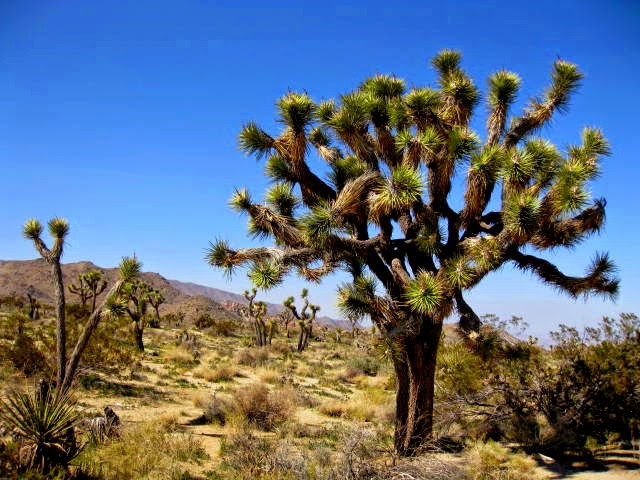
After I left Arizona, I camped a coupled nights in Joshua Tree National Park, California. In my years of working in the national parks, I wanted to see other national parks, especially on my various biannual cross-country journeys. Growing up in the 1980s, I remembered the Irish rock band U2 with their 1987 album, The Joshua Tree. The album’s theme was their fascination and love/hate relationship with the United States, American music and culture. The front cover had the band members staring at various directions on the left side of the photo with a desert on right side. The cover photo was photographed at Zabriskie Point at Death Valley National Park. No Joshua Tree appears on the front cover, but the image of the band standing by a solitary tree in the gatefold sleeve would become memorable.
The lead singer for U2, Bono, discovered a single Joshua tree standing by itself during a short road trip of desolate California locations to shoot photos for the album cover. At that time, Bono thought the Bible mentioned Joshua Tree. In fact, Mormon travelers in the mid-19th century gave the tree its common name as they traveled across the Mohave Desert. They believed the tree’s unique shape symbolized the biblical story of Joshua raising his hands in prayer.
I found the trees to have a unique picturesque beauty. They were not huge or magnetic like a Redwood or Sequoia tree, but they looked like an Oak Tree with having yucca fronds at the end of the branches, instead of leaves. I thought they made the Mohave Desert come alive and they were fun to photograph. It was another park for me where hiking and exploring brought a sense of serenity to me. A highlight for me was driving my car up to the Keys View to get a wide-open dramatic view of the desert with nearby mountains with snow on top and a view of the cities of Palm Springs and Palm Desert underneath the mountains.
Two years later, I put together my climate change evening program at Crater Lake. By then, I knew the research suggesting that by the year 2099 climate change could eliminate nearly all suitable habitat for Joshua trees in the park and its reduce habitat in the Southwest by 90 percent. I used one of my photos from Joshua Tree National Park in that PowerPoint program.
After I left Joshua Tree National Park, I had a day long drive to Three Rivers, California to stay a few days with my friend Cherie Barth who worked nearby Sequoia National Park. I knew Cherie for over 10 years. I met her around 1999 when we were both worked in Flamingo in Everglades National Park, Florida. I worked as a naturalist guide narrating the boat tours. Cherie was an interpretive ranger working out of the Flamingo Visitor Center for the National Park Service. She gave various ranger programs such as early morning guided bird walks, canoe trips, evening campfire programs, and answering visitor questions at the Visitor Center information desk. Both of us were avid bird watchers, so we enjoyed hiking and bird watching together.
When we worked in the Everglades, I had a bit of a crush on Cherie, but she always saw me strictly as a friend. Both of us stopped working in Everglades National Park around 2002, but we stayed in touch. For several years, I would visit Cherie for a couple of days when she worked in Canyonlands National Park in Utah during my cross-country drives from St. Louis, Missouri to my summer job at Crater Lake National Park, Oregon. When I visited Cherie at Sequoia in 2009, she was dating Dan who was a law enforcement officer there.
One late afternoon, Cherie and I went to a local tavern in Three Rivers for a drink and early dinner. While we were there, an attractive slender young 20 something gal walked up to a bar stool with some friends. She had a fun bubbly uplifting personality as she conversed with her friends and the bartender. Cherie noticed that the woman caught my eye and I found her attractive. Cherie loved to play matcher. She informed me that “Her name is Lizzy Bauer, and she will be working as a seasonal park ranger at Redwoods National Park that summer.”
My heart skipped a beat. Redwoods is only 4-hour drive from Crater Lake. Cherie offered to introduce us, and I gladly took her up on that. Lizzy was friendly and welcoming when I chatted it her. When she learned that I would be at Crater Lake that summer while she was working in the Redwoods, she was enthusiastic to exchange phone numbers with me. Success! Thank you, Cherie, for being a potential matcher!
As far as Sequoia National Park, I traveled there previously in October 1996 on a cross-country drive from Crater Lake to St. Louis. This would be my first time seeing the Sequoia trees in the winter. The trees looked fantastic with their massive orange girth of the bark on their trunks offset by foot or less of winter snow surrounding the base. Add in the blue sky and the bright green needles on the trees, and it was a colorful delight to see and photograph. I wore myself out hiking as much as I could to enjoy being around these enormous trees.
One of the best parts of having ranger friends is that they know where the best trails are in the national parks where they work. Cherie’s job at Sequoia was a full-time backcountry ranger issuing permits. Part of her job duties was to hike on the wilderness trails so she had familiarity for advising visitors obtaining backcountry permits. During my Sequoia visit, Cherie suggested that I drive my car to hike at South Fork, located at the southwest corner of Sequoia.
The next day, I followed Cherie’s advice to hike at South Fork. It was a long winding steep uphill Forest Service road from the Three Rivers area that led to the parking lot. From the South Fork parking area, I chose to hike on the Lady Bug Trail three miles one way to the Garfield Sequoia Grove. I did not see anyone else on this trail. It was a true hidden gem to immerse myself in this wilderness forest and admire this hidden Sequoia grove. I am not sure now why I did not take any photos that day. Maybe I just wanted to enjoy the solitude of the wilderness and the majestic beauty of the Sequoia trees. I saw very few people that day and the Garfield Sequoia Grove felt like a natural sacred temple with mammoth columns of these bright orange trees. I could not wait to meet up with Cherie that evening to tell her about this experience and thank her. She was thrilled for me because it was one of her favorite areas in the park.

I arrived at Crater Lake National Park on March 21, 2009. The calendar said it was the official start of spring, but it was 3 more months of winter at Crater Lake. It was fascinating to see the tremendous amount of snow on the ground, enough to completely cover some of the buildings at Crater Lake Rim Village. I led snowshoe walks for school groups as a park ranger in that spring. I did not like the directive by the Classroom at Crater Lake Director to teach the students how to use GPS electronic devices. However, I loved teaching the students all about the snow, showing them how to sled down hills on their backs, and challenging them to try to hit me with snowballs at the end of my programs. Overall, it was one of the most fun jobs I ever had.
I had a great team of ranger colleagues working with me at Classroom for Crater Lake, Ross Studlar and Lise Wall. Ross was very tall, lanky, soft spoken, but with a great sense of humor. He was a very talented cartoonist, illustrator, and artist. Lise Wall was also slender but shorter than me had long flowing brunette hair down to her waist and a soft whispering voice. She was proud of her Norwegian heritage and advised that her name Lise be pronounced with a soft S sound. Her name was definitely not pronounced Lee-za or Lease-za.
Lise relished and appreciated my sense of humor. I could always count on her to laugh at my jokes. Or, at least, grimace at me with a painful smile when she did not think I was funny. There seemed to be a latent attractive chemistry between Lise and me. I did not want to pursue her romantically though since we were colleagues working in a very small group. I felt like I made a friend for life though. Lise would talk about how she spent her summers working at the Illahee Fire Lookout, located on an hour and a half drive west of Crater Lake. She described it in such glowing terms that she had me curious to see it. I asked her if I could visit her there during the summer. She was delighted with the possibility that I would come visit her that summer.
The three of us would regularly get together for dinner. We enjoyed each other’s company and our teamwork to make Classroom at Crater Lake a success for the spring of 2009.
The worst day of my job was when I led a ranger snowshoe hike on the Crater Lake Rim with a small group of rural high school students and their adult chaperones from Red Bluff, California. The adult leaders of the group and I got into a heated argument about the reality of climate change as well as allowing guns in the national parks. The students did not know what to think as we debated global warming and other issues.
One guy missing several teeth from what looked like poor dental hygiene habits kept insisting that I was wrong about everything. Another group leader and I had a huge disagreement about the Pacific Ocean Garbage Patch. I had just read a 2008 book, You Are Here: Exposing the Vital Link Between What We Do and What That Does to Our Planet by author and journalist Thomas M. Kostigan. It was frightening to read in that book and with other news stories of that time about the environmental threat and damage of the Pacific Ocean Garbage Patch.
The adult leader refused to accept the Pacific Garbage Patch was real because he could not see it on the Google satellite images. The adults believed that humans cannot harm the planet. They thought it was too big and we are too insignificant to do that. My knowledge about climate change was very limited at that time, outside of seeing the 2006 documentary An Inconvenient Truth and reading the companion book. I also watched the 2006 HBO documentary Too Hot Not to Handle: Global Warming Is the Most Urgent Threat Facing Humanity Today. The HBO documentary interviewed several climate scientists about the threat and consequences of climate change. When I worked in Everglades National Park, a friend recommended the 2006 Elizabeth Kolbert book, Field Notes from a Catastrophe: Man, Nature, and Climate Change. I probably had read other books about climate change at that time.
Yet, I felt I was not knowledgeable and had the weak responses when they kept pushing me that climate change was not real. I knew then I needed more training, knowledge, and organizational support to be more comfortable talking about the science, evidence, threat, and solutions to climate change. Yet, I did not know at that time where to get this information or any groups to join to become a better climate advocate. All I could do at that time in 2009 was to keep working as a Crater Lake park ranger and keep my eyes and ears open for any opportunities.
To read more of my story, stay tuned for Part 2 of this blog: My Pacific Northwest spring travels, my summer at Crater Lake National Park, and living in Ashland, Oregon in Autumn 2009.
