What do Hummers and Obesity have in common?

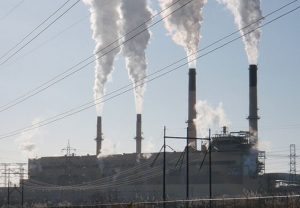
Meramec Coal Plant, location Oakville, Missouri. Image Source: sierraclub.org

In one word: everything.  In a nutshell, we humans are changing the planet’s climate by releasing over 30 billion tons of carbon dioxide each year.  We release all this carbon dioxide by burning fossil fuels (oil, coal, and natural gas) to drive our cars, obtain electricity for our homes and businesses, deforestation and to maintain a very consumptive lifestyle.  This is clearly not sustainable for our planet and our children.  I will never forget reading in the November/December 2002 issue ofSierra Magazine a short article, “Using up the Planet.”  In the article, researchers at Redefining Progress noted that

“In the early 1960s, humans used up 70 percent of the earth’s productive capacity.  By the 1980s, we started to exceed nature’s annual output. In 1999 we were using 125 percent of capacity. At this rate, says lead researcher Mathis Wackernagel, ‘we may have to prepare for ecological bankruptcy.’”

Affluent societies like, the United States, over consumption of the planet’s resources has lead to owning questionable status symbols like GM Hummers and other SUVs, ‘McMansion’ type houses, super large flat screen tvs, and other electronic gadgets.  The outer consumption that leads to climate change though does not end there.

This massive over consumption of resources also extends to our bodies.  In the United States, too many people are eating way too many fatty and unhealthy foods.  According to the US Center for Disease and Prevention, over one third of Americans are overweight and another third are obese.  Just as we may be stripping the planet of our natural resources, excessive over-eating can much damage to our bodies.  It increases health risks such as heart attacks, strokes, diabetes, and even shortening life spans.  An August 25, 2009 edition of USA Today reported that “extremely obese people (over 5% of the US population) — those who are 80 or more pounds over a normal weight — live three to 12 fewer years than their normal-weight peers.”

Overeating is the opposite side of the same coin as climate change.  This has been a central thought of mine ever since I saw a segment on Jamie Oliver’s Food Revolution show on ABC network in April, 2010.  Chef and media personality Jamie Oliver traveled to Huntington, West Virginia, one of the unhealthiest cities in America, to try to convince the locals to eat healthier.  He has a really hard time making the case to a central figure on the town, ‘Rod the Dawg,’ a local radio talk DJ.  With a very creative message, Jamie takes Rod to a local funeral home to show the extra large caskets in the funeral home.  Jamie’s point: as Americans have increased in girth, funeral homes had to respond by creating larger caskets.  You can watch the show segment here:

For human beings to live sustainable with our planet, we are going to have to forgo the Hummers and greatly reduce the intake of those fatty foods.  Exercise and fresh air should be more valued than TV.  Public transportation, bicycling, and walking should be more of a status symbol than a Hummer.  Caring for the planet also means caring for the way that we treat our bodies.


Extending an Olive Branch to a Climate Change Advesary

Image Source:
http://peace.mennolink.org/clipart.html 


I will never forget my mentor Steve telling me, “There is only one way can deal with your enemies, you engage them.”

His point was ignoring people never inspires them to change.  The best way to reach your adversaries is through conversation.  My friends have huge debates how to engage those who reject the science of climate change and spread misinformation.  Some friends like to engage them in a vigorous debate.  Other friends, citing evidence of prominent reports such as Global Warming’s 6 Americas Report in May 2011 and The Psychology of Climate Change Communication, point out that it can be a huge waste of time to engage people who are completely dismissive of the science of climate change.

I agree more with those who say it is a waste of time to chat with people who are so hostile to the message of climate change.  I have even said so many times myself: The hardest substance in the universe is the human mind.  Once a mind is made up, it can be impossible to change it.”  Thus, I try not to engage closed minded skeptics about climate change.  I have had little success changing their minds.
However, last Sunday evening, I saw an opening to engage my enemies that hopefully would make Steve proud.  I read Brian Merchant’s article from May 12, 2011, “Do Climate Skeptics change their mind?”  In the article, Brian asked Anthony Watts, the meteorologist who runs a very popular climate-skeptic blog, Watts Up With That, what could lead him to accept climate science. A “starting point for the process,” he said, wouldn’t begin with more facts but instead with a public apology from the high profile scientists who have labeled him and his colleagues “deniers.”

Below is the letter I sent to Anthony on his website.  I never did hear back from Anthony.  No surprise.  That did not bother me.  He probably receives plenty of e-mails.  Or, he could have been suspicious about the intent of my e-mail.  That’s his judgment call.

The only disappointing response was when I posted the letter on the Facebook page “Global Warming Fact of the Day.”  Overall, the feedback was very negative from the group about my attempts to reach out to Mr. Watts.  I received responses, such as “No reason to believe that ‘nice’ might work with psychopaths,” “Abandon “denier”? OK, sure. I’ll try to consistently use “denialist” instead,” “(Anthony Watts) is a hack, as well as a cultist who is a clear and present danger to civilization.” and “Walks like a denier; talks like a denier; quacks like a …”

Somehow, they thought I had grand delusions I could change Anthony’s mind over night.  Nope.  I even expressed that in the letter.  However, I saw an opportunity to extend an olive branch.  Anthony stated in the article that he could be more open to the science if prominent people apologized for using the term “Deniers.”  I decided to call his bluff on this.  Anthony decided not to take up my challenge.  Oh, well.  Life goes on.  There was no harm in trying.

I think Steve would be proud of me also for taking this action.  I did an engage an enemy, in a peaceful way with an open heart.  I remember Steve once telling me when it comes to doing the right thing and saving nature, that “At the very least, you have to try.”  Steve, I salute you for teaching me to be a peaceful warrior for the planet.

Mr. Watts:
I just read the article from Slate by Brian Merchant, “Do Climate Skeptics Change Their Minds?” from May 12, 2011. I really enjoyed the article. In the article, the author, Brian Merchant, I asked you what could lead you to accept climate science. Your response: ‘A “starting point for the process wouldn’t begin with more facts but instead with a public apology from the high profile scientists who have labeled you and your colleagues ‘deniers.'”
I thought this was very intriguing. I really try hard not to use this term, since you and your colleagues do find the term so offensive. I am extremely concerned about climate change and I do speak out in the St. Louis area about this issue. I recently went to AGU this past December and met so many top climate change communicators and scientists. I really enjoyed getting to know them. Any chance that if I approached them about dropping the term “deniers” and apologizing to you for using it, would you be more open to hearing about the science of climate change?
Unfortunately, there seems to be an incredible amount of animosity between you and the other side. They may need you to apologize for some things said also. Any chance you are willing to meet them halfway if they are willing to drop the term “deniers”?
I am extremely concerned about the health of the planet with burning so much greenhouse gases. I really do not like all the pollution it creates for the cities and rural areas. I am really concerned about the future of the planet we are leaving behind for my nieces & nephews, the children of the planet, indigenous people across the world, and poor people living at sea level by all of us dumping such copious amounts of carbon dioxide in the atmosphere. I am very skeptical we can maintain civilization as we know it by our heavy reliance of fossil fuels. As I heard Dr. Richard Alley say in ‘Earth the Operator’s Manual, “We are burning through fossil fuels a million times faster than nature created them for us. Sooner or later they are going to run out.”
I just ask that you read this letter with an open mind and heart. I realize you have invested a lot of time and energy in ‘WattsUpWithThat.’ For the sake of my nieces & nephews, the children across the world, indigenous people across the world, and folks in poverty who may be in biggest harm’s way to the consequences of climate change, I ask you for a more civil and open dialogue for those you disagree with about climate change. I am more than willing to help you with these efforts, starting with not using the term “deniers” myself and encouraging others I know not to use that term also.
I wish you peace.
Sincerely,
Brian Ettling

The Silence that Speaks to Us

            I have a friend and mentor, Steve, who was a ranger in Everglades National Park in Florida.  In his spare time, he would drive up to a scenic overlook.  He loved to sit there and look over the beautiful scene of a saw grass prairie.  It looks like this.  One occasion, when he was there for a time, a park visitor drives his car up to the nearby parking lot.  The visitor grabs his camera from the car and quickly runs to the overlook.  When he gets there, the visitor felt disappointed in the lack of action and the flatness of the plain saw grass vista.  So he mumbles, “Nothing.”  Steve smiled at him.  He looked at the scene, stretched out his arms, and proclaimed, “Everything.”
 
            For the past 20 years, I work in our nation’s national parks.  During that time, I notice that many park visitors do not take enough time to appreciate and enjoy these spectacular areas.  According National Park Service surveys, the average visitor spends about four hours visiting at national park.  Of those visitors, eighty percent of their time is spent inside their car driving around the park.  Those folks spend the remaining time outside their car using the bathroom, getting food, and buying souvenirs.
            My focus today is to encourage you to spend more time in nature.  We need to do this for three reasons:  for inter peace to balance the turmoil in our world, for renewal from the stress and demands of our own lives, and because nature can actually give us guidance on how to live our lives.
            First, as we all know, the chaos in the world is very intense right now with war, recession, terrorism, gas prices, and other problems.  It is so important not to let these problems overwhelm us.  Anne Frank, the teenage girl who was a victim of the Nazi Holocaust almost seventy years ago, wrote in her famous diary on February 23, 1944.
“The best remedy for those who are afraid, lonely or unhappy is to go outside somewhere where they can be quiet, alone with the heavens, nature and God.  Because only then does one feel that all is as it should be…amidst the simple beauty of nature.
 
 In the year 2012, nature can still provide comfort for us when it seems like the world is aiming for us.
            Second, we need to spend quiet time in natural areas not just to escape from the outer problems of the world.  We also need to spend time in nature to refresh ourselves from the stress and obligations of our own lives.  Our own lives carry the demands of paying bills, work, family, school, and even preparing speeches for tonight.  Nature can give us a temporary peace and courage to face our problems.
“Everyone needs beauty as well as bread, places to play in and pray in, where nature may heal and give strength to the body and soul alike.”
 
The beauty of nature can provide hope and inspiration for our stressful lives.
            My third point, not only can nature uplift us from the anxiety of the world and our own problems; nature can also teach us how to live and function in the world.  As you spend some quiet time in nature, you will hear your inner wisdom.  You may even be open to the beauty of the scenery speaking to you.  As John Denver sang over thirty years ago:
 “But the Colorado Rocky Mountain high,
   I have seen it rain and fire in the sky
   You can talk to God and listen to the
   casual reply
   Rocky Mountain high, Colorado…”
            I can hear what you are thinking right now.  Brian, I do not have time or money to travel to the Everglades, the Rocky Mountains, Yosemite or other wilderness areas.  However, the beauty is you do not need to leave St. Louis to enjoy nature.  A walk in nearby Power Valley State Park can be quality time in nature.  If you have woods behind your house, take advantage of them.  My favorite activity is go hiking in nearby Bee Tree County Park that overlooks the Mississippi River.  You do not need much time either.  Just ten minutes in a natural area will do a world of good for you.
           Now we have talked about how spending time in nature can provide inner peace, renewal and guidance for our lives.  Before I end my speech, I want to share a story how spending time in nature can also help us develop our sense of humor.  One day a man was walking in the woods when he thought he heard the voice of God.
The man said, “God, can I ask you a question?”
God said, “Sure, go ahead.”
The man said, “God what is a million years to you?”
God said, “Well, a million years is as a second to me.”
The man asks, “What is a million dollars to you?
God says, “To me, a million dollars is as a penny.”
So the man asks, “God can I have a penny?”
God says, “Sure, just a second.”
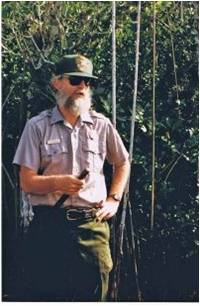
Spending time in nature can be the silence that speaks to us, even providing us with a sense of humor.  Unfortunately, my friend Steve passed away over four years ago from cancer.  All I have left of him is this picture, as well as his wisdom, humorous stories, and his love of nature.  Steve would want me to conclude my speech tonight saying,
“Spending time in nature even if it is a saw grass prairie, is not NOTHING, it is EVERYTHING.” 


EXPAND YOUR PATRIOTISM!

It was a late at night and a policeman was responding to public disturbance.  The officer tried to break up the scene by asking a scruffy instigator, “Where do you live?”
The middle aged shabby man responded, “I live on 8th Street.”
The policeman inquired, “What is your address?”
The untidy man then hemmed and hawed, but he would not give a direct answer.
The cop then barked, “Look, are you a transient?”
“No!” the homeless man defiantly responded, “I AM AN AMERICAN!”
This is a true story on the TV show COPS eighteen years ago.  The man in that story may have been homeless and down on his luck.  However, he was still proud to be an American, just like all of us are here tonight.
America has been so wonderful for me also providing me a free public education, allowing me to work as a ranger in the national parks, and the freedom to travel about the country and world.  Even though I am proud to be an American, I am here tonight to say that my patriotism does not end at the Mexican and Canadian border.  That is where it begins.  I am even more patriotic for the planet, for our spaceship Earth.  It is our home.  Without it, none of us would be here.  My focus here tonight is to inspire you tonight to care for our planet.  Just like you love America, you want to be patriotic for the Earth because it is UNIQUE, SMALL, AND OUR SACRED HOME.
How unique is Earth?  According to the September 12, 2011 edition of National Geographic News, astronomers have now discovered over 600 planets outside our solar system.  As far as scientists can tell, Earth is still the only know planet that can support life for you and me.
  
Author Paul Hawken tells a fascinating story in his 2007 book Blessed Unrest.  Recently, Paul and I even corresponded directly about this story which I think demonstrates how unique the Earth is.  Sixty chemical engineers from a very prominent chemical company were divided into four teams.  Each team was to design a spacecraft that would support life for 100 years.  In this competition, the spaceship would have no size limit, no trap door or way to throw anything away, but it could receive light.  The four teams would present their spaceship.  Everyone would then vote for the best spaceship where they would want to live.   The winners brought no company products.  In fact, they shunned them.  They grew their food organically on the ship, without using the company pesticides.  The other ships brought videos and dvds to entertain themselves.   However, the winners took diverse people on board, such as storytellers, artists, singers, dancers, (and possibly TOASTMASTERS!).  After that, several quit their job at this chemical pesticide company.   They started an organic garden.  To me, this story says you just cannot beat spaceship Earth as a unique home.
My second point: Besides being unique, like the song says: IT REALLY IS A SMALL WORLD AFTER ALL!

According to NASA, the circumference or distance around the earth is almost 25,000 miles.  That is extremely small when you realize that the average American drives their car over 13,000 miles a year, according to the U.S. Department of Transportation.  If you do the math, this means the miles you will drive in your car in less than 2 years for all purposes will equal the distance around the earth.
Renowned scientist Carl Sagan used to say that “If you had a globe covered with a coat of varnish, the thickness of that varnish would be about the same as the thickness of the earth’s atmosphere compared to the earth itself.”
Basically, the atmosphere that surrounds us on the planet is extremely miniscule.  The habitable part of the planet where humans can tolerate continuously living appears to be up to 18,000 feet elevation.  This is less than 3 and half miles.  That is less of a distance than probably most of us drove from our house to this Toastmasters meeting tonight.
But, Hey!  We have a big problem right now.   We are treating the small livable part of spaceship earth, our atmosphere, as an unregulated SEWER to dump our vehicle and industrial wastes.  Currently, carbon dioxide emissions are roughly 36.7 billion, with a B, metric tons a year.  Throwing this much carbon dioxide into our atmosphere is really no different than me lighting up a cigarette in this room.   Even more, imagine that you were swimming in a beautiful Olympic size swimming pool.  Then you saw someone peeing into the pool.  Then you saw another person peeing into the pool.  Then another.  And another.  At way point would you yell at the top of your lungs, “STOP PEEING IN MY POOL!”

Fortunately, we can find ways to stop polluting our small spaceship earth.  All this carbon dioxide is thrown into our atmosphere by burning mass qualities of coal, oil, and natural gas.  The good news is that there are alternative ways to obtain our energy such as solar, wind, geothermal, bio fuels, and even nuclear to reduce the pollution of our atmosphere.  Even you can do your part to pollute Spaceship Earth less by driving slower, driving less, and looking for ways to be more energy efficient in your home or business.
Now we just talked about how earth is UNIQUE, SMALL, AND WE ARE POLLUTING IT WAY TOO MUCH.  However, my goal here tonight is to get you to EXPAND YOUR PATRIOTISM.  May your love for America also be expanded to a love for our planet.
 
I want to inspire you to think of the earth as SACRED by giving you a gift here tonight.  Please feel free to open up the envelope placed in front of you.  What is it?  It is a little blue marble.  Now I want you to take that little blue marble between your fingers and stretch out your arm as far as it will go.  This is approximately what spaceship earth, our home looks like from a million miles out in space – a blue water planet
I first read about the little blue marbles in this December 2011 issue of Outside Magazine.  SEA turtle Biologist, Wallace J. Nichols, who is pictured on the cover, originated the idea of giving away the blue marble.  Wallace even friended me on Facebook recently.  If Dr. Nichols was here tonight, he would want us to know that if water was inside the marble, the marble would contain virtually all of earth’s elements.  Most importantly, he wants you to think of someone who is doing good work for the planet.  Then, imagine how good both of you would feel if presented them with this marble saying ‘thank you for caring for the earth’.

Again, my focus here tonight was to inspire you to care for our planet.  Whether we are that homeless man causing a disturbance, a policeman or a millionaire, we all have been blessed to live in America.  What a great county!  With all the benefits of living here, it is very easy to be patriotic.  However, there would be no United States of America without sacred planet Earth, our home.  I now want to encourage you for EXPAND YOUR PATRIOTISM FOR THE PLANET.   As American writer and activist Henry David Thoreau said so beautifully in 1851, “What is the use of a house, if you do not have a decent planet to put it on?”

A MESSAGE THAT STICKS

What is the most effective way to communicate with people about climate change?  Even more, how can we inspire people to take action to resolve climate change now?
I found a great answer to this question over a month ago when I attended the American Geophysical Union Conference in San Francisco.  I heard many fabulous presentations about how to communicate climate change effectively.  The best message that still “sticks” in my mind was by Dr. Edward Maibach, the Director of The Center for Climate Change Communication at George Mason University.
Dr Maibach made the case for this formula for effective public communication:
“Simple clear messages, repeated often, by a variety of trusted sources.”
 
Even better, he then showed what this simple clear message is.  It is a beautiful message because it can be repeated often.  Furthermore, one can easily back up this message with a variety of trusted sources, such as NASA, NOAA, American Meteorology Society, all US Military Institutions  (Army, Navy, Air Force, & Coast Guard), and all 32  US & Worldwide Science Academies.
Dr. Maibach then boiled it down to Five messages about global warming – identified through audience research – that you may wish to convey:
 
•      Climate change is real.
 
•      People are causing it this time.
 
•      There is widespread agreement among climate scientists; more than 95% of scientists are convinced of the above two points.
 
•      It is harmful to people.
 
•      People can limit it, if we choose to.
 
As a climate change communicator, I struggle with communicating climate change quickly, succinctly and in a manner that it easy for me to say.  Even more, I think this is a “sticky” message that is easy for my audience to remember.  Hopefully, other climate change communicators can easily repeat this message to their audiences to spread the message.
Dr. Maibach discovered this technique of effective “sticky” messages from the book, Made to Stick: Why Some Ideas Survive and Others Die by Chip & Dan Heath.  In my correspondence with Maibach and another friend, Tom Smerling, it was highly recommended that I read this book.  I was so impressed with Dr. Maibach’s presentation about effective climate change communication and The Five Messages about Global Warming – that you may wish to convey that I bought Made to Stick yesterday.
I felt like I just found an excellent “sticky” tool to enable me to be a more effective climate change communicator.  I hope this “sticky” tool helps you too.

MY 12 CLIMATE CHANGE HEROES

Let me introduce you to climate change communicators and scientists who are inspiring me to be a climate change communicator.  These folks generously allowed me to have my picture taken with them.  They are not household names.  Most people would not recognize them walking down the street.  Most people would prefer to have their picture taken with a famous movie star, sports athlete, or politician.  On the other hand, below are some of the people I met, who are effectively communicating this message:
• Climate change is real.
• People are causing it.
• Widespread agreement among scientists (more than 95%) that it is happening right now because of humans.
• Climate change is harmful to people.
• Humans can limit the most dangerous consequences if we choose to act now.
1. Dr. Gavin Schmidt 
He is a climate scientist at the NASA Goddard Institute for space studies.  He is also a cofounder of Realclimate.org, where he is a contributing editor.  I got to meet him this past September when he presented at the NASA & National Park Service Earth to Sky Conference V: Communicating Climate Change in Washington, D.C.  After his presentation, all the participants in the conference, including me, received a free copy of his book: Climate Change: Picturing the Science.  He kindly autographed the book for me.  I enjoyed reading it this past autumn.

2. John Cook
(pictured in the center) He is the creator of skepticalscience.com.  This website makes climate science accessible to the layman by using easy to read, jargon-free language to debunk climate myths spread by climate science doubters or “skeptics.”  Even more, John set up Skeptical Science to be a database of peer-reviewed science to best answer the skeptic’s full range of arguments.  (And nobody, including John, knows why he is holding that paper plate)


3. Dr. James Powell
(pictured on the right) He is the author of six science books, including, Dead Pool: Lake Powell, Global Warming, and the Future of Water in the West.  He has a website, jamespowell.org where he writes about global warming from his perspective as a scientist.  I met John Cook and James Powell at a party in Berkeley, California in December, 2011 while all of us were attending the American Geophysical Union (AGU) conference in San Francisco.
4. Kaitin Alexander
At the same party in Berkeley, I got to chat with Kaitin.  She is already a rising star at just 19 years old.  She is a student at the University of Manitoba, Canada, studying climate modeling and is an aspiring climatologist.  Her blog, ClimateSight, was highly praised and is closely followed by the other climate communicators who attended AGU.
5. Peter Sinclair
He also attended the same party in Berkely.  His blog, desmogblog.com and hisYouTube series, “Climate Denial Crock of the Week” is also an excellent tool to directly debunk climate myths spread by climate science doubters.
6. Dr. Richard Alley
I got to meet him at AGU in San Francisco.  He is a Professor of Geosciences at Penn State University.  He is known for his research of glaciology and ice sheets.   I love his PBS documentary, Earth: The Operator’s Manual.  I am currently enjoying reading his book by the same title.  He also signed a copy of his book for me when I met him.
7. Dr. James Hansen
I got to meet him via Kaitlin Alexander.  She told me where he was lecturing during the AGU conference.  Kaitlin and I attended his lecture.  Afterwards, we had the incredible fortune to chat with him directly.  He is head of the NASA Goddard Institute for Space Studies and he is famous for testifying before Congress on climate change since the 1980s.  I enjoyed reading his book Storms of My Grandchildren two years ago.
8. Dr. Naomi Oreskes
While waiting to chat with Dr. Hansen, I got to meet Dr. Oreskes.  I just finished reading her book, Merchants of Doubt.  It meticulously documents how a small group of contrarian scientists spread doubt and confusion after a scientific consensus had been reached on the dangers of tobacco smoking, acid rain, the hole in the ozone, and climate change.
9. Tom Smerling
My friends, Sundae Horn and Rob Temple, who I used to work with in the Florida Everglades introduced me to Tom.  He created the website, Climate Bites.  This website is an online toolkit for climate change communicators, like me.  It brings fun into climate communication with metaphors, sound bites, humor, stories and graphics that help make your message stick.  I personally enjoyed contributing “bites” or short essays to this website since I met Tom last October.
10. Dr. Richard Somerville
I also met him at AGU last December.  He is a climate scientist and Distinguished Professor Scripps Institution of Oceanography at the University of California, San Diego.  I first saw him on the HBO special on climate change in 2006, Too Hot to Handle.  Dr. Somerville and other scientists interviewed, such as Dr. Stephen Schneider, had a deep impact on me with their sobering statements on the problem of climate change and the nasty consequences if we fail to act.  Dr. Somerville is also the Science Director of a great website, Climate Communication.  He collaborates on this website with Susan J. Hassol, Director of the Climate Communication, on the latest information on climate science communication and outreach.
11.Dr. Benjamin D. Santer
I also met him at AGU last December.  He is a climate researcher at Lawrence Livermore National Laboratory and former researcher at the University of East Anglia’s Climatic Research Unit.  He wrote the key statement in the 1995 United Nations Intergovernmental Panel on Climate Change (IPCC) report that “the observed trend in global mean temperature over the past 100 years is unlikely to be entirely natural in origin…Taken together, these results point towards a human influence on global climate.”  That statement resulted in a firestorm of vicious attacks from climate change contrarians, such as physicist Dr. Fred Seitz.  However, Dr. Santor stood firm behind what he wrote.  Many other distinguished climate scientists, such as Dr. Stephen Schneider, defended him.   The statement has since stood the test of time.  Since then, it has been reaffirmed by more recent IPCC reports.
12. Larry Lazar
I first met Larry at a St. Louis Science Center café last April.  We both attended a lecture by Jim Kramper, Warning Coordination Meteorologist with National Weather Service, on “Climate Change – What We Really Know.”  This winter, Larry and I co-founded the meet up group, Climate Reality St. Louis.  Our group focus is to exchange ideas on how we can locally and individually reduce our impact on climate change.  We had 14 people at our first meeting last December 11th.  We hold our next monthly meeting this Sunday, January 15th.
There are so many other climate heroes I want to mention.  A special mention needs to go to Scott Mandia.  I met him through Larry Lazar.  He is a professor of meteorology at Suffolk County Community College in New York.  Scott is also the founder of the Climate Science Rapid Response Team.  This is a group of scientist researchers and professors who are on call to “matchmake” media and lawmakers to climate scientists.  This group enables the media and lawmakers to receive rapid high quality information when they inquire on climate change.
It was also such a pleasure to interact with Scott at AGU.  He even bought me breakfast at my first morning of the conference.  Somehow, I let the opportunities at AGU slip away to get my picture taken with him.  Scott Mandia, James Powell, Tom Smerling, and Professor John Abraham from the University of St. Thomas also took me out for a fantastic sushi dinner while I was in San Francisco in December.  Needless to say, I am having a fabulous time meeting climate scientists, professors, and communicators who as just as passionate about climate change as me.
Stay tuned.  I cannot wait to meet and have my picture taken with my more climate heroes in 2012.  I will make sure I post on my blog when I meet them and have my picture taken with them also.

A LITTLE BLUE MARLE COULD SAVE THE EARTH

According to sea turtle biologist, Wallace J. Nichols, this little blue marble could inspire people to take meaningful action to protect our planet.  Outside Magazine featured Dr. Nichols in its December 2011 cover article, “The Outside Guide to Fixing the World” by Michael Roberts.
This article inspired me so deeply that I gave my nieces and nephews a little blue marble for Christmas recently.  Even more, this little blue marble will be featured prominently in my next Toastmaster’s speech at the end of January.  My speech is called, “EXPAND YOUR PATRIOTISM.”  The theme of this speech is caring for the earth and eliminating pollution is patriotic for the planet and America.
Nichols estimates around a million of his blue marbles are in circulation around the world.  They have made it into the hands of Dr. Jane Goodhall, Harrison Ford, James Cameron, E.O. Wilson, and four-time Iditarod champion Lance Mackey, who carried one in this year’s race.
The concept of the blue marble is simple.  If Nichols was standing in front of you, first you would take the little blue marble between your fingers and stretch out your arm as far as it will go.  This is approximately what spaceship earth, our home looks like from a million miles out in space – a blue water planet.
Then, he would want you to hold it up to your eye and look at the sun.  If water were inside, the marble would contain virtually all of earth’s elements.  Finally, think of someone who is doing good work for the planet.  Hold the marble to your heart: think how it would feel to you and them if presented them with this marble as a way of saying thank you.
At first, Outside writer, Michael Roberts felt uncomfortable with this “shtick.”  However the last line giving the marble away to an old friend caused Roberts “fall under (Nichols) spell.”  I also fell under this spell to immediately go on the website, BlueMarbles.org to purchase 50 marbles.
Roberts believes that “Nichol’s feel good approach offers a compelling alternative to the usual tactics of scaring people into action with bad news about extinctions or global warming.”  Nichols himself told a group of graduate students in a lecture at Stanford University, as conservationists, “We have the power of happiness on our side.”
 
The blue marbles have brought me happiness. Now I give them as gifts to family members, Toastmasters, and others who are inspiring me to “be green” to save the planet from climate change.

FIND THAT “ONE THING,” AND STICK WITH IT

I read that title and essay by Christian missionary Keith Barnett back in the year 2000.  In the essay, Keith talked about how he felt God had been speaking to him for a few years to just focus on one thing.  This singular divine focus led Keith to be a missionary in Guatemala at the time.

Keith went on to explain that just like a plant growing has a tendency to grow in many directions and produces off-shoots, or “suckers.”  These small off-shoots can draw of the life and vitality of the plant to useless ends.  For this reason, a wise gardener cuts off the smaller offshoots.   This causes the plant to direct all of its life force into the fruit of the plant, its seed, blooms, and its fruit.

This essay struck a deep accord in me because I was struggling at the time to find my “one thing” and stick with it also.  At the time, I was a naturalist guide in Everglades National Park narrating the boat tours the tourists.  I worked for a private company that treated its employees poorly and it did not really care about the environment.  I also felt I had a deeper message to give the world than just pointing out the alligators, crocodiles, birds, dolphins and manatees in the Everglades.  Still, when there was not wildlife around, which was often, I shared a message of the importance of the natural world and protecting the Everglades.  However, the tourists just focused most of the time on spotting the wild animals and paid little attention my message of conservation.

Brian Ettling, Everglades National Park, around 2006

I knew in my heart and gut that I did not want to be a naturalist guide in the Everglades forever.  However, I had no idea what the vision or “one thing” was.  Around this time, I found a book in a used book store, Laboratory Earth: The Planetary Gamble We Cannot Afford to Lose by Dr. Stephen Schneider.  He was a climate scientist out of Stanford University.  I purchased the book because passengers on the boat tour were asking me about global warming. I wanted to start educating myself on this issue.  The science in the book was very technical, but I was hooked.  I started reading more books on climate change over the years, especially whenever I would see a new book on this subject at Barnes and Noble.

In spring 2008, I quit working as a naturalist in the Everglades.  I knew I wanted to go to grad school to study about communicating climate change.  I set out a deadline for myself to be enrolled in a graduate program by 2010.  Unfortunate, I did not have a pin point dedication to this goal.  I got distracted by dating the wrong women, traveling, and having fun as a seasonal summer ranger at Crater Lake National Park in Oregon.

It is now the last week of 2011.  I am still not in grad school yet.  However, I have made major strides in following my “focus” and sticking with my deepest passion to be a climate change communicator.  In this past year alone, I started this blog.  I worked at the St. Louis Science Center answering questions and engaging visitors at their temporary climate change exhibit.  I joined South County Toastmasters.  I have successfully presented four speeches now at Toastmasters over the past year about climate change and promoting sustainable green living.  For my last two speeches, the other Toastmaster members voted for me as ‘Best Speaker.’

Brian Ettling winning “Best Speaker” for Toastmasters speech, November 2011.

This past summer at Crater Lake, I created an evening campfire program on the impact of climate change on Crater Lake.  This past September, the National Park Service invited me to attend the 2011 NASA ‘Earth to Sky’ conference in Washington D.C. on successfully communicating climate change with park visitors.

Within the past month while currently living in St. Louis, Missouri for the winter, I co-founded Climate Reality St. Louis Meet Up group.  This is a group of locals that meets regularly to discuss the impact and solutions to climate change in St. Louis.  In early December, I attended the American Geophysical Union Conference in San Francisco where I got to meet and interact with America’s top climate scientists and communicators.

In 2012, I hope to meet with professors at grad schools like Columbia, George Mason, and Colorado State to find a program that can really enable me to be a top climate change communicator.  I also hope to give more speeches at Toastmasters and elsewhere about climate change.  I also hope to return to Crater Lake to present my climate change evening program again and keep improving it.  2012 is going to be an exciting year for me as I edge ever closer “finding that one thing and sticking with it” as a climate change communicator.

The Two ‘Green’ Wise Men Pushing on My Best Friend

In the original Christmas story, a bright star appears over Bethlehem attracting three wise men from the East.  They traveled from far away to see what they believed was the Messiah who was just born.  The arrival of the wise men was considered to be a very strong signal.   This baby born in Bethlehem was a very strong to be a very strong teacher, prophet and healer.
 
Over 2,000 years later, the signal of climate change is becoming evident from many different sources of scientific evidence, such as changes in the atmosphere, oceans, polar ice shelves, sea level rise, weather patterns, etc.  Just like the prominent news in Bethlehem of wise men arriving from the East, it is getting harder to ignore the vast amount of news about climate change these days.

For me, it has been fascinating how my best friend, Scott, has reacted to the news of climate change.  I have known him for nearly 30 years.  I met him back in 7th grade when we would eat lunch together at school and talk baseball. We still talk regularly on the phone.  Since high school, our lives have gone in totally different directions.  He is an auto mechanic outside of Seattle, Washington with a wonderful family.  I am a single seasonal park ranger at Crater Lake.  Scott has similar conservative political views as ‘Joe the Plummer,’ who became famous during the 2008 Presidential Campaign.  I have become very a very progressive environmentalist with spending the last twenty years working in the national parks.   We have kept the friendship strong over the years with the unspoken rule of not talking about politics.

Over the years, Scott has had a lot of fun making fun of the issue of global warming.  He loved to joke how he would love to see palm trees in Seattle and his home state of Wisconsin.  He would welcome sea level rise because he could launch his boat so much closer to the Puget Sound form his house.  We would have so much fun talking about other stuff about baseball, the outdoors, music etc.  However, I would have to bite my tongue so hard that it would almost bleed at times when he would make his global warming jokes.  I would be staying at his house, with his family, and eating his food during these short visits.  I wanted to be a gracious guest so I just did not have the heart to correct him.

Scott was very eager to share with me amazing story though when I visited him in 2008.  He was teasing his son, Ricky about global warming over the years, just like me.  However, Ricky was coming home from school and not giving an inch on this issue.  He kept saying, “No, Dad, we are learning about this in school and this is why global warming is a huge concern…“
 
Finally, Scott wanted to let me know that he thought Ricky was on to something. He could not dismiss his own son and what he was learning in school. His best friend, who is a tree hugger park ranger, he might overlook on this issue from living out in the woods too long. However, it was hard to ignore his son who was coming home from school with articulate facts on climate change.  Just like the town of Bethlehem noticing the original Wise Men, it was hard for Scott to ignore the Two Green Wise Men showing up in his life.

As a side note, I called up Scott a few days ago to ask him if this story was true.  He said it was.  However, we wanted to add that he still welcoming global warming and sea level rise so he can go fishing from his house.  However, Scott went out of his way to wish me all the best as I am following my passion to be a climate change communicator.  His tone could not have been more supportive and encouraging.  In the end, that is all you can ask for in a best friend and more.  It makes me want to double my efforts even more to inspire people to resolve climate change.  I am going to do all I can to prevent dangerous climate change.  In the end, all the negative consequences are going to far outweigh any possibility of Scott being able to fish from his house.  
WHEN NATURE CALLS, WATCH OUT FOR THE SUN


Photo by Gary Reysa,   http://www.builditsolar.com/Projects/PV/ColdSprings.htm 

It was one of those road trips where you are in desperate need of a restroom.  It around 1 pm in May, 2008.  I was driving across country from my winter job in Florida to my summer job at Crater Lake National Park in Oregon.  On this day, I was driving across the World’s Loneliest Highway, Highway 50 going across the state of Nevada.  There were no developments (i.e. RESTROOMS) for past 100 miles of my drive.  As usual, I was drinking lots of water to keep me awake and hydrated while I was driving.  However, I thought my bladder going to burst before I reached any civilization.  I still had around 100 miles to drive to meet up with a friend in Carson City, Nevada. Finally, I saw a gas station/mini mart around the “blink and you will miss it” extremely tiny town of Cold Springs, Nevada.   It felt like a miracle to finally see an active building that may have a restroom.

I very quickly pulled over, ran out of my car to go inside the mini-mart.  As I bolted from my car, I was doing that funny walk/run where you desperately need a restroom.  Yet, your bladder is so heavy you can barely use your walk.  When I walked inside the store, the clerk at the counter told me the restrooms were ‘way out back past the solar panels.’   Whatever.   It was an emergency so I ran past the rows of solar arrays to get to the tiny-Johnny-on-the- spot.  I thought for a second, ‘Interesting, solar panels’ as I really needed to relieve myself in time. Fortunately, Thank God!  I did make it to the Port-a-John just in time. I was then so much more relaxed and mellow as I strolled back towards the mini-mart. Then, I really noticed, “WOW! LOOK AT ALL THESE SOLAR PANELS!”
I then asked the store clerk, ‘So how do you like those solar panels?’ She responded, “GREAT! We love them. We still have to go on the grid at night. However, the solar panels do provide all of our electricity during the day and we are even able to sell some of it to the electric utility.”  According to Gary Reysa on his website www.builditsolar.com, the owner of the Cold Springs facility also told him that it is a 30 Kilo Watt grid tied solar photo voltaic (PV) installation that sells excess power to the utility.  The owners installed the solar PV as an investment, and feel that it has paid well — they intend to install additional PV in the future.
I then mentioned the solar panels at Cold Springs to my friend, Dave, in Carson City. He responded that Nevada was even offering tax credits to residences at that time for those who put solar panels on their homes. I believe, Like the Cold Strings Station Motel, RV Park and General Store, there are so many more things we can be doing to be energy independent and use clean energy here in America. The problem is that often we do not notice these things, unless we really, really truly have to use the bathroom.